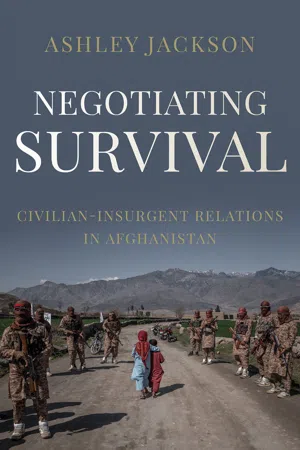
Two decades on from 9/11, the Taliban now control more than half of Afghanistan. Few would have foreseen such an outcome, and there is little understanding of how Afghans living in Taliban territory have navigated life under insurgent rule.
Based on over 400 interviews with Taliban and civilians, this book tells the story of how civilians have not only bargained with the Taliban for their survival, but also ultimately influenced the course of the war in Afghanistan. While the Taliban have the power of violence on their side, they nonetheless need civilians to comply with their authority. Both strategically and by necessity, civilians have leveraged this reliance on their obedience in order to influence Taliban behaviour.
Challenging prevailing beliefs about civilians in wartime,Negotiating Survivalpresents a new model for understanding how civilian agency can shape the conduct of insurgencies. It also provides timely insights into Taliban strategy and objectives, explaining how the organisation has so nearly triumphed on the battlefield and in peace talks. While Afghanistan’s future is deeply unpredictable, there is one certainty: it is as critical as ever to understand the Taliban—and how civilians survive their rule.
Insurgents and counterinsurgents alike have long agreed that the outcome of the wars they wage are heavily influenced by their relationships with the civilian population. Mao Tse-Tung compared guerrillas to fish, and the people to the water in which they swim (Mao, 2011). Che Guevara wrote that guerrilla warfare ‘draws its great force from the mass of the people themselves’ (Guevara, 2018: 59–61). Pick up nearly any counterinsurgency tome, or a core text on modern civil wars, and you will find that they all agree that an insurgency’s relationship with the civilian population is determinative to its success or failure (see, for example, Thompson, 1966; Nagl, 2006; Kalyvas, 2006). Yet there is a paradox here: civilians are rarely constructed as full-fledged or meaningful actors within a conflict. Combatants are actors, and noncombatants are ‘acted upon’. Civilians are understood to be mostly passive victims, even where it is argued civilian obedience or support is essential to insurgent survival and victory.
It’s a curious contradiction, and part of the problem lies in how we study and write about civil war. The spotlight is almost always cast on those fighting the war, and civilian perspectives have been comparatively neglected. Civilians are stripped of agency both rhetorically and theoretically, and silenced empirically. Civilians come to the fore of analysis when belligerents need them in some way, but even here use of the passive voice is endemic. Civilian loyalty is ‘secured’ by combatants, their ‘hearts and minds’ won by one side or the other. Civilians never tip the balance of the contest, and their behaviour is fairly one-dimensional, driven by either survival concerns or naked self-interest (see Kalyvas, 2006; Metelits, 2009). The insurgent–civilian relationship is often constructed as a by-product of insurgent needs or choices (i.e., material endowments, power maximisation strategies, survival concerns) (Christia, 2012; Hovil and Werker, 2005; Lidow, 2011; Salehyan et al., 2014; Weinstein, 2006). Consequently, little on-the-ground, rigorous research has been done to understand what drives civilian behaviour in wartime.1 After all, it makes little sense for political scientists to study civilians if civilians do not substantially impact combatant conduct or war outcomes.
The neglect of civilian agency is, however, particularly perplexing in the context of post-2001 Afghanistan, where counterinsurgency and stabilisation approaches have sought to win over civilians as a means of undermining the Taliban. To be sure, reams of research have been devoted to understanding the Taliban–civilian relationship, and into developing metrics meant to measure civilian ‘support’ for the Taliban. But, again, civilians aren’t seen as meaningfully influencing the Taliban. They appear passive and one-dimensional, their motives and behaviours curiously uncomplicated. Their loyalty might be secured with aid or compelled through coercion. Despite some recognition of the importance of ‘winning Afghan hearts and minds’, it appears to have been taken for granted in mainstream policy thinking that civilians have little influence over the Taliban’s conduct and strategy.
This chapter seeks to correct that neglect of civilian influence, and outlines an alternative framework for viewing civilian–insurgent relations. The core premise is that civilians and insurgents bargain with one another, and that process of negotiation affects the behaviour of both sides. As in any negotiation, there are three main elements of the civilian–insurgent bargaining process: the interests of each side (why they bargain), the types of leverage they have at their disposal (what they bargain with) and the options and strategies they pursue (how they do it).
Towards a theory of civilian–insurgent bargaining
Civilians and insurgents are best thought of as locked in an interdependent relationship. Insurgents need civilians to comply with their demands, in order to achieve their political and military objectives. Civilians, at minimum, need insurgents not to kill them or otherwise make their lives impossible. This drives them to bargain with one another (see Figure 1.1). Most negotiations follow a similar pattern. There is a back and forth in which each party takes a series of successive positions. They do this to assess their leverage over the other side and gauge how the other party will react to their next move. This process allows each side to gather information and evaluate their options. Even if the sides reach some kind of deal, the bargaining process doesn’t necessarily have a defined end point. Agreements break down, or one side’s interests may change, or their leverage may increase—all of which spurs renegotiation.
Unlike most negotiations, interactions between insurgents and civilians are underpinned by coercion, violence and fear. Insurgents live with the constant threat that civilians might betray or rebel against them, and civilians that insurgents might harm or kill them. Pervasive fear and uncertainty mean that there is a higher barrier to negotiating in wartime, which means that not all insurgents nor all civilians negotiate all of the time. Each side must trust the other enough to be able to interact, bargain and, ultimately, reach an agreement that both parties believe the other will uphold.
A corollary is that because wars are volatile, socially transformative processes, we can expect negotiations to be equally unstable. That said, certain patterns typically emerge. Civilian–insurgent bargaining is unlikely to be prevalent early on in the conflict. Insurgencies are typically weakest and most disorganised at their inception. They have little leverage over civilians (other than ad hoc or only semi-selective violence) and little organised capacity to bargain. As insurgents develop internal control and greater information-gathering capacities, violence becomes more selective. It can be used as a bargaining chip. As they gain strength, insurgents will likely be more receptive to civilian interests and may more actively seek to provide incentives to compel compliance. They duly use this information to inform their bargaining strategies, calculating risk versus reward. This process, however, is unlikely to be terribly linear, as military pressure and territorial control fluctuate. Armed groups typically show remarkably different capacities, attitudes and behaviours towards civilians as they gain or lose territory, have greater or lesser ability to devote resources to engaging with civilians and face greater or lesser military pressure from their adversaries (Kasfir, 2015; Wood, 2010).
All the while, civilians monitor the balance of the conflict, assessing the coherence of the insurgency and measuring their power vis-à-vis the incumbent state or other armed groups. Civilians carefully calculate the risks of engaging with the insurgency, and whether those risks are worth taking in light of prospective success. They might initially keep their distance from the insurgency, but when state abuses become intolerable or insurgent victory seems more likely they might change tack. Some civilians are savvier than others, calibrating their behaviour in ways that maximise their protection and enhance their status or gains. All of this depends on the power they possess over the insurgency and the quality of information they can access.
The problem, however, with gathering and analysing information in wartime is that rumour, misinformation and misperception are rife, distorted by coercion and fear (Kalyvas, 2006; Kalyvas and Kocher, 2007). Insurgents need strong intelligence-gathering systems. That means earning the trust of—or at least infiltrating—the civilian population, which takes time. For civilians, violence sends the loudest signal about what insurgents want, but they aren’t always able to accurately interpret the meaning. Insurgent targeting of civilians may be erroneous or unhelpfully broad, or it may suddenly shift. Any negotiation can be compromised by emotion and pressure, but wartime contexts are extreme in this respect. High stakes and intense pressure influence each side’s perception of their choices and risk tolerance.
Unlike most models of negotiation, which assume each party is on relatively equal footing, insurgent–civilian bargaining is deeply lopsided, myopic, unpredictable and high risk. Civilians are generally coerced into bargaining, and parties negotiate amidst a volatile and violent environment. Given the vast asymmetry of power between civilians and insurgents, civilians make enormous concessions and insurgencies relatively few. In general, civilians are faced with a choice between bad and worse. The insurgency will punish those that they believe support the government, and the government will punish those that they think support the insurgency. As such, civilians try to assess which option is least bad and weigh that against which punishment is more likely.
Models of interpersonal negotiation also generally assume that either party can walk away from negotiations at any time, for any reason. The entanglement between insurgents and civilians is more complicated. Most civilians would not freely choose to engage with the insurgency, had they much of a choice in the first place. Where insurgencies are locally embedded phenomena, civilians and insurgents are enmeshed in the same social fabric: they are family members, old schoolmates, acquaintances and so on. They are all but unavoidable. Civilians might prefer to opt out of interacting entirely, and do so by fleeing or taking up arms against the insurgency. If they stay, however, civilians typically have little choice but to negotiate. They also have few good options if negotiations fail, as insurgents typically mete out harmful (if not fatal) consequences for non-compliance.
A few further caveats, more of an academic nature: at the risk of stating the obvious, this is not a general theory that applies to all insurgents and all civilians in all civil wars; at best, it attempts to explain behaviour in the post-2001 Afghanistan War and might well apply, in whole or in part, to other wars. Moreover, it’s exceptionally important to emphasise (at the risk of repetition) that there are those who choose not to negotiate. Some civilians simply obey rather than risk negotiating, while others flee. Some choose to fight against the insurgency and some join the insurgency, with a subset of those seeing the choice of joining the insurgency as the only safe or desirable option. Not all insurgencies negotiate, and this varies according to their goals, ideologies and other factors. Genocidaires or those with no concrete political objectives, for example, may not feel they need or want civilian compliance. A core assumption here is that insurgencies aspiring to political legitimacy—like the Taliban—are more likely to negotiate with civilians to compel compliance than those who do not seek political legitimacy or external recognition.
Interests are the concerns, needs and fears of each party engaged in negotiation. Some interests may be shared by both parties while others may be at odds, but shared interests are what necessitate negotiation. More broadly, interests are what motivate each actor to bargain in the first place, and they are what drives their behaviour afterwards (Fisher and Ury, 1991). The tricky thing about interests is that they are not always apparent. Parties typically tend to hide their interests for fear that expressing them openly will weaken their leverage or otherwise expose their vulnerabilities (Lewicki et al., 2010). The bargaining position encompasses the demands expressed in negotiations (reflecting what both parties think they can get or how they want to be perceived), while interests are the needs that drive negotiation (what they actually want).
In negotiating with insurgents, this framework assumes that civilians’ primary interest is survival. Nathan Leites and Charles Wolf, referring to this as damage limitation, argue that the desire to limit damage to oneself, family or community is likely to take precedence over any innate preference or strongly held ideals (Leites and Wolf, 1970). Civilians do not want to be targeted by the insurgency and they do not want to be collateral damage. They may try to convince the insurgency to suspend fighting in civilian areas, or to give fair warning when villages are likely to come under attack. They may not want insurgents to plan attacks in or on areas that civilians frequent or that they consider to be ‘civilian’ in nature (i.e., the bazaar or town marketplace, frequently travelled roads, schools, clinics). Many protection interests are collective, but individuals also face unique problems which require negotiation. Some cases may be extreme or life-and-death scenarios (i.e., the insurgency may detain a relative) while others may be more routine (i.e., a civilian might be caught at a checkpoint and have to negotiate with the commanders manning it for safe passage).
Damage limitation may be combined with efforts to maximise the benefits that one can accrue from complying with insurgent rule (Leites and Wolf, 1970; Mason, 1996). The insurgency has the power to bestow advantages to civilians, either collectively or individually, as it sees fit—and civilians are well aware of this. In practice, the line between damage limitation and well-being can be permeable and subjective. Someone might inform upon someone else so that they can seize that person’s property after they are rounded up by the rebels. One community may leverage its relationship with the insurgency in a dispute with a neighbouring community, or one business may draw on insurgent support to seek a competitive advantage. Not all civilians have the same interests, and pre-existing tensions, divisions, and forms of social organisation must be considered.
This framework assumes that organisational survival is the insurgency’s most immediate and primary interest. The insurgency seeks to control the population so that civilians (a) do not inform on the insurgency to their adversaries and (b) comply with insurgent demands (safe passage, shelter, food, recruiting pools, concealment and so on). Controlling the civilian population is essential to the insurgency achieving their longer-term goal of territorial control, the expansion and consolidation of which is what ultimately leads to victory. The insurgency’s interests are often veiled behind comparatively benevolent rhetoric, and many insurgencies present their interests as being aligned with the interests of civilians. Insurgents may frame their fight as a struggle for collective well-being. They may argue that they are seeking to rid the area of tyrannical interlopers or occupiers, or to establish a better form of government or a more just society. Regardless of whether civilians buy into these narratives, few among them would doubt that the insurgency seeks to control their behaviour and keep them onside. Alongside this, insurgencies bargain with civilians because they want to increase their political power or recognition (i.e., taking part in government or replacing the incumbent government entirely). Of course, some insurgencies may be motivated by social or economic inequalities, or they might simply not seek legitimacy in this way (see Keen, 2012; Reno, 2015). Those that disregard legitimacy concerns may have little interest in bargaining.
That said, we cannot consider just group interests; we must also look at the interests of individual insurgents. The weight of individual interests may depend on the insurgency’s structure and coherence: the tighter the structure, the less individuals can act on motives that conflict with group objectives (Hoover Green, 2016; Lidow, 2011; Staniland, 2014). Nevertheless, negotiations are interpersonal affairs, even where individuals are negotiating on behalf of group interests. One caveat is that in some cases individual insurgents may not, in fact, prioritise their own survival. Where martyrdom is a prominent part of the insurgency’s ideology, for example, some fighters may actively seek opportunities to sacrifice themselves for the collective cause. Other fighters, however, may actually want to survive and want civilians to mostly survive too. Social relations and histories come into play. Insurgents from the community may be more interested in ensuring that civilians—including their family and loved ones—are protected and have access to things like schools and jobs.
Borrowing from Steven Metz’s typology of insurgent motives, insurgents can be roughly divided into six non-mutually exclusive groups: the socially obligated, the survivors, the lost, the aggrieved, the thugs and the ambitious (Metz, 2012). For the socially obligated, ties and norms shape their behaviour. Metz argues that this may be particularly prevalent where tribal or traditional structures are strong, or as important as the individual’s tie to the overall insurgency. Others may join an insurgency primarily to survive, particularly where joining the insurgency is perceived as less costly than not, or where membership bestows access to valuable resources. This is also likely to be more pronounced where the insurgency engages in forced conscription or where they are likely to retaliate against non-joiners (i.e., the Lord’s Resistance Army (LRA) in Uganda, the Maoists in Nepal, the Liberians United for Reconciliation and Democracy (LURD) (Gates, 2017).
People who feel lost or disconnected from society may find a sense of belonging in joining an armed group. Some may be driven by personal grievances or a broader sense of injustice, or by boredom or unemployment (Stern, 2003). Some may join an insurgency because they already have a propensity for aggression and violence, and the war gives them a chance to enact these tendencies. Others may join because they have a particular ambition the insurgency will help them fulfil. The ambitious may be more common in contexts where upward mobility is otherwise blocked for specific segments of the population. The ambitious might also more generally be found among insurgencies easily able to generate or exploit resources (Weinstein, 2006; Collier and Hoeffler, 2004; Keen, 2000). Here the line between the ambitious and the thugs gets blurry; Metz describes those motivated by personal profit as ‘thugs’, arguing that they ‘seldom create or lead insurgencies, but they do provide many of its foot soldiers’ (Metz, 2012). Yet even the greedy may be driven by multiple factors.
To be clear, insurgent motives are not uniform up and down, or across, a movement. The ambitious might fight alongside the lost and the aggrieved. We know that an affiliation with the Taliban or Al Shabaab might be little more than a means to an end for those seeking to profit from the drugs trade or the black market in Afghanistan or Somalia (Gopal, 2015; Harper, 2019; Joseph and Maruf, 2018). Yet there are also those who see themselves as true believers filling the Taliban and Al Shabaab ranks (Strick van Linschoten, 2016; Giustozzi, 2008; Ladbury, 2009; Hansen, 2013). A given fighter might be lost as well as aggrieved, while also seeking advancement and enrichment. Even in groups seen as heavily ideological, more mixed motives might be found among individuals. In groups most often described as Islamists or jihadis, there may be those motivated primarily by injustice and grievance, and secondarily religion (see Ratelle and Souleimanov, 2017).
What, then, does this mean for civilians seeking to bargain with insurgents? Civilians must understand both group interests as well as the interests of the specific individuals they encounter: where they come from, why they are fighting and what their pressur...
Table of contents
Cover
Title Page
Copyright
Contents
Acknowledgements
Abbreviations and Acronyms
Glossary
Introduction
1. Negotiated Rebellion: A Theory of Civilian—Insurgent Bargaining
2. Dancing with Whoever Is There: Surviving the Afghanistan Wars
3. Coercion, Co-option, and Co-operation: Taliban Tactics and Strategy
5. The Art of the Deal: Evolution, Variation, Enabling Factors, and Constraints
Conclusion
Notes
Bibliography
Index
Trusted by 375,005 students
Access to over 1.5 million titles for a fair monthly price.
Study more efficiently using our study tools.
Frequently asked questions
Yes, you can cancel anytime from the Subscription tab in your account settings on the Perlego website. Your subscription will stay active until the end of your current billing period. Learn how to cancel your subscription
No, books cannot be downloaded as external files, such as PDFs, for use outside of Perlego. However, you can download books within the Perlego app for offline reading on mobile or tablet. Learn how to download books offline
Perlego offers two plans: Essential and Complete
Essential is ideal for learners and professionals who enjoy exploring a wide range of subjects. Access the Essential Library with 800,000+ trusted titles and best-sellers across business, personal growth, and the humanities. Includes unlimited reading time and Standard Read Aloud voice.
Complete: Perfect for advanced learners and researchers needing full, unrestricted access. Unlock 1.5M+ books across hundreds of subjects, including academic and specialized titles. The Complete Plan also includes advanced features like Premium Read Aloud and Research Assistant.
Both plans are available with monthly, semester, or annual billing cycles.
We are an online textbook subscription service, where you can get access to an entire online library for less than the price of a single book per month. With over 1.5 million books across 990+ topics, we’ve got you covered! Learn about our mission
Look out for the read-aloud symbol on your next book to see if you can listen to it. The read-aloud tool reads text aloud for you, highlighting the text as it is being read. You can pause it, speed it up and slow it down. Learn more about Read Aloud
Yes! You can use the Perlego app on both iOS and Android devices to read anytime, anywhere — even offline. Perfect for commutes or when you’re on the go. Please note we cannot support devices running on iOS 13 and Android 7 or earlier. Learn more about using the app
Yes, you can access Negotiating Survival by Ashley Jackson ,Ashley Jackson in PDF and/or ePUB format, as well as other popular books in History & Military & Maritime History. We have over 1.5 million books available in our catalogue for you to explore.