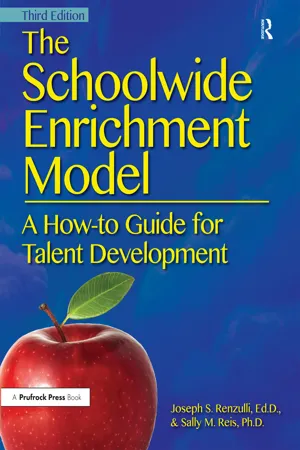
The Schoolwide Enrichment Model: A How-to Guide for Talent Development (3rd ed.) presents a common sense approach for helping students achieve and engage in joyful learning. Based on years of research, the Schoolwide Enrichment Model (SEM) is founded on highly successful practices originally developed for programs for gifted students. The SEM promotes "a rising tide lifts all ships" approach to school improvement by applying general enrichment strategies to all students and opportunities for advanced level follow-up opportunities for superior learners and highly motivated students.
This guidebook shows educators step by step how to develop their own SEM program based on their own local resources, student population, and faculty strengths and interests. Instead of offering students a one-size-fits-all curriculum, the model helps educators look at each student's strengths, interests, learning styles, and preferred modes of expression and capitalize on these assets. The book highlights the model's fundamentals and underlying research and provides information about organizational components, service delivery options, and resources for implementation. The book suggests methods for engaging and challenging identified gifted students and provides practical resources for teachers using the SEM with all students.
eBook - ePub
The Schoolwide Enrichment Model
A How-To Guide for Talent Development
- 446 pages
- English
- ePUB (mobile friendly)
- Available on iOS & Android
eBook - ePub
The Schoolwide Enrichment Model
A How-To Guide for Talent Development
About this book
Information
CHAPTER 1 A Vision and a Plan
10.4324/9781003238904-1
The "Why" of Schoolwide Enrichment
Imagine if your students came to school each day with the same positive attitude we see when they are working on the school yearbook, preparing for a choir presentation, getting ready for a field trip, working on a robotics competition, or preparing to play their archrivals in basketball. Why is the magnetism surrounding these experiences so different from regular schooling and how can this positive energy be created within the regular curriculum? Ask teachers this question, and you will almost always get similar answers about why it is challenging for them to replicate the types of excitement that accompany the activities described above: "We have a prescribed curriculum to cover.” "We need to prepare our students for the state achievement tests.” "We don't have the time or resources for differentiation.”" We are evaluated based on our students' test scores.” In this book, we provide a plan that will help educators create enrichment opportunities that will engage and enrich education for all students.
The Schoolwide Enrichment Model (SEM) was designed to address some of the challenges teachers face in overstructured learning environments and the many outside regulations that have been imposed on them that inhibit what should be a joyful "brand” of teaching and learning. For many teachers, there is a disconnect between their vision of challenging and rewarding teaching and the day-to-day grind of test-prep so rampant in today's highly prescribed curriculum. Teachers have the skills and motivation to do the kinds of teaching about which they dreamed but the regulations and requirements imposed upon them "from above” result in both a prescriptive approach to teaching and a barrier to creating challenging and exciting classrooms. Overprescribing teachers’ work can lobotomize them and deny the creative teaching opportunities that attracted them to the profession. Not every type of prescribed, standards-based teaching is bad; however, a good education must balance a prescribed curriculum with regular, systematic enrichment opportunities that allow students to develop their interests, abilities, learning styles, and preferred modes of expression.
The Three Es of The Schoolwide Enrichment Model
When considering the goals of the SEM model, we have avoided endless lists of cliches, jargon, and the latest flavor-of-the-month education buzzwords that have come to dominate the school improvement literature and the speaker’s staff development circuit. We choose instead to express the goals of our model with a few simple concepts depicted in Figure 1. Our work has clearly and unequivocally found that school achievement, the minimization of boredom, and positive attitudes on the parts of both teachers and students can be accomplished when we focus on what we call the Three Es of the SEM—enjoyment, which leads to higher engagement, which in turn leads to greater enthusiasm for learning. Our research shows that when the Three Es are working well, students not only like school better, they also show improvements in school achievement (Reis & Renzulli, 2003; Renzulli & Reis, 1997).
Although we could easily spend a great deal of time criticizing the regular curriculum, the reality is that prescribed curriculum is and will continue to be a fact of life in most schools. It includes important information for successful learning and is necessary in today's dominant accountability environment. Any model that challenges the standards-based movement and the major role played by standardized achievement testing is doomed to failure due to contemporary policies, political considerations, and the vast financial investments that have been made by the influential prepackaged curriculum companies and the testing industry. SEM, however, offers what we have called an "infusion-based approach” that examines the regular curriculum and explores opportunities and strategies to inject enrichment experiences into any and all prescribed topics. The procedures for using this approach will be described in a later section of this chapter.

Figure 1. The Three Es.
The SEM and Talent Development
The SEM has been developed over three decades and is based on the shared vision of thousands of teachers and administrators with whom we have worked in academic programs and summer institutes that date back to the 1970s, Simply stated, the vision underlying the SEM is that schools should be places for talent development (Renzulli, 1994), We believe that academic achievement is one of the most critically important parts of the model for schoolwide enrichment described in this book. What has made our nation great and our society one of the most productive in the world have been opportunities for talent development across all levels of human productivity. From the creators and inventors of new ideas, products, and art forms, to the vast array of people who manufacture, advertise, and market the creations that improve and enrich our lives, there are levels of excellence and quality that contribute to our standard of living and way of life. Our vision of the SEM and our belief in schools for talent development is based on the premise that all students should have some time in school to develop their talents. We believe that all educators should provide students with opportunities, resources, and encouragement that enable them to develop their talents. Rewarding lives are a function of the ways people use and develop their individual potentials in productive ways, and the SEM is our practical plan to make schools for talent development a reality. We are not naive about the politics, personalities, and financial issues that often supersede the pedagogical goals that are the focus of this book. At the same time, we have seen this vision manifested in schools in impoverished urban areas, poor rural areas, and affluent suburbs. The strategies to implement the SEM described in this book have provided the guidance for transforming schools into places for talent development for more than three decades.
There are no quick fixes or easy formulas for creating schools based on a talent development philosophy. However, our experience has shown that once the concept of talent development begins to catch on, students, parents, teachers, and administrators view their school in a different way. Students become more excited and engaged in what they are learning; parents find more opportunities to become involved in various aspects of their children’s education; teachers begin to find and use a variety of resources that, until now, seldom found their way into classrooms; and administrators start to make decisions that affect positive outcomes in learning that are conducive to implementing the SEM,
Everyone has a stake in schools that provide our students with a high-quality education, as parents benefit when their children lead happy and successful lives. Employers and colleges benefit when they have access to people who are competent, creative, and effective in the work they do and in higher educational pursuits. Political leaders benefit when good and productive citizens contribute to a healthy economy, a high quality of life, and respect for the values and institutions of democracy. Professional educators at all levels benefit when the quality of schools for which they are responsible is effective enough to create respect for their work and generous financial support for the educational enterprise.
Everyone has a stake in good schools because schools create and recreate a successful modern society. Renewed and sustained economic growth and the well-being of all citizens requires investments in high-quality learning in the same way that previous generations have invested in machines and raw materials. Our schools are already placing millions of functionally illiterate young people into the workforce. More and more colleges are teaching remedial courses based on material formerly taught in high school, and college graduates in almost all fields are experiencing difficulty entering career areas of choice.
Although everyone has a stake in good schools, some Americans have declining confidence in schools and the people who work in them, limitations in the amount of financial support for education, and some public apathy or dissatisfaction with the quality of education our young people are receiving. The parents of poor children have given up hope that education will enable their sons and daughters to break the bonds of poverty. The middle class, perhaps for the first time in our nation's history, is exploring government-supported alternatives such as vouchers and tax credits for private schools, homeschooling, charter schools, and summer and afterschool programs that enhance admission to competitive colleges. Much has been written about America’s “school problem” and studies, commissions, reports, and even a Governor’s Summit Conference have been initiated to generate solutions to problems facing our schools. But the hundreds, if not thousands of conferences, commissions, meetings, reports, proclamations, and lists of goals have yielded minimal results, because they generally focused on change related to traditional methods of schooling. Our response to better schools is to consider a paradigm switch and the creation of schools for talent development, which is the basis of the SEM,
The SEM is a detailed blueprint for schoolwide talent development that is flexible enough to enable each school to develop its own unique program based on local resources, student populations, school leadership dynamics, and faculty strengths and creativity. Although this research-supported model is based on highly successful practices that had their origins in special programs for gifted and talented students, the major goal of SEM is to promote both challenging and enjoyable high-end learning across the full range of school types, levels, and demographic differences. The SEM is not intended to replace or minimize existing services to high-achieving students. Rather, it is a common sense plan that provides a broad variety of general enrichment experiences for all students and opportunities for advanced-level follow-up on the parts of individuals and small groups who show special aptitudes, interests, and motivation for more challenging involvements in academic, artistic, or other pursuits. We believe that “a rising tide lifts all ships” and that making schools more joyful and challenging places for all students also improves learning for any group or individual with special needs across the entire range of the aptitude, achievement, interest, and creativity continuum that exists in every school.
The SEM provides educators with the means to:
- › develop the talent potentials of young people by systematically assessing their strengths; providing enrichment opportunities, resources, and services to develop their strengths; and using a flexible approach to curricular differentiation and the use of school time;
- › improve the academic performance of all students in all areas of the regular curriculum and blend standard curriculum activities with meaningful enrichment learning;
- › promote continuous, reflective, growth-oriented professionalism of school personnel to such an extent that many faculty members emerge as leaders in curriculum and staff development, program planning, etc.;
- › create a learning community that honors ethnic, gender, and cultural diversity and promotes mutual respect, democratic principles, and the preservation of the Earths resources; and
- › implement a collaborative school culture that includes appropriate decision-making opportunities for students, parents, teachers, and administrators.
How to Use This Book
It is difficult to summarize in a reasonably sized book more than 30 years of research and development that have been incorporated into the SEM and the voluminous amounts of practical know-how that we have gained from thousands of schools and teachers that have used this model. And nowadays, school administrators and policy makers are cautious about adopting any school improvement initiative that does not show evidence of a strong theoretical and research-based background. Because we intend this book to be a guide for practical implementation of the SEM, we are addressing the background-material problem in two ways. In Chapter 2, we will provide a brief overview of the theories and research underlying the SEM, but we will also provide references to a website entitled The Schoolwide Enrichment Model—Theory and Practice (see http://www.routledge.com/Assets/ClientPages/sem.aspx). This easy-to-access site is specif-ically tailored to this book and includes both a Theory and Research” section as well as a “Practical Implementation” section. All material at this site is down-loadable and can be reproduced for classroom use without cost or permission. If someone wants to, for example, “see the research” on a specific component of the model, they can access this website and download what they need. The website also includes the names of other books and resources on implementation, such as our book Enrichment Clusters, We have also included a section on human and material resources and a direct contact to our SEM Outreach Coordinator. This person is readily available for e-mail and telephone contact and for assistance with implementing the SEM.
Three Things to Keep in Mind as You Read This Book
Common Goals and Unique Means: All Roads Lead to Rome!
The selection and use of a program development model has two essential requirements. First, a model should include a shared mission and set of objectives. Everyone (or at the very least, almost everyone) involved in the selection and implementation of a model should agree that the mission and objectives represent a destination” that they would like to reach. If an agreed upon goal is “to get to Rome,” then there is no ambiguity, vagueness, or misunderstanding about where everyone is going. This first requirement lor selecting a model means that a great deal of front end time should be spent exploring alternative models, discussing and debating the advantages and disadvantages of various approaches, and examining related factors such as underlying research, implementation, and the availability of supportive resources. Reaching consensus before embarking upon a journey will help ensure that everyone involved will get to Rome rather than to Venice or Moscow.
But . . . There Are Many Ways to Get to Rome
No one likes cookie-cutter solutions to initiatives that should be opportunities for developing our creativity. One thing that is different about the SEM is that it is not a rigid formula, and we do not expect all SEM schools to look alike or to do the same things. When this is the case, model builders have overstructured schools “from the outside,” and by doing so, have failed to take into consideration the demographics of varying school populations. They have also failed to take into account the various strengths, interests, and talents of the faculty, and the creative ideas that generate the energy and enthusiasm for building programs. As long as we all agree upon and pursue the common goals (getting to Rome), the unique means that a school uses to reach these goals is what causes teachers and administrators to build ownership and pride in their program. It also creates fertile ground for educators to try new things, experiment with emerging resources and technology, and provide an environment for various leadership opportunities to emerge from faculty members. We believe that the SEM enables teachers to be more creative, to make choices about what is in the best interests of their students, and to have more choice in the instructional strategies they use and the curriculum they implement. There will certainly be some things that don’t work out as planned or that need additional tweaking and development. This is what being an experimenter and an inquirer is all about, but we all know that growth comes from disappointments as well as successes.
We have observed with pride the many teachers from SEM schools who have made and will continue to make original contributions to progr...
Table of contents
- Cover Page
- Half Title Page
- Title Page
- Dedication Page
- Copyright Page
- Table of Contents Page
- List of Figures Page
- Preface Your Own Creativity Is the Best Way to Get to Rome Page
- Chapter 1 A Vision and a Plan: The “Why" of Schoolwide Enrichment
- Chapter 2 The Four Theories Underlying the SEM
- Chapter 3 An Overview of the SEM: Focusing on Student Strengths and Interests
- Chapter 4 Identifying Students for SEM Programs: The Talent Pool Approach
- Chapter 5 The Enrichment Triad Model in an SEM Program: Type I Experiences
- Chapter 6 Overview of Type II Enrichment: Developing Thinking, Investigative, and Personal Skills
- Chapter 7 Implementing Type III Enrichment: Thinking, Feeling, and Doing Like the Practicing Professional
- Chapter 8 The Total Talent Portfolio and Renzulli Learning System
- Chapter 9 Curriculum Compacting and Instructional Differentiation
- Chapter 10 Implementing Enrichment Clusters for All Students
- Chapter 11 Extensions of the SEM: The Schoohvide Enrichment Model in Reading (SEM-R)
- Chapter 12 Renzulli and Schoolwide Enrichment Academies
- Chapter 13 In Conclusion
- References
- Appendix A Titles of Some of Our Favorite How-to Books
- Appendix B Oh, the People You’ll Meet! Writing a Biography
- Appendix C Interest-A-Lyzers
- Appendix D Total Talent Portfolio Examples
- About the Authors
- Index
Trusted by 375,005 students
Access to over 1.5 million titles for a fair monthly price.
Study more efficiently using our study tools.
Frequently asked questions
Yes, you can cancel anytime from the Subscription tab in your account settings on the Perlego website. Your subscription will stay active until the end of your current billing period. Learn how to cancel your subscription
No, books cannot be downloaded as external files, such as PDFs, for use outside of Perlego. However, you can download books within the Perlego app for offline reading on mobile or tablet. Learn how to download books offline
Perlego offers two plans: Essential and Complete
- Essential is ideal for learners and professionals who enjoy exploring a wide range of subjects. Access the Essential Library with 800,000+ trusted titles and best-sellers across business, personal growth, and the humanities. Includes unlimited reading time and Standard Read Aloud voice.
- Complete: Perfect for advanced learners and researchers needing full, unrestricted access. Unlock 1.5M+ books across hundreds of subjects, including academic and specialized titles. The Complete Plan also includes advanced features like Premium Read Aloud and Research Assistant.
We are an online textbook subscription service, where you can get access to an entire online library for less than the price of a single book per month. With over 1.5 million books across 990+ topics, we’ve got you covered! Learn about our mission
Look out for the read-aloud symbol on your next book to see if you can listen to it. The read-aloud tool reads text aloud for you, highlighting the text as it is being read. You can pause it, speed it up and slow it down. Learn more about Read Aloud
Yes! You can use the Perlego app on both iOS and Android devices to read anytime, anywhere — even offline. Perfect for commutes or when you’re on the go.
Please note we cannot support devices running on iOS 13 and Android 7 or earlier. Learn more about using the app
Please note we cannot support devices running on iOS 13 and Android 7 or earlier. Learn more about using the app
Yes, you can access The Schoolwide Enrichment Model by Joseph S. Renzulli,Sally M. Reis in PDF and/or ePUB format, as well as other popular books in Education & Inclusive Education. We have over 1.5 million books available in our catalogue for you to explore.