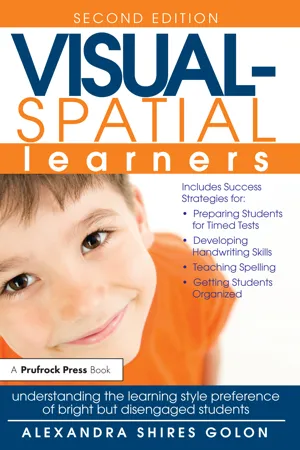
Are you looking for ways to differentiate your instruction to meet the needs of gifted visual-spatial learners? You've found it in Visual-Spatial Learners: Understanding the Learning Style Preference of Bright But Disengaged Students (2nd ed.). Visual-spatial learners are students who show advanced abilities with computers, maps, construction toys, and puzzles. The techniques outlined within these pages help all learners succeed—regardless of preferred learning style. Based on the most current understanding of the brain's hemispheric functions, the author provides a number of strategies and lesson plan ideas to help make your classroom a successful learning environment for all learners. These strategies address preparing students to succeed on timed tests; easing the pain of handwriting; teaching spelling using imagery; incorporating mnemonics, rhyme, and other tricks that engage the right hemisphere of the brain; helping students stay focused and on track; getting—and keeping—students organized; and much more!
eBook - ePub
Visual-Spatial Learners
Understanding the Learning Style Preference of Bright But Disengaged Students
- 220 pages
- English
- ePUB (mobile friendly)
- Available on iOS & Android
eBook - ePub
Visual-Spatial Learners
Understanding the Learning Style Preference of Bright But Disengaged Students
About this book
Information
CHAPTER 1 LEARNING STYLES DIFFERENTIATION
DOI: 10.4324/9781003239482-1
Auditory-Sequential and Visual-Spatial
As a classroom teacher, you’ve probably been exposed to a number of theories on learning styles and perhaps several ideas about differentiation. Some approaches can be complicated and involve lengthy assessments to fully understand each student; others require a complete revamping of the curriculum you’re currently using or that your school already has approved; still others keep changing and evolving so that just when you’ve learned how to apply the construct, the parameters change and you’re left to start all over. You won’t find anything like that within these pages. This book provides strategies that are easy and fun to implement; they are essential for your visual-spatial learners and will serve as reinforcement for your auditory-sequential learners—the only two learning styles involved!
I wrote the first edition of this book because I wanted to share just how easy differentiating for students’ learning styles can be. I was a classroom teacher myself, I homeschooled for many years, and I worked with teachers and schools throughout the U.S. and in several other countries. I know how challenging it is to try to meet the unique needs of each and every child. In her book, Upside-Down Brilliance: The Visual-Spatial Learner, Silverman (2002) wrote:
Today’s teachers must be superhuman and adapt to the children, instead of the other way around. To be a modern teacher, you must be part entertainer, part social worker, part special educator, part police officer, part ringmaster (to accommodate the range of abilities and learning styles and backgrounds and needs of all your students) and, oh yes, part enthusiast—knowledgeable of your subject matter and of the fine art of teaching. (p. 55)
In the years since I left the classroom, I have worked in the field of corporate adult education, designing and developing computer-based business simulations for use in leadership development, business acumen, and organizational transformation. I can confirm that hands-on, experiential learning remains the most powerful method of acquiring and retaining new skills and knowledge—no matter the age of the learner. We learn best by doing. We have taught that way—from observing, doing, then showing others—for far more centuries than an alphabet has existed. The move toward a text approach was profound in its ability to communicate across greater numbers, but, for the vast majority of humans, it has rarely, if ever, proven to be an effective, permanent way to gain new knowledge.
When I present to teachers, I often begin by asking them to draw a rectangle, 2 inches wide by 1/2 inch tall—a space similar to the signature line on a personal check. Then, I ask them to place their writing instrument in their nondominant hand and sign their name within the box. I almost always hear a lot of groaning as they perform this uncomfortable task. I then ask for feedback about how it felt to sign their name this way. “Awkward,” “messy,” “uncomfortable,” and “I can’t wait to switch back” are some of the most common responses. Those who’ve broken their dominant hand or arm and had some experience with this task report that, although unpleasant, it wasn’t as awkward as it was for their peers. Everyone reports that it wasn’t their best work, nor the most efficient means of writing their name. This is what every school day feels like to a right-hemispheric, visual-spatial student sitting in a left-hemispheric, word-dominated classroom.
I became immersed in the concept of visual-spatial learners while working for Dr. Linda Silverman, director of the Gifted Development Center in Colorado (a resource center for developmentally advanced children and their parents). In the late 1990s and early 2000s, her theory was based on the current understanding of the functions of the hemispheres. Silverman began using the term visual-spatial learner in 1981 to define students who think in images and the term auditory-sequential learner to include students who think and learn in words, sequentially, and who typically do well in traditional classroom environments (these are not the students for whom parents and teachers seek my advice). In the process of testing children’s intelligence, she discovered a pattern among children who scored in the highest ranges. They did so with their phenomenal abilities to solve problems presented to them visually and by excelling in the spatial tasks of intelligence tests. Analyzing hundreds of children’s test results, Silverman observed two distinct learning styles: auditory-sequential and visual-spatial. Kinesthetic learners, those who learn best with hands-on activities, who often need movement to improve focus, and who learn by doing, not just watching or hearing, are included within the construct of the visual-spatial learner. The strategies recommended within this book incorporate techniques that will successfully serve your kinesthetic students, as well.
Silverman’s theory boils down to this: We each have two hemispheres of the brain. However, much like handedness, many of us prefer one hemisphere to the other. That preference can have dramatic implications in the classroom. It is important to reiterate that both hemispheres work together to accomplish most cognitive tasks. It would be wrong and, in fact, silly to conclude that a student is exclusively right- or left-brained, functioning with only half of a brain! As Hardiman (2003) noted, we “know that the two hemispheres are continuously working in tandem to produce the rich complexities of human thought” (p. 7). In addition,
The research data support the notion that each hemisphere has its own set of functions in information processing and thinking. However, these functions are rarely exclusively to only one hemisphere, and in even some simple tasks, it is possible for both hemispheres to be involved. (Sousa, 2006, p. 169)
School is geared to left-hemispheric learning. We teach in a step-by-step manner, mostly in words, and require mastery of one area before progressing to a higher level. We also tend to teach, particularly in the higher grades, in a strictly auditory fashion, leaving manipulatives and hands-on learning for younger students. Those who favor their right hemisphere are at a distinct disadvantage. Because they are presented with new material in a sequential fashion, they are required to use their weaker hemisphere (the left), rather than their stronger one.
This is analogous to someone breaking his or her arm of the dominant hand and being forced to write with the weaker hand. Eventually, and with much practice, the individual will be able to produce legible writing, but it never will be the most efficient means, nor the most beautiful writing of which he or she is capable. Only when the ability of the dominant hand is returned can this person produce his or her best work. Unfortunately, I have firsthand experience with this, having lost use of my dominant right hand for nearly 2 years. Although I was able to write legibly and even to paint after considerable practice, my output was nothing to what my right hand had been able to produce (thankfully, I did regain functionality).
Schools were designed for right-handed students during the ages when left-handed students were forced to write with their right hands. I still meet people in workshops all across the country who were forced to use their right hands to write even though they were not right-handed. My own grandmother, who was born completely deaf, said her biggest handicap in school wasn’t that she couldn’t hear, but that she was left-handed. Prejudice against our right hemisphere (which directs our left hand) continues with the emphasis on left-hemispheric educational practices. Only when we create classrooms that allow visual-spatial students to access the right hemisphere will we afford them the opportunity to produce their best work and learn in the most efficient manner for their learning style.
Understanding the specific learning style of your students and differentiating your instruction based on those learning styles may be the single most important aspect you uncover about them. To be able to teach to their strengths may be a life-changing experience for them, one that likely will leave a lasting impression for the duration of their academic career and beyond. Our personal learning style affects not only how we learn while we are students, but also how we think and approach problem solving as adults. How one thinks and learns can dramatically affect one’s personal and business relationships, too.
In the 1990s, research by the Gifted Development Center staff members (Silverman, 2002) was validated using an instrument they developed called the Visual-Spatial Identifier. The results surprised even those who designed and conducted the study. The research included 750 students in grades 4–6. The children were primarily Caucasian and Hispanic, from all socioeconomic backgrounds and all IQ ranges, in an urban and rural setting.
The results demand the attention of every educator and administrator: More than one third of the study group strongly preferred a visual-spatial learning style, whereas one fourth of the group strongly preferred an auditory-sequential style. Of the group (42%) that did not lean strongly one way or the other, 30% favored a visual-spatial approach to their learning. This is an astonishing percentage of kids in the regular classroom who prefer a visual-spatial method of instruction (at least 45%) and far more than was anticipated (see Figure 1). Figure 2 shows the distribution of preferred and strongly preferred learning styles among students in the regular classroom.
In 2006, the Visual-Spatial Resource Access Team, which then consisted of Linda Silverman, Linda Leviton, Steve Haas, Penny Choice, and myself, worked with the district of Page, AZ, to identify the preferred learning style of its predominantly Navajo students in grades 3–7 (DeVries & Golon, 2011). The study found that 530 students (69%) were identified as either strongly or tending toward visual-spatial, whereas 238 students (31%) were identified as either strongly or tending toward auditory-sequential. The numbers, based on ethnicity, were as follows:
- ➤ 390, or 71%, of the Navajo students in this district were visual-spatial learners, and
- ➤ 118, or 66%, of the Anglo students in this district were visual-spatial learners.
Being very...
Table of contents
- Cover Page
- Half Title Page
- Title Page
- Copyright Page
- Table of Contents Page
- INTRODUCTION Page
- CHAPTER 1 Learning Styles Differentiation: Auditory-Sequential and Visual-Spatial
- CHAPTER 2 Finding the Visual-Spatial Kids in Your Classroom
- CHAPTER 3 Are Boys More Visual-Spatial Than Girls?: Why Gender Matters in Every Classroom
- CHAPTER 4 Reading
- CHAPTER 5 Creative Writing
- CHAPTER 6 The Art of Handwriting Versus the Act of Keyboarding
- CHAPTER 7 Helping Students Ace Their Spelling Tests
- CHAPTER 8 Taking Notes in Pictures
- CHAPTER 9 Teaching Math Facts
- CHAPTER 10 Social Studies: A Natural Environment for Strategies Friendly to Visual-Spatial Learners
- CHAPTER 11 Using Visual-Spatial Strengths to Learn New Material
- CHAPTER 12 Organizational Skills
- CHAPTER 13 Helping Your Students Stay Focused
- CHAPTER 14 The Dreaded Timed Test
- CHAPTER 15 Creating a Visual-Spatial Classroom
- ADDITIONAL RESOURCES
- REFERENCES
- ABOUT THE AUTHOR
Trusted by 375,005 students
Access to over 1.5 million titles for a fair monthly price.
Study more efficiently using our study tools.
Frequently asked questions
Yes, you can cancel anytime from the Subscription tab in your account settings on the Perlego website. Your subscription will stay active until the end of your current billing period. Learn how to cancel your subscription
No, books cannot be downloaded as external files, such as PDFs, for use outside of Perlego. However, you can download books within the Perlego app for offline reading on mobile or tablet. Learn how to download books offline
Perlego offers two plans: Essential and Complete
- Essential is ideal for learners and professionals who enjoy exploring a wide range of subjects. Access the Essential Library with 800,000+ trusted titles and best-sellers across business, personal growth, and the humanities. Includes unlimited reading time and Standard Read Aloud voice.
- Complete: Perfect for advanced learners and researchers needing full, unrestricted access. Unlock 1.5M+ books across hundreds of subjects, including academic and specialized titles. The Complete Plan also includes advanced features like Premium Read Aloud and Research Assistant.
We are an online textbook subscription service, where you can get access to an entire online library for less than the price of a single book per month. With over 1.5 million books across 990+ topics, we’ve got you covered! Learn about our mission
Look out for the read-aloud symbol on your next book to see if you can listen to it. The read-aloud tool reads text aloud for you, highlighting the text as it is being read. You can pause it, speed it up and slow it down. Learn more about Read Aloud
Yes! You can use the Perlego app on both iOS and Android devices to read anytime, anywhere — even offline. Perfect for commutes or when you’re on the go.
Please note we cannot support devices running on iOS 13 and Android 7 or earlier. Learn more about using the app
Please note we cannot support devices running on iOS 13 and Android 7 or earlier. Learn more about using the app
Yes, you can access Visual-Spatial Learners by Alexandra Shires Golon in PDF and/or ePUB format, as well as other popular books in Education & Inclusive Education. We have over 1.5 million books available in our catalogue for you to explore.