Thinking Like an Engineer focuses on high-interest, career-related topics in the elementary curriculum related to engineering. Students will explore interdisciplinary content, foster creativity, and develop higher order thinking skills with activities aligned to relevant content area standards. Students will complete design challenges, visit with an engineer, and investigate real-world problems to plan feasible engineering solutions. Thinking Like an Engineer reflects key emphases of curricula from the Center for Gifted Education at William & Mary, including the development of process skills in various content areas and the enhancement of discipline-specific thinking and habits of mind through hands-on activities.
Grade 4
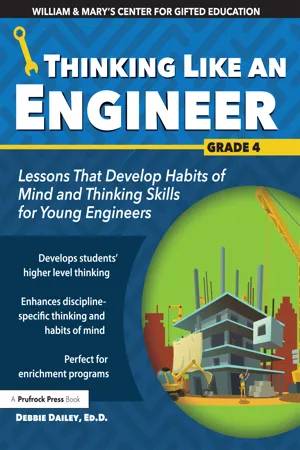
eBook - ePub
Thinking Like an Engineer
Lessons That Develop Habits of Mind and Thinking Skills for Young Engineers in Grade 4
- 126 pages
- English
- ePUB (mobile friendly)
- Available on iOS & Android
eBook - ePub
Thinking Like an Engineer
Lessons That Develop Habits of Mind and Thinking Skills for Young Engineers in Grade 4
About this book
Information
UNIT 1 WHAT IS AN ENGINEER?
DOI: 10.4324/9781003239093-2
RATIONALE
The unit will familiarize students with engineers and their characteristics, job roles, and careers. The unit concludes with an introduction to design thinking using the engineering design process.
PLAN
In Lesson 1.1, students will complete a Draw an Engineer Test. This assessment should be readministered after Unit 6 is completed to examine the progress made by students. After completing the test, students will complete a Frayer model in order to develop a definition of an engineer.
In Lesson 1.2, students will read a biography about an engineer. Throughout the unit, students should remember and compare the characteristics of the real-life engineer to their own characteristics as they solve various problems.
In Lesson 1.3, students will be introduced to the engineering design process on a “need to know” basis. Students will be given a challenge to solve before they are provided information about the engineering design process. After completing the challenge, students will reflect on and discuss how their design/solution could be better and what they need to improve it.
LESSON 1.1 WHAT IS AN ENGINEER?
DOI: 10.4324/9781003239093-3
RESOURCES AND MATERIALS
- Lesson 1.1 Draw an Engineer Test
- Sticky notes
- Chart paper with blank Frayer model
- Video: “Solve Problems: Be an Engineer!” (https://www.youtube.com/watch?v=D9I35Rqo04E)
ESTIMATED TIME
60-75 minutes
OBJECTIVES
In this lesson students will:
- illustrate an engineer,
- compare and contrast various illustrations of engineers,
- evaluate roles and characteristics of engineers, and
- develop a definition of an engineer.
CONTENT
The purpose of the Draw an Engineer Test (Knight & Cunningham, 2004) is to understand and use students’ preconceived ideas to help guide instruction. Typically, students will draw engineers as men who fix things.
Working with the Frayer model will allow students to examine the roles and characteristics of engineers through brainstorming, discussion, and structured argument.
PRIOR KNOWLEDGE
- Skills: compare and contrast, data collection, presentation tools
- Vocabulary: engineer, characteristics, example, nonexample, career
INSTRUCTIONAL SEQUENCE
- Distribute Lesson 1.1 Draw an Engineer Test to determine students’ existing perceptions of engineers. Instruct students to draw an engineer in an engineer’s work environment. You may ask: What does an engineer do? What does an engineer look like?
- After students complete the drawing, divide them into groups of 3-4. Instruct students to compare and contrast their drawings with their group members’ by completing the graphic organizer included in Lesson 1.1 Draw an Engineer Test.
- Have students create a list of shared characteristics that they can all agree on. Students should then develop a new drawing based on their group’s consensus. These revised drawings could be completed using regular paper or poster-sized paper. Alternately, students could complete this exercise using a computer or tablet drawing application, such as Sketchpad.
- Display the new drawings, and ask groups to participate in a gallery walk, noting how other groups’ drawings are similar and different.
- As an alternative to creating a new drawing, students could use an app such as HP Reveal to create a video about an engineer. The original drawing would launch the video; during the gallery walk, students could access the video through the app.
- Once students have completed their gallery walk, present the video “Solve Problems: Be an Engineer.”
- Present a class Frayer model created on chart paper or projected on the board (see Figure 3). In groups of 3-4, students should list roles and tasks of an engineer on sticky notes. Have students add their sticky notes to the class Frayer model.
- As a class, have students categorize engineering roles and tasks based on identified and agreed-upon criteria. Although students have not yet learned about the engineering design process, look for students to form criteria such as “engineers ask questions,” “engineers create and improve,” etc.
- In their groups, have students list examples of engineering titles or jobs (e.g., chemical engineer, electrical engineer, etc.). Have students add their examples to the class Frayer model.
- Conduct a debate in which students discuss whether or not the examples are correct. For example, students might ask, “Is there an...
Table of contents
- Cover Page
- Half Title Page
- Title Page
- Copyright Page
- Table of Contents Page
- Introduction
- Unit 1: What Is an Engineer?
- Unit 2: Who Can Be an Engineer?
- Unit 3: Design Cities Like an Engineer
- Unit 4: Care for Your World Like an Engineer
- Unit 5: Explore Beyond Your World Like an Engineer
- Unit 6: You Can Be an Engineer
- References
- About the Author
- Next Generation Science Standards Alignment
- Common Core State Standards Alignment
Trusted by 375,005 students
Access to over 1.5 million titles for a fair monthly price.
Study more efficiently using our study tools.
Frequently asked questions
Yes, you can cancel anytime from the Subscription tab in your account settings on the Perlego website. Your subscription will stay active until the end of your current billing period. Learn how to cancel your subscription
No, books cannot be downloaded as external files, such as PDFs, for use outside of Perlego. However, you can download books within the Perlego app for offline reading on mobile or tablet. Learn how to download books offline
Perlego offers two plans: Essential and Complete
- Essential is ideal for learners and professionals who enjoy exploring a wide range of subjects. Access the Essential Library with 800,000+ trusted titles and best-sellers across business, personal growth, and the humanities. Includes unlimited reading time and Standard Read Aloud voice.
- Complete: Perfect for advanced learners and researchers needing full, unrestricted access. Unlock 1.5M+ books across hundreds of subjects, including academic and specialized titles. The Complete Plan also includes advanced features like Premium Read Aloud and Research Assistant.
We are an online textbook subscription service, where you can get access to an entire online library for less than the price of a single book per month. With over 1.5 million books across 990+ topics, we’ve got you covered! Learn about our mission
Look out for the read-aloud symbol on your next book to see if you can listen to it. The read-aloud tool reads text aloud for you, highlighting the text as it is being read. You can pause it, speed it up and slow it down. Learn more about Read Aloud
Yes! You can use the Perlego app on both iOS and Android devices to read anytime, anywhere — even offline. Perfect for commutes or when you’re on the go.
Please note we cannot support devices running on iOS 13 and Android 7 or earlier. Learn more about using the app
Please note we cannot support devices running on iOS 13 and Android 7 or earlier. Learn more about using the app
Yes, you can access Thinking Like an Engineer by Debbie Dailey in PDF and/or ePUB format, as well as other popular books in Education & Education Teaching Methods. We have over 1.5 million books available in our catalogue for you to explore.