The twenty-first century has brought the perfect storm of conditions to create substantive global instability. This contemporary operating environment (COE) is characterized by complexity, ambiguity, volatility, and constant danger. It is a human invention that requires a human solution. Special operations forces (SOF), a group comprised of highly trained personnel with the ability to deploy rapidly and apply special skills in a variety of environments and circumstances, is the logical force of choice to achieve success in the COE. Increasing their effectiveness is cultural intelligence (CQ) – the ability to recognize the shared beliefs, values, attitudes, and behaviours of a group of people and then apply that knowledge toward a specific goal. Empowered by CQ, SOF are positioned to dominate in the COE. Solving the People Puzzle makes a convincing argument for the powerful union of the "force of choice" with the "tool of choice." This book will inspire and inform.
eBook - ePub
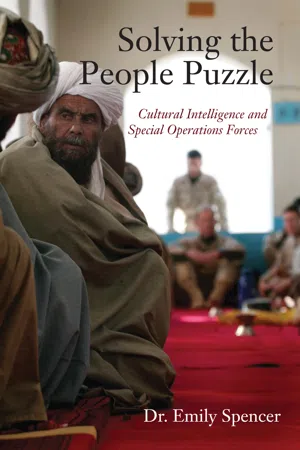
Solving the People Puzzle
Cultural Intelligence and Special Operations Forces
- 192 pages
- English
- ePUB (mobile friendly)
- Available on iOS & Android
eBook - ePub
About this book
Trusted by 375,005 students
Access to over 1.5 million titles for a fair monthly price.
Study more efficiently using our study tools.
Information
PART 1
The Contemporary Security Environment: Challenges and Solutions
Chapter 1
Global (In)Security
Global security or, perhaps more accurately, global insecurity, in the twenty-first century is not simply a linear continuation of the problems that plagued the world during the preceding hundred-year period. While individual aspects of the contemporary operating environment (COE), such as the use of terror as a tactic and the reliance on alliances and coalitions to achieve common goals, are not unprecedented, the COE is markedly different from conflict during much of the twentieth century. Enabled by globalization and the proliferation of the media, and fuelled by the global power vacuum that the end of the Cold War created, the twenty-first century brought with it the “perfect storm” of conditions that has now created substantive global instability.
Scholars, military and security analysts, and practitioners in particular, tend to agree that the contemporary operating environment is extremely complex, ambiguous, volatile, dynamic, and exponentially more dangerous than previous periods. The enemy is no longer limited to symmetrical, uniformed rivals aligned to one of two superpowers. Rather, our adversaries run the gamut of rogue states, regional rivals or power blocks, warlords, globally networked transnational criminals, narco-traffickers, as well as radical extremists fuelled by ideology and/or religion.
Arguably, the concurrent end to the Cold War and the rise of globalization in the 1990s created the conditions that were ripe for the ambiguous, complex, volatile, and ever changing operating environment in which we now find ourselves. With the collapse of the Berlin Wall in 1989, which symbolized the end of the Cold War as a result of the implosion of the Warsaw Pact and the Soviet Union, the rigidly controlled bipolar world tumbled into a free fall. An economic and political power vacuum was created as the superpowers disengaged from many areas around the world. Very quickly, failed and failing states mushroomed around the globe. Exacerbating the situation were other significant problems such as ethnic violence, narco-trafficking, transnational crime, and competition for resources. At the same time, the world was becoming more interconnected or “globalized,” as demonstrated by an increase in international traffic, both economic and cultural, linking peoples of disperse geographic regions and thereby redefining power relationships and enabling the proliferation of non-state actors on the world stage.1
Certainly, throughout the 1990s the security operating environment continued to become more challenging for Western nations. With only a single global superpower, the United States, the West, following the lead of the Americans, began a series of selective interventions. In this context the landscape for militaries also dramatically changed. The belligerents were no longer clearly identified or well understood. Indeed, operations in the 1990s contained a monumental leap in complexity. Antagonists ranged from military to paramilitary forces, from warlords to criminal organizations and gangs to armed mobs. In addition, military forces had to deal with other governmental departments and agencies, non-traditional coalition partners, non-governmental organizations (NGOs), civilian populations, and an aggressive, omnipresent media.
By 1993, United States Marine Corps (USMC) commandant, General Charles Krulak, described operations in the new security environment within the context of the “three block war.” He described an operational concept in which soldiers conducted operations spanning humanitarian assistance to peacekeeping and/or mid-intensity combat all in the same day and all within three city blocks.2 Central to Krulak’s thinking was the realization that military personnel could no longer rely on the conformity and relative order of the Cold War; they now have to be capable of operating in an ambiguous, chaotic, volatile, and dynamic battleground. Military leaders and soldiers have to operate and conceptualize in non-traditional, non-Western ways and actually think from the perspective of the enemy. Moreover, they need to be able to seamlessly transition through the entire spectrum of conflict to fight the “three block war” all in the same relative area, all in the same day.3
Just as militaries began to cope with this new environment the 11 September 2001 terrorist attacks on the twin towers of the World Trade Center in New York (9/11) shattered any level of comfort that they may have developed. A “Global War on Terror” quickly engulfed the Americans and their international allies in deadly struggles in Afghanistan, Iraq, and other parts of the globe. The new adversaries also acted as catalysts to redefine the contemporary operating environment by underscoring existing problems and opening the gates to new challenges. The tactics they adopted, which were applied in the economic, informational, military, societal, and political domains, forced Western industrialized nations to examine how they viewed the world and how they could effectively provide domestic and global security and stability.
Undeniably, the events of 9/11 exacerbated regional instability around the world. In its aftermath, with American and allied focus drawn to Iraq and Afghanistan, many nations found themselves short of the manpower and money, not to mention political will, required to focus as effectively as they may have otherwise been able to in other areas of the world. Consequently, political, military, and social instability continues to increase in certain areas, particularly less affluent regions. Urbanization, resource scarcity, transnational criminal activity, climate change, and pandemics are but a few examples of factors that continue to contribute to regional instability.
Regional instability is an important component of the contemporary operating environment because these areas are often targeted by adversaries of the West in order to harness more strength and support. These troubled areas provide the potential for resources (e.g., recruiting, natural resources that can be exploited for money) and offer sanctuary (to organize, plan, and train). Indeed, weak and failing states prove easy victims to tactics of persuasion and coercion by adversaries. Regardless of their motivation—be it economic, political, or religious—adversaries intent on imposing their political, ideological, or religious will in areas that are already marked by regional instability are difficult to contain because of a lack of political and/or security infrastructure in these areas. Either through corruption, support by rogue states, or force of arms, these fragile states or areas become the breeding ground for global instability. As the Western industrialized world is preoccupied with their ongoing conflicts, already overextended by their current military commitments or simply uninterested in specific regions, the threats proliferate. Regional instability represents a global threat.
However, dealing with the adversaries that have arisen is not a simple task. Those who have faced the overwhelming economic, technologic, and military superiority of the Americans and their allies, or those who have learned the lesson of those confrontations, have realized that success lies in the asymmetric approach. In simple terms this means that our adversaries utilize methodologies in conflict and war that are fundamentally different than that of the opposition to achieve their goals. Respected American strategist Steven Metz explained that asymmetry:
is acting, organizing, and thinking differently than opponents in order to maximize one’s own advantages, exploit an opponent’s weaknesses, attain the initiative, or gain greater freedom of action. It can entail different methods, technologies, values, organizations, time perspectives, or some combination of these . . . [and it] can have both psychological and physical dimensions.4
Colin Gray, another internationally renowned strategist, lamented, “Difficult to respond to in a discriminate and proportionate manner, it is of the nature of asymmetric threats that they are apt to pose a level-of-response dilemma to the victim.” He explained, “The military response readily available tends to be unduly heavy-handed, if not plainly irrelevant, while the policy hunt for the carefully measured and precisely targeted reply all too easily can be ensnared in a lengthy political process which inhibits any real action.”5
But that is the appeal of an asymmetric approach. After all, it is a concept based on the premise of “circumvent[ing] or undermin[ing] an opponent’s strengths while exploiting his weaknesses, using methods that differ significantly from the opponent’s usual mode of operations.”6 Asymmetric warfare, in contrast with traditional warfare, refers to operations that do not rely on troop numbers or weapons to destroy and/or control an enemy and gain control of an area of operation. Rather, “asymmetric warfare most commonly refers to warfare between opponents not evenly matched where the smaller or weaker force must exploit geography, timing, surprise, or specific vulnerabilities of the larger and stronger enemy force to achieve victory.”7 As Colonel Bernd Horn articulates, “[A]t its core, asymmetry is not designed to win battlefield victory. Rather its aim is to disrupt, distract and disconnect. In short, its goal is to wear down a normally superior opponent.”8
The reliance on the asymmetric approach as a central tenet of the contemporary operating environment is wrapped up with the concept of fourth generation warfare (4GW), which “refers to a nonlinear approach to conflict and war in which agility, decentralization and initiative are instrumental to success.” As part of 4GW, adversaries employ the full range of economic, informational, political, societal, and military capabilities in order to erode an adversary’s power, influence, and will. In essence, 4GW “seeks to convince the enemy’s political decision makers/political leaders that their strategic goals are either unachievable or too costly for perceived benefit.” The struggle “is rooted in the fundamental precept that superior political will, when properly employed, can defeat greater economic and military power.”9 In essence, the enemy uses 4GW in order to influence and affect the non-military population of a country or region. It is “war amongst the people,” according to General Sir Rupert Smith.10
The concept of 4GW is also important because it captures the ambiguity, complexity, and dynamic nature of the contemporary operating environment. Now the enemy is not necessarily another state. Rather, adversaries are often non-state actors such as al Qaeda or other networked organizations that are capable of significant and deadly operations far removed from their traditional zones of operation. Importantly, the definition of combatants and non-combatants in accordance with internationally accepted conventions and laws of armed conflict are not recognized by many of the adversaries. In fact, to our newly defined enemies “civilian and military is often indistinguishable.”11
As a result, much of their targeting and attacks do not adhere to the same set of “moral” guidelines and imperatives as those of Western nations. In fact, they often specifically target civilians. The use of terror as a tactic by contemporary adversaries of the West underscores the asymmetry of the contemporary battlefield and the reliance on 4GW.12 As the events of 9/11 showed, and as developments in Afghanistan and Iraq demonstrate, the use of terror on civilian populations is a powerful tool. It can convince populations to withdraw political support from their governments and force changes ...
Table of contents
- Cover
- Half title
- Title
- Copyright
- Contents
- Foreword
- Acknowledgements
- Introduction
- PART I: The Contemporary Security Environment: Challenges and Solutions
- PART II: Cultural Intelligence In-Depth
- PART III: Enabling the Force: The SOF-CQ Interface
- PART IV: Doing the “Right” Thing
- Notes
- Selected Bibliography
- Index
Frequently asked questions
Yes, you can cancel anytime from the Subscription tab in your account settings on the Perlego website. Your subscription will stay active until the end of your current billing period. Learn how to cancel your subscription
No, books cannot be downloaded as external files, such as PDFs, for use outside of Perlego. However, you can download books within the Perlego app for offline reading on mobile or tablet. Learn how to download books offline
Perlego offers two plans: Essential and Complete
- Essential is ideal for learners and professionals who enjoy exploring a wide range of subjects. Access the Essential Library with 800,000+ trusted titles and best-sellers across business, personal growth, and the humanities. Includes unlimited reading time and Standard Read Aloud voice.
- Complete: Perfect for advanced learners and researchers needing full, unrestricted access. Unlock 1.5M+ books across hundreds of subjects, including academic and specialized titles. The Complete Plan also includes advanced features like Premium Read Aloud and Research Assistant.
We are an online textbook subscription service, where you can get access to an entire online library for less than the price of a single book per month. With over 1.5 million books across 990+ topics, we’ve got you covered! Learn about our mission
Look out for the read-aloud symbol on your next book to see if you can listen to it. The read-aloud tool reads text aloud for you, highlighting the text as it is being read. You can pause it, speed it up and slow it down. Learn more about Read Aloud
Yes! You can use the Perlego app on both iOS and Android devices to read anytime, anywhere — even offline. Perfect for commutes or when you’re on the go.
Please note we cannot support devices running on iOS 13 and Android 7 or earlier. Learn more about using the app
Please note we cannot support devices running on iOS 13 and Android 7 or earlier. Learn more about using the app
Yes, you can access Solving the People Puzzle by Emily Spencer in PDF and/or ePUB format, as well as other popular books in History & Military & Maritime History. We have over 1.5 million books available in our catalogue for you to explore.