![]()
THE LIRI VALLEY
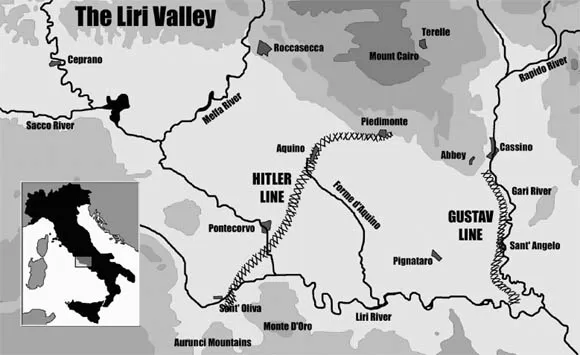
MAY 11, 1944, FOUND FOUR ALLIED ARMY CORPS concentrated on the front in western Italy, ready to strike. The signal to the troops came via a coded message over the BBC at 2300, and immediately two thousand guns rained death and destruction on the Germans in the Liri Valley. The II Polish Corps launched their attack in the middle of the night. Their target: Monte Cassino, the stronghold that had eluded capture for four months. Simultaneously, the 13th British Corps crossed the Garigliano River to assault the Gustav Line head-on. The 1st Canadian Armoured Brigade supported the 8th Indian Division during their crossing of the Rapido River. In the well-coordinated attack the French Expeditionary Corps ascended the Aurunci Mountains to outflank the Germans in the valley, while the 2nd U.S. Corps pushed up the coast in an attempt to link up with the attacking forces from Anzio.
One of the highlights of the action was the successful deployment of the Kingsmill bridge. Prior to the attack, Captain H. Kingsmill conceived of a way to install a bridge across a river while under attack, and proceeded to modify one of his tanks to accomplish it.
Joseph Reid (Calgary Regiment)
Tony Kingsmill was our LAE officer—that’s Light Armour Engineer—and he devised a track to roll a Bailey bridge down. He put a set of rollers on the deck of tank, and they shoved the bridge across the river. A tank would shove this Bailey bridge to the other bank, and it worked. The Kingsmill bridge they called it, and the tanks were able to get across the river and in effect control the development on the other side. It ended up by us being able to take Monte Cassino. The Poles actually took it, the infantrymen were the ones that took Monte Cassino, and I have highest regard for the Poles. Men without a country, the greatest fighters you ever saw. Except for the Canadians, of course.
John Richardson (Ontario Regiment)
We got in there with the 8th Div and we had some dirty fighting for a couple of days, but we pretty well wiped out the Gustav Line.
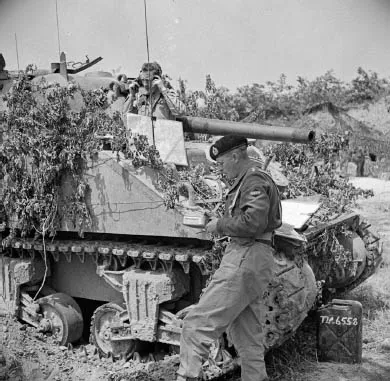
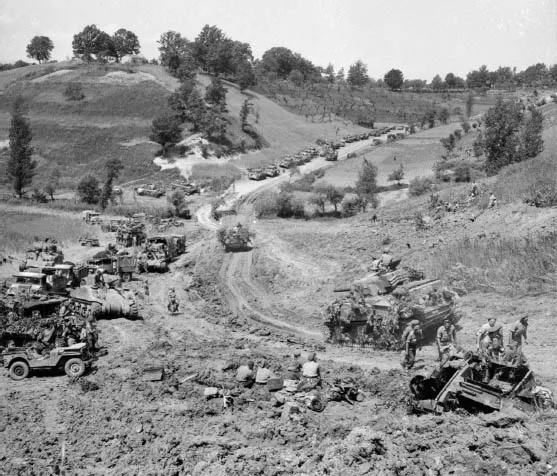
A camouflaged tank of the Ontario Regiment prepares for the advance towards Rome through the Liri Valley.
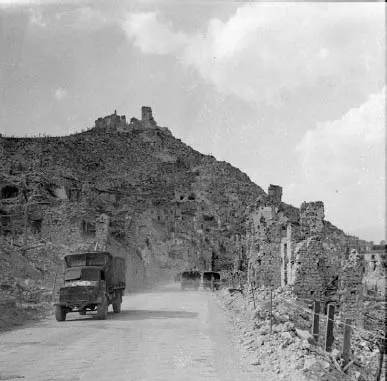
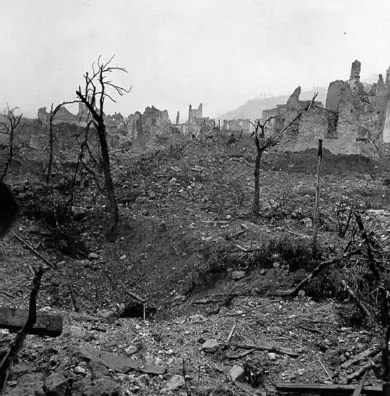
View from Highway No. 6 of what was left of the town of Cassino, destroyed after months of bitter fighting.
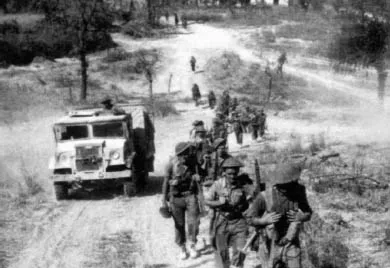
A column of Canadian soldiers march beyond Pignataro on May 16.
Canadian tanks played a big role in the assault on the Gustav Line, with squadrons of the Three Rivers Regiment, the Ontario Regiment, and the Calgary Regiment partaking in the crossing of the Gari River. It was a difficult encounter, and the Germans made every inch gained a painful experience. For four days the bitter fighting continued. Eventually, several bridges were built across the river and the Allied forces surged ahead and broke through the Gustav Line. On May 15 the Canadian 1st Division entered the fray, crossing the river and moving into position along the 8th Army’s flank to relieve the 8th Indian Division. The next day, the RCRs and Hasty Ps led the way across the Liri Valley, heading for the Hitler Line.
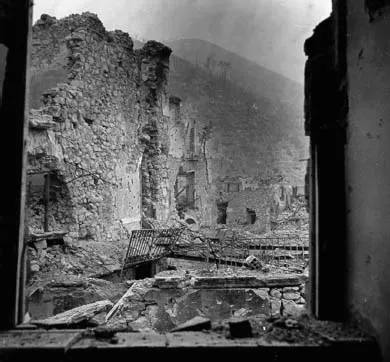
The ruins of Monte Cassino.
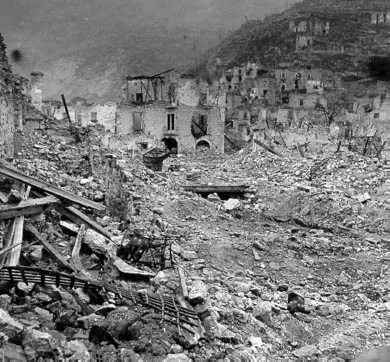
The fierce fighting at Monte Cassino left very little intact.
The devastation of Monte Cassino.
Harry Fox (Hastings and Prince Edward Regiment)
Well, to be quite honest with you, 1st Canadian Division did no fighting on the Gustav Line. It was the 8th Indian Division that broke through. It was after we passed through the Gustav Line into the Liri Valley that we went into action.
Al Sellers (Governor General’s Horse Guards)
We were in the valley and there was high land on each side. The valleys were quite wide, they could be a couple of miles wide, but it was still controlled by the enemy on this high ground, and Monte Cassino was a stronghold.
Harry Fox (Hastings and Prince Edward Regiment)
Well, it was open country. Hills, valleys, patches of wood, the odd farmhouse, and you never knew where you were going to get ambushed. So you had to be very careful about moving forward. We suffered casualties, but we pushed them back, just a steady push. They had observers in the mountains actually behind us. So the observers in front could see us and fire on us, and the observers in the back could see us and fire on us, so it was a tricky time.
Jim Holman (48th Highlanders)
Where we were we could actually see the action at the Cassino. You could see aircraft going in and you could see smoke over the mountain from the shelling. There was a lot of talk among the guys about how stupid it was. They wasted so many men when they could have went around it and just left it there. So many guys were killed there at Cassino. I can mostly remember being tired and hungry.
Peter Routcliffe (Governor General’s Horse Guards)
The first time we went in there we went up the side of a hill and everything was sort of like a conglomerate of bodies and men. That was where I saw my first casualty—at the base of Cassino, going up the hill. This poor guy had been fighting and all of a sudden he had no chin. A shell had blown off the whole bottom of his face. So I was going to give him a shot of morphine and the doctor says, “No, don’t do it” he says, “He’ll be dead in a minute,” and he was. He was just off like that. He was dead.
Albert Wade (Royal Canadian Dragoons)
Well, the role of a reconnaissance unit is to go forth and seek out information regarding the position of an enemy, regarding obstacles that would hinder a regiment, especially an infantry regiment or an artillery regiment, in their advance towards a battle area. And, if possible, have contact with the enemy, but nothing serious. If the worst came to the worst, we were trained to try to fight our way out. We had a troop consisting of two scout cars and two armoured cars, they were both armed—both scout cars were equipped with a Bren gun, also a .38-calibre Browning machine gun, automatic belt-fed, and we used various smoke bombs. We removed the seating and we sat on sandbags. The floors were sandbagged. The biggest enemy we had was road mines. That’s where I received all these wounds on my leg. I think it’s been fourteen operations on my legs, and most of the time they’re taking shrapnel out. I’m still being treated for that.
Throughout the day the Canadians clashed with the German defenders and the advance was torturously slow. The 48th Highlanders were moved forward to lead the way towards the Forme d’Aquino River, where they were to capture a bridge. As they approached, they came under fire, but one company was able to get through and seize the bridge before the Germans could blow it up. That night the 48th Highlanders repelled a counterattack and destroyed two German 88mm guns in the process.
John Richardson (Ontario Regiment)
The 88 was our nemesis. They used it for artillery, they used it for ack-ack, they used it for anti-tank, they used it for everything. It was a marvellous gun.
Jim Holman (48th Highlanders)
They just knocked tanks out like crazy. I know one tank that I ran past and one guy was lying out of the turret on fire, and the other guy was lying on the ground on fire.
Gord Outhwaite (48th Highlanders)
You heard the explosion and then you heard the shell.
Herb Pike (48th Highlanders)
Yeah—phsssssst!
Gord Outhwaite (48th Highlanders)
And you’d hear a bang, so you know it’s an 88, and they were deadly.
Al Sellers (Governor General’s Horse Guards)
They used to call them whiz-bangs. You’d hear the whiz first and then bang! In a Sherman tank the frontal armour used to be about seven inches thick, and the sides were maybe about two to three inches, and an 88 would go through everything. They were good gunners, and I remember one of our tanks getting hit. The gun was stuck over top of the driver’s hatch, and the tank brewed, or it caught on fire. So when he was stuck under there and we could hear him hollering but we couldn’t help him. He just burned to death. So anybody trapped in their tank and it was on fire, they were goners. We had the Shermans. Sometimes we’d put on tractor wheels and so on for bits of armour—so that would increase the weight, and that thing’s top weight would be around forty tons. Our infantry guys would be knocking out tanks, they would have the PIAT gun, which was pretty good, but wouldn’t do anything to a Tiger tank, and we had what they called the sticky bomb. They go up and they’d ram this thing about a foot in circumference and it was sticky. Exactly as the name implies, it would stick to the hull of the tank, turret, whatever it was, and it did a good job of knocking them out.
The advance of the Canadians from the Gustav Line to the Hitler Line.
Joseph Reid (Calgary Regiment)
Armour-piercing shells have a hard iron steel inner core, and if it hits a tank and doesn’t glance off, it goes through. It starts off in the shell, but the shell is pointed and it’s armour-piercing, and so the hot steel core of that shell goes through and it inevitably starts the fire, igniting the gas fumes inside the tank. So that’s what happens most of the time. Crews have to bail out in a hurry and take a chance from there on.
Jim Holman (48th Highlanders)
They had broken through the Gustav Line and I couldn’t see much fortification. The Germans had these things like anti-tank guns that were low to the ground, and you couldn’t see them and they were just lethal things for our tanks.
Gord Outhwaite (48th Highlanders)
I rode a motorcycle a lot, and a buddy and I were going right up to the line and we came across a tank battle. So we said, “Oh, can’t go through there, to heck with that.” You don’t have too much armour on a motorcycle you know. So we stopped and we got over to a gun pit. We thought, “Well we’ll see”—there’s always a lull for maybe about a minute, it could even be two minutes, and that’s the time you got to get going. All of a sudden we heard this damn thing wind up, and you wouldn’t believe the screech, and we say, “What in the devil is that?” Then all of a sudden you could hear the bombs and they have the tail fins pierced to create a screaming noise on its way down. There’s six of them—so as soon as that sixth one goes, you have a minute to get the hell out of there.
On May 17 they were over halfway to the Hitler Line, with battles raging on either side of them. To the right the Poles threw everything that they had at the Germans in Monte Cassino, gradually prying t...