![]()
1
Maritimes and Newfoundland
| INTRODUCTION BY MELYNDA JARRATT | |
| THE ONLY PLACE SHE WANTED TO BE | JEAN (KEEGAN) PAUL |
| RATHER THAN LOSE HIM, I MARRIED HIM | BETTY (LOWTHIAN) HILLMAN |
| THERE WAS A COLOUR BAR | MARY (HARDIE) GERO |
| NO HARMONY IN HARMONY JUNCTION | ELIZABETH (KELLY) MACDONALD |
| TIME IS SHORT | MILDRED (YOUNG) SOWERS |
| A UNION JACK ON HER GRAVE | MARY (FLETCHER) SHEPPARD |
| THE TOWN THAT WAR BRIDES BUILT | MARION (ELLIOT) HODDINOTT |
| EVERYTHING WILL BE FINE | ROSE (O’REILLY) BOULAY |
When we think of the War Bride experience one of the first things that comes to mind is the long train journey across the vastness of the Canadian landscape, but War Brides who came to the Maritime provinces had geography on their side.
For women headed to Halifax, the long transatlantic journey ended the moment her ship landed at Pier 21. When War Bride Marguerite Turner of Leeds, England arrived in March 1946 she was thrilled to see her husband Jim waving at her from atop the building facing the Aquitania. ‘I remember it clearly. He was standing on the roof, wearing a brown pinstripe suit and he had a brown fedora and I was standing on the side at the rail of the ship and he was dead opposite me with two other chaps’.1
That kind of a reunion was unusual; most British wives had a long distance ahead of them and the vast majority did not meet their husbands in Halifax. For those men waiting patiently in Quebec, Ontario and especially out west, another five more days would pass as their wives made their way across Canada by train.
In 1946 Canada consisted of 11.5 million people living in nine provinces and two territories, stretching nearly 4,000 miles from Nova Scotia on the east coast to British Columbia on the west.
The Maritime region, where Halifax is located, consisted of three eastern provinces, Nova Scotia, New Brunswick and Prince Edward Island. Together they had a combined population of just over one million people2 and of these, most lived in a rural setting, either on a farm or out in the country, far away from the closest city or town.3
Compared to Ontario and Quebec, the Maritimes were a mainly rural population. In 1946 there were only three or four big cities in the whole of the region, the main ones being Halifax, followed by Saint John and Moncton, New Brunswick, the hub of the Maritimes where trains travelling east and west would pass through. The whole of Prince Edward Island had only 95,000 people and the majority lived on farms.4 Most people in the Maritimes worked in the resource-based economies of farming, forestry, fisheries and mining as had their forefathers for generations.
The three provinces share a unique cultural heritage that is tied to 400 years of European settlement as well as a pattern of immigration that brought newcomers mainly from France (known as Acadians), England, Scotland and Ireland. There is also an Aboriginal presence stretching back more than 10,000 years with Mi’kmaq and Maliseet settlements throughout the region, and even Black Loyalists – former slaves – who were promised their freedom for supporting the British during the American Revolution. The French-speaking Acadians shaped the character of the region and there were immigrants from other countries such as Lebanon, Italy and Eastern Europe, but for the most part Maritime Canada in the postwar years was English speaking and place names like New Glasgow, Newcastle and Hampshire reflected its British heritage.
Newfoundland is often mistakenly included as one of the Maritime provinces but it isn’t today and it certainly wasn’t in 1946. As Newfoundland had not yet joined the Confederation – and wouldn’t until 1949 – War Brides who went to Newfoundland were, in fact, going to another country and when they arrived in Halifax they still had a long way to go by ferry before they were home.5
But War Brides who were headed to Halifax or Dartmouth could have taken a taxi to their new homes or driven to surrounding communities like
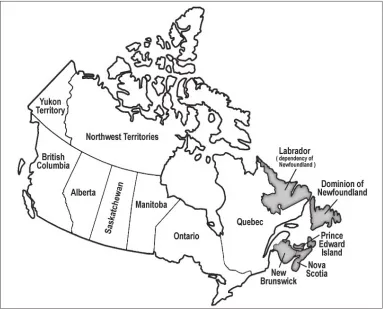
Map of Maritimes, Canada including Newfoundland and Labrador. The Maritimes included Nova Scotia, Prince Edward Island and New Brunswick. Newfoundland did not become part of Canada until 1949 so War Brides who travelled there were headed to another country.
Truro in a couple of hours. Depending on the weather, those destined to the far-flung reaches of Cape Breton or New Brunswick would be in their husband’s arms in less than a half-day by train. And although Prince Edward Island was accessible only by ferry, War Brides who were headed to PEI were at home, bags unpacked and sipping a cup of tea a long time before their shipmates who were going to Quebec and Ontario.
London-born War Bride Beatrice MacIntosh came to Halifax on the Mauretania in March 1946 destined for South Harbour, Cape Breton. She had no idea of the hardship she caused her husband who had the wrong date of his wife’s ‘imminent arrival’ in Halifax. His long journey by snowshoe, dog sleigh, foot, ferry, bus and horse sleigh in the middle of a cold Cape Breton winter amounted to a journey of epic proportions.
He assumed that the War Brides for Cape Breton would be sent by train from Halifax to Sydney. It was February, mid-winter, and the roads were not open. He started out by snow shoes to Big Intervale. He was joined by a local friend who also wanted to travel to Sydney. From Big Intervale they got a ride by horse and sleigh to the foot of North Mountain. Carrying the snowshoes (one pair between them) they followed a snow track made by the mailman … They finally reached Pleasant Bay and went to a hotel … The next morning they gave their backpacks to the mailman (he had a dog team), left their snowshoes at the hotel and walked behind the mailman all the way to Cheticamp, crossing both MacKenzie and French Mountain. Quite a walk!
In Cheticamp they stayed a night at Aucoin’s Hotel, owned by a man nicknamed ‘Johnny on the Spot’. The following morning they took a large six passenger bus to the Strait (Hawkesbury), where they changed to an Acadian Lines bus. They had only gone a few miles when the bus had problems so the driver pulled into a hotel where they stayed that night. There was a dance in a hall close by, so the passengers all went. The bus driver got very intoxicated and couldn’t drive the bus the next morning. He was fired and another driver came to drive the bus. At last, they arrived in Sydney, only to find out that I had sent a cable to South Harbour telling Kendrick that the boat I was supposed to travel on, the Ile de France, had been wrecked in a storm and I had to wait for further notice about another boat.6
Beatrice MacIntosh’s experience aside, for most War Brides who went to the Maritimes the journey by train was not so important. Their biggest challenges lay in adapting to the cold Canadian climate and adjusting to a rural lifestyle far from towns and city centres where the things they had taken for granted in Britain, like shopping, transportation, and culture, were now but a distant memory.
The Only Place She Wanted to Be
Jean (Keegan) Paul
Jean Keegan was born in Coulsdon, Surrey, England in 1926. She married Charles Paul of the Tobique Indian Reserve in New Brunswick.
Jean Keegan was just a teenager from Coulsdon, Surrey when she fell in love with a young Aboriginal soldier, Charles Paul, of the Tobique Indian Reserve in northwestern New Brunswick.
One of four daughters of Charles and Mary Keegan, Jean came from a comfortable, middle-class background and lived in a large English city with all the modern amenities. No one in the family would have imagined that Jean would end up on an Indian Reserve in Canada but once she met Charlie Paul, that’s the only place she wanted to be.
Jean’s older sister Pat was stationed with the WAAF at the Kenley Aerodrome and she only came home to Coulsdon on leaves, but she remembers when Jean and Charlie Paul started going out together.
‘They met at a dance near the old Cane Hill Hospital in Coulsdon,’ says Pat, who is now eighty-three and lives in Warlingham. ‘There were a lot of Canadians around the area and my mother really liked “Buck”, as we called him, so she didn’t mind Jean going out with him. They all used to go to a pub called the Midday Sun where the Canadians and their girlfriends gathered.’
Jean’s father was only thirty-nine when the war started so he rejoined the King’s Own Regiment and was stationed in Formby, Lancashire. The three younger girls lived at home with their mother and when Coulsdon was under attack from German bombing the two youngest, Kathy and Mary, were evacuated to northern England. That left Jean and her mother at home so the two of them would go to the dances, her mother as the chaperone. Mrs Keegan was attractive in her own right and was often mistaken as a sister to Pat and Jean, to her great delight.
Pat says other people may have thought that Charlie was different but nobody in their family gave much thought to the fact that he was a Canadian Indian. ‘I remember after they married a girl came over to look at Jean’s baby Christine and said, “Oh she’s white!” I was amazed. I never even thought of Charlie or his brother Jim as not being like us.’
But in the weeks before Jean and Charlie married, her mother’s friendly disposition towards Buck had changed.
‘I was on my first leave home and Mum greeted me with tears,’ Pat recalls. ‘She said that Jean was pregnant, and what was she going to say to dad? What was she to do?’
The first thing they did was make wedding arrangements. Jean and Charlie were thrilled: they were in love and wanted to get married – everything was unfolding as planned as far as they were concerned – but Pat remembers her parents weren’t very happy about it and neither was the Catholic priest, Father Tindal at St Aidan’s Church.
All food and clothing was rationed so a friend of Mrs Keegan helped out by lending Jean a fur stole for the wedding ceremony and she even hosted the reception. Soon after, Charlie was sent to Italy with his regiment, the Carleton York, and after Christine was born, Jean went to Liverpool to stay with an aunt. Charlie contracted malaria and was diagnosed with arthritis that bothered him his whole life, but once he recuperated from his illness he was sent back to serve in northwestern Europe and at the end of the war he was repatriated to Canada.
Soon it became time for Jean to make her own travel arrangements through the Canadian Wives Bureau. Pat recalls that the padre of Charlie’s regiment tried to dissuade Jean from going to the reserve and so did the British Red Cross, but Jean wouldn’t listen to any of it. She was going to be with her husband and nothing would change her mind.
‘It’s what she wanted,’ Pat says. ‘Jean was very headstrong and always got what she wanted.’
In May 1946 twenty-year-old Jean and her daughter Christine crossed the Atlantic with hundreds of War Brides on board the Aquitania, arriving at Pier 21 on 21 May. From Halifax they made their way by train to McAdam, New Brunswick where they were met by the Roman Catholic priest, Charlie and Mrs Valreia Hunter, a volunteer with the Canadian Red Cross Train Meeting Committee who faithfully recorded Jean’s arrival in the diary she kept of War Bride arrivals at McAdam.
The priest, Jean, Charlie and Christine were taken by canoe to the Maliseet Indian Reserve above Perth, New Brunswick. Reserve life was a very trying experience for a woman from a fine home in urban England. The community was located at the juncture of the Saint John and Tobique Rivers where the people eked out a meagre existence from the land, relying on the seasons and nature to bring what they needed to survive. Jean adapted to this rough life: she learned the ways of the people and became fluent in the language and ways of the Maliseet tribe. It was another twenty years before she was able to return to England for a visit.
There was little or no employment on the reserve so Charlie found work as a river guide during the fishing season and a hunting guide during the hunting season. In the fall, they would pick potatoes and in the summer they’d follow the blueberry trail as had generations of Native Indians before them.
Their daughter Cindy remembers growing up with her three brothers and sisters in grinding poverty in a shack on the edge of the reserve where rats would scamper across the floor. They didn’t have a fridge or electricity and the bathroom was an outhouse in the back. When the Indian Agent would show up on the reserve to do his annual assessments he’d leave behind a barrel of flour and leftover army rations for every family. The convent school was run by nuns and they’d give the children a treat of hard tack and cod liver oil to battle malnutrition and rickets.
When Cindy was still a youngster her father built a small house for the family near the church. It was a step up and Jean was pleased with the new surroundings. When Jean’s grandfather died she was asked what she wanted from the inheritance; a bathtub and running water was her request, and that’s what she got.
Jean never complained about her life on the Tobique Reserve and her English family had no idea of the living conditions until her mother came to visit when the last child was born. It was quite a shock to see the way people lived on the reserve but Jean wasn’t askin...