Exploring Toronto's history through the stories of its most fascinating and shadowy deaths.
If these streets could talk…
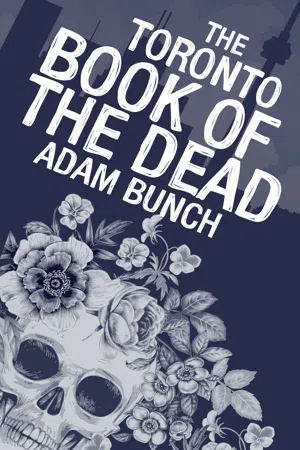
With morbid tales of war and plague, duels and executions, suicides and séances, Toronto's past is filled with stories whose endings were anything but peaceful. The Toronto Book of the Dead delves into these: from ancient First Nations burial mounds to the grisly murder of Toronto's first lighthouse keeper; from the rise and fall of the city's greatest Victorian baseball star to the final days of the world's most notorious anarchist.
Toronto has witnessed countless lives lived and lost as it grew from a muddy little frontier town into a booming metropolis of concrete and glass. The Toronto Book of the Dead tells the tale of the ever-changing city through the lives and deaths of those who made it their final resting place.
- 424 pages
- English
- ePUB (mobile friendly)
- Available on iOS & Android
eBook - ePub
The Toronto Book of the Dead
About this book
Information
1
The Feast of the Dead
The land was torn apart. A big, rumbling steam shovel ripped through the earth, eating away at the hill. Great scoops of dirt were carved out of the ground. This was 1956. A new subdivision was being built in Scarborough; rows of bungalows were set to appear on the land near Highland Creek. But on a spot not far from the corner of Lawrence Avenue and Bellamy Road, a large mound of earth stood in the way. Tabor Hill was nearly twenty metres high, so the steam shovel was brought in to flatten it; the extra dirt would be used in the construction of the nearby Highway 401.
But as the digger tore away at the hill, the work suddenly came to a halt. The machine had uncovered something in the dirt.
Tabor Hill isn’t a natural formation. It’s a seven-hundred-year-old mass grave. The steam shovel had uncovered an ancient ossuary. Inside were the bones of more than five hundred people laid to rest in the early 1300s.
Centuries before subdivisions, skyscrapers, and highways covered the land where Toronto now stands, it was home to Wendat villages. (Europeans would later call them the Huron.) Hundreds of people lived together in each community. Their longhouses were surrounded by sprawling fields of maize. They hunted in towering forests of oak and pine, carefully managed by controlled fires. Those woods were filled with deer, wolves, cougars, and bears. Every fall, the rivers flowed thick with salmon. Bald eagles soared overhead. Enormous flocks of passenger pigeons filled the sky.
Once every ten to thirty years, when the natural resources surrounding a village had been depleted and needed time to recover, the Wendats would move to a new location. But first, they would mark the occasion with a huge festival — ten days of feasting and gift-giving capped by a burial ceremony: all of those who had died of natural causes since the village last moved were laid to rest in one communal grave. When the first French missionaries showed up, they gave it the name most people use today: the Feast of the Dead.
As the time of the great feast approached, the villagers paid a visit to the cemetery. Over the years, as the daily life of the village carried on, the graveyard had slowly filled with bodies. Every time someone died of natural causes, they were placed on a litter and carried to the cemetery, the villagers following in silence. The corpse was placed in a temporary coffin made of bark, to be kept on a wooden platform two or three metres above the ground. There they rested for years on end, until it was time for the Feast of the Dead.
Then, they were brought back out.
The French missionary Jean de Brébeuf was invited to attend the Feast of the Dead in 1636. His account is deeply coloured by his own prejudice, but it provides a detailed record of the event and the preparations that went into it, including the moment when the bodies were taken out of their bark coffins.
“After having opened the graves,” Brébeuf explained in The Jesuit Relations, “they display before you all these corpses, on the spot, and they leave them thus exposed long enough for the spectators to learn at their leisure, and once for all, what they will be some day. The flesh of some is quite gone, and there is only parchment on their bones; in other cases, the bodies look as if they had been dried and smoked, and show scarcely any signs of putrefaction; and in still other cases they are still swarming with worms.”
The missionary was amazed by the power of that sight — by the raw truth of death. He thought Christians could stand to learn from it. “I do not think one could see in the world a more vivid picture or more perfect representation of what man is,” he wrote. “It is true that in France our cemeteries preach powerfully … but it seems to me that what our Savages do on this occasion touches us still more, and makes us see more closely and apprehend more sensibly our wretched state.”
The bodies were then prepared for reburial. The freshest corpses — those still writhing with maggots — were simply wrapped in beaver-fur robes and placed on litters to be carried to the site of the new grave. But the others had their bones cleaned. The remaining flesh was stripped from their skeletons and burned in a fire. Then, the body was taken apart and the bones were bundled in beaver fur.
For days, the villagers would feast, sing, and cry out in honour of the dead. Gifts were exchanged among the living. They held sporting contests and gave prizes to the winners. And then, finally, it was time to bring the dead to the place where they would be buried again.
The Feast of the Dead Brébeuf attended came more than three hundred years after the burial of the bones in Tabor Hill. By then, villages were bigger and were moving more frequently, the territory of the Wendats had shifted north toward Georgian Bay, and the ceremony included communities from outside the village itself. When a Feast of the Dead was being planned, invitations were sent to other Wendat villages, and even to some close allies. They were all invited to come and bury their dead in one communal grave. The bones of many different communities would rest together in the earth for eternity, never to be separated: a powerful symbol of their intimate connection and commitment to one another.
In the days before the reburial, hundreds of people left their villages and began their journey to the site. They carried their dead with them: bundles of bones slung over their shoulders, full bodies stretched out on litters.
As they passed other villages along the way, they would pause to visit and give gifts. Their numbers grew with every stop, an ever larger procession making its slow way toward the site of the grave. Two thousand people attended the Feast of the Dead in 1636. They came from miles around, gathering to bury the dead from eight or nine villages, according to Brébeuf’s account.
When they had all arrived, the dead were made ready. Families unfolded the beaver fur to reveal the bones of their loved ones and said goodbye one last time. “The tears,” Brébeuf remembered, “flowed afresh.”
He described one woman in particular: the daughter of a dead chief. “She combed his hair and handled his bones, one after the other, with as much affection as if she would have desired to restore life to him.” The old man wasn’t the only relative she had lost in the time since the last great burial. “As for her little children,” the missionary remembered, “she put on their arms bracelets of porcelain and glass beads, and bathed their bones with her tears; they could scarcely tear her away.”
The dead would be buried in a deep pit. The ossuary at Tabor Hill was fifty feet long; Brébeuf compared the one he saw to the size of a grand square in Paris. Along the edges of the grave, the Wendats built wooden scaffolding from which they hung the bundles of bones. The full bodies were stretched out on bark or on mats. All afternoon and into the evening, they made the final preparations, and gave gifts in the names of the dead.
It was seven o’clock by the time the burial was ready to begin. First, the pit was lined with beaver fur. Then, the bodies of the most recently deceased were lowered into the bottom of the hole. “On all sides,” Brébeuf wrote, “you could have seen them letting down half-decayed bodies … ten or twelve [people] were in the pit and were arranging the bodies all around it, one after another.”
Gifts were also buried: kettles, furs, bracelets, and other prized possessions. “You might say that all [the Wendats’] exertions, their labours and their trading,” Brébeuf wrote, “concern almost entirely the amassing of something with which to honour the dead … they lavish robes, axes, and porcelain in such quantities that, to see them on such occasions, you would judge that they place no value upon them; and yet these are the whole riches of the Country.”
“One man,” another missionary wrote after witnessing a Feast of the Dead years earlier, “will give almost all he possesses for the bones of the man or woman he loved and cherished in this life and still loves after their death.”
At dawn the following morning, the bones were added to the bodies in the grave. They were lowered into the pit until it was nearly full. Once they had all been set in place, they were covered with another layer of beaver fur. Then, finally, the rest of the hole was filled in.
The Wendats believed every person had two souls. The Feast of the Dead allowed one of them to leave the body and begin the journey into the afterlife. The other would remain in the bones, resting beneath the earth with the souls of all of those who had been buried along with them.
By bringing so many together in one communal grave, the Feast of the Dead forged strong bonds between the living. “Essentially,” Wendat historian Georges E. Sioui explains, “the Feast of the Dead was a gigantic ten-day ritual celebrating the people’s unity and their desire to live in peace and to extend the bonds of symbolic kinship to the greatest possible number.” It was, he says, “certainly one of the most remarkable and most pivotal features of this civilization.”
The 1636 Feast of the Dead came at a dark time for the Wendat nation. The threat of war with their Indigenous neighbours loomed, and smallpox had reached their territory: the first epidemic would kill half the population in just six years. This was an especially important time to cement alliances.
Two Frenchmen had recently been buried in Wendat villages, including the young explorer Étienne Brûlé — who some believe was the very first European ever to set foot on the land where Toronto now stands. The Wendats invited Brébeuf to rebury those French bones in the same communal grave as their own people. It would be a powerful and intimate sign of friendship between the two civilizations.
Brébeuf refused. “We respected their bones too much,” he explained, “to permit them being mingled with the bones of those who had not been baptized.”
When a Wendat chief offered the missionary a gift of beaver fur, he refused that, too. While he admired some aspects of the Feast of the Dead, he wrote of his hopes that it would die out quickly. The missionaries had not come to take part in Wendat culture. They had come to destroy it. The Jesuits had a clear mission: to wipe out the ancient traditions of the Indigenous nations they encountered and convert them all to Christianity.
“The only acceptable gift,” as Sioui writes (with his own emphasis), “was the abandonment of their culture by all of the savages.” The Wendat historian has no doubt about what Brébeuf’s account represents: “This description of the Feast of the Dead is really of the end of a world … as seen by those who would bring about its destruction. Apocalypse is always dreadful to contemplate. Three and a half centuries later, the shock and horror of it is still palpable.”
Today, the dead of Tabor Hill are still resting in the place they were buried seven hundred years ago. The mound was never flattened for the subdivision; instead, the bones were reburied and the mound was preserved as a cemetery: a sacred green space in the middle of a residential neighbourhood. The hill towers over the bungalows that surround it — it’s the highest point for miles in every direction. At the top sits a stone inscribed with a memorial to the dead below. From that spot on a clear day, you can see all the way across the eastern half of the city: from the cliffs of the Rouge Valley that mark the eastern border of Toronto all the way to the gleaming skyscrapers of Yonge Street in the west. Millions of people go about their lives in the shadow of those dead souls.
Tabor Hill is far from the only ancient grave in the city. At least twenty ossuaries have been found within the borders of the Greater Toronto Area (the GTA). And preserved in the earth are countless other signs of the people who lived here in centuries gone by — many of them from long before the modern city was founded. Eighty percent of all the archaeological sites in Ontario are Indigenous sites. The remains of entire villages have been discovered beneath Toronto. There are longhouses, hunting camps and portage routes, shards of pottery and ornate bracelets, arrowheads and spear points, and many other remains from the daily life of those who lived in this place hundreds and thousands of years ago.
Tabor Hill reminds us that Toronto is not a blank slate. The land beneath our feet is not empty. It has stories to tell, if we’ll listen.
2
The Beaver Wars
The year 1687 was a year of war and famine on the shores of Lake Ontario. That summer, on a night in early July, an army camped near the mouth of the Rouge River, at the very eastern edge of what’s now the city of Toronto. A few thousand men — professional soldiers from France, militia from Quebec, and their First Nations allies — feasted on venison before bed. They were tired, finally heading home at the end of a long and bloody campaign against the Seneca.
Their war was driven by a fashion trend. Far on the other side of the Atlantic, in the cobblestone capitals of Europe, hats made of beaver felt were all the rage. The demand had already driven European beavers to the brink of extinction. Now, the furriers turned to the Americas to feed their ravenous sartorial appetite. The competition over the slaughter of the large, aquatic rodents plunged the Great Lakes region into more than a century of bloodshed and violence. By the end of the 1600s, there had been decades of conflict. Thousands of warriors had fought bloody battles over control of the fur trade. They called them the Beaver Wars.
This was still long before the city of Toronto was founded, long before the British conquered Quebec, all the way back in the days when the French still claimed the Great Lakes for themselves. As far as they were concerned, the land where Toronto now stands was part of New France. But barely any Europeans had ever set foot on the land: only a few early explorers, fur traders, and missionaries.
There were plenty of people, just not French ones. In the late 1600s, the Seneca had two bustling villages within the borders of today’s Toronto, with dozens of longhouses surrounded by fields of maize. In the west, Teiaiagon watched over the Humber River at the spot where Baby Point is now (just a bit north of Bloor Street and Old Mill Station). In the east, Ganatsekwyagon had a commanding view over the Rouge.
Both were very important places. The Humber and the Rouge were at the southern end of a vital fur trade route: the Toronto Carrying Place trail, which gave the city its name. The rivers stretched north from Lake Ontario toward Lake Simcoe. From there, fur traders could reach the Upper Great Lakes, where the beaver population was still doing relatively well. Now that the Seneca controlled the Toronto Carrying Place, they could ship beaver pelts south into the American colonies and sell them to their British allies.
That profoundly annoyed the French. They wanted those beaver pelts flowing east down the Ottawa River instead, toward their own relatively new towns of Montreal and Quebec.
By then, the French had already spent decades fighting over the fur trade. They were on one side of the Beaver Wars, generally allied with the Wendats and a variety of Algonquin-speaking nations, like the Odawa. On the other side, the British supported the Haudenosaunee (whom they called the Iroquois): a confederacy of five nations, including the Seneca.
Things weren’t going well for the French. By 1687, they still had only a few thousand settlers living in all of New France, most of them centred around Montreal and Quebec. They had tried to expand their control west into the Great Lakes, establishing a trading post — Fort Frontenac — where Kingston is today. But their efforts ended in humiliating failure. They’d been forced to make peace with the Haudenosaunee and their British allies.
The French now worried they would lose the Beaver Wars — and with them, all of New France. They were scared the Haudenosaunee might overrun their settlements, and that their own First Nations allies would soon abandon them to trade with their enemies instead.
Thousands of kilometres and an entire ocean away, in his new royal palace of Versailles, King Louis XIV — the famous Sun King, who reigned over France longer than any monarch has ever reigned over a major European nation — decided it was time for a change. The governor of New France was fired. In his place, a new governor was sent across the Atlantic to run things.
His remarkably long name was Jacques-René de Brisay de Denonville. He was a career soldier; a respected officer from an old, rich family with deep ties to the throne. Upon his arrival in Canada, he would write a bloody new chapter in the history of the Great Lakes.
The new governor’s first move was to ignore the peace treaty the former governor had negotiated with the Seneca. Denonville sent a hundred men north to Hudson Bay with orders to launch a surprise attack against British trading posts there. It was a rout. The French seized three posts run by the Hudson’s Bay Company and just like that, they controlled the northern trade.
Next, Denonville turned to treachery. In the summer of 1687, he proposed a peace council: a great feast with the leaders of the Haudenosaunee Confederacy. Fifty chiefs came to Fort Frontenac that June to meet under a flag of truce. But it was a French trap. When the chiefs and their families arrived, Denonville’s men captured them all, taking about two hundred prisoners. Some were tied to posts, bound so tight they couldn’t move; some were tortured. Many would be shipped across the Atlantic in chains to serve King Louis as galley slaves.
And Denonville still wasn’t done. He’d brought an army with him to Fort Frontenac: three thousand men, including professional French soldiers, militiamen from Quebec, a few coureurs de bois, and hundreds of First Nations allies. He led them across Lake Ontario, a fleet of hundreds of canoes and bateaux, sailing toward the southern shore, where New York State...
Table of contents
- halftitle
- title
- copyright
- dedication
- contents
- foreword
- introduction
- part1
- 1
- 2
- 3
- 4
- 5
- 6
- part2
- 7
- 8
- 9
- part3
- 10
- 11
- 12
- 13
- part4
- 14
- 15
- 16
- 17
- 18
- 19
- part5
- 20
- 21
- 22
- 23
- 24
- 25
- 26
- 27
- part6
- 28
- 29
- 30
- 31
- 32
- 33
- acknowledgements
- selectedbibliography
- promo
Trusted by 375,005 students
Access to over 1.5 million titles for a fair monthly price.
Study more efficiently using our study tools.
Frequently asked questions
Yes, you can cancel anytime from the Subscription tab in your account settings on the Perlego website. Your subscription will stay active until the end of your current billing period. Learn how to cancel your subscription
No, books cannot be downloaded as external files, such as PDFs, for use outside of Perlego. However, you can download books within the Perlego app for offline reading on mobile or tablet. Learn how to download books offline
Perlego offers two plans: Essential and Complete
- Essential is ideal for learners and professionals who enjoy exploring a wide range of subjects. Access the Essential Library with 800,000+ trusted titles and best-sellers across business, personal growth, and the humanities. Includes unlimited reading time and Standard Read Aloud voice.
- Complete: Perfect for advanced learners and researchers needing full, unrestricted access. Unlock 1.5M+ books across hundreds of subjects, including academic and specialized titles. The Complete Plan also includes advanced features like Premium Read Aloud and Research Assistant.
We are an online textbook subscription service, where you can get access to an entire online library for less than the price of a single book per month. With over 1.5 million books across 990+ topics, we’ve got you covered! Learn about our mission
Look out for the read-aloud symbol on your next book to see if you can listen to it. The read-aloud tool reads text aloud for you, highlighting the text as it is being read. You can pause it, speed it up and slow it down. Learn more about Read Aloud
Yes! You can use the Perlego app on both iOS and Android devices to read anytime, anywhere — even offline. Perfect for commutes or when you’re on the go.
Please note we cannot support devices running on iOS 13 and Android 7 or earlier. Learn more about using the app
Please note we cannot support devices running on iOS 13 and Android 7 or earlier. Learn more about using the app
Yes, you can access The Toronto Book of the Dead by Adam Bunch in PDF and/or ePUB format, as well as other popular books in History & North American History. We have over 1.5 million books available in our catalogue for you to explore.