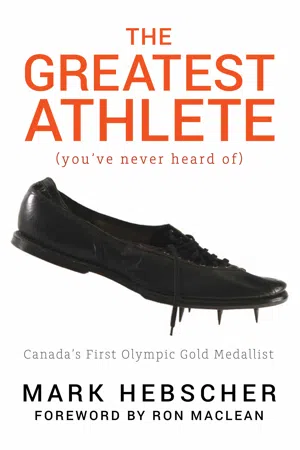
Canada's first Olympic gold medallist couldn't walk until he was ten, and became the greatest runner of his generation. Who was the first Canadian to Win an Olympic Gold Medal? When Mark Hebscher was asked this simple trivia question, he had no idea that it would lead him on a two year odyssey, researching a man he had never heard of. Paralyzed as a child and told he would never walk again, George Washington Orton persevered, eventually becoming the greatest distance runner of his generation, a world-class hockey player, and a brilliant scholar. A sports pioneer, Orton came up with the idea of numbered football jerseys and introduced ice hockey to Philadelphia. Orton's 1900 Paris Olympic medals were credited to the United States for seven decades before the mistake was uncovered and rectified. Yet he is virtually unknown in Canada. Finally, his story is being told.
eBook - ePub
The Greatest Athlete (You've Never Heard Of)
Canada's First Olympic Gold Medallist
- 248 pages
- English
- ePUB (mobile friendly)
- Available on iOS & Android
eBook - ePub
About this book
Information
Print ISBN
9781459743359
1
THE BIGGEST RACE OF HIS LIFE
It is not the size nor build nor physique nor qualities of inherited ancestry that determines a track and field champion. The boy of slender build and of apparent constitutional weakness may turn out to be another George Orton, invincible in the distance runs.
— Donald W. Hendrickson, 1909 1
Imagine you are three years old. You love to run and jump and play with your friends. But the doctor has just told your parents that you may never be able to walk or use your right arm again because of a terrible accident. You lie in bed, paralyzed, while your friends play outside. You dream of someday running again. Fast. Faster than all your friends. Faster than everyone in the world.
On a brutally hot July afternoon in Paris, a slender, curly-haired man with a shrunken arm is running in the Olympic 2,500-metre steeplechase. He had predicted in the newspaper that he would win the gold medal in this event, but he is in fourth place, and victory seems unlikely.
The year is 1900. George Washington Orton is the most decorated distance runner in the world, having won over 120 championships in the United States, Canada, England, France, Belgium, Holland, and Germany. At age 20, he had earned his bachelor’s degree from the University of Toronto. When he was 23, he became one of the youngest to earn a Ph.D. at the University of Pennsylvania. He looks more like a scholar than a world-class athlete. He is five feet six inches tall and weighs 120 pounds. He squints a lot, like he needs eyeglasses.

George Orton in 1893. As a student at the University of Toronto, he held the North American record for the mile-run and drew thousands of spectators to university track meets.
A week earlier, the English track and field championships had been held at Stamford Bridge, home of the London Athletic Club. In 1898, Orton won the two-mile steeplechase there, demolishing the field by 80 yards and becoming the first North American to win the coveted title. It took 24 years before an athlete from outside Great Britain won the steeplechase again.
By 1900, Orton was already a racing legend in Great Britain, and large crowds had come to see him and the other North American track and field stars in advance of the Paris Olympics.
But in the windy and damp conditions of Stamford Bridge, it was English champion Sidney Robinson who won the steeplechase that year, with Orton finishing a distant fourth. It was a painful defeat for Orton, who was in rough shape after a gut-wrenching 10-day ocean voyage from America.
He vowed to get better and defeat Robinson and the others at the upcoming Olympics.
Orton had been hired as a special correspondent by the Philadelphia Inquirer under the byline “George Orton — the famous Pennsylvania athlete.” One of his assignments was to provide an insider’s look at the Olympic track and field events and predict the winners of each discipline. He mostly chose North American athletes to win, believing them to be superior to the Europeans. And when it came time to preview the 2,500-metre steeplechase, Orton didn’t beat around the bush. “Orton has more speed than the others,” he wrote, “and, as he is a good jumper, he should win, if in condition.”2 It was simple and succinct. He predicted victory, but in the third person, as if he were talking about someone else.
But Orton is not in condition on this day. Not even close. He hasn’t been right since leaving America nearly four weeks earlier. Forty-five minutes earlier, he had finished a close third in the 400-metre hurdles, becoming the first Canadian to win an Olympic medal, although he may not have been aware of the significance of that feat at that moment. While his opponents in the steeplechase were resting up for their big event, Orton was hurdling against the world’s best.
The Olympic track and field events that year were contested on the grounds of the Racing Club of France, in the Bois de Boulogne, a huge park located in western Paris that is two and a half times the size of New York’s Central Park. It may have been perfect for picnics, but it was a terrible choice as the venue for the Olympic Games.
As Orton pointed out, “The grounds are very picturesque, but not as well adapted for athletes as they might be.”3 He was being very kind. The biggest problem was the track itself. There wasn’t one. The French had refused to install a cinder track in their municipal park. There was no way they were going to tear up their beautiful grass for foot racing. Instead, they laid out an irregular-sized 500-metre oval (standard size is 400 metres) on uneven grass. Orton pointed out that the track “leads around beneath the trees” and its condition was so poor that “no less than four sprinters broke down.” The steeplechase course was especially brutal. Jumps consisted of authentic stone walls that couldn’t be moved, thick hedges that were difficult to vault, and imposing water hazards. Even if one could successfully negotiate the water jump, a soaker would await you on the other side. The hurdles for the steeplechase were one metre high and fashioned from 30-foot-long telephone poles that had been stripped. None of the obstacles could be knocked down, unlike those in the hurdles events, which would fall fairly easily upon contact.
Conditions for the field events were hardly better. The last few yards of the running broad jump approach featured a six-inch incline. There were reports of some jumpers having to dig their own pits. As well, the venue was not spectator friendly. The Bois de Boulogne was at least a mile from any tramway and far from the nearest railroad station. “This inaccessibility affected the attendance greatly, which was disappointing considering the caliber of the runners and the importance of the events,” wrote Orton.4
Gaining a good view of the track was another issue. Most spectators had their sightlines obstructed by a large grove of trees that made up the far end of the race course. Those who were fortunate enough to have the latest invention — binoculars — had the best view of the action.
Orton may have predicted victory in the newspaper, but he confessed two weeks later that he was anything but confident the day of the Olympic 2,500-metre steeplechase.
No man received a worse drubbing than I in the English steeplechase championship. I must confess, while I did not fear defeat in Paris, I knew I was against the best of the Old World and was pretty sure to be beaten. The race is sort of a dream to this day. We were all racing for the lead, and at the end of the mile we were dead to the world. A long stretch of woods was in the corner of the field and partially hid the backstretch. I was running fourth, and seemed to be out of the race, as [Sidney] Robinson was running strongly. About 300 yards from home, I seemed to realize that I was in the race for which I had come 4,000 miles.5
As the field headed for the treacherous water jump, Orton trailed Robinson, French champion Jacques Chastanie, and American Arthur Newton. Orton’s childhood dream may have propelled him at that point. The fear of having to eat crow because of his newspaper prediction also provided the likely impetus to get a move on.
After the water, the runners would head through the trees at the far end of the backstretch and then turn for home. Nobody thought Orton had a chance, except the man with a clock in his head. You see, Orton had a near-perfect sense of pace. It was innate. He had perfected the art of running and waiting. In most of his races, Orton would conserve his energy by running perfectly timed intervals, falling behind and then finishing with a big kick, bolting past his opponents in dramatic fashion.
Most distance runners of the day did not have Orton’s discipline. They ran as fast as they could for as long as they could before quitting or collapsing. Orton ran like a man with ice water coursing through his veins. Cool as can be, he would wait until the last possible moment before making his move. And most of the time, it resulted in victory.
Because he was a brilliant mathematician and had diligently studied and practised proper pacing since childhood, Orton could read a field of runners and know when to go and when to back off. When certain muscles became fatigued, he knew to change his gait and put less stress on them. He was one of the first on record to time his training intervals. He tried using a pocket watch initially, but the second hand was difficult to read and the watch too cumbersome. Orton felt that by fumbling with it, he was losing a second or two. It’s possible that his withered arm made it even more difficult, and he eventually scrapped the idea. Later, he learned that British military officers were using a newfangled way to tell the time while both hands were occupied: wristwatches. Orton fashioned a primitive one with leather straps and began utilizing it, checking his intervals often. In training, he could run a mile in four minutes, 28 seconds. He paced himself with laps of 66, 68, 69, and 65 seconds. Even the most seasoned runners could not run the final lap faster than the opening lap. The fact that a teenager could do it was nothing short of amazing.
Orton always appeared relaxed during his races, without the strained look of a man gasping for air, face contorted and lungs ready to burst.
There are many photos of the legendary long-distance runner Paavo Nurmi, “the Flying Finn,” carrying a stopwatch in training and in races. He also looks confident and relaxed, as if he knows he’s going to win. In 1924, Nurmi, who won a record nine Olympic gold medals in track, was dubbed “the father of perfect pace.”
But Orton’s 100-plus victories and strict attention to time, decades before the invention of the stopwatch, should be recognized here: “The grandfather clock of perfect pace” seems like a good handle.
Back on the grass oval that Sunday in Paris, Sidney Robinson maintained his lead and was running without distress. After winning the week before in London, Robinson was poised to take the gold medal.
Orton, still running fourth, decided to make his move with an all-out sprint, urged on by some of his Penn teammates. Many in the crowd were well aware of Orton’s legendary finishing kick and rose to their feet as the former Penn runner gave it the old college try.
Just then, the crowd lost sight of the runners, their views obstructed by the trees. When the runners entered the forest, Orton was fourth; when they emerged, he was in the lead!
Many were certain he had somehow lost the course and taken a shortcut. It appeared to be an optical illusion. How did he make up so much ground so quickly? As per his usual MO, Orton had timed his run perfectly, blowing past his rival Robinson with 100 yards to go. From there, he thundered down the stretch in front of the cheering crowd like a runaway freight train, flying over the final hurdle, winning handily and setting a world record: 7 minutes, 34 4/5 seconds.
Immediately upon breaking the tape, Orton raised his arms in triumph and collapsed, likely from a combination of exhaustion and elation. Robinson, the runner-up, fell right behind him five seconds later.
It was a sensational victory, as thrilling a race as anyone would see in these Olympics. Orton had erased a 20-yard deficit between him and Robinson in the final 300 yards to snatch the victory. According to the New York Times, the steeplechase “created a greater enthusiasm than all other events of the day.”6
Despite suffering from what would later be diagnosed as a stomach virus, Orton had made good on his newspaper prediction. And his childhood dream had come true. In less than an hour, he had won two Olympic medals — a bronze and a gold. It would be 84 years before another Canadian, Marita Payne, would win two Olympic track medals on the same day. (Years later, Payne’s fame would rise again when her son, Andrew Wiggins, became the number one pick in the National Basketball Association’s 2014 draft and went on to take Rookie of the Year honours. Wiggins, and by extension his mother, Marita, are as famous in Canada as Orton is obscure.)
Orton was considered to be an American for many years after that victory, simply because he ran as a representative of the University of Pennsylvania. In his mind, the American sporting republic included Canada, but he never competed for either nation. Nevertheless, Americans took ownership of this great champion, and his Canadian heritage rarely came up. It would be more than 70 years before Orton was officially and correctly recognized as a Canadian by the International Olympic Committee.
But that didn’t make him any less obscure.
When Olympic researchers made the discovery in the early 1970s, Orton’s Olympic gold and bronze medals were officially removed from the U.S. total and added to the Canadian tally. This announcement was made without fanfare and without notifying any member of the Orton family. There was no press release to announce the changes, and no declaration that Orton was now a Canadian. Only a few people in Canada even knew about this discovery. Besides, Orton was already dead.
The moment he crossed the finish line on that steamy Paris Sunday in 1900, George Orton became the greatest Canadian athlete since Confederation in 1867. His sterling performance would pave the way for Canadian multi-sport stars such as Lionel Conacher and Fanny Rosenfeld, voted the greatest Canadian athletes of the first half of the 20th century. Prior to Orton, only rower Ned Hanlan and weightlifter Louis Cyr could be considered dominant 19th-century Canadian athletes, having beaten the best in the world consistently over a period of time.

Competitive rowing was a popular professional sport in the mid- to late-19th century. Winners received large cash prizes, and there was always heavy betting on the outcome.
Ned Hanlan had started out as a teenage “rum runner,” rowing crates of whisky from his home on Toronto Island across the harbour for his bootlegger father. Soon, he was winning races, and from there his celebrity grew. He participated in numerous promotions, autograph sessions, and whistle-stop tours to encourage ticket sales and betting interest from the Nepean River in New South Wales, Australia, to Lachine, Quebec, and Chautauqua Lake, New York. He enjoyed meeting his adoring public and always found the time to show them how good he was on the water. Few could beat Hanlan straight-up, so he would give his opponents head starts in time or distance in order to drum up betting. Occasionally, he would give his backers fits by making it look as if he wouldn’t be able to catch up. In the end, he would usually make a spirited effort to win, alth...
Table of contents
- Cover
- Title Page
- Copyright
- Dedication
- Contents
- Foreword by Ron MacLean
- Introduction: First-Time Author, Long-Time Reader
- 1 The Biggest Race of His Life
- 2 The Documentary
- 3 The Boy Who Never Walked
- 4 A Dirty Pro
- 5 Your Humble Narrator
- 6 Philadelphia Freedom
- 7 The Father of Philly Hockey
- 8 Family Life
- 9 Author, Author
- 10 North America’s Athletic Missionaries
- 11 Bonjour, Paris!
- 12 Heavy Medals
- 13 “Making Good Boys Better”
- 14 The Philly Hall of Fame
- 15 A San Francisco Treat
- 16 Life Is a (Relay) Carnival
- 17 The Innovator
- 18 A Treasure Trove
- 19 “Howdy, Partner”
- 20 The Fourth Estate
- 21 “We’ll Fix It in Post”
- 22 The Last Mile
- Epilogue
- Acknowledgements
- Appendix: Orton’s Athletic Victories
- Notes
- Bibliography
- Image Credits
- Book Credits
Trusted by 375,005 students
Access to over 1.5 million titles for a fair monthly price.
Study more efficiently using our study tools.