In this new and revised edition, Knowles explores new materials relating to multiculturalism and immigration. Immigrants and immigration have always been central to Canadians' perception of themselves as a country and a society. In this crisply written history, Valerie Knowles describes the different kinds of immigrants who have settled in Canada, and the immigration policies that have helped define the character of Canadian immigrants over the centuries. Key policymakers and shapers of public opinion figure prominently in this colourful story, as does the role played by racism. This new and revised edition features a chapter on the Conservative government's handling of immigration between 2006 and 2014. Special attention is paid to the role played by the activist minister Jason Kenney and his attempts to develop a faster, more flexible immigration regime. The Temporary Foreign Worker Program and the Interim Federal Health Program are also discussed. The book's final chapter, "Issues in the Twenty-First Century, " introduces new material relating to multiculturalism and outlines arguments supporting population growth, increased immigration, and decreased immigration.
eBook - ePub
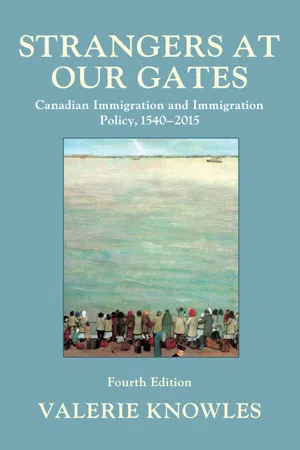
Strangers at Our Gates
Canadian Immigration and Immigration Policy, 1540–2015
- 336 pages
- English
- ePUB (mobile friendly)
- Available on iOS & Android
eBook - ePub
About this book
Information
STRANGERS
AT OUR GATES
Canadian Immigration and
Immigration Policy, 1540–2015
Immigration Policy, 1540–2015
— Fourth Edition —

— CONTENTS —
Preface
Introduction
1. The Beginnings
2. Canada’s First Large Influx of Refugees
3. British Immigration Transforms the Colonies
4. Immigration in the Macdonald Era
5. The Sifton Years
6. Forging a New Immigration Policy
7. Immigration Doldrums
8. Immigration’s Post-War Boom (1947–1957)
9. Major New Initiatives
10. A New Era in Immigration
11. The Turbulent 1980s and Beyond
12. Immigration Grabs Attention, 1996–2006
13. Developments 2006–2015: Pruning the Queue
14. Issues in the Twenty-First Century
Appendix: Tables and Figures
Notes
Bibliography
Index
— PREFACE —
THE IDEA FOR THIS BOOK originated with Kirk Howard, Dundurn Press’s publisher, who asked me in 1988 if I would undertake a two hundred-page survey of the history of Canadian immigration and immigration policy. When I agreed to take on the assignment, I little dreamt that in 2015 I would be toiling away on a fourth edition of the book. At times, I have been overwhelmed by the magnitude of the task, and by the challenge of compressing a wealth of material into a short history that touches on most of the key topics that should be raised in an introductory work of this nature.
Fortunately, I have had a lot of assistance along the way, most of which has been acknowledged in earlier editions. Nevertheless, I still owe a debt of gratitude to several people who played a role in the evolution of this fourth edition. I am most grateful to Joe Bissett, who answered questions during an interview and who provided a valuable print summary of immigration developments in recent years. I also owe a vote of thanks to Gerry Maffre and Mike Molloy, who read chapter 13 and made suggestions for its improvement. Anne Arnott made a huge contribution to this chapter as she checked all the facts, even rising to the occasion when she was on holiday overseas! For editorial expertise, I enlisted the help of my amazing Toronto editor, Kate Merriman, who edited chapters 13 and 14. Cheryl Hawley of Dundurn Press did a final copy edit and piloted all the chapters through their final stages. And finally I would like to express my gratitude to my husband, David Knowles, who was frequently called upon to solve computer problems and print chapters.
— INTRODUCTION —
THE SIGNIFICANCE OF THE ROLE played by immigrants in Canada’s history is underscored by an observation made by William Scott. In or around 1913, the superintendent of immigration from 1903 to 1924 observed: “More important than the drilling of armies, more important than the construction of navies, more important than the fiscal policy of this country is the question of who shall come to Canada and become part and parcel of the Canadian people” (William Scott, “Immigration and Population,” Canada and Its Provinces, edited by Adam Shortt and Arthur Doughty [Toronto: The Publishers’ Association of Canada, 1913], vol. 7, 589).
Closer to the present day, Richard Tait, chairman of the Canadian Immigration and Population Study, which issued the Green Paper of 1975, echoed these sentiments when he said, “A hundred years from now, I don’t suppose people will care all that much whether we legalized marijuana or not. But decisions about who you let into Canada will decide the kind of country we have 100 years from now.”
The people who have come to Canada have, by their efforts and talents, fashioned this country’s institutions, political and economic character, and cultural diversity. In short, they have made Canada what it is today. The purpose of this book is not to re-tell the important story of what these people endured and accomplished but rather to describe briefly the different kinds of immigrants who have settled in this country over the centuries and the immigration policies that have helped to define the character of immigration in various periods. Special attention is paid to some of the key policy-makers and moulders of public opinion. And, because racism frequently plays a role in the Canadian immigration story, it is also discussed, as is the effectiveness of various policies in achieving Canada’s immigration goals. The last part of the book touches on the realities of the 1990s and the early years of the present century that influence the framing of immigration policy, and tries to make some sense of the current debate about this country’s immigration and multiculturalism policies.
— CHAPTER 1 —
The Beginnings
THE BEGINNINGS
THE PREHISTORIC ANCESTORS OF CANADA’S present-day Indians and Inuit became this country’s first immigrants when they journeyed to America by way of the Bering Strait, at a time when a land bridge, now vanished, still connected Asia and America. Centuries later, according to an unconfirmed hypothesis, Irish monks visited Newfoundland. Then, starting around the year 1000, Vikings made occasional stops, overwintering at points on Baffin Island, Labrador, and the northeastern tip of Newfoundland (L’Anse aux Meadows). Still later, in 1497, the Italian mariner John Cabot, sailing in the service of England, glimpsed the shores of Newfoundland while searching for the country of the Great Khan (Asia). After viewing the Grand Banks, he sailed back to Bristol with amazing tales of an ocean dense with schools of codfish. The European fishery, if not in existence in these waters before Cabot’s sighting, certainly came into being shortly after. And, as it developed, knowledge of the resources and configuration of the northeastern coast of North America spread throughout the fishing ports of western Europe.
Among the beneficiaries of this knowledge was a group of Portuguese who established a colony on Cape Breton Island between 1520 and 1524. Their exploits were eclipsed, however, by those of a remarkable Italian-born explorer who sailed in the service of France: Giovanni da Verrazano. In 1524, Verrazano struck out on a new route to North America, hoping that it would lead him eventually to the “blessed shores of Cathay” and the fabled riches of Asia. Although he failed in his mission, the Italian succeeded for the first time in history in charting the Atlantic seaboard of the North American continent from Florida to Cape Breton. On this spectacular voyage the explorer also conceived the name “Nova Gallia”, envisaging a New France that would encompass all of North America from Spanish Florida to the far north.
But it was Jacques Cartier, a Frenchman carrying on the exploration started by Verrazano, who paved the way for permanent European settlement in Canada. On July 24, 1534, Cartier clambered up the Gaspé shore of the Baie de Chaleur, erected a thirty-foot cross and claimed the newly discovered territory for His Most Christian Majesty, Francis I. On his second voyage, made the following year, the French explorer journeyed up the St. Lawrence River and visited Stadacona (Quebec). Then he went on to Hochelaga (Montreal) before wintering on the Sainte-Croix River near Stadacona. When he returned to France in 1536, having lost a fourth of his crew to scurvy, the hard-bitten St. Malo seaman had discovered the St. Lawrence River, explored the continent’s interior as far as Montreal, and proven that Anticosti and Newfoundland were both islands.
Five years elapsed before Jacques Cartier returned to the New World, and when he did, he was on a major expedition designed to found a settlement “in the aforementioned countries of Canada and Hochelaga”. To give the undertaking adequate stature, it was placed under the direction of Jean-François de La Rocque, Sieur de Roberval, a court favourite. Cartier was appointed chief pilot. That spring the master mariner and five ships sailed for Canada, expecting the expedition’s leader to follow. Roberval, however, delayed his departure until the spring of 1542, by which time a discouraged Cartier was on his way back to France, having abandoned the settlement of Charlesbourg-Royal that he had founded at Cap Rouge above Quebec. Roberval re-established the colony at Cap Rouge, but after a disastrous winter there he and his colonists followed Cartier’s example and returned to France.
The failure of the Charlesbourg-Royal colony and renewed war with Spain diverted French thinking from colonizing ventures to developments in Europe. Then came bitter conflict between Huguenots and Catholics, which was to distract France for almost another forty years. New France, meanwhile, was left to the fishermen and the fur traders, who returned each year to exploit its bounties. In the half-century that followed Cartier’s last venture, French fishermen journeyed westward from Brittany, the Bay of Biscay, and the Channel ports to Newfoundland, seeking to corner the seemingly inexhaustible supply of cod at the expense of their Spanish, Portuguese, and English competitors. Further west, fur traders, following in the wake of Cartier, sailed up the St. Lawrence River to the interior to obtain furs, the most prized being beaver, which was felted and made into fashionable hats. Not until the close of the sixteenth century, when order had been restored to their country by Henry IV, did the French once again turn to colonizing their overseas possessions such as New France. There, they would pursue their goals in Newfoundland; in Acadia, an area that lay within the present day boundaries of Nova Scotia, New Brunswick, and Prince Edward Island (known as Île Saint-Jean until it was ceded to Great Britain in 1763, at which time it was called the Island of Saint John); and in Canada, the St. Lawrence River settlement that centred on Quebec and Montreal.
In order to est...
Table of contents
- Cover
- STRANGERSAT OUR GATES
Trusted by 375,005 students
Access to over 1.5 million titles for a fair monthly price.
Study more efficiently using our study tools.
Frequently asked questions
Yes, you can cancel anytime from the Subscription tab in your account settings on the Perlego website. Your subscription will stay active until the end of your current billing period. Learn how to cancel your subscription
No, books cannot be downloaded as external files, such as PDFs, for use outside of Perlego. However, you can download books within the Perlego app for offline reading on mobile or tablet. Learn how to download books offline
We are an online textbook subscription service, where you can get access to an entire online library for less than the price of a single book per month. With over 1.5 million books across 990+ topics, we’ve got you covered! Learn about our mission
Look out for the read-aloud symbol on your next book to see if you can listen to it. The read-aloud tool reads text aloud for you, highlighting the text as it is being read. You can pause it, speed it up and slow it down. Learn more about Read Aloud
Yes! You can use the Perlego app on both iOS and Android devices to read anytime, anywhere — even offline. Perfect for commutes or when you’re on the go.
Please note we cannot support devices running on iOS 13 and Android 7 or earlier. Learn more about using the app
Please note we cannot support devices running on iOS 13 and Android 7 or earlier. Learn more about using the app
Yes, you can access Strangers at Our Gates by Valerie Knowles in PDF and/or ePUB format, as well as other popular books in History & North American History. We have over 1.5 million books available in our catalogue for you to explore.