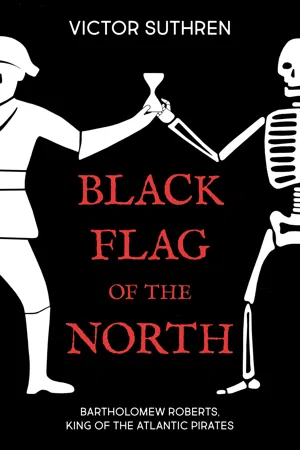
The incredible story of the "King of the Pirates, " who burst from the waters of early Canada to become a terror of the seas. He was tall, dark, and handsome, he wore fine velvets and lace, and in four tumultuous years he tore the guts out of the Atlantic. Bartholomew Roberts took over four hundred ships and rarely lost a fight at sea in his short, spectacular reign. Black Flag of the North tells the story of Roberts's dramatic life, from his boyhood in rural South Wales through his days at sea in the slave trade. He set the Atlantic aflame from the Grand Banks to Brazil, and by blood and fire won his reputation as the fearless and feared king of the pirates.
- 176 pages
- English
- ePUB (mobile friendly)
- Available on iOS & Android
eBook - ePub
About this book
Information
1
Drawn to the Sea
In Pembrokeshire, in the wet and windy southwest corner of Wales, there stood in the last decades of the seventeenth century a small, impoverished village of a few houses with the unexpectedly grand name of Castell Newydd Bach, or Little Newcastle. Home to Welsh-speaking cattle herders of the green hills not far from the growing village of Haverfordwest, and, six miles farther south, the port of Milford Haven on its estuary leading to the Irish Sea, it was the unremarkable birthplace of a baby boy on May 17, 1682.
That small, squalling bundle occasioned little more in its anxious parents than gratitude that both mother and child had survived the rigours of the birth and gloomy awareness that, by the dreadful standards of mortality of the late seventeenth century, the child stood a fifty percent chance of not living past the age of three, and even less of reaching adulthood. The parents need not have worried: their lusty-lunged little son, christened John Robert or Roberts, would not only survive, but grow to strapping six-foot manhood and on faraway seas become the most feared and successful — if the word is appropriate — open-ocean pirate of the age. And it would be in what later became Canadian waters that he seized the tools that would have him appear out of the north in this role as uncrowned but de facto king of the Atlantic pirates.
In a brief, incandescent career from 1718 to 1722, he would take more than 450 ships and bring West Indian and African trade virtually to a standstill before dying in a hail of Royal Navy gunfire.
Yet there was little in the boy’s background to suggest not an obscure life in the little houses and rain-soaked hills of Little Newcastle, but an eventual bloody career as a criminal terror of the seas. His father, identified as such in the Pembrokeshire Hearth Tax lists of 1670, was most probably known as George Robert — the change in spelling to Roberts, a common Welsh name, would come later.[1] His mother’s name is unknown.
The little village was fervently religious in the manner of the rural Welsh, possibly adhering to the Calvinist rigour of the small Baptist community that had established itself in South Wales in the 1640s. That faith had to struggle to survive in the face of various Acts of Parliament intended to enforce the superiority of the Church of England. The villagers clung doggedly to their abstemious faith, the one small chapel “of the very meanest fashion” a centrepiece of the tiny community. And while English was increasingly the dominant language along the more populous coast to the south, the spare, devout lives of the Little Newcastle people were spent in a grimly surviving Welsh culture.
That is not to say that the Robert family were struggling paupers: there was at least home ownership, which made them akin to the English yeomen class. As historian Richard Sanders has expressed it, it was a status of “middle class, but in the context of a backward, rural society that was poor even by the standards of late seventeenth-century Britain.”[2]
It was not an auspicious entry for the newest member of the Robert family, but the boy’s later career as an otherwise-ruthless high-seas pirate would always be marked by a puritanical personal restraint and religiosity that had its roots in the dim, fervent world of rural faith in which he was raised.
The nature of life for the poor Welsh was only marginally different from what it had been in the Middle Ages: subsistence farming and animal husbandry tied to the ebb and flow of the seasons, and now marked by a reticence and suspicion of the non-Welsh who increasingly were settling the Pembrokeshire coast. Historian R.J. Hammond observes:
There was one small part of the Principality whose history branches off in Norman times — that part of southern Pembrokeshire known as “Little England Beyond Wales.” This is where the followers of William the Conqueror had some success and they settled their tiny gains with Flemings, refugees from the flooding of the Low Countries. They were reinforced in the time of Henry the Second who brought Flemish soldiers to settle in Wales and interspersed them with Englishmen in order that they should learn to speak English.[3]
There is an image of the South Welsh that persists from that age: a short, stocky people of swarthy, almost Mediterranean appearance — the “Silures” of the Romans — keeping to their valleys and uplands in ever more heightened suspicion of the English after the great Civil War, when the Welsh had remained largely Royalist, sustained by their nonetheless Nonconformist faith and the unfathomable intricacies of their ancient language: a musical, poetic, darkly serious people with a deep historical sense of loss, an enduring resilience in the face of hardship and want, and their suspicions of the tan-haired strangers on the coast. It was a close, emotional tribal culture akin to that of Scots Highland clans or the wild countrymen of Ireland, and to a lad of modest means it was also characterized by an outdoor life of physical harshness that would go a long way to prepare him for the rigours of the sea. George Owen, a member of modest Welsh gentry at the time, is quoted by Richard Sanders:
I have by good account numbered 3,000 young people to be brought up continually in herding of cattle within this shire who are put to this idle education when they are first come to be ten or twelve years of age … They are forced to endure the heat of the sun in his greatest extremity, to parch and burn their faces, hands, legs, feet and breasts, in such sort as they seem more like tawny Moors than people of this land, and then the cold, frost, snow, hail, rain and wind. They are so tormented, having the skin of their legs, hands, face and feet all in chinks and chaps.[4]
The influence of religion in the shaping of young Roberts — for such we may begin to call him — is markedly similar to the preparation of another extraordinary seafarer who would emerge decades later, and go on to greater notice, albeit of a markedly different and admired kind: Pacific navigator James Cook. Cook spent much of his formative youth in the company of Yorkshire Quakers, and it was noted of him during his later remarkable voyages of discovery that he was never known to have succumbed to the allure of rum — unlike almost anyone who sailed with him — nor did he share in the sexual contact with Pacific island women when his crews did, virtually to a man. Roberts would be marked by the same restraint, even as he led crews of hardened men characterized by almost no restraint at all. For Roberts, as for Cook, there would be no drunken revels or sexual profligacy, and if both men came to this remarkable restraint due to the strong role religion played in their lives, it would give them incalculable strength through social distance in their leadership of their rough-hewn men. That one bound himself by a sense of duty to the legalities of society and the other set himself at war with those legalities does not mask that they approached the tricky business of leading men in harsh pursuits from the same place. One would die respected and honoured, destined for an admiral’s flag and a knighthood, had he lived; the other died reviled as a criminal, and destined to the shame of the gibbet, had he lived to be captured. But both men had the qualities of which leadership is made, in remarkably similar ways.
For the Welsh, the slow progress into a resolute Protestantism was aided by the 1588 translation of the Bible into Welsh, and the efforts of the Welsh Tudor Elizabeth I to ensure Catholicism would not dominate Britain. That struggle would not be resolved until the “Great Revolution” of 1688, but, during the 1640s and 1650s, and the struggles of the bitter Civil War, the Welsh were paradoxically dogged supporters of the Crown. By 1647, though, the parliamentary army had crushed dissent in both North and South Wales. The exception would be the town of Pembroke, near Milford Haven, which remained a lonely outpost of parliamentary support — and with likely an English rather than a Welsh mentality. Why the Welsh embraced Nonconformist religion, much like the men of Parliament, yet remained suspicious of their motives, and, like the Loyalists of the American Revolution, “would rather be governed by one tyrant three thousand miles away than three thousand tyrants one mile away,” may have its roots in the same Celtic survival mentality that characterized both the Irish and the Highland Scots. Whatever its effect, it gave young John Roberts a unique, almost tribal sense of differing identity in the British world, and seems to have anchored it with an abstemious religiosity in his personal ways even as he led amoral and bloodthirsty “lost” men in a fiery career of theft, destruction, and violence: a life of being, in a very real sense, an outsider at war with all the world.
How a cattle-herding boy of the Welsh hinterland could become the seaman and leader he did is subject to much speculation, as almost no records exist of the period between his birth in 1682 and his reappearance at sea in his midthirties as a capable open-ocean mariner. With Milford Haven within walking distance of his village and the increasing pace of shipping offering much to entice a likely lad beyond the mucking-out of byres, it may be that, again like James Cook, who fled his barnyard boyhood to follow the sea, Roberts — we can begin calling him Bartholomew, as he seems to have been known at sea — came to the coast to seek his fortune afloat.
Already a strapping six-footer, in contrast to the short stature so common in South Wales then, he would have stood out as a prime candidate for an apprenticeship as a seaman in one of the many coastal vessels sailing from Milford Haven. Roberts appears years later, in 1718, as a capable Second or Third Mate of a 140-ton slaver — one account claims him to be a carpenter, a valuable man on any wooden ship — and the question arises whether he had grown to manhood with his evident skills solely in the grim world of the slave ship.[5]
That seems unlikely. As historian Marcus Rediker points out,
Slave-trade seamen came from numerous social backgrounds, from orphanages and jails to respectable working-class and even middle-class families. But sailors as a whole were widely known as among the poorest occupational groups in Britain and America in the eighteenth century, so there were many more of the former group than the latter. Indeed [a writer] described slave-trade seamen as “the refuse and dregs of the Nation,” refugees of the “prisons and glass houses.” He added that most “have generally been bred to it young” … but some were also “boys impatient of their parents or masters” … and men “already ruin’d by some untimely vice” … The “white slaves” who served aboard [slave] ships were essentially the “very dregs of the community.”[6]
In sharp contrast, the Roberts of 1718 was somehow literate, having evidently mastered navigation (as his later career would show), and had a number of other skills, fighting and otherwise, which it is hard to imagine were won in long residence in the fetid mess decks of a Guineaman, as slavers were known. The life of a seaman of the day commonly involved a period of service — voluntary or not — in one of His Britannic Majesty’s warships, which, during the War of the Spanish Succession (1701–14) were hungry for men “trained for the sea,” and anyone wishing to be. The apparent truth of the matter is that by 1718, when Roberts appears for the first time in any kind of formal historical record, he was a competent and skilled open-ocean mariner of strength and a commanding presence who knew how to lead men and how to “fight” a ship: to use its guns and sailing tactics to defeat an enemy at sea. Such skills were learned in privateers, of course, but more readily in disciplined warships, and when, after 1713, Roberts may have conceivably been among the many paid-off navy crews looking for work afloat, he was a prime candidate: many others, less fortunate, would be left ashore to poverty and beggary. It can reasonably be argued that it was in navy service that he learned the critical skills, like many other pirates in the turbulent postwar world — including the fearsome and legendary “Blackbeard,” Edward Teach. Why Roberts would opt for the dark world of the slave ships instead of a merchant vessel is not clear: his circumstances at the time are not known. He may have been glad of any opportunity.
The Royal Navy that conceivably either swept up young Roberts in its “press” or received his volunteer service had gone through a varied period of strength and decline, from its heady days of success under Cromwell to the humiliation of the Dutch raids of the 1660s, and an uncertain degree of national support through the last years of the seventeenth century. By Queen Anne’s time and the beginning of the War of the Spanish Succession, the navy had benefitted from some reforms brought about by James II and a shipbuilding program initiated by King William in 1690. By the time war broke out in 1702, the Royal Navy was at least as strong as the French navy, and was concentrating on acting in concert with the now allied Dutch. It would produce some significant victories, notably the capture of Port Mahon on Minorca and the natural fortress of Gibraltar. Although many thousands of men served in the navy until peace in 1713, it was not a war of many massive fleet actions, but more one of manoeuvring, seamanship, gunnery, and smaller ship-to-ship encounters. The war ended with Britain in commercial and naval control of the Atlantic and the Mediterranean, but with the war’s end many warships were “paid off” and their highly trained crews — Roberts arguably among them — were released into the uncertain peacetime world in their thousands, competing for berths in merchant shipping, the fishing fleets, or, as a last resort, the slave ships. To their numbers would have been added the men who crewed in privateer vessels; civilian warships under licence from the Crown to prey on enemy shipping for profit. The major sea powers’ preoccupation with the war had left few resources for suppressing the endemic piracy that bedevilled western European sea commerce. Ironically, the peacetime freedom to turn naval attention to the scourge of piracy came just as thousands of capable recruits for that criminal life, who could find no legitimate employment at sea, were released into the lawless open-ocean environment — where piracy was arguably their final option.
If Roberts was indeed shaped into a fighting leader by service in the navy, the nature of that institution at the time is worth examining. The navy of Queen Anne would become, through the War of the Spanish Succession, Britain’s principal instrument of policy and “national extension” into the coldly competitive international world. In the time of Elizabeth I, the ships maintained by the Crown had formed only a fraction of those available, or necessary, for the defence of the British Isles, or the extension of the Crown’s policies against England’s principal adversaries. The English fleet that harried the Spanish Armada through its disastrous 1588 attempt at invasion was primarily a private one, over which the Crown had imprecise and unpredictable control. Through the seventeenth century, through Cromwell’s Commonwealth, and then under the Stuarts, the transition was made from a small core of Royal vessels around which a temporary fleet could assemble to a permanently established Royal Navy funded by Parliament that acted in accordance with the wishes and intent of the Crown and government. Other European nations established national navies, some before Britain, but geographic necessity ensured that Britain’s navy was, in the main, the most successful. That success was by no means certain in the seventeenth century, and would build only toward the end of the eighteenth.
In 1702, when Roberts would have been entering his twenties, Britain maintained a fleet of several hundred proper warships, or “men of war.” These were supported by a wide range of auxiliary vessels and an established dockyard system that was intended to maintain both operational vessels and those that were laid up in reserve, or “in ordinary.” These warships were very roughly divided between those ships considered large enough to take a meaningful role in a major battle formation — to “lie in the line” and thus be a “ship of the line” — and those considered too small to do so. In the era of Queen Anne, the principal armament of British warships were batteries of cast iron, or occasionally bronze, smoothbore muzzle-loading guns carried on one or more decks of the ship and set in rows to fire out through “gun ports” along the ship’s side. These were fired by black powder charges loaded into the guns along with the cast-iron round “shot” they propelled, by a team of up to a dozen seamen commanded by a gun captain. The shot was of graduating sizes measured in pounds of their weight, and the gun was known by the weight of the ball it fired: a “24-pounder” was a gun that fired a ball weighing twenty-four pounds, and so on.
A variety of projectiles were used, including balls linked by chain to cut through rigging; bags of smaller balls called “grape” to fire at human targets; and bar shot, halves of round shot linked by a bar and meant to cartwheel through the air and strike crew and ship alike.
In a “broadside” — the firing together of all the guns on one side of a warship — the larger vessels could hurl up to a half-ton of metal to an extreme distance of three miles, with a rate of fire often as fast as two rounds in three minutes. The principal aim of ship combat, which pirates sought to avoid at all costs, as they wished to remain healthy in a functioning ship, was to batter the enemy into submission by inflicting either casualties to the crew or damage to the ship (or, rarely, by sinking it). The line-of-battle formation was the standard means of presenting all vessels’ broadsides for maximum effect against a similar enemy formation. Smaller vessels, usually those with fewer than sixty guns, were often sent on lone patrols as scouts for the larger formation, and the handiest and most active of these were the nimbler vessels known as “frigates,” which might carry as few as twenty guns. The family of warships was organized into six “rates,” with the giant, hundred-gun battleships being “first-rate” warships and the lowly eighteen-gun sloop being a “sixth-rate.”
By the time Roberts went to sea, the ships were remarkable summations of almost three hundred years of European ocean-going experience, if the Viking period is discounted. Acres of oak forest were felled to provide the timber for the hulls. Miles of rope-work and cordage, acres of canvas, and a complex pantheon of craftsmen’s skills went into producing each ship, whether a merchantman or a warship. The most fleet and beautiful designs were traditionally French and Spanish, while the sturdiest of construction, if dull in performance, were English or Dutch. Vessels like the coastal traders, which conceivably were Roberts’s first experience at sea, could be sailed by five or six able men, controlling sails and rigging with a complex series of pulleys and tackles, while a vast battleship could be crammed with seven hundred men to ensure she could be sailed and “fought” at the same time. The vessels were taken to sea and operated there by “sea officers,” which is to say professional seamen, by the end of the seventeenth century and the reign of Queen Anne. They were controlled by the Admiralty and supplied by a separate and often maddeningly independent Navy Board.
The organizational leadership, sense of discipline, and orderly conduct that Roberts would display in his piratical career, even leading men to whom such things were anathema, and which lay at the heart of his successful career, are telling signs, in the view of this writer, of his exposure at some point in his life to the ordered world of a seagoing warship’s society. The key elements of that society were the body of competent sea officers below the captain, who aspired to their own commands one day, and the prime seamen, from Able Seaman to Sailing Master, who did the physical work that made the ship operate. The former were meant to command and navigate; the latter to obey, and to sail the vessel under direction. The distinction between officer and man was, by 1700, becoming great, socially: the former entered the navy, and left it, voluntarily; the latter, if he did not volunteer, could be pressed into service and he was released only if the navy saw fit to do so. Press gangs scoured shore ports for victims to feed into the navy’s endlessly man-hungry system in wartime, and once in the navy the newcomer entered a brutal and regulated world that offered little sympathy for the disinclined. It was a cruel and callous age to later eyes, with capital punishment in society ashore a common penalty for the most trifling of crimes. In the Royal Navy, discipline and deference to authority were enforced with the lash. Admiral Edward Vernon, writing a generation later, would say that the navy was manned by violence and maintained by cruelty. Yet, as an institution, it was able to inspire the mostly young men who formed it to fight with fierce spirit, or endure astonishing hardships. It was a hard, utterly unforgiving society, mirroring perhaps both the fatalism of the age and the indifferent menace of the sea. In addition to the risk of death by drowning or enemy action, the seaman faced the greatest killer, disease, accompanied by ignorance, crowded mess decks, monotonous food, and an appalling lack of sanitation in modern term...
Table of contents
- halftitle
- title
- copyright
- dedication
- contents
- 1
- 2
- 3
- 4
- 5
- 6
- 7
- 8
- 9
- 10
- notes
- selectedbibliography
- credits
- endmatter
Trusted by 375,005 students
Access to over 1.5 million titles for a fair monthly price.
Study more efficiently using our study tools.
Frequently asked questions
Yes, you can cancel anytime from the Subscription tab in your account settings on the Perlego website. Your subscription will stay active until the end of your current billing period. Learn how to cancel your subscription
No, books cannot be downloaded as external files, such as PDFs, for use outside of Perlego. However, you can download books within the Perlego app for offline reading on mobile or tablet. Learn how to download books offline
Perlego offers two plans: Essential and Complete
- Essential is ideal for learners and professionals who enjoy exploring a wide range of subjects. Access the Essential Library with 800,000+ trusted titles and best-sellers across business, personal growth, and the humanities. Includes unlimited reading time and Standard Read Aloud voice.
- Complete: Perfect for advanced learners and researchers needing full, unrestricted access. Unlock 1.5M+ books across hundreds of subjects, including academic and specialized titles. The Complete Plan also includes advanced features like Premium Read Aloud and Research Assistant.
We are an online textbook subscription service, where you can get access to an entire online library for less than the price of a single book per month. With over 1.5 million books across 990+ topics, we’ve got you covered! Learn about our mission
Look out for the read-aloud symbol on your next book to see if you can listen to it. The read-aloud tool reads text aloud for you, highlighting the text as it is being read. You can pause it, speed it up and slow it down. Learn more about Read Aloud
Yes! You can use the Perlego app on both iOS and Android devices to read anytime, anywhere — even offline. Perfect for commutes or when you’re on the go.
Please note we cannot support devices running on iOS 13 and Android 7 or earlier. Learn more about using the app
Please note we cannot support devices running on iOS 13 and Android 7 or earlier. Learn more about using the app
Yes, you can access Black Flag of the North by Victor Suthren in PDF and/or ePUB format, as well as other popular books in History & Military & Maritime History. We have over 1.5 million books available in our catalogue for you to explore.