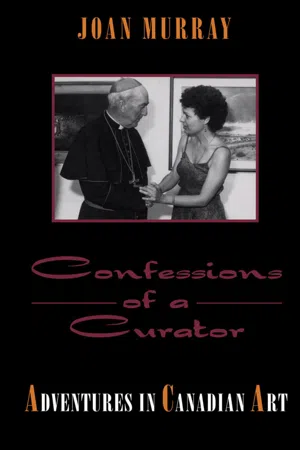
In this witty and compelling defence of the art field itself, Joan Murray, one of the country's most outspoken art historians, discusses the great figures of Canadian art and the rise of our national are in institutions such as the Art Gallery of Ontario.
Trusted by 375,005 students
Access to over 1.5 million titles for a fair monthly price.
The American critic Leslie Fiedler, in What Was Literature?, his 1982 book on American culture, asked himself who he was. We thought we knew the answer. He was the supreme Freudian analyst of the American novel, a critic who broadened the range of literary studies to include Americas half-hidden myths and legends. He was the man who gave us Huckleberry Finn as a homoerotic dream, and gave us arresting insights into books of apparently transient historical interest like Uncle Tom’s Cabin.
I thought I knew Fiedler. I remember him because he sat on the Woodrow Wilson Fellowship jury in Toronto in 1965, the year I received a fellowship. A curious incident cast a strange light on our meeting. Just before my interview, I was glancing through a magazine in the waiting room, and I discovered between its pages a long analysis, by Fiedler, of one of the other candidates. The words jumped out at me: “I recommend this individual not receive the fellowship as he is sure to receive others.” As I went into the room I handed the form to Fiedler, and put what was written on it out of my mind. When I heard that I had been awarded the fellowship, I wondered whether I had been given it because the jury thought I might not receive any other. For this small but permanent self-doubt, I did not blame Fiedler. To me, he was always one of the leaders in the critical world.
With What Was Literature? Fiedler introduced us to quite another man, someone whose lifelong task had been to abolish the distinction between high and popular literature but who believed he had become a critic only by default. He had wanted to be a writer, he said, but had not made the grade. He had regrets. As a critic, he felt he wrote too much, too variously, and for too many sponsors. He answered the question about who he was in a wry manner, more like a genial philosopher than a scholar. He wrote as though in conversation — in a tone reminiscent, to me, of the man who had interviewed me for the fellowship.
The question Fiedler asked himself is of course the essential one, which must be asked in any stocktaking. I ask it now of myself. Who was Joan Murray? After more than twenty-five years in the gallery world curating shows of Canadian art, I ask myself, pretending I’m Fiedler, whether my profession perpetuates an unfortunate distinction, not between high culture and popular culture, but between Canadian and American art. That one is high and the other “low” is an idea based — perhaps — on the American art world’s assumption that Canadian art is provincial. Americans (and many Canadians) believe that to be a real artist a Canadian must get a toehold in New York.
It is an odd notion, that a country’s artists must achieve a reputation elsewhere, but the idea underlies the decisions of many curators in the larger institutions, and perhaps even decisions of the juries of the Canada Council and other granting agencies. The idea is never explicitly stated, but we in the field have learned to wonder about the artists who are preferred.
That artists are interesting because they are Canadian is an important idea for a scholar of Canadian art. I like to find proof of the individual’s development in his home town - say, for instance, Paul Sloggett’s development in Oshawa, where he went to the Robert McLaughlin Gallery in 1971, saw an exhibition of loans from local collections, fell in love with a print by Richard Diebenkorn, and never looked back. He trained at the Ontario College of Art, formed friendships with a peer group that included many of the Young Turks, and is today an abstract painter, firmly rooted in the visual culture of his country and his region. His origin, his influences, and his work are all Canadian.
Joan Murray, unlike Sloggett, had a terrible secret. It was true that she grew up in Toronto and cut her teeth at the University of Toronto. She became an art historian because she liked the courses, and indeed, art history was one of the few areas in which she showed real talent, along with English language and literature. In her heart, like Fiedler, she had always wanted to write, though each year, as she determined to change her course, her English teachers persuaded her that fine art was an excellent preparation for a literary career. But what was Joan Murray’s secret? That she was born American. She was a convert rather than someone born into the faith.
I’ve often been introduced as “our Joan Murray” when speaking in Canada on Canadian art, but I was born not at Toronto General, but at Presbyterian Hospital in New York City, the second child of Lucia de Castro Charlat, a former nurse, and Sidney Arnold Charlat, a dentist. When I was born they had just moved to an apartment on the West Side, the second in which they had lived: it had high ceilings, six elegant rooms, and a stunning view of the Hudson River.
I grew up in an unusual, culture-driven family, of a kind that was not as familiar to Americans as it is now. In 1939, a year after they married, my parents were introduced to antiques by a charming friend, the interior decorator Marcelle Hirsch (later, she became Marcelle Morgenthau, wife of Henry Morgenthau Jr., secretary of the treasury under Roosevelt). Marcelle and her first husband Stephen (a manufacturer of Lurex textiles) took them on a tour of the dealers. That day, they were reborn as collectors. Marcelle helped shape their taste as collectors as did George Basso de Breux, a dealer who loved fine Italian furniture. French & Company, when they discovered it later, also helped to form them. As a child, I played under French and Co.’s tables while my parents studied the stock, or went with them as they toured exhibits at the Metropolitan Museum of Art. They learned about works of art pragmatically, by buying them. They were deeply in love with the field of decorative arts, but they had sceptical minds, and they were choosy.
From left to right: Dr. Sidney Charlat, Carol Charlat, and Lucia Charlat, New York, 1942. Behind them on the wall is the eighteenth-century Venetian mirror that was my parents’ first purchase from French & Co.
A museum was like a church, they believed. They were worshippers of art. Dad would vary the idea by saying that a museum visit was like “intimacy,” and mother would chime in that it was as good as seeing a beautiful woman — for they loved beauty everywhere, even in the live specimen. They themselves were beautiful: Dad looked like movie director Vittorio de Sica; Mother had a perfect complexion, tiny figure, and vivacious ways from her French background. Their effect of glamour was part reality — good bones and good health; and part art - grooming, and dress. “She looks beautiful,” was Dad’s constant refrain about Mother. Not “she is beautiful.”
He himself always had enormous style, presence, and wit. One day in an art gallery the attendant at the desk by the door, struck by his dignified bearing, tweed jacket, grey pants, bow tie and matching silk pocket handkerchief, said, “Pardon me, sir, but haven’t I seen your face somewhere before - you were on television today, weren’t you?”
“Not today, dear,” my father assured her.
Art was, like their personal beauty, their magic carpet; it transported them from monotonous routine to a fascinating world where they played at being king and queen. On the other hand, they owned the object, and through proper care, conservation, and research, “sharpened it up.”
To collect for them was like going on holiday or to a party. They never knew what they were going to find as they made their weekly visit to the twenty-six dealers and auction houses they frequented, but they loved the objects and the gossip, and they always had fun. Yet their own description of what it meant to them to collect is evidence that what they did was mysterious even to them: they collected dreams, discovering desires impossible to fulfil in any other way.
At home, because the focus was on art, we spoke a specialized telegraphic language of centuries, descriptions, techniques, prices. On our weekly visits to the Metropolitan, my parents introduced us (my sisters Carol and Adele, and my brother Richard) to the infrastructure and apparatus of the museum. They were as interested in the labels, especially the donors of funds used for purchase, as in the work of art. As a result, their account, so lively and entertaining but filled with information, piqued our imagination, fashioning in our minds the places where such great objects had once found their home, and even suggesting to us the attitudes we could strike were we one day to act as guides. Choosing words carefully, as though giving a lecture, father would explain why the work was of interest — or why it was not. Then, turning to mother, he would ask, as though seeking affirmation, a question I still ask myself, “What do you think?”
Mother, more volatile, was given to emphatic declarations. “I want it,” she would say. Their favourite work at the Met was the handsome Western Asian Head of a Ruler from the late third millennium B.C., always on view in the Early Near Eastern hall. Its rich green colour came from many centuries of oxidizing copper. They loved the Islamic section. In 1975 Dad was named to the acquisition committee; and they studied every piece and understood each change a curator made to the display. Yet they were catholic in their taste; they liked many different periods and different styles, and as a result they collected with unusual breadth of taste. The only period they did not like was contemporary art; not much that was new pleased them.
Since they were observant, they helped develop our powers of observation. We developed an ability to judiciously infer from what was observed, then thoroughly analyse the result. They were discerning collectors, tastefully choosing and selecting. Even their children had been carefully chosen, we felt. They trained me. After I read Kim, I thought of him as a child who, like me, had to be taught to see. Father showed me how to recognize when an object was old and distinguish it from fake (Basso once had sold them a “wrong” table). Besides their collection, my parents’ lives were filled with the visits of curators, dealers, collectors, and even directors of great institutions: James Rorimer, head of the Metropolitan Museum from 1954 to 1966, was a close friend and visited often. He was less a showman than a curator (yet it was he who purchased Rembrandt’s masterful Aristotle with a Bust of Homer, painted in 1653, and so started the museum on its path as an attendance draw). I remember him looking, studying, talking about the medieval art in house. His favourite work of art, he told my father once, was a medieval carved wooden figure of an Apostle Saint of the Spanish school in the Cloisters Museum where he had once been a curator. Mitchell Samuels, the head of French & Co., was another constant visitor, who over dinner talked about art and auctions of the day. Gossip about museum and commercial gallery staff and their conflicts, prices, purchases - it never ended.
Courtesy of the author.
Top of the book case in the Charlat dining room, New York, 1982. Because of the number of objects, my parents’ home recalled the open storage of some museums.
Courtesy of Carol Nace, Dallas, Texas.
Interior view, the Charlat Home, 1995.
Courtesy of Carol Nace, Dallas, Texas.
Interior view, the Charlat Home, 1995. The photograph at the right-hand side of the chest is of me in 1959.
“After all these years, one thing I have learned is what makes a museum object,” father would say as he slowly paced the apartment analysing his collection. Hopeful curators told him which ones their museums wanted, and he carefully recorded this and other kinds of information in the catalogue he and mother made. He applied his acute knowledge of the auction market, supplying detailed prices, currencies, percents charged by auctions, sales, “call-ins.” Mother was intelligent and swift; she observed better. Together, accomplices in adventure, they made a formidable team. She checked one side of an antique dealer’s gallery as he checked the other. They never stopped working at collecting; it was their way of living, an all-consuming obsession.
Through the years, father sold only a few objects. The collection was his life work, he felt. However, when he decided to sell an object he was delighted if it sold quickly at auction. Interest, bidding, these were signs that he had done the right thing in focusing so totally on ownership.
“The prices went to the sky,” he liked to say when recounting recent auctions. Then he would add twenty-five percent to the cost of the work (15 percent for the house, 8
percent sales tax), and give a quick computation.
“What good is paper money, anyway?” he would finish by saying.
He liked to ask, as though looking for approval, “Have I ever mentioned money?” (Actually, he did, often.) What he meant was that he was without social pretension and this was perfectly true. He did not speak of lineage or family, only of the value of art. His office was one block from the gates of Columbia University, at Riverside Drive and 116th Street, so he met and befriended academics, people like the philosopher Jacques Barzun, metal expert Deson Sze, the Library of Congress head, Luther Evans. Yet his love for art was emotional, not intellectual. He had to fall in love with something before he bought it, he said, and he felt that it was love alone that drove him, love of beauty.
“I fell for it,” he said when he bought an antique.
The objects that so charmed them were often small, and our home had a claustrophobic feel from so many tiny things crowded into the space. The scene was what I imagined Hadji Baba’s cave to be: stuffed with treasure. Tables were covered with groupings of silver snuff boxes, spoons and miniatures, window sills with chests, the beds with layers of carpets, shelves with dishes, vases, African containers, old dolls. Walls were covered by Oriental screens, Islamic and Indian miniatures, Islamic tiles and dishes, Victorian needlepoint, paintings and etchings (these they bought for the frames rather than for the artist, as they mistrusted paintings - too much conservation, they felt), antique mirrors. My parents also hung pastels and paintings by my older sister Carol, who had attended the Art Students’ League in New York and become a professional artist, and by my younger brother Richard and little sister Adele, who had gone to the same school but remained talented amateurs.
We were never treated much like children, or as children are supposed to be treated. We were treated like connoisseurs-to-be or the cheering section of the galleries. An article by Jared Diamond in The New York Review of Books about biologist Edward O. Wilson discusses the physiological and sensory apparatus that influences what we are capable of doing well and what fits our self-image. Wilson had a fishing acciden...
Table of contents
Cover
Title
Copyright
Dedication
Contents
Preface: Provenance and Exhibition History
Acknowledgements
1 Who was Joan Murray?
2 Canadian Art History is Born
3 O Canada!
4 Canadian Art History as an Institution
5 McMichael and Me
6 The Task of the Curator
7 Rites of Passage
8 The Many Trees of Thomson’s West Wind
9 Abstraction: Visit to a Small Planet
10 Harold Town
11 The Journey of Alexandra Luke
12 Empowerment and the Canadian Woman Artist
13 The Prairie Gang
14 Canadian Working-Class Art
15 Criticism Reconsidered
16 What Is to Be Done?
Index
List of Illustrated Works of Art
List of Figures
Frequently asked questions
Yes, you can cancel anytime from the Subscription tab in your account settings on the Perlego website. Your subscription will stay active until the end of your current billing period. Learn how to cancel your subscription
No, books cannot be downloaded as external files, such as PDFs, for use outside of Perlego. However, you can download books within the Perlego app for offline reading on mobile or tablet. Learn how to download books offline
Perlego offers two plans: Essential and Complete
Essential is ideal for learners and professionals who enjoy exploring a wide range of subjects. Access the Essential Library with 800,000+ trusted titles and best-sellers across business, personal growth, and the humanities. Includes unlimited reading time and Standard Read Aloud voice.
Complete: Perfect for advanced learners and researchers needing full, unrestricted access. Unlock 1.5M+ books across hundreds of subjects, including academic and specialized titles. The Complete Plan also includes advanced features like Premium Read Aloud and Research Assistant.
Both plans are available with monthly, semester, or annual billing cycles.
We are an online textbook subscription service, where you can get access to an entire online library for less than the price of a single book per month. With over 1.5 million books across 990+ topics, we’ve got you covered! Learn about our mission
Look out for the read-aloud symbol on your next book to see if you can listen to it. The read-aloud tool reads text aloud for you, highlighting the text as it is being read. You can pause it, speed it up and slow it down. Learn more about Read Aloud
Yes! You can use the Perlego app on both iOS and Android devices to read anytime, anywhere — even offline. Perfect for commutes or when you’re on the go. Please note we cannot support devices running on iOS 13 and Android 7 or earlier. Learn more about using the app
Yes, you can access Confessions of a Curator by Joan Murray in PDF and/or ePUB format, as well as other popular books in Art & Art général. We have over 1.5 million books available in our catalogue for you to explore.