Wilfrid Laurier's life journey took him from a small Quebec village to the Parliament of Canada. He possessed a rare combination of the common touch and political savvy, which he effectively used to remain prime minister of Canada for fifteen years (1896-1911).
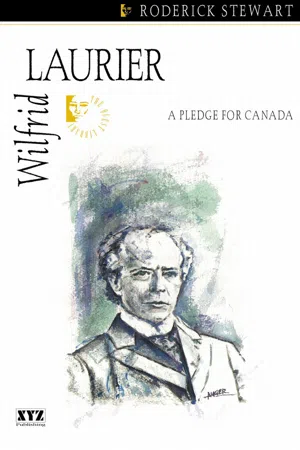
- 192 pages
- English
- ePUB (mobile friendly)
- Available on iOS & Android
eBook - ePub
Wilfrid Laurier
About this book
Information
1
Canadien Roots

Wilfrid Laurier was a seventh-generation Canadien. Like his ancestors, he grew up speaking the French language and believing in the Roman Catholic religion.
Laurier’s Canadien roots reached back almost two centuries to the early years of the colony of New France. One of his ancestors, Augustin Hébert, was among the tiny group of adventurous French people led by Paul de Chomedey de Maisonneuve, who founded Montreal in 1642. A native of Laon in northern France, Hébert eventually lost his life in a skirmish with Iroquois warriors in 1662.
Three years later, Francois Cotineau-Champlaurier arrived in Montreal, from Saint-Claud in southern France. He was a soldier in the famous Carignan-Salières regiment, which had come to New France to protect the inhabitants during the continuing struggle with the Iroquois.
Before Cotineau-Champlaurier completed his military service, he married Madelaine Milot, the granddaughter of Augustin Hébert. Their sons and the succeeding generations of Cotineau-Lauriers, as they called themselves, prospered. They eventually moved from the island of Montreal to the mainland in their search for even more productive soil. On the banks of the Achigan River northwest of Montreal, at the edge of the rolling Laurentian hills, they found what they were looking for.
In 1815, Wilfrid’s father, Carolus, was born. Because his own father had decided to drop the name Cotineau, he was baptized simply Laurier. Shortly after his marriage to Marcelle Martineau, he and his bride built a house in the village of Saint-Lin. Though Carolus continued to work the land inherited from his father, he spent much of his time practising his profession as a land surveyor.
On November 20, 1841, Marcelle gave birth to a son, Henry-Charles-Wilfrid. Marcelle, who was a dedicated reader, probably named her son after one of her literary heroes, Wilfrid, in Sir Walter Scott’s novel, Ivanhoe. She loved music and art as well as books, and she always encouraged young Wilfrid to read. She was delighted too, to find out that he had a fine singing voice. Unfortunately she also probably passed on to him the physical weakness that plagued him throughout his life: unhealthy lungs. But this she would never know because seven years after Wilfrid’s birth she herself died from tuberculosis at the age of thirty-three.
All his life, Wilfrid would cherish his few warm memories of Marcelle: how they would walk hand-in-hand along forest paths to find a spot where she could sit and paint; the way she gently stroked his hair while reading to him at bedtime, then kissed him on the forehead and blew out the lamp.
After Marcelle’s death, Carolus found it difficult to care for a young son and a sickly daughter, Malvina, who, like her mother, had weak lungs. He soon proposed to Adeline Ethier, and she accepted. For several years, Adeline had helped Marcelle with the housework, and during her final months had been her nurse. Both Wilfrid and Malvina liked Adeline, and she fitted easily into their lives. She was a kind, affectionate person, who treated Wilfrid and Malvina with the same love she showed the children she later bore Carolus. Wilfrid returned her love and always remained devoted to his stepmother.
His father, though, had more influence in shaping his life. Wilfrid loved and respected Carolus. A handsome man with a relaxed and friendly manner, his father was well liked and trusted in his community. For several years he was mayor of Saint-Lin. Carolus was intelligent and wide-ranging in his interests, and he could express himself clearly and forcefully on many subjects. And while he remained a faithful Catholic and attended Mass regularly, he was always quick to oppose any attempt by the Church to step into the world of politics. Often, with young Wilfrid in tow, he would meet the local priest on the main street of St-Lin and stop to talk.
“Good day, Monsieur Carolus,” the priest greeted him one morning. “And what plans, if I may ask, does the mayor have today to improve Heaven and earth?” he quipped.
Smiling broadly, Carolus tipped his hat. “Ah Father,” he replied, “you give me far too much credit. I can barely handle my own part. I’m afraid I’ll have to leave Heaven to you.”
With a respectful nod of his head, Carolus moved on. As he did, he winked at Wilfrid and squeezed his hand. Wilfrid returned the squeeze, and marched proudly along at his father’s side, his shoulders back as far as they would go.
Carolus had a gift for arguing without anger or spite in his voice and manner, a characteristic Wilfrid adopted. Later in life this gift would often allow Wilfrid to keep friends even when he and they disagreed about a subject.
Another of Laurier’s personal traits may also have come from his father as a result of Carolus’s experience as a surveyor. Watching him settle disputes over boundaries, Wilfrid came to believe that most arguments have at least two sides and that compromise is often necessary. The idea stuck with him.
Even more important was Carolus’s faith in education. He was convinced that if Wilfrid were to succeed in life he would have to learn far more than the basic skills that most people of the time thought were necessary. There was no boys’ school in Saint-Lin, so Wilfrid’s parents taught him until he was ten years old. At that point, Carolus decided it was time for his son to begin his formal education, but not in French, his native tongue, nor even in his native village. In Canada at that time, all the important businesses were in the hands of les anglais. For that reason, Carolus decided that Wilfrid must become bilingual.
The village of New Glasgow lay twelve kilometres to the west of Saint-Lin, an hour’s ride by calèche along the road that followed the Achigan. Apart from a few French-speaking Canadien families, most of its eight hundred inhabitants were English-speaking descendants of Irish and Scottish immigrants. Parents who wanted their children to get an education sent them to the Fort Rose School. Perched high on a hill looking down on the Achigan River, the school was open to both boys and girls, and Catholics as well as Protestants. The single teacher, who taught all the grades and all the subjects, was Sandy Maclean, a Protestant Scot.
Carolus was able to arrange for Wilfrid to board in the village with an Irish Catholic family, the Kirkes, and to spend a few hours a week working in the tailor shop of John Murray, another Scot. It must have been a shock for a ten-year-old boy to be separated from his family. Young Wilfrid would only return home for a few brief visits and at Christmas and Easter. Yet somehow he managed to bottle up his misery and loneliness. School, after all, was his father’s wish, so Wilfrid tried to appear cheerful and to accept his new surroundings. In the end, his two years in New Glasgow were happy ones.
Wilfrid learned English unusually quickly with the help of Sandy Maclean and John Murray. His teacher taught him grammar and introduced him to some of the classic works of the English language. This was the start of a lifelong fascination with English literature. The tailor introduced him to the Bible in English, the King James or Protestant version. Wilfrid was curious and had an open mind. Above all, he had a passion to learn English. Although he was a Catholic, he chose to attend Protestant religious classes in school, and listened eagerly when John Murray read the Bible aloud. Wilfrid came to love the beauty of its language, and continued to read it from time to time for the rest of his life.
In September 1854, at age thirteen, Wilfrid was ready to enter the Collège de L’Assomption, a Roman Catholic boys’ school, which prepared students for the priesthood and the professions. Located in the village of L’Assomption, thirty-three kilometres to the east of Saint-Lin, it was dramatically different from Fort Rose School. Life at the Collège meant discipline and rules, study and prayer. Every morning during the school term, for seven years, Wilfrid had to climb out of bed in his boarding house, dress, and run down the street to the Collège to be in his seat in the chapel by 5:45. After prayers, he and his classmates went to the study room for an hour before returning to the chapel for mass at 7:00. At the end of mass, he raced to the boarding house for a quick breakfast. Then from 8:00 until 11:45, with only a fifteen-minute break, he attended class. After lunch, he returned at 1:00 for five hours of lessons and study, broken only by a twenty-five-minute recreation period. At 6:00 there was a half-hour of religious reading, then dinner at 6:30 at the boarding house. Back in the chapel at 8:00 for prayers, he made his final return to the boarding house and bed by 9:00.
It was a demanding schedule. In addition, school regulations on attendance were rigid. Without exception, including holidays, every boy had to remain at the Collège from September to July. But Wilfrid was already used to living away from his family, and besides, he was able to see them during their brief visits at Christmas and Easter. As before, he hid any regrets or loneliness he felt and tried to fit in. Gradually his self-reliance increased as he learned to make some decisions without parental advice. He was growing up quickly.
And school wasn’t all work. Thursday was usually a holiday, and Wilfrid’s schoolmates often played games or went on hikes. Sometimes Wilfrid joined them. More often, though, talking about everything and nothing, he and his friends preferred to ramble along the edge of a stream that meandered through the forest.
Wilfrid liked games, but even before his arrival at L’Assomption, he had learned he could not take part in any activity that involved running and jumping. After a short time, he always ended up out of breath, and coughing. If he didn’t stop, he would find himself bent over in a powerful spasm of coughing that often lasted for several minutes. At L’Assomption, when Wilfrid was seventeen, his condition reached a new stage.
He had been fighting a cold, but he could not bear to miss the Thursday outing with his friends. It was a frigid winter’s day, and he and a classmate, Oscar Archambault, were walking along the bank of their favourite stream. Suddenly, he felt a violently sharp pain in his chest. Then began a series of wracking coughs that made his whole body tremble and his head shake back and forth. Instinctively, he pressed his gloved hands to his mouth. But he was unable to stop the repeating surges of pain that came with each cough. On the verge of panic, and eager to be alone, he left his companion, who had stood helplessly watching in horror, and ran the short distance into the woods.
He was too weak to go far. Out of breath and weakened by the convulsions, he collapsed in the snow. Gradually the coughing eased off, and as he rose to his knees, he felt something warm and sticky in his mouth. He looked at his gloves and saw that they were covered with blood. Shocked by the sight, he began to spit out the blood. Then he hurriedly dug his hands into the snow and washed his face, his blood-spattered gloves, and jacket.
By this time, Oscar had recovered from his shock and come running to Wilfrid’s side. Together the two made their way out of the woods and back to the boarding house, where Wilfrid was put to bed.
He recovered after several days of bed rest. In the future, whenever he felt the symptoms of a cold, he had to take to his bed. But the bleeding returned again and again for many years. These attacks left him not only weak, but frightened and depressed. It was a nightmare he had to live with.
Fortunately, none of the boys thought the less of him for not joining in rough and tumble sports. Wilfrid was well liked at L’Assomption.
Languages formed the core of the subjects taught at the Collège: French, Latin, English, and some Greek. There were courses in history, mathematics, and philosophy too. Wilfrid did well at everything, but above all, he loved words. He loved them whether they were French, English, or Latin. In later years, he would take books of Latin poetry with him on holidays, and at home on Sundays, he would spend hours reading many from the thousands of books of French and English literature that filled the shelves of his constantly growing library. At critical moments of his life, no matter how busy he was or how much pressure he was under, he was able to shut out the outside world and escape by reading a book.
At L’Assomption he turned his love of words into a new skill – debating. He discovered that he revelled in preparing an argument for a debate. He learned to trust his amazing memory, too. Then, and for the rest of his career, he spoke only from notes. The drama of debating appealed to him just as much as the words. To rise to your feet with all eyes on you, to argue your point, to carry your listeners along with you… This was heady stuff for young Wilfid, a way to show that despite his disability, he was strong and capable. Everyone listened in silence when he spoke. In part, it was his voice, a pleasing, silvery-toned, yet strong voice that carried his words to every corner of a room. He was sincere and held himself well, and he had taught himself to avoid distracting gestures. But above all, he convinced listeners by the way ...
Table of contents
- Cover Page
- Title Page
- Copyright Page
- Contents
- Prologue: The Pledge
- 1. Canadien Roots
- 2. The Secret of the Future
- 3. Time to Take a Chance
- 4. New Horizons
- 5. The Way Forward
- 6. One Nation
- 7. The Sunny Way
- 8. Storm Warnings
- 9. Downhill
- 10. First Chill of Defeat
- 11. Under Fire
- 12. Defeat With Honour
- Epilogue: Canada First
- Chronology of Wilfrid Laurier (1841-1919)
- Index
Trusted by 375,005 students
Access to over 1.5 million titles for a fair monthly price.
Study more efficiently using our study tools.
Frequently asked questions
Yes, you can cancel anytime from the Subscription tab in your account settings on the Perlego website. Your subscription will stay active until the end of your current billing period. Learn how to cancel your subscription
No, books cannot be downloaded as external files, such as PDFs, for use outside of Perlego. However, you can download books within the Perlego app for offline reading on mobile or tablet. Learn how to download books offline
Perlego offers two plans: Essential and Complete
- Essential is ideal for learners and professionals who enjoy exploring a wide range of subjects. Access the Essential Library with 800,000+ trusted titles and best-sellers across business, personal growth, and the humanities. Includes unlimited reading time and Standard Read Aloud voice.
- Complete: Perfect for advanced learners and researchers needing full, unrestricted access. Unlock 1.5M+ books across hundreds of subjects, including academic and specialized titles. The Complete Plan also includes advanced features like Premium Read Aloud and Research Assistant.
We are an online textbook subscription service, where you can get access to an entire online library for less than the price of a single book per month. With over 1.5 million books across 990+ topics, we’ve got you covered! Learn about our mission
Look out for the read-aloud symbol on your next book to see if you can listen to it. The read-aloud tool reads text aloud for you, highlighting the text as it is being read. You can pause it, speed it up and slow it down. Learn more about Read Aloud
Yes! You can use the Perlego app on both iOS and Android devices to read anytime, anywhere — even offline. Perfect for commutes or when you’re on the go.
Please note we cannot support devices running on iOS 13 and Android 7 or earlier. Learn more about using the app
Please note we cannot support devices running on iOS 13 and Android 7 or earlier. Learn more about using the app
Yes, you can access Wilfrid Laurier by Roderick Stewart in PDF and/or ePUB format, as well as other popular books in History & Historical Biographies. We have over 1.5 million books available in our catalogue for you to explore.