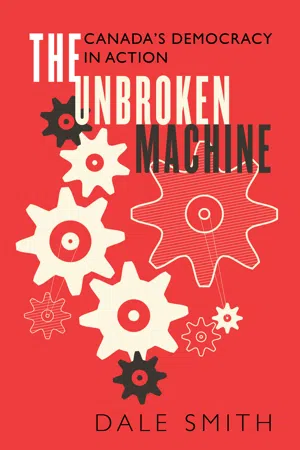
The Hill Times: Best Books of 2017 What if it is not our political system that is broken, but our understanding of it? Everybody thinks that it's the system that's broken in politics; but what if it's not the system that's broken but rather our understanding of it? What if everyone's proposals to make the system "more democratic" only wind up making things worse, and weaken our systems of accountability so much as to make them meaningless? What if it's our own ignorance that is killing democracy in this country? Dale Smith looks at the critical gaps in civic literacy that have become endemic within Canadian political culture, wading through buzzwords and meaningless proposals to suggest real solutions. Designed for the lay reader, The Unbroken Machine seeks to explore our lack of civic literacy and show how our system of democracy should work — if only we were to engage with it the way it was meant to be.
- 152 pages
- English
- ePUB (mobile friendly)
- Available on iOS & Android
eBook - ePub
About this book
Information
1
The Age of Civic Illiteracy
We will make every vote count.We are committed to ensuring that 2015 will be the last federal election conducted under the first-past-the-post voting system.We will convene an all-party Parliamentary committee to review a wide variety of reform, such as ranked ballots, proportional representation, mandatory voting, and online voting.This committee will deliver its recommendations to Parliament. Within 18 months of forming government, we will introduce legislation to enact electoral reform.— Liberal Party of Canada
In recent years, Canadian politics has been filled with talk of the need for reform of the system. Political action groups like Fair Vote Canada and RaBIT (the Ranked Ballot Initiative of Toronto) have been advocating for changes to the way votes are cast in this country. A number of political parties have also become involved in attempts to change the political system in Canada. In 2005 the B.C. Liberal Party sponsored a province-wide referendum that asked voters to decide if they wished to replace the existing first-past-the-post system with another system called Single Transferable Vote — an attempt that failed. In the 2015 federal election, Liberal Party leader Justin Trudeau promised that if elected his party would form a committee to consider reforms to the voting process. Since winning the election, they have followed up on that promise and that committee has met to consider proposals for electoral reform.
This movement for political change is fostered by a widespread sense of dissatisfaction with Canadian politics as it exists now and a belief that the perceived problems could be corrected if the system was changed. In short, there is a belief that the machine is broken and that all would be well if somehow it can be fixed.
The machine is not broken. It has a defined purpose and it works — it works well, in fact. At the municipal, provincial, and federal levels, candidate nominations are held. Political parties hold conventions to decide policy and elect leaders. Elections are held in towns and cities across the country to elect councillors and mayors, provinces and territories hold elections for their legislatures, and nationally, federal elections to select MPs, and thereby, a government. Following all of these elections, the various politicians and the government bureaucracies work to keep all of the offices and agencies of state running smoothly.
But many of the people who operate it seem to have forgotten just how it’s supposed to work. They keep coming up with ways to “improve” it, to somehow change its outcomes — creating something that will be fantastic and magical, like unicorns. However, when they don’t use the machine properly, and when they have unrealistic expectations about what it’s supposed to be producing, well, they deem it to be “broken” and in need of an overhaul.
Welcome to the state of Canadian democracy, something that many claim needs reform. While for decades now it has often been said that ours is an age of reform, it would also seem that ours is also an age of civic illiteracy. The demands that we see for electoral reform often spring from unfamiliarity with just how the system operates, and some blatant misrepresentations about the nature of some of our institutions. It doesn’t help that we are bombarded by depictions of the American political system in our popular culture, depictions that have created a distorted image of our own system — a fiction that involves elements of the American system mapped over ours in people’s minds. Things are made worse by the fact that many Canadians are wrapped up in American political concerns, never mind that they can’t actually vote in their elections.
For some Canadians, the level of illiteracy is pretty extreme — you might even say that it is alarming.
“Stephen Harper’s the mayor, right?” asked one constituent of a prospective MP who was knocking on doors in a Calgary riding during the 2011 federal election.
Many can’t tell you the three levels of government, who the head of state is, and you might be lucky if they know who the prime minister is at any given moment. Others can’t distinguish between the public service and the elected officials, between government and Opposition, or between the roles of an MP versus the role of a minister. To them, everything is just “government.” Many people don’t know about the nomination process that political parties use to select candidates, or the policy conventions that parties hold to draft election platforms, or the roles that parties play within our system, and may instead believe a narrative that fits their world view, which often involves belief that a small cadre of powerful elites pulls the strings and makes our democratic institutions dance to their machinations.
This general confusion about Canada’s electoral system and belief that it is “broken” is often encouraged by the very people who do know better. They do this because they have their own ideas about how the system should operate instead, which usually involves changes made for their own partisan advantage. They sow additional confusion into the system and then declare it to be broken because it is in their advantage to do so. Of course, they may not actually have engaged in enough of a consequence-based analysis of just what would happen if they should implement their “reforms,” but that doesn’t stop them from trying to push their own vision or agenda. “Reform,” they feel, will benefit them in the long term.
And more often than not, their visions will go unchallenged by the media or the general public because of a pervasive lack of knowledge of how the systems of our democracy operate, or how they would be affected by changes that may sound novel or interesting.
⚙
For many Canadians, this lack of knowledge of our system of government stems from inadequate education in the primary and secondary levels. Most provinces don’t require civics education or its equivalent in their social studies curriculums, and when students are offered civics education, they are often taught only a few basic facts without being given an accurate representation of the mechanics of a system. In some cases, such as in Ontario, it was found that the civics course being taught in high schools was imparting wrong information about the roles and responsibilities of the different institutions of government.
Not only are our students being given an inadequate education in civics but they are often being taught by instructors who have a bias against the system as it exists. Studies have shown that teachers with the greatest interest in politics are also those with the greatest belief in the need for reform of the system. This bias among many teachers and political scientists for reform of one form or another, means that students often graduate with a distorted understanding of the system and how it operates currently.
One of the most damaging misunderstandings about how the system operates stems from a pervasive misuse of the term democracy, or rather, democratic. This leads to the completely false notion that things can be made “more democratic,” as though there were a way to assign a point value to the “democraticness” of systems or proposed reforms, and the first one to get to a hundred, wins.
The most popular notions for making things “more democratic” tend to involve adding more votes to the process — votes by the general public, or by members of the House of Commons — or require positions currently held by appointment be made elected ones, or that certain decisions that would ordinarily be under the purview of the Crown be similarly put to a vote. And while votes are a good thing, they need to be held with a specific purpose in mind and within a specific framework — what is this vote going to accomplish and what does the democratic weight behind it mean?
Part of the problem with many of these proposals to hold more votes is that the resulting votes are simply votes held for the sake of holding a vote to put a coat of “more democratic” paint over decisions that are, in fact, foregone conclusions based on how the seats break down in a majority government in the Commons. Others are votes structured in a way to artificially create a “50-percent-plus-one” result, even though that was not the intent of the votes being cast. Still others ignore one of the most fundamentally important mechanisms inherent within the Westminster democratic model: accountability.
As things are currently structured in the Canadian parliamentary system, there is a healthy tension between democracy and accountability. When voters elect MPs, they hold them accountable for their conduct at the next election. When MPs form governments, those governments are held accountable to the Commons by votes of confidence. And when decisions are made by governments, they are made accountable to both the Commons and to the electorate.
But this is where the demand for more votes can turn into a problem. When individual MPs start voting on decisions that the government should make on its own, it dilutes accountability because it means that when things go wrong, those MPs share in the decision. When an appointed position is instead made an elected one, it starts to lose its ability to speak truth to power because it must satisfy the demands of voters rather than holding the government that appointed it to account. The delicate balance between democracy and accountability tilts toward “more democracy,” and inevit-ably what results is less accountability. But unless one understands that the balance exists within the system, then it gets easy to be swept up in the romanticism of “more democracy,” and the accumulation of imaginary points toward the supposed perfect one hundred.
⚙
Our collective lack of understanding of how the Westminster system — the parliamentary system that Canada inherited from Britain — operates has also allowed for a more presidential political discourse to develop here, and as a result, the role of individual MPs has been reduced in favour of an expansion of the power of party leaders. It’s rare to hear anyone discuss the election of local MPs; instead, we focus all of the attention on the leader. Despite the fact that policy is supposed to come from the grassroots membership of a political party, we have become used to the expectation that leadership candidates will develop their own policy platforms during party leadership contests, and so we are now seeing the rise of candidates with no history of political involvement who suddenly decide that they should run for leadership because they have policy ideas they want to present. Never mind that there are already mechanisms in place for parties to decide policy, the fact that the focus has shifted entirely to leadership means that the avenues for ordinary citizens to contribute to the process are being steadily sidelined and starved for oxygen.
This same kind of lack of oxygen for the role of the grassroots also affects MPs. The lack of civic literacy is not only a demonstrated problem for voters but for the MPs they elect as well, and there are studies that show that the vast majority of MPs don’t even know their own job descriptions. Canadian politics and elected office has become an exercise in winging it, while all eyes are on the leadership. Backbenchers are increasingly treated as puppets or ciphers for those party leaders. They have become little more than a chorus, background actors who only do as they are told in Parliament. With their reduced status in Ottawa, they are encouraged to take on a vastly inflated role at the constituency level that focuses on “customer service,” work that the permanent civil service should be doing, while the work that MPs should be doing — holding the government to account — is left by the wayside.
And a perhaps more damning indictment is that the media itself largely doesn’t seem to have a firm enough grasp on civic literacy and the importance to accurately reflect the system. The prorogation crisis of 2008, when Prime Minister Stephen Harper used a procedural tactic to avoid a confidence vote, was a prime example of how the media was largely unable to offer informed commentary on just what prorogation meant. Even fewer offered challenges to the Conservatives who delivered talking points about going over the head of the governor general to take the question of a coalition to the people — in fact, Don Newman seemed to be the only journalist who challenged a minister on that very point. The fact that prorogation became synonymous for an illegitimate attempt at shutting down a legislature from that point on indicates that the media as a whole still hasn’t come to terms with a routine operation of Parliament or legitimate power of the Crown.
During elections, media comment immediately moves to a “winner takes all” mode rather than relying on the actual parliamentary process — the election of MPs, the summoning of Parliament, the giving of the incumbent the first opportunity to meet the House of Commons, and the selection of a new first minister only once they inform the governor general or lieutenant governor that they intend to resign in order to let someone else try to form a government that can command the confidence of the chamber.
Media attention is leadership-focused, and as a result, recognition of the importance of individual MPs is reduced. Most MPs gain no attention from the press unless they do or say something outrageous. There is an inherent dichotomy in the competing demands that MPs have a bigger role, while at the same time any glimmer of independent thought or action is immediately accompanied by headlines that the party leader is losing control of the caucus. Policy is written about as being decided by leadership candidates rather than grassroots membership, especially as leadership contests take place. In day-to-day parliamentary coverage, much of the coverage revolves around personalities, in part because of the dramatic narratives that can be drawn from it. Many other aspects are dismissed as “process stories” which, it is assumed, people will not read — despite the fact that the heart of democracy is process and that understanding how that process works and how the issues of the day fit into that process is a critical component of civic literacy and a gateway for citizen engagement. Debate or argument is written off as “squabbling,” despite the fact that the Opposition is an inherent and important feature of our system because it is a built-in mechanism for accountability. Entire segments of the parliamentary process are treated with outright derision, in particular the Senate, while there is little awareness of the role of the Crown-in-Parliament.
Add to that the kind of envy that many Canadian political journalists suffer from when it comes to the romance with American politics, and it is perhaps not surprising that undue comparisons are drawn, be it with terminology or job description, or the particular sense of celebrity or personality-led drama that seems inherent in that system.
The media also tends to focus on stories about how to enact political reform of any particular description — to increase decorum in the chamber, to make MPs’ jobs somehow more meaningful, to make the electoral system more “reflective,” or to reform the Senate — rather than on stories that demonstrate the kind of critical awareness of what those reforms might actually mean. And having journalists who are able to critically challenge the perceptions put forward around reform ideas or characterizations of the system would be of tremendous public benefit if the knowledge were to be found.
Not all of this is the fault of individual journalists or even the media establishment as a whole, either — it is merely a reflection of the broader decline in civic literacy in general society. Most political journalists have the same level of inadequate civics education as the rest of Canadians, and view the parliamentary process through that same lens. They simply don’t know enough about how things actually work, and so, as a consequence, they rely on shorthand that elides the actual functions inherent in the Westminster model when they report, or they frame things in American-centric terms. They have expectations of MPs that are bred from the same lack of know-ledge that MPs themselves possess, and the distortions that appear in copy are a mere reflection of that. Tightening budgets and the tighter deadlines in the era of the twenty-four-hour news cycle, reporting at the speed of Twitter, only make things worse. The kind of beat system that used to happen in newsrooms in which reporters were able to focus on a specific area and so gain knowledge in that area is by and large a thing of the past. Most reporters are now of necessity generalists. They must develop knowledge of everything rather than cultivate a mastery of specialized areas, and the loss of expertise is the inevitable result.
⚙
So where do we go from here? Have the waters been too muddied with misconceptions and wrong-headed notions about how our system works or is meant to accomplish? Is the effect of our collective civic illiteracy so corrosive that there is no hope? Has the discourse around reform become so pervasive that there can be no other ways forward? Have we reached the point where the only thing we can do is burn the system to the ground and start over with some more “modern” and “democratic” way forward, striving for those hundred imaginary points? My answer is no, and will always be no.
I’m not about to suggest that there ever was a “golden age” of Canadian political discourse, or even of civic literacy, because I simply have no metrics by which to compare it. I do believe, however, that in our constant grasping to be more “modern” in our democracy, we have forgotten the reasons why our system evolved the way that it did, and that we should be looking to restore some of the things that we have already abandoned, and turn back to re-engage with those parts of the machine of parliamentary democracy that we have not yet debased. Indeed, many of our attempts at “modernizing” the machinery of governance have wound up being for the worse, whether it’s the way in which political party leadership contests are held, the power of party leaders to sign nomination papers, or the way in which prorogation is handled as a matter of course.
None of this is about actual reform — it’s about education and understanding of the way our democracy functions. As long as we don’t understand how it functions, we can’t be expected to actually properly engage with it in a meaningful way. If there is a “democratic deficit” in this country, as has so often been declared, it’s because the deficit is in our understanding.
Over the course of this book, I will be looking at the various parts of our democracy, showing the role and proper context of each. I will explain why the various and sundry ideas for “reform” of the system are, in fact, bad ideas, taken in the broader context, and show how the system actually addresses most everyone’s concerns provided that they actually engage with it properly. Chapters will look at what responsible government means, how our voting system works, the House of Commons, the Senate, and the Crown in Canada.
The machine works. We need only to relearn how to use it, and understand what its outcomes actually are and what they mean.
2
A Refresher on Responsible Government
Before Canadians can relearn how to use their political system, it’s necessary to understand how it’s structured, what its component parts are, and how they relate to one another. In order to do that, it’s necessary to understand the principles that underlie it. In other words, we need to go back to the basics.
As I mentioned before, a fair amount of the political discourse we hear focuses on some pretty American notions, like “checks and balances,” rather than on issues such as “accountability” and “maintaining confidence,” issues that lie at the heart of the Canadian political system. Of course, it’s not hard to understand why — with much of our media dominated by American imports, we Canadians are constantly bombarded by American political discourse and the terminology used in it. The notion that governments need “checks and balances” is one of these imported American terms. I’m not suggesting that there are no checks and balances in Canada’s political system; there are, and with the advent of the Charter of Rights and Freedoms, they have multiplied in number and achieved greater prominence in the system. However, they function in a different way in Canada from those in the United States, because our system is constructed differently from the one that operates south of the border.
Canada’s political system is based on the one that operates in the United Kingdom, what is known as the Westminster model — Westminster being the London borough where Great Britain’s Parliament is located. The British system is made up of the sovereign, the House of Lords, and the House of Commons. There is also a separate and independent judiciary. Over tim...
Table of contents
- Cover
- Contents
- Foreword
- Introduction
- 1
- 2
- 3
- 4
- 5
- 6
- 7
- Acknowledgements
- Notes
- Bibliography
- Copyright
Trusted by 375,005 students
Access to over 1.5 million titles for a fair monthly price.
Study more efficiently using our study tools.
Frequently asked questions
Yes, you can cancel anytime from the Subscription tab in your account settings on the Perlego website. Your subscription will stay active until the end of your current billing period. Learn how to cancel your subscription
No, books cannot be downloaded as external files, such as PDFs, for use outside of Perlego. However, you can download books within the Perlego app for offline reading on mobile or tablet. Learn how to download books offline
Perlego offers two plans: Essential and Complete
- Essential is ideal for learners and professionals who enjoy exploring a wide range of subjects. Access the Essential Library with 800,000+ trusted titles and best-sellers across business, personal growth, and the humanities. Includes unlimited reading time and Standard Read Aloud voice.
- Complete: Perfect for advanced learners and researchers needing full, unrestricted access. Unlock 1.5M+ books across hundreds of subjects, including academic and specialized titles. The Complete Plan also includes advanced features like Premium Read Aloud and Research Assistant.
We are an online textbook subscription service, where you can get access to an entire online library for less than the price of a single book per month. With over 1.5 million books across 990+ topics, we’ve got you covered! Learn about our mission
Look out for the read-aloud symbol on your next book to see if you can listen to it. The read-aloud tool reads text aloud for you, highlighting the text as it is being read. You can pause it, speed it up and slow it down. Learn more about Read Aloud
Yes! You can use the Perlego app on both iOS and Android devices to read anytime, anywhere — even offline. Perfect for commutes or when you’re on the go.
Please note we cannot support devices running on iOS 13 and Android 7 or earlier. Learn more about using the app
Please note we cannot support devices running on iOS 13 and Android 7 or earlier. Learn more about using the app
Yes, you can access The Unbroken Machine by Dale Smith in PDF and/or ePUB format, as well as other popular books in Politics & International Relations & Civics & Citizenship. We have over 1.5 million books available in our catalogue for you to explore.