In the early 1800s, Timothy Robers, a Quaker millwright from Vermont, drew a flourishing community of fellow Quakers to the area which became the new-market for settles and traders. It soon became the commercial hub of a rich farming area. By the mid-1800s it was a central point on the Ontario, Simcoe, and Huron Railway. Over the following decades, gas deposits were confirmed there and a barge canal was built along with a street railway. In the early 20th century Newmarket languished through a long period of slow growth — wars and the Depression took a terrible toll on the small town. Yet in the 1940s it was another war that brought thousands of soldiers to Newmarket's training camp on their way to battlefields in Europe. It took the 1960s to bring real prosperity — builders began developing the inexpensive land, industries came, and the town flourished. The pace of construction continued through the 1980s as Newmarket prepared for its busy life of today.

- 104 pages
- English
- ePUB (mobile friendly)
- Available on iOS & Android
eBook - ePub
About this book
Information
1
The Settlers’ Trail
Timothy Rogers splashed through the river ford late one June evening in 1800, climbed the hill on the ancient Indian trail he had been following all day and decided to make camp under some tall maples. His decision to sleep on the hill over-looking the Holland River made him the first white man to spend the night on the future site of Newmarket. What he saw next morning was to change the course of his whole life. Rogers chose his campsite because there was marsh nearby where he could gather juicy reeds for his mare. In the not-too-distant future, that trail from the ford to the campsite would become Newmarket’s Main Street. The York County Registry Office would be built where Rogers camped.
A Quaker millwright from Vermont, Rogers was exploring alone — looking for good land to which he could bring Quaker settlers anxious to improve their lot on a new frontier. In part his journey was a response to Governor John Graves Simcoe’s offer of free land in York County, but it was also because Quakers in the new United States often found their pacifist ways made life difficult in a republic only recently born of violence. Rogers also had a personal goal: to found a third and central Quaker settlement in Upper Canada linking the earlier ones in Prince Edward County and the Niagara Peninsula.
When he awoke that June morning, he pushed on up the trail as far as Lake Simcoe before deciding the rich farmland he had come hundreds of miles through the virgin forests to find, lay back where he started the day, on the west side of the Holland River valley. He especially prized the land along the trail Governor Simcoe had ordered blazed in 1793 and named Yonge Street for his friend, Sir George Yonge, the British secretary of war. Although it was still a muddy and often impassable forest trail, Rogers must also have known the governor’s intention was to see Yonge Street developed into a major settlement and military road linking his capital at York with the upper Great Lakes.
Heavily forested with hardwood and pine, the northern reaches of York County that Rogers was seeing for the first time had gently rolling hills with the promise of well-drained, fertile soil under the forest bed. There was a small rapids near the ford where he had crossed the river which gave promise for a mill site. Half a mile to the north, a substantial tributary from the east joined the river, offering more development potential. This combination of factors must have made the future site of Newmarket irresistible to the American Quaker.
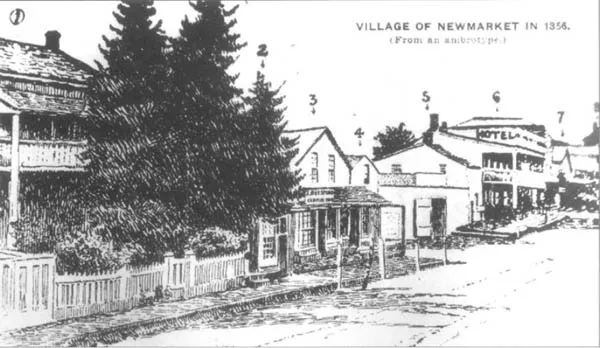
Main Street by 1856 consisted of frame businesses and homes. This view of the west side between Timothy and Botsford Streets shows
(1) the Botsford home,
(2) B. Joy’s barbershop,
(3) Botsford’s shop,
(4) Betsy Barber’s dressmaking shop,
(5) the bar at the North American Hotel,
(6) the hotel,
(7) Smith & Emprey general store,
(8) Dr. Orin Ford’s sanitarium (later the Royal Hotel).
(Author’s collection)
Rogers’ journal recounts of how he raced back to the colonial capital to stake his claim and beat a company which had viewed the same land:
And then it seemed as if I must go to York in this province, and by a great deal of hard travel, got to York and then went 30 or 40 miles back, and following my concern made way to apply to Governor General Hunter; and John Elmsley, Chief Justice, became my friend.
And all the land was viewed by a company before me. I got back and got a grant for 40 farms, of 200 acres each.
The journal doesn’t tell us at what point in his journey from Vermont Rogers found the Rouge trail, one of a network of ancient native trails known as the Carrying Place which linked the mouths of the Rouge, Don and Humber rivers on Lake Ontario to the Holland River and Lake Simcoe. From Lake Simcoe the trail lead westward to Georgian Bay, doorway to the upper Great Lakes, the northwest and the prairies.
The Rouge trail ran from the mouth of the Rouge River east of Toronto, from the Indian village of Ganatsekwyagon, north to the Jersey River and the Newmarket branch of the Holland. Joliet, explorer of the U.S. midwest and the Mississippi had travelled over it from south to north in 1669. There are pioneer accounts of the remains of Indian campsites along the Holland near the ford, but no vestiges of permanent native villages have ever been found within Newmarket’s boundaries.
The rolling, forested hills through which the Carrying Place trails of one of North America’s most important routes to the interior passed seem to have been primarily reserved as hunting grounds. Ruled by the powerful Huron nation from their villages on Georgian Bay when the white man arrived, control passed to the fierce Six Nations confederacy of New York State after Iroquois warriors smashed the Hurons. The dispersal of the Six Nations during and after the American Revolution resulted in a power vacuum which was soon filled by migrating Mississauga and Ojibway hunters and their families.
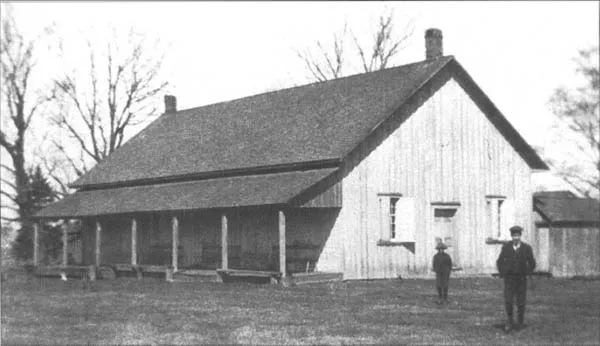
The Yonge Street Quaker Meeting House is the oldest, continuously used place of worship north of Toronto. It was built in 1810. Although Timothy Rogers founded another settlement in Pickering Township after the Yonge Street settlement was underway, he lies buried among friends and family in the cemetery next the Yonge Street Meeting House. (Author’s collection)
Rogers’ settlers, all friends and relatives and most of them Quakers, arrived to begin clearing their farms in the spring of 1801. His own cryptic account of this journey says on February 15, “I started one sleigh, and on the 17th started seven sleighs and all my effects, and had a tedious voyage.
“We had a great move and many trials but got on the ground about the first of the 5th month, 1801.”
Among the settlers were many whose family names are still common in the Newmarket area today, Huntley, Proctor, Griffin, Smith, Crone, Clark, Howard, Farr and a miller named Joseph Hill, Newmarket’s first white citizen. Although historians often refer to the arrival of the Rogers’ settlers as a Quaker migration, not all were members of the Society of Friends. Bethuel Huntley was a Rogers’ settler and although a kinsman of Timothy Rogers, he was a Methodist. Rogers’ mother’s maiden name was Mary or Mercy Huntley.
Huntley, who didn’t get on his Yonge Street land grant until April, 1802, almost a year after the others arrived, had served in the Revolutionary Army during the War of Independence. His grant was the third farm north of today’s Davis Drive on the west side of Yonge Street. In 1839 the family sold it to Jacob Aemilius Irving, who erected a substantial home known as Bonshaw.
Huntley helped to found the first Methodist church in Newmarket, the tiny Episcopal Methodist Church built about 1821 on a corner of the Srigley farm (now the northeast corner of Prospect and Timothy Streets.) The church had a cemetery and the community’s first school was also erected on the property. Bethuel Huntley was one of seven trustees of this church. In 1801 the Quaker settlers had built a small log meeting house on the northeast corner of the present Yonge and Eagle Streets and in 1810 the frame meeting house which still stands on the west side of Yonge Street was built to replace it.
Hill dammed the river near the ford, creating a millpond known today as Fairy Lake. By the week before Christmas, 1801 he had ground the first bushel of wheat in the primitive mill with a run of two stones that Timothy Rogers must have helped him construct. Hill also built a store and a frame home. This was the beginning of Newmarket.
Hill’s lonely forest clearing offered an alternate trading post — a new market — cutting off the arduous portage over the Oak Ridges and down to Muddy York for trappers and Indians from the north and settlers now pushing into York and neighbouring Simcoe counties. This historic site is today marked by an Ontario government plaque commemorating the Founding of Newmarket. However none of Hill’s buildings remain there. The mill burned in 1871 and the house, which once looked up the trail towards the hilltop, was moved many years ago to an Eagle Street site at the bottom of Church Street, where much-altered, it still stands.
First known record of the use of the name “New Market” is in an April 1, 1810 letter from Peter Robinson to Toronto merchant Quetton St. George, which is now in the Metropolitan Toronto Reference Library. Earlier references to the little community were all as Whitchurch, but later letters continued to use the new name and when the post office was opened in 1822 its name was officially New Market. The name continued to be spelled as two words until well into the 1890s.
As a second and third wave of Quaker settlers took up farms in ever-widening circles in the townships around Timothy Rogers’ Yonge Street settlement and other land-hungry colonists followed suite, tradesmen and entrepreneurs trickled in too and a small settlement formed around Joseph Hill’s clearing. Among them was an enterprising and well-connected New Yorker named Elisha Beman who probably arrived here in the spring of 1803. He brought with him his new wife and his five step-children and immediately began acquiring land. In 1804 he bought Joseph Hill’s mill, store and house. Beman arrived in the colonial capital, York, in 1795, only two years after Governor Simcoe founded the town. He was 35, had a wife and young daughter. He became involved in a number of commercial ventures but his major goal was to settle on the northern trail between York and Georgian Bay. In a 1798 petition to the colony’s Executive Council he offered to establish himself and his family at Holland Landing or farther north on the Matchedash (Severn) River, build an inn, grist and saw mills and operate a ferry. In return he sought permission to purchase 1,000 acres.
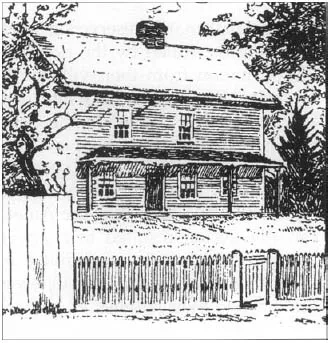
The Beman-Robinson house now stands on Eagle Street at the foot of Church Street, but in its heyday, when it was the little community’s social centre and probably also housed a trading post, it stood on Water Street at the foot of Main Street. It sported a wide front porch and was surrounded by fences and trees. (Author’s collection)
It was a period of building tensions along the international border and the future of the northern trail as a major fur trade, military and colonist route avoiding the American guns at Detroit looked bright.
In April, 1799 the petition was granted but before Beman could act, his daughter and then his wife died. In 1802 he married Esther Sayre Robinson, a well-connected but impoverished widow with five children. Christopher Robinson, her first husband, came from an aristocratic Virginia Loyalist family, fought under Simcoe in the Queen’s Rangers, followed him to Upper Canada, and had been a member of the Legislative Assembly and Surveyor-General of Woods and Forests. The marriage gave Beman an entree into the colonial power structure. It also gave him responsibility for Esther’s three sons, Peter, 18, John Beverley, 11, and William, 5. Each in his time was to play a vital role in the growth of Newmarket and the colony.
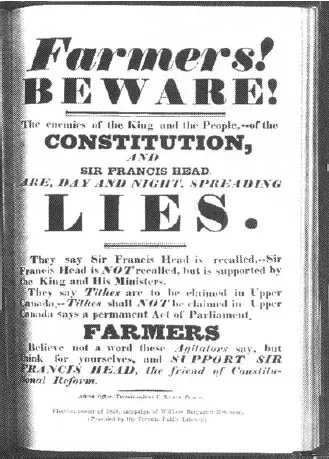
W.B. (William) Robinson was one of three powerful brothers who were members of the colony’s ruling elite. At right, an election poster from W.B. Robinson’s 1836 election campaign for a seat in the colony’s Assembly. (Author’s collection)
One example of Beman’s hard-nosed business ethics which must have rankled his neighbours in the predominately Quaker settlement was his acquisition of Joseph Hill’s second mill site. Hill had located on the eastern tributary of the Holland River where it crosses the present Gorham Street and built a tannery. Beman discovered that the land was still owned by the Crown and arranged to lease it, evicting Hill.
Beman and Peter Robinson quickly got into the fur trade and in addition to the mill business and store, they developed a commercial nucleus for the struggling frontier community. Beman erected a distillery to complement his mill at the northeast corner of Water and Main streets, built an ashery on the east side of the river and Peter built a second distillery on the east side of the pond. Firewater and the fur trade always went hand in hand.
Elisha Beman’s vision of a business empire on the Yonge Street trail was well on its way to reality when he died in 1820. Magistrate and justice of the peace, this New York entrepreneur was in many ways the local authority of Britain’s colonial government during the years he was known here as Squire Beman. One of Newmarket’s most important founders, he is buried in the little Anglican cemetery on Eagle Street. The Beman businesses continued to flourish under the Robinsons, first Peter and later William.
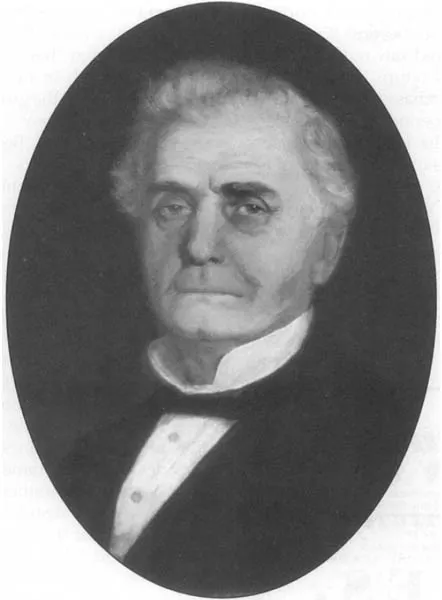
William Roe was born in British Detroit in 1795. An unlikely hero of the War of 1812 when still a teenager, he came to Newmarket as a fur trader and stayed to become one of its most substantial citizens. His store and trading post at Water and Main streets were also the first post office. (Newmarket Historical Society Ar...
Table of contents
- Cover
- Half Title
- Title
- Copyright
- Contents
- Foreword
- 1. The Settlers’ Trail
- 2. Heart of the Rebellion
- 3. The Growth Years
- 4. The Late Victorians
- 5. Wars, Depression and an Uncertain Future
- 6. Boom Times Return
- Bibliography
- Index
Trusted by 375,005 students
Access to over 1.5 million titles for a fair monthly price.
Study more efficiently using our study tools.
Frequently asked questions
Yes, you can cancel anytime from the Subscription tab in your account settings on the Perlego website. Your subscription will stay active until the end of your current billing period. Learn how to cancel your subscription
No, books cannot be downloaded as external files, such as PDFs, for use outside of Perlego. However, you can download books within the Perlego app for offline reading on mobile or tablet. Learn how to download books offline
Perlego offers two plans: Essential and Complete
- Essential is ideal for learners and professionals who enjoy exploring a wide range of subjects. Access the Essential Library with 800,000+ trusted titles and best-sellers across business, personal growth, and the humanities. Includes unlimited reading time and Standard Read Aloud voice.
- Complete: Perfect for advanced learners and researchers needing full, unrestricted access. Unlock 1.5M+ books across hundreds of subjects, including academic and specialized titles. The Complete Plan also includes advanced features like Premium Read Aloud and Research Assistant.
We are an online textbook subscription service, where you can get access to an entire online library for less than the price of a single book per month. With over 1.5 million books across 990+ topics, we’ve got you covered! Learn about our mission
Look out for the read-aloud symbol on your next book to see if you can listen to it. The read-aloud tool reads text aloud for you, highlighting the text as it is being read. You can pause it, speed it up and slow it down. Learn more about Read Aloud
Yes! You can use the Perlego app on both iOS and Android devices to read anytime, anywhere — even offline. Perfect for commutes or when you’re on the go.
Please note we cannot support devices running on iOS 13 and Android 7 or earlier. Learn more about using the app
Please note we cannot support devices running on iOS 13 and Android 7 or earlier. Learn more about using the app
Yes, you can access Newmarket by Robert Terence Carter in PDF and/or ePUB format, as well as other popular books in History & North American History. We have over 1.5 million books available in our catalogue for you to explore.