How royal parents dealt with raising their children over the past thousand years, from keeping Vikings at bay to fending off paparazzi.
William and Kate, the Duke and Duchess of Cambridge, are setting trends for millions of parents around the world. The upbringing of their children, Prince George and Princess Charlotte, is the focus of intense popular scrutiny. Royalty have always raised their children in the public eye and attracted praise or criticism according to parenting standards of their day.
Royal parents have faced unique challenges and held unique privileges. In medieval times, raising an heir often meant raising a rival, and monarchs sometimes faced their grown children on the battlefield. Conversely, kings and queens who lost their thrones in wars or popular revolutions often found solace in time spent with their children. In modern times, royal duties and overseas tours have often separated young princes and princesses from their parents, a circumstance that is slowly changing with the current generation of royalty.
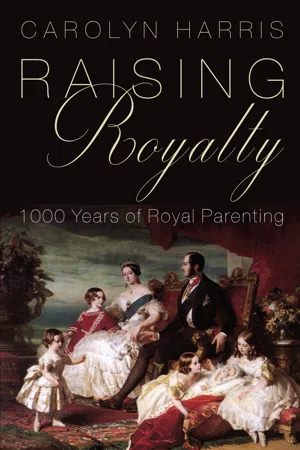
- 256 pages
- English
- ePUB (mobile friendly)
- Available on iOS & Android
eBook - ePub
About this book
Information

DEDICATION
For my parents and my grandparents
Table of Contents
- COVER
- DEDICATION
- INTRODUCTION
- ONE
- TWO
- THREE
- FOUR
- FIVE
- SIX
- SEVEN
- EIGHT
- NINE
- TEN
- ELEVEN
- TWELVE
- THIRTEEN
- FOURTEEN
- FIFTEEN
- SIXTEEN
- SEVENTEEN
- EIGHTEEN
- NINETEEN
- TWENTY
- EPILOGUE
- ACKNOWLEDGEMENTS
- NOTES
- FURTHER READING
- Copyright
INTRODUCTION
Raising a Royal Child
Prince William made his first parenting mistake in the eyes of the world on the day that his son, Prince George, left hospital in July 2013. There had been journalists and photographers camped around the maternity wing of St. Mary’s hospital in London for weeks leading up to the birth, waiting for the moment when William and his wife Catherine — nicknamed Kate by the media — the Duke and Duchess of Cambridge, would emerge from the hospital to present their newborn child to the world. Every moment of baby George’s first public appearance was captured on camera to be scrutinized by people around the world on their television screens and online streams. The royal parents received a great deal of praise. William had his sleeves rolled up as though he had just changed a diaper, and Kate wore a fitted dress that did not attempt to disguise her post-pregnancy figure. Even little George appeared to be waving to the crowds from his swaddling clothes.
The criticism came when it was time for William to strap George into his car seat. In previous generations, this kind of task would have been left to a member of the royal household, but William was determined to strap his son into the car and drive his family home like any other new father. Knowing the world’s press would be watching him closely, William reputedly practised assembling the car seat in the privacy of Kensington Palace during the weeks leading up to the birth. Despite these careful preparations, not everything went perfectly on the big day. Within moments of the royal couple and their baby leaving hospital and returning to the palace, parents from all walks of life were posting on internet forums that George had not been properly strapped into his car seat.
On the British childcare blog “Baby Centre,” an irate commenter posted, “If you scroll down to the photos of the baby in the carseat [sic] you will see he is not properly strapped in AT ALL!! Very disappointed! I’m sure they were in a hurry, and I hope that Kate will fix it once they are in the vehicle as it appeared she was sitting in back with the baby.” The commenter included guidelines from the website ChildCarSeats.co.uk to back up her comments. Over at iVillage, online commenters questioned whether a swaddled baby should be in a car seat at all. By the time George’s younger sister, Princess Charlotte, was born in 2015, William seemed to have mastered the car seat — but there was a new complaint: the baby princess’s bonnet appeared to be on backwards for her first public appearance!
The debate over William and the car seat continued for years after George’s birth. In May 2016, one of the United Kingdom’s most prominent etiquette experts, William Hanson, complained that Prince William’s approach to fatherhood was undermining the traditional grandeur, and therefore the future, of the monarchy, writing in the Daily Mail, “I want a well-waxed chauffeured Bentley, not Prince William driving mother and latest child home from the hospital in their family car like a regular bloke.”
Commentary of this kind is almost unknown in the Commonwealth realms, including Canada, where William and Kate were praised for touring with a small entourage in 2011 and spending time with their children in 2016. When the Canadian edition of Hello! published photographs of William holding George at a garden party at Government House in Victoria, British Columbia, in the autumn of 2016, the coverage included praise of William’s close relationship with his son. Hello! reported that “Royal watchers will never forget how he expertly fastened Prince George into the back seat of the car when the tot was just one day old and leaving the hospital.” William’s decision to strap his newborn son into a car seat and drive his family home from hospital had transcended popular debates over the nature of good parenting to encompass the public image of the monarchy as an institution.
The monarchy has always been a family affair. Raising Royalty is the story of how twenty royal couples over the past thousand years have navigated the unique challenges of parenting in the public eye. From fending off Vikings to fending off paparazzi, royal mothers and fathers have made decisions for royal children that encompassed their own personal ambitions and the stability of the throne as well as the timeless needs of young children. Over the past ten centuries, royal children have been parented both in country palaces with well-appointed nurseries and in exile far from their birthplaces. As royal parents, William and Kate are following in the footsteps of centuries of kings and queens, princes and princesses, who were mothers and fathers as well as royalty.
The length and definition of childhood has changed over the centuries, shaping the experiences of royal children. Before the Norman Conquest of 1066, a boy was old enough to swear allegiance to the king at the age of twelve, but Richard III’s nephew, Edward V, was considered too young to rule as king in his own right at that age in 1483. Until the nineteenth century, royal children were often betrothed before they were twelve and married in their early teens to seal diplomatic alliances. The business of ruling was conducted in person by kings and queens who were often away from their children for long periods of time. Even the most devoted royal parents paid little attention to the emotional needs of their children, expecting the obedience of a subject to a sovereign as well as a child to a parent. At a time of high infant mortality, royal parents often expressed their attachment to their children through concern for their health instead of their happiness.
By the late eighteenth century, a new emphasis on “natural” childrearing resulted in royal mothers such as Queen Marie Antoinette of France creating parenting philosophies that took the individual personalities and emotional needs of their children into account. Older methods of royal parenting, however, proved remarkably resilient. Well into the twentieth century, generations of royal children complained that they saw little of their parents and were expected to obey them without question, even as adults. The public viewed the open displays of affection between Diana, Princess of Wales, and her sons, captured by photographers, as a break from royal tradition. Today, William and Kate emphasize that their children will receive as normal an upbringing as possible, demonstrating that the youngest generation of royal parents recognizes the differences between royal tradition and modern parenting trends.
The intense public scrutiny William and Kate experience as parents seems like a modern phenomenon fuelled by the 24-hour news cycle and ubiquity of online message boards, but for as long as there has been royalty, there has been public scrutiny of royal parenting. For centuries, observers from diverse social backgrounds have expressed advice intended for royal parents. Critiquing royal parenting has also been a way of expressing political dissent. Until the twentieth century, high politics was the preserve of a tiny, predominantly male elite, but everyone had ideas about marriage and childrearing from their own experiences and observations. A royal couple whose marriage and family did not meet popular expectations might find themselves the target of satire in popular verse and pamphlets. If relations between monarchs and their people completely broke down, royalty might find themselves having to defend their parenting as well as their political decisions before parliament or a revolutionary tribunal.
Satisfying public opinion is just one of the many challenges royal parents have faced over the centuries. Parenting advice manuals written for commoners — even wealthy commoners — had little to say that addressed the unique circumstances in the royal nursery. Seventeenth-century Protestant clergymen urged fathers to take charge of their children’s training and education, as mothers might be inclined to spare the rod and therefore spoil the child, but King Charles I of England and Scotland had signed a marriage contract that guaranteed his French wife Henrietta Maria control of their children until they turned thirteen. Eighteenth-century French philosophers encouraged mothers to breastfeed and allow their children to explore freely, but when Marie Antoinette tried to follow this advice, she found herself at odds with the strict court etiquette of Versailles. The parenting experts of the 1950s urged parents to teach their children self-reliance, but Queen Elizabeth II’s children were surrounded by servants charged with making their beds and preparing their meals.
For centuries, one of the biggest differences between royalty and everyone else was whom they married. While most people found partners within their own communities, kings and queens, princes and princesses married foreign royalty to cement diplomatic alliances. Until the First World War, royalty was expected to marry other royalty, and that sometimes meant co-parenting with a spouse who did not speak the same language let alone share the same culture and parenting philosophy. In medieval and Renaissance times, English kings often married princesses from regions that are now part of France or Spain, popularizing new baby names such as Eleanor, Isabelle and even Alphonso. In the eighteenth and nineteenth centuries, a series of German royal consorts brought their own traditions to England, including, most famously, the Christmas tree.
When British princesses married foreign princes, they brought their own customs with them, often in the face of considerable opposition. In the nineteenth and early twentieth centuries, Queen Victoria’s granddaughters and great-granddaughters found that their traditions, parenting techniques, and British nannies were not always appreciated in Germany, Russia, Romania, Greece, or Spain. After the First World War, British royalty married into the English and Scottish aristocracy, who were accustomed to more privacy for their families than royalty usually experienced. William is the first direct heir to the British and Commonwealth thrones to marry a woman from a middle-class background since 1660, and Kate’s upbringing was very different from his own. Of all the royal parents discussed in this book, only one couple — Richard III and his queen, Anne Neville — were raised in the same castle with a similar outlook on life.
William is involved in the upbringing of his children and enjoys a close relationship with his father, Prince Charles, but in past centuries, raising a son often meant raising a rival for European royal fathers. William the Conqueror’s queen, Matilda of Flanders, interceded with her husband on behalf of her eldest son Robert, who led an army against his father. Henry II went to war against his three elder sons; his queen, Eleanor of Aquitaine, backed her children against her husband. These conflicts had the potential to turn deadly — Czar Peter the Great of Russia sentenced his son and heir to death — but by the eighteenth century, conflict between royal parents and children had been absorbed into the political system. The origins of opposition parties date from the political factions that surrounded the sons of George I and George II, who were in constant conflict with their fathers. Among the royal fathers who had the most success as parents were those who bonded with their children during periods of war and revolution that threatened their thrones.
For a royal mother, the vast responsibilities of being a queen consort, including witnessing legal charters, ruling the kingdom while the king was at war, and acting as a patron of artists and musicians, often took priority over day-to-day childrearing. The result was generations of royal children raised by grandmothers, governesses, and nannies. Those queens who expected to raise and educate their children themselves, such as Eleanor of Provence, Catherine of Aragon, and Marie Antoinette, left themselves open to accusations of bringing foreign ideas into the nursery and acting beneath the dignity of a queen. A royal mother’s distance from the nursery, however, did not mean disinterest. The relatives and servants charged with day-to-day childrearing received constant instructions and requests for news. Royal mothers were often extremely ambitious for their children and willing to go to great lengths to ensure their future. The first crowned English queen consort, Elfrida of Northampton, was accused of orchestrating a murder to ensure her son became king.
Regardless of who raised a royal child, a decision had to be made about where they would be raised. In the fourteenth century, the ideal home for a growing English prince or princess was a country palace, far from the Black Death plague that spread so quickly in crowded towns. By Victorian times, royal palaces throughout Europe had nursery wings where children had their own routines separate from those of their parents, including simple food, open windows for plenty of fresh air, and regular walks. There were plenty of royal children, however, who grew up far from home because their kingdoms were at war. King Ferdinand of Aragon and Queen Isabella of Castile spent much of their reigns on military campaign, and their children accompanied them as they waged war against the Emir of Granada to unite all of Spain under their rule. King Frederick and Queen Elizabeth of Bohemia had to leave Prague so quickly during the Thirty Years’ War that they nearly...
Table of contents
- 1-frontmatter
- 2-intro
- 3-ch1
- 4-ch2
- 5-ch3
- 6-ch4
- 7-ch5
- 8-ch6
- 9-ch7
- 10-ch8
- 11-ch9
- 12-ch10
- 13-ch11
- 14-ch12
- 15-ch13
- 16-ch14
- 17-ch15
- 18-ch16
- 19-ch17
- 20-ch18
- 21-ch19
- 22-ch20
- 23-epilogue
- 24-acknow
- 25-notes
- 26-furtherreading
Trusted by 375,005 students
Access to over 1.5 million titles for a fair monthly price.
Study more efficiently using our study tools.
Frequently asked questions
Yes, you can cancel anytime from the Subscription tab in your account settings on the Perlego website. Your subscription will stay active until the end of your current billing period. Learn how to cancel your subscription
No, books cannot be downloaded as external files, such as PDFs, for use outside of Perlego. However, you can download books within the Perlego app for offline reading on mobile or tablet. Learn how to download books offline
Perlego offers two plans: Essential and Complete
- Essential is ideal for learners and professionals who enjoy exploring a wide range of subjects. Access the Essential Library with 800,000+ trusted titles and best-sellers across business, personal growth, and the humanities. Includes unlimited reading time and Standard Read Aloud voice.
- Complete: Perfect for advanced learners and researchers needing full, unrestricted access. Unlock 1.5M+ books across hundreds of subjects, including academic and specialized titles. The Complete Plan also includes advanced features like Premium Read Aloud and Research Assistant.
We are an online textbook subscription service, where you can get access to an entire online library for less than the price of a single book per month. With over 1.5 million books across 990+ topics, we’ve got you covered! Learn about our mission
Look out for the read-aloud symbol on your next book to see if you can listen to it. The read-aloud tool reads text aloud for you, highlighting the text as it is being read. You can pause it, speed it up and slow it down. Learn more about Read Aloud
Yes! You can use the Perlego app on both iOS and Android devices to read anytime, anywhere — even offline. Perfect for commutes or when you’re on the go.
Please note we cannot support devices running on iOS 13 and Android 7 or earlier. Learn more about using the app
Please note we cannot support devices running on iOS 13 and Android 7 or earlier. Learn more about using the app
Yes, you can access Raising Royalty by Carolyn Harris in PDF and/or ePUB format, as well as other popular books in History & Historical Biographies. We have over 1.5 million books available in our catalogue for you to explore.