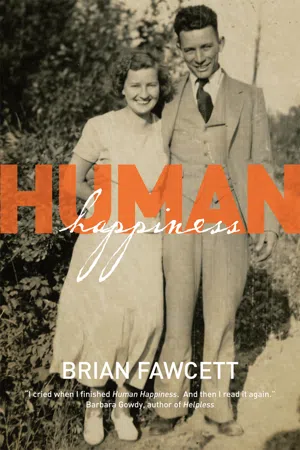
"The last time I talked to my mother, she announced that she hated my father." So begins Brian Fawcett's compelling new book about happiness and a new way of looking at family. A public intellectual who will shame the devil in the interests of truth, Brian Fawcett has staunchly refused to buy into the prevailing techno-corporate ethos that defines our culture today. With Human Happiness, Fawcett has taken another leap into unexplored territory. Where previously Fawcett has explored such topics as globalization and the role of the media, this time he turns the lens inward to search for the meaning of happiness by examining the mysteries of marriage and family. Featuring prose that is often painfully candid and frequently laugh-out-loud funny, Human Happiness is a story-driven narrative centered around the seemingly happy marriage between Fawcett's parents, about how families really work (or don't), about the intergenerational conflicts that seem inevitable between headstrong fathers and sons, and how old hostilities can poison and distort through generations and – in extraordinary cases – can be resolved. For 25 years now, Brian Fawcett has been Canada's most unconventional writer and public intellectual, a man Paul Quarrington described as our literature's enfant terrible and eminence gris rolled into one. His true gift is for making readers laugh while raising the most fundamental questions that face us. He might be Canada's most original writer.
- 288 pages
- English
- ePUB (mobile friendly)
- Available on iOS & Android
eBook - ePub
Human Happiness
About this book
Information
Salt and Cinnamon
IT STRUCK ME, in the mid-1990s that I’d never asked either of my parents what they thought about life and about their place in it. The truth was that I’d never been very interested, and the idea that they had “inner lives” was alien and vaguely threatening. In part this is a “natural” carry-over of the authority parents have during one’s childhood, but in my case it was at least partly because my father was always telling me exactly what he thought, then trying to force me to agree with him, and finding it incomprehensible when I had alternate views, which I did have about virtually everything.
But now I wanted to get some of their thoughts onto the record, not so much because I was suddenly filled with curiosity, but because their grandchildren and great-grandchildren might someday wonder what their ancestors liked and disliked, and what they thought about the human condition. I drew up a list of about 40 questions, starting with simple stuff like, “What’s your favourite colour or vegetable or fabric?” After that, I moved on to fundamental questions like, “Is your life a success?” and “How important is sexual happiness?”
It seemed an outlandish thing to ask one’s parents point-blank what they liked and disliked about the world and what they thought about life’s big issues. I could find no one who’d done anything like it in a systematic way. When I told several friends what I intended to do, most responded with an “oh, wow,” that let me know they weren’t about to rush off to draw up a list of their own questions.
As the decade began to wind down, it became apparent that I’d better get going if I was to have these conversations. My father was already in his nineties, and my mother’s health, in her late eighties, was beginning to fail. So in September 1998, I cornered her while she was visiting Toronto, and got her to agree to answer “some” questions. I didn’t say how many, or what they were going to be about. She wasn’t terrifically enthused, but after a bit of wrangling, she agreed to it.
We sat down on the backyard deck of my house on the second-last day of her two-week visit. She’d come because she wanted her tenth grandchild, my then 14-month-old daughter, Hartlea, to know her paternal grandmother.
The visit had gone very well. Grandmother and granddaughter quickly bonded, and the small anxiety my mother’s growing physical handicaps must have been raising in her mind about the practicality of a relationship with a toddler had been sweetly resolved. Hartlea’s walking pace was perfectly tuned to my mother’s, and they spent hours together happily exploring the streetscapes in our neighbourhood. The relationship had been made, my mother had a sense of little Hartlea’s character, and she’d relaxed, her mind at peace.
I was the anxious one, actually. Several years before, I’d made a number of tape recordings of her reminiscences about the past, with the thought of collecting them in the same sort of life history I’d made for my father 15 years before. In the tapes I made with her, she’d recounted anecdote upon story after fable for me, but they’d all been oddly unsatisfying. She was so seamless a raconteur that the stories dramatized events without revealing very much, if anything, of her. Her recall of her life was utterly unlike my father’s reminiscences, which all led back to a single philosophical point of reference: his business successes, and why I and everyone else ought to emulate him. Her reminiscences were pure plot—and therefore pure fabrication, complete with the telling, but disconnected from any deeper issues of character or values. For posterity, I wanted a record that would reveal at least something of what she believed about human life and the things about it that troubled her.
It was late in the afternoon before we got down to it, sitting across from one another at a round metal deck table with a pot of tea and a tape recorder in the warm September sunlight. As we settled in, I realized that the two of us had been talking all my life, but we’d never once talked this way. She told stories—usually about others—or she gave situational and practical advice. But she was elusive about herself and evasive when asked to talk on terms not of her choosing. It hadn’t ever been that one or the other of us consciously controlled the agenda when we talked. It was more an issue of having comfortably worked out our relative roles with one another. She’d never been one to burden her kids with her thoughts, and as the youngest of her children and the one on whom she’d lavished the most attention, I’d let myself think that she didn’t have an inner life. She, underplaying her hand as she always did, had allowed me to think whatever I wanted for nearly 50 years.
I clicked on the tape recorder, and to get her attention, I shuffled the sheet of questions I had in front of me. “I’ve got about 40 questions here,” I said. “So why don’t we start with some of the easy ones. Let’s try this: What’s your favourite season?”
She looked puzzled for a moment. “What’s my favourite seasoning? That’s rather hard to say. I can’t imagine life without salt or cinnamon.”
“I don’t think that’s quite the question,” I said, laughing. “But it’s a good answer. Salt and cinnamon. I’ve got to write that down.”
She frowned. Was I playing with her? Wasn’t this supposed to be serious? “Well,” she said, “I do love anything with cinnamon in it. And what would life be without salt. It’d be like life without sex.”
“I was asking you what your favourite season was.”
Her turn to laugh. “Oh, for God’s sake,” she said. “I thought you wanted to know my favourite seasoning. That’s funny. Well, my favourite season is autumn. It’s so rich and fulfilled, and oh, I don’t know. It just seems to me the ultimate harvest time, I guess.”
We went through the other easy ones. Favourite vegetable: asparagus, preferably wild; Fish? She liked salmon, but having spent most of her adult life in the B.C. Interior, distinguished it from seafood, which she enjoyed more. For that, it was orange roughy. She described it this way: “splendid. It comes from Australia, and sole is nothing compared to it. It’s like sole but it has body. It doesn’t fall apart on you, which I don’t like.”
I asked her a question I thought I knew the answer to because I bought it for her most Christmases: What was her favourite perfume?
“I prefer 4711,” she said. “I used to like Chanel 22. But older women shouldn’t wear strong perfume. It makes them cheap, I think. So Chanel 22 is now too harsh for me. Too, ah . . . indelicate. It was good when I was young and flirty.”
She looked directly into my eyes to make sure I’d gotten the message. “My ambition in life now is to grow old gracefully. And 4711 is graceful.”
I made the appropriate mental note: No more Chanel 22. Had she been giving it away, or did she have a cupboard full of it somewhere in the Penticton house?
On we went: favourite flower? carnations (a surprise, I assumed it would be roses); favourite tree? maple, because of their autumn colours; favourite colour? rose, and yellow; favourite fabric? satin. I could see she was getting a little bored, so I began to pop more complicated questions.
“What,” I asked, “do you think life is for? Does life have any purpose?”
She was silent for a long moment. “Do you mean personally, or in general?”
“Either, or rather, both.”
“Well,” she said, “it’s rather a difficult question because it has so many aspects.”
I could feel her scrambling on the unfamiliar ground. “For instance,” she said after another pause, “a man and a woman have different purposes in life. Basically, I think most women want to be mothers. Men may want children to bear their name or continue the race I guess, but women want children because, well, they make you whole. I think they bring us the greatest happiness in life, depending of course on your outlook.”
“If you’re a professional woman, for instance”—she glanced into the house where Leanna was fussing with some papers in the kitchen—“possibly not. But when I look at you, or at your brother, or the twins, I understand that life is going to go on. It doesn’t end with me. And that’s everything.”
“So the purpose of life is to continue life?”
“Yes, I think so,” she said, gazing directly at me. “Life is its own purpose.”
“Okay,” I said. “Next question: Does God exist? And if so, in what form? I mean, do you think that God is a guy up there somewhere, sitting on a throne, dreaming up horrible things to do to us?”
She cleared her throat and laughed, accepting that this line of questions was going to go on, and letting me know she thought it was absurd that I was asking her about such things.
“I’ve never analyzed what God is,” she said. “But you know, religion is purely a matter of faith. I asked our minister in Prince George about it once, and he said that sometimes he’d had questions. So it’s what you choose to believe. There’s no proof or certainty.”
I let that answer hang for a moment because its sophistication surprised me more than a little, and because I was hoping she’d go on.
“When I had cancer,” she said, “I said to God, if you let me live and see my children finish high school, get married, and start successful lives where they’ve got somebody else to love them besides me, I promise that I’ll try to help other people as long as I live. And I’ve done that—because I made a promise to something that is real. It wasn’t an imaginary something in the clouds that I made that promise to. And I think because of that, when I had the second bout of cancer, I never questioned whether I’d survive.”
For a moment I was thrown by the idea of my mother talking to God. She’d told me several times in the past she didn’t believe in God. Then the second datum registered: second bout of cancer? When did that happen? And why didn’t I know about it?
I had to collect myself to prompt the next question: “So this God you talked to was more an embodiment of what goes around comes around rather than the giant guy in the white robe, inflicting natural disasters and sending people plagues of boils, right?”
She tried to give me a stern look, but lost it to a smile. Then she composed herself.
“I’ve really never tried to analyze what God might look like. God has never needed to look like anything. God just is. I mean, how can anyone look at a beautiful tree, or all the beautiful flowers, the wonderful colours of nature and not see something behind it. What would the world be without beauty? So, where did it come from? It had to start somewhere. I think that’s why people say God created the world—because it’s beautiful.”
She was warming up to what we were doing, so I pressed it. “You’re saying that beautiful things have to come from something beyond us? That they’re not random?”
“I’m saying that life didn’t just appear out of nothing. That doesn’t mean it’s all good, though. The world is like your father says it is: there are good people and there are bad people. But I would never try to ram any of this down other people’s throats the way he does. I decided with you children that I would take you to church, but that what you did with it, once you got old enough to think for yourselves, was up to you. It wasn’t for me to say what you should believe about these things. I have my own private beliefs, and they’re actually quite different to that of a lot of people I know. It’s a private thing. Just mine. Sometimes I drive along the street and see something that disturbs me, and I’ll say, ‘Well, what do you think of that, God?’”
That made me laugh out loud, and she did, too, albeit sheepishly. “Maybe it’s a weakness that I need something to lean on,” she said. “But I don’t see it so.”
“I don’t think it’s silly,” I assured her, and changed my tack slightly to let her expand on it in a different way. “What’s the most important thing in life, then?”
The question seemed to stop her in her tracks. “That’s a toughie,” she said. There was a long silence as she considered how to answer.
“Here’s what I think,” she said, finally. “The most important thing in life—to me—is family. My family. It’s so important that we belong to one another, and that we love each other. It doesn’t matter whether what we do is perfect or imperfect. What matters is that we’re still family.”
“There’re several possible ways to understand family,” I said. “One is family in the sense of ‘us against them.’”
“No, no,” she said. “Not that way. That just starts wars.”
“Then there’s family for the purposes of living a good and decent life. Are you saying that the best way to lead a good and decent life is through the family?”
She considered this for a moment.
“That’s close to what I mean,” she sai...
Table of contents
- COVER PAGE
- TITLE PAGE
- COPYRIGHT PAGE
- CONTENTS
- APRIL 1945
- AN AUTHORIAL INTRUSION
- THE SOCIOLOGICAL SCRIPT
- WILD STRAWBERRIES
- BREAST CANCER
- SOME STORIES ABOUT ROAST BEEF
- AUGUST 1966
- A PHOTO ALBUM, WITH COMMENTARY
- SALT AND CINNAMON
- BURIAL PLOT
- CHESS GAME
- DYING AND KILLING
- CHRISTMAS TIME: BUT FIRST, A FUNERAL
- A WEDDING
- JANUARY 2008: BLUE SKIES
- DROWNING
- A POSTSCRIPT
- THE CLOSET
- END NOTE
Trusted by 375,005 students
Access to over 1.5 million titles for a fair monthly price.
Study more efficiently using our study tools.
Frequently asked questions
Yes, you can cancel anytime from the Subscription tab in your account settings on the Perlego website. Your subscription will stay active until the end of your current billing period. Learn how to cancel your subscription
No, books cannot be downloaded as external files, such as PDFs, for use outside of Perlego. However, you can download books within the Perlego app for offline reading on mobile or tablet. Learn how to download books offline
Perlego offers two plans: Essential and Complete
- Essential is ideal for learners and professionals who enjoy exploring a wide range of subjects. Access the Essential Library with 800,000+ trusted titles and best-sellers across business, personal growth, and the humanities. Includes unlimited reading time and Standard Read Aloud voice.
- Complete: Perfect for advanced learners and researchers needing full, unrestricted access. Unlock 1.5M+ books across hundreds of subjects, including academic and specialized titles. The Complete Plan also includes advanced features like Premium Read Aloud and Research Assistant.
We are an online textbook subscription service, where you can get access to an entire online library for less than the price of a single book per month. With over 1.5 million books across 990+ topics, we’ve got you covered! Learn about our mission
Look out for the read-aloud symbol on your next book to see if you can listen to it. The read-aloud tool reads text aloud for you, highlighting the text as it is being read. You can pause it, speed it up and slow it down. Learn more about Read Aloud
Yes! You can use the Perlego app on both iOS and Android devices to read anytime, anywhere — even offline. Perfect for commutes or when you’re on the go.
Please note we cannot support devices running on iOS 13 and Android 7 or earlier. Learn more about using the app
Please note we cannot support devices running on iOS 13 and Android 7 or earlier. Learn more about using the app
Yes, you can access Human Happiness by Brian Fawcett in PDF and/or ePUB format, as well as other popular books in Social Sciences & Social Science Biographies. We have over 1.5 million books available in our catalogue for you to explore.