![]()
CHAPTER 1
CONTINUITY AND CHANGE IN FEDERAL ELECTIONS
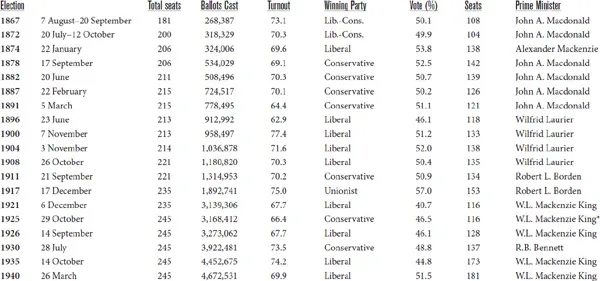
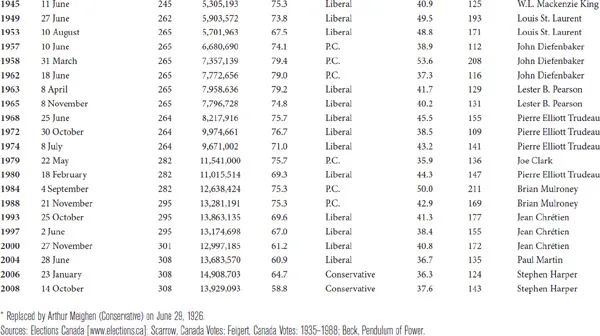
Elections are markers in a nation’s political history. They provide occasions, both practical and symbolic, when a collective political decision is rendered by the citizenry. Long after they occur, they also provide important reference points for significant political events or periods of political, social or economic change. The 1896 and 1968 elections that inaugurated the Laurier and Trudeau eras were two such major political turning points. Election results can sometimes be decisive, as in the “landslide” elections that occasionally thrust one party into a dominant position. Canada has experienced this type of outcome in elections such as those of 1940, 1958, and 1984 (see Table 1.1).
Such decisive victories are often interpreted at the time as a clear expression of the national will, but they do not always inaugurate a long era of dominance for the winning party. In reality, they sometimes owe as much to the operation of our electoral system as to the wishes of the voters. In the most recent of these dramatically one-sided elections (1984), the winning Progressive Conservatives received barely half of the total votes cast.1 And nine years later, the Parliamentary caucus of the PCs was reduced to two members.
TABLE 1.1
An Overview of Canadian Federal Elections, 1867–2008
Election outcomes can also be indecisive, sometimes making the formation of a government difficult and creating an atmosphere of political uncertainty. Minority governments such as those elected in 1957, 1962, 1979, or 2004 lasted only a short time before the public was asked to render a verdict in another election. In the past, minority results have sometimes paved the way for majorities, as in 1925, 1957, and 1972. At other times, they have led to reversals of electoral fortune, as happened after the 1979 and 2004 elections.
The electoral system plays a role in producing these minority outcomes as well. The Progressive Conservatives, for example, who formed a minority government following the 1979 election, received four percent fewer votes in that election than did the Liberals, but substantially more seats.2 In the 2006 federal election, Stephen Harper’s Conservative Party of Canada received about the same percentage of votes (36.3 percent) as Joe Clark’s Progressive Conservatives in 1979 (35.9 percent). In both instances, the party that assumed office held the confidence of barely more than a third of the Canadian electorate, but formed a minority government nevertheless.
Over the course of Canadian history, electoral patterns have sometimes become established that persisted over several consecutive elections. Typically, these elections have ushered in long periods of relative political stability, which we will refer to throughout this book as political dynasties.
There have been a number of instances in Canadian political history when the same party held power for a considerable length of time, often under the same prime minister. But these long periods of dominance by one party, so significant to historians today, would not necessarily have been regarded as imminent at the time they began. The 1993 election, for example, brought about one of the greatest political upheavals in Canadian history, devastating the then governing Progressive Conservatives and thrusting two new political parties — Reform and the Bloc Québécois — onto the federal scene (see Chapter 11). As it happened, the period following 1993 proved to be one of remarkable political stability, with Jean Chrétien winning three consecutive majority governments before yielding power to Paul Martin in 2003. Similarly, Mackenzie King’s tenure in office began during a period of turmoil following the First World War, a time of great social change both in Canada and in many other countries.
King first gained power with a minority government in 1921, an election which also saw the Progressives win 64 seats — one of the most successful “third party” surges in Canadian history. Winning fewer seats and substantially fewer votes than the Conservatives in the following election of 1925, King nevertheless clung to power, yielding office briefly to Arthur Meighen, but recovering to win a majority of seats in the election that took place less than a year later.3 Despite that victory, few would have predicted at that time that King would go on to lead the most successful political dynasty in Canadian history. But, when he finally retired in 1948, King had served a total of 22 years as prime minister, his long tenure in office interrupted only by the three months that Meighen served as prime minister in 1926 and by R.B. Bennett’s single term in office (1930–35).
Brief departures from long periods of political stability, such as the Bennett government, we refer to here as interludes. Political scientist Peter Regenstrief first used this term in the Canadian context when he titled his analysis of the Diefenbaker years “The Diefenbaker Interlude.”4 At the height of Diefenbaker’s success in 1958, it was not generally anticipated that the Liberals would be back in power only a few years later. It is only with the benefit of hindsight that analysts of that period of Canadian politics were able to recognize the Diefenbaker regime as an interlude in an otherwise long period of Liberal hegemony, first under King and St. Laurent, and later under Pearson and Trudeau.5 In the aftermath of his 1958 landslide, Diefenbaker’s political prospects would have appeared very different to his contemporaries (see Chapter 4).
In this book, we will advance the thesis that Canadian politics has repeatedly followed these patterns — long periods of political hegemony under successful political leaders, punctuated by short, sharp interludes that disrupted what seemed at the time to be a one-dimensional political success story. Nearly all of Canada’s successful political leaders have had this experience. Macdonald lost power to Mackenzie’s Liberals in the election of 1874, but regained it in the following election and continued on to head Canada’s first political dynasty until his death in 1891. Laurier, who became prime minister in the transformative election of 1896 and retained his majority in each of the next three (1900, 1904, and 1908), lost an election to Borden in 1911. Mackenzie King’s political dynasty was interrupted twice over a long period, by the Meighen and Bennett interludes, respectively. Having passed power on to Louis St. Laurent in 1948, the Liberal dynasty begun by King continued until Diefenbaker upset it in 1957. But Diefenbaker’s landslide victory in the election a year later proved to be short lived, in spite of the size of his parliamentary majority. Reduced to a minority government in 1962, Diefenbaker was out of office in 1963, replaced by the two successive minority governments of Lester Pearson. Pearson’s successor, Pierre Trudeau, consolidated a new Liberal dynasty with a decisive electoral victory in 1968 but suffered a setback in the near defeat of 1972.
Trudeau went on to lead one of the more successful political dynasties in modern Canadian history. Regaining a majority government in 1974, Trudeau’s tenure in office was also punctuated by a short interlude of defeat in 1979 (see Chapter 8). But the minority government of Joe Clark itself went on to electoral defeat only nine months later, placing Trudeau once again at the head of a majority government. When he retired from office in 1984, Trudeau had served a total of 15 years as prime minister, a tenure equivalent to that of Laurier and surpassed only by King (22 years) and Macdonald (18 years).
Chrétien’s dynasty lasted 11 years, and might conceivably have continued further had Paul Martin and his supporters not pushed him out of office in 2003.6 Martin’s two years in office can be thought of now primarily as an extension of the Chrétien dynasty, of which Martin was a key part until the onset of the “civil war” between these two camps within the Liberal Party (see Chapter 13).
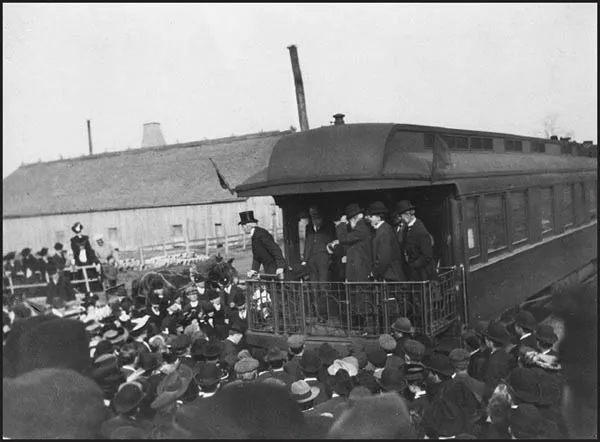
Library and Archives Canada.
Sir Wilfrid Laurier campaigning in Exeter, Ontario, 1904 election.
TABLE 1.2
Five Elections That Established New Political Dynasties
TABLE 1.3
Six Elections That Failed to Establish New Dynasties
The election in 2006 of a minority Conservative government under Stephen Harper could ultimately prove to be either an interlude (albeit one including two election victories), or the beginning of a new dynasty, depending upon Harper’s continued success in repositioning his party along the key issue dimensions of Canadian federal politics — an enduring characteristic of all successful dynasties that we will discuss in some detail throughout this book.7
In the chapters following, we will highlight the rise and fall of five major political dynasties: those of John A. Macdonald and Wilfrid Laurier, who shaped so much of Canada’s early political history; William Lyon Mackenzie King, whose dynasty continued for another nine years through the succession of Louis St. Laurent; Pierre Trudeau, representing a long period of Liberal governance begun by Lester Pearson in 1963 and punctuated only by the short-lived Clark government of 1979–80; and Jean Chrétien, whose three consecutive election victories beginning in 1993 extended a period of Liberal dominance with a fourth election won by Paul Martin in 2004.
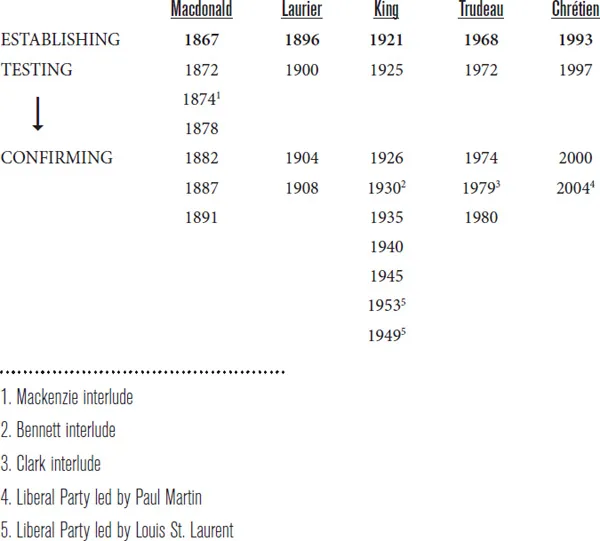
The establishment of these dynasties was not a simple matter. While each of the periods described above started with a decisive election victory, the new pattern established in that election was tested in the one following. Often, given the inherent volatility of Canadian electoral politics, the existence of the dynasty could not be confirmed until a third election demonstrated the staying power of both the party and its leader (see Table 1.2).
In the cases of both Mackenzie King and Pierre Trudeau, the test that occurred after their initial election was a dramatic one. King lost the election of 1925, but managed to remain in power for eight months before yielding to Arthur Meighen, whom he defeated more decisively in the subsequent election (1926). Trudeau’s election victory in 1968 was followed by near defeat in 1972 (see Chapters 6 and 7). Only after his political recovery in the 1974 election would it have been possible to discern the shape and durability of a “Trudeau dynasty.”
Such patterns suggest that to understand electoral politics in Canada, it is essential not to put too much emphasis on the interpretation of a single election. Instead, it is important to place elections within the context of a somewhat longer and more complex process of political and social change and of the evolution of political leadership.
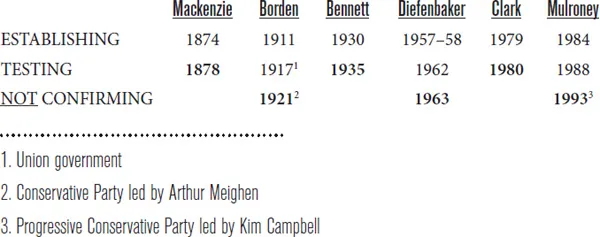
The interludes to which we refer throughout this book also contain many elements of complexity. A few, such as the single-term governments of Alexander Mackenzie (1874–78) or R.B. Bennett (1930–35) are readily demarcated. Likewise, the nine-month administration headed by Joe Clark (1979–80) represents a typical interlude, with Pierre Trudeau being returned to power decisively in the election of 1980. But others are not so readily classified. The Borden government elected in 1911 might not have lasted so long had its term not first been extended by the war and then subsequently by the election of a wartime Unionist government in 1917. Historically, it now appears as an extended interlude, in spite of the decisiveness of the 1911 and 1917 elections, both of which we will examine in greater detail in Chapter 2.
The Diefenbaker and Mulroney periods are likewise complicated segments of Canadian electoral history. Given their one-sided election victories (Diefenbaker in 1958, Mulroney in 1984), both of these leaders had the potential to establish new political dynasties. Mulroney in particular had the clear determination to do so. But, for a number of reasons that we will explore in greater detail in Chapters 5 and 11 respectively, neither Diefenbaker nor Mulroney was able to translate his dramatic election victory into the type of lasting political success attained by King or Trudeau (see Table 1.3). Despite the 1958 landslide, Diefenbaker failed a crucial electoral test in the election of 1962, and his government was defeated a year later. Mulroney, in contrast, won a difficult re-election in 1988, but was ultimately unable to either hold on to power himself or to pass the leadership on to a successor who could do so.
Had the political and economic events of the early 1990s unfolded differently, there could well have been a “Mulroney dynasty.” We could argue that the 2008 election likewise represented a crucial electoral test for Stephen Harper. But the continuation of minority government and the persi...