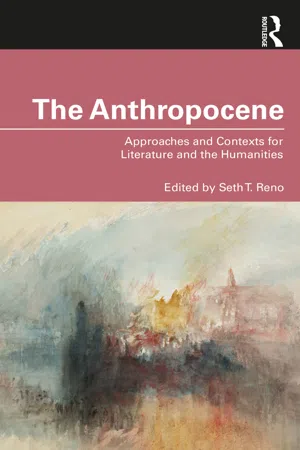
Perhaps no concept has become dominant in so many fields as rapidly as the Anthropocene. Meaning "The Age of Humans," the Anthropocene is the proposed name for our current geological epoch, beginning when human activities started to have a noticeable impact on Earth's geology and ecosystems. Long embraced by the natural sciences, the Anthropocene has now become commonplace in the humanities and social sciences, where it has taken firm enough hold to engender a thoroughgoing assessment and critique. Why and how has the geological concept of the Anthropocene become important to the humanities? What new approaches and insights do the humanities offer? What narratives and critiques of the Anthropocene do the humanities produce? What does it mean to study literature of the Anthropocene? These are the central questions that this collection explores. Each chapter takes a decidedly different humanist approach to the Anthropocene, from environmental humanities to queer theory to race, illuminating the important contributions of the humanities to the myriad discourses on the Anthropocene. This volume is designed to provide concise overviews of particular approaches and texts, as well as compelling and original interventions in the study of the Anthropocene. Written in an accessible style free from disciplinary-specific jargon, many chapters focus on well-known authors and texts, making this collection especially useful to teachers developing a course on the Anthropocene and students undertaking introductory research. This collection provides truly innovative arguments regarding how and why the Anthropocene concept is important to literature and the humanities.
- 184 pages
- English
- ePUB (mobile friendly)
- Available on iOS & Android
eBook - ePub
About this book
Information
Part 1 Approaches
DOI: 10.4324/9781003095347-2
1 The Deep Time Life Kit Thinking Tools for the Anthropocene
Lisa Ottum
DOI: 10.4324/9781003095347-3
Imagine you’re at home on the couch, scrolling through pictures of kittens, or Kardashians, or something. It’s late (or maybe it’s early—the time doesn’t really matter). You hear “breaking news” chimes on the TV and look up. It’s one of those depressing environment stories. You’ve seen these before: in fact, you could practically script the entire thing. There’s the familiar red “Alert!” banner next to a worried-looking expert. In the background, there’s footage of something on fire, or something melting, or some awful-looking pile of trash. Even though the sound is down, you can pick out the phrases “scientists warn” and “without further action.” Ugh. You sigh loudly. You look away. You feel bad about this latest catastrophe … but also irritated. Isn’t this someone else’s fault—all those stupid people more wasteful and shortsighted than you? Screw those people, whoever they are. You—you didn’t cause this, at least not directly. Besides, maybe they’re just exaggerating—hopefully. The media exaggerates, right? You flip off the TV. Still, you can’t shake a lingering sense of unease. None of this is really your fault, and yet you also feel a little stab of guilt—or maybe it’s sadness? It’s something unnamable, a sensation in search of a word.
This is life in the Anthropocene—or one part of it, anyway: the unsettling feeling that Earth is off-kilter, and that everyone, but no one in particular, is responsible. It’s not your imagination. Climatologically speaking, we are living in momentous times. According to the United Nations, the last six years (2015–2020) were the hottest on record; temperatures in the Arctic have risen three degrees Celsius since 1990.1 Globally, July 2019 was the hottest July ever recorded by the National Oceanic and Atmospheric Administration.2 According to NASA, arctic sea ice is melting at a record pace.3 I could list other alarming developments, although most people—even climate skeptics—can tell without consulting statistics that that weather outside their window is changing, and that things seem similarly out-of-whack elsewhere.
For scientists, the term “Anthropocene” refers to changes in Earth’s systems—to the myriad ways humans have altered the oceans, the land, and the air. Humanists, meanwhile, invoke the Anthropocene as a historical or cultural label. This chapter examines the Anthropocene from both of these perspectives, as well as a third perspective: that of the nonspecialist struggling to make sense of their role in creating, and responding to, climate change and other large-scale environmental disasters. For many people, the sheer magnitude of today’s environmental problems forms an emotional barrier to engagement. (Think back to that couch example from a moment ago.) What if ordinary people—and not just specialists—were to embrace the Anthropocene in both our private and public deliberations about the environment? By introducing geologic time into the conversation, the Anthropocene reframes partisan debates about climate change. It also invites us to imagine new ways of relating to environmentalism. While the idea of the Anthropocene is not a panacea for anger or anxiety, it might help us to cultivate affective stances that are more sustainable, and thus more compatible with action, than amorphous feelings of guilt and helplessness. In the pages that follow, I offer a brief history of the Anthropocene concept, before turning to an in-depth analysis of “Anthropocenic” thinking and its affordances.
The term “Anthropocene” surfaced in scientific literature as early as the 1980s, though its formal emergence is usually traced to a 2000 article in a rather obscure geology publication. In this article, Earth scientist Paul Crutzen and ecologist Eugene Stoermer proposed the term “Anthropocene” to describe a global environment dominated by human activity. Mankind, they asserted, has become a geological force whose influence seems likely to endure “for many millennia, maybe millions of years to come.” Therefore, they conclude, “it seems to us more than appropriate to emphasize the central role of mankind in geology and ecology by proposing to use the term ‘anthropocene’ for the current geological epoch.”4 Crutzen reiterated this view in a 2002 article for the journal Nature; it was then that the term “Anthropocene” came into widespread usage, catapulting from obscurity to common usage in less than a decade.5
As with any paradigm shift, the notion of an “Anthropocene” has been controversial, not only among geologists but among other scientists. At issue is the way we measure and describe planetary history: when exactly does one era of Earth’s history become a new one? For geologists, the question of whether we are indeed in a new era is a matter of stratigraphic evidence.6 Until the debate over the Anthropocene arrived, geologists placed our present day in the Holocene, an epoch that began about 11,500 years ago after the last glacial period. Compared to previous epochs in Earth’s history, this one has been pretty stable, ecologically speaking: Earth’s temperatures have stayed within a 1-degree Celsius range, and, as a result, human civilization emerged and has flourished. Yet things are changing fast—especially the temperature, which, even in most optimistic projections, is set to rise 1.5 degrees Celsius. Moreover, life on Earth is changing in ways that suggest a catastrophic rupture in the Holocene. On the geologic timescale, several key turning points correspond to mass extinction events (the so-called “Big Five” extinctions). Many experts believe that such an event—a Sixth Mass Extinction—is currently underway. Now, if you’re picturing “mass extinction” as the kind of event that wiped out the dinosaurs, this might seem far-fetched: there are no flaming meteorites raining from the sky outdoors. Not all mass extinctions are this cinematic, though. For example, the so-called Great Dying that took place at the end of the Paleozoic Era 250 million years ago may have included an enormous volcanic event; if this is true, then what actually killed everything was the global warming and ocean acidification that followed. In our own moment, species are going extinct at a rate that far exceeds the “background rate”—that is, the estimated natural rate at which species go extinct, absent catastrophe. (For reference, according to a 2015 study, for mammals, this rate is 2 species per 10,000 per 100 years. A recent study estimates that the current rate of vertebrate loss is 100 times that pace.)7
If previous geologic eras are marked by mass extinctions, and if we are currently in a mass extinction, then it stands to reason that we have entered a new moment in geologic time. It takes time for extinction events to show up in the rock record, though. Will geologists thousands of years in the future be able to pinpoint this event in Earth’s underlayers? Even if the answer is no, we’ve made other changes to the planet that may register stratigraphically. For example, humans have massively reshaped Earth’s surface through mining, agriculture, and the building of dams, all of which adds up to some pretty wicked erosion. We’ve also introduced millions of tons of manufactured stuff into the environment. A 2017 article in The Anthropocene Review estimates that the material output of humans—what the authors call the “physical technosphere”—weighs about 30 trillion tons. This technosphere “includes a large, rapidly growing diversity of complex objects that are potential trace fossil or ‘technofossils’.”8 In other words, our junk is creating a new Earth layer—one that “already exceeds known estimates of biological diversity as measured by richness, far exceeds recognized fossil diversity, and may exceed total biological diversity through Earth’s history.”9
Given all of these signs that humans are a planet-altering force, it might seem that the Anthropocene discussion is settled. Geologists are not in agreement, though, about whether to amend the geologic timescale. As geologist Jill Schneiderman explains, “formal stratigraphic practice requires a systematic approach to define, delineate, and correlate sequences of rocks and to identify stratigraphically constrained units of time based on contained rocks, minerals, and fossils as well as chemical and physical parameters.”10 The conditions do not yet exist to perform this sort of analysis because, in terms of geologic time, humans basically just got here. Another difficulty is that “certain indicators of the Anthropocene,” such as the rise of greenhouse gases in the atmosphere, “do not leave abrupt boundary layers in strata that would delineate the Anthropocene clearly.”11 Some other markers are not globally synchronous. For instance, if farming marks a significant turning point in Earth’s history, its traces will appear to start at different times, since some parts of the world were cultivated on a mass scale before others.
Here, we arrive at some questions that are interesting to people other than geologists, whose debates might seem arcane to those of us outside the field. Broken down its roots, the term “Anthropocene” names the “age of humans”; it is commonplace to use collective pronouns in discussing “our” imprint on the planet. However, as numerous critics of the term “Anthropocene” point out, our current environmental dilemmas are hardly the fault of “humankind.” Consider for a moment your personal carbon footprint compared to that of someone—an anonymous member of “humankind”—in a developing country. The resources brought to bear on housing, transporting, and feeding those of us in the Global North are enormous. To say that “humans” have mucked up the air, or the soil, or the oceans is to ignore profound differentials in responsibility. It also means ignoring the uneven distribution of environment-related burdens. To cite an obvious example, sea level rise is an acute problem for only some places, even though we have all contributed to the carbon emissions that drive sea level rise. For now, at least, people not living along coastlines have the luxury of simply ignoring the ocean, while some communities, and even entire island nations in the Pacific, scramble to cope with regular inundation, land loss, freshwater contamination, and other problems.
The disparities that underwrite the Anthropocene manifest in individual bodies, too. Children living near open waste dumps, or near polluting factories, bear the costs of “progress” at the level of their very cells. Thanks to a practice known as “regulatory arbitrage,” in which companies exploit weak environmental regulations in certain areas in order to comply with stiffer regulations elsewhere, toxins associated with a European or American product often end up in African bodies. For example, as historian Gabrielle Hecht explains, commodity trad...
Table of contents
- Cover
- Half-Title Page
- Title Page
- Copyright Page
- Table of Contents
- List of Figures
- List of Contributors
- Introduction: The Anthropocene and the Humanities
- Part 1 Approaches
- Part 2 Contexts
- Index
Trusted by 375,005 students
Access to over 1.5 million titles for a fair monthly price.
Study more efficiently using our study tools.
Frequently asked questions
Yes, you can cancel anytime from the Subscription tab in your account settings on the Perlego website. Your subscription will stay active until the end of your current billing period. Learn how to cancel your subscription
No, books cannot be downloaded as external files, such as PDFs, for use outside of Perlego. However, you can download books within the Perlego app for offline reading on mobile or tablet. Learn how to download books offline
Perlego offers two plans: Essential and Complete
- Essential is ideal for learners and professionals who enjoy exploring a wide range of subjects. Access the Essential Library with 800,000+ trusted titles and best-sellers across business, personal growth, and the humanities. Includes unlimited reading time and Standard Read Aloud voice.
- Complete: Perfect for advanced learners and researchers needing full, unrestricted access. Unlock 1.5M+ books across hundreds of subjects, including academic and specialized titles. The Complete Plan also includes advanced features like Premium Read Aloud and Research Assistant.
We are an online textbook subscription service, where you can get access to an entire online library for less than the price of a single book per month. With over 1.5 million books across 990+ topics, we’ve got you covered! Learn about our mission
Look out for the read-aloud symbol on your next book to see if you can listen to it. The read-aloud tool reads text aloud for you, highlighting the text as it is being read. You can pause it, speed it up and slow it down. Learn more about Read Aloud
Yes! You can use the Perlego app on both iOS and Android devices to read anytime, anywhere — even offline. Perfect for commutes or when you’re on the go.
Please note we cannot support devices running on iOS 13 and Android 7 or earlier. Learn more about using the app
Please note we cannot support devices running on iOS 13 and Android 7 or earlier. Learn more about using the app
Yes, you can access The Anthropocene by Seth T. Reno in PDF and/or ePUB format, as well as other popular books in Literature & Literary Criticism. We have over 1.5 million books available in our catalogue for you to explore.