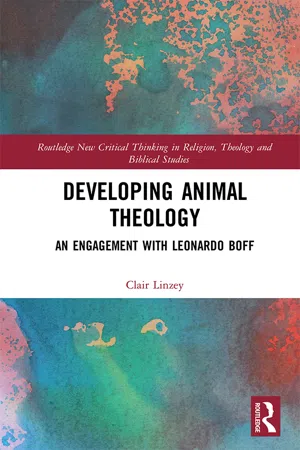
This book offers an up-to-date examination of the nature and development of animal theology. It considers what animal theology is and how it challenges, and is challenged by, liberation and ecological theology. At the heart of the work is a critical engagement with the Brazilian ecotheologian Leonardo Boff. Clair Linzey addresses ideas that originate from the papal encyclical Laudato Si' and considers how Pope Francis is developing an animal friendly tradition within Catholicism. Exploring new vistas in animal theology, this volume makes a valuable to contribution to debates on how religion should be concerned with animals and the environment. This book is essential reading for anyone who wants to know the current state of debate with animal theology and its effects on the wider Christian community.
- 206 pages
- English
- ePUB (mobile friendly)
- Available on iOS & Android
eBook - ePub
About this book
Information
1 Introduction
DOI: 10.4324/9781003205678-1
On the outskirts of São Leopoldo, I see an emaciated, tired horse searching for food in a rubbish heap. Behind the horse, I see homes made from corrugated cardboard and a small, thin child playing in the rubbish. I am on my way to a theological congress at EST Faculdades in São Leopoldo, in the south of Brazil. The image of the horse and the child on the rubbish heap haunts me as I travel through Brazil, as it brings together the central themes of my work—poverty, ecology, and animals—in the largest Catholic country in the world.
This book seeks to develop animal theology in dialogue with the Brazilian theologian Leonardo Boff. His work encompasses liberation, ecological, and contextual theologies, and it is in these principal areas that I hope to develop my animal theology. Boff’s theology reflects the theological neglect of animals in the Roman Catholic tradition. Yet paradoxically, his thought, especially his ecotheology, may be a catalyst for greater concern for creation, including animals. I look in detail at four of his most significant works over three decades, works that best represent the development of his thought in these areas.
This introduction begins with a discussion of what animal theology is based on, foundational insights of animal theology, which provide a guide to the key themes of the work, and a review of current literature. The last section of this chapter comprises my methodology and an outline of the chapters. It poses three guiding methodological questions which frame the book. It also contains a guide to the interviews conducted in Brazil in order to provide an overview of interview method, the interviewees, and their expertise. The introduction ends by explaining the contents of the appendices.
What is animal theology?
Before I turn to my discussion of what animal theology is, some definitions may be useful. In discussions of creation theology, some terms are often used interchangeably—for instance, “animals” and “creatures.” Many theorists now adopt the language of “nonhuman animals” instead of “animals” because it signifies the fact that biologically humans are animals. This term is often used in an attempt to bridge the linguistic divide that can be used to separate humans from animals. While acknowledging the importance of language in constructing how we understand human–animal relationships, this work will retain the word “animal.” For the sake of brevity, throughout this work “animal” will be understood as nonhuman animal, and “human” as human animal. For the purposes of this work, the term “animal(s)” is used to mean nonhuman animals in whom sentiency can be reasonably supposed—that is, all mammals, reptiles, amphibians, birds, and fish. Sentience may be defined as the ability to experience pleasure and pain, including mental suffering involving fear, shock, terror, anticipation, anxiety, stress, foreboding, or distress.1 Sentiency has been established by scientific papers in peer-reviewed journals and in many academic volumes.2 The theological implications of sentience will be discussed below in relation to insight (e). Although insects are animals, they are not included within this definition because sentiency has yet to be established in their case. “Creature(s)” is a broader term that is used to indicate beings within creation, which would include all animals, sentient or not. Creation here is understood as including all created beings, whether animals or plants, as well as other parts of the natural world, such as rivers, mountains, minerals, and so on.
To understand what is developed in this book, we must first grasp what animal theology is. Animal theology is a term coined by Andrew Linzey3 in 1994 in his now classic work Animal Theology.4 The grounds for selecting and focusing on Linzey’s work are threefold. First, Linzey has pioneered the field. Mark Rowlands maintains that: “Andrew Linzey is virtually synonymous with the discipline of animal theology: a discipline that he has legitimate claim to have single-handedly invented.”5 Second, Linzey is the only theologian to be recognised by the awarding of a Lambeth Doctorate of Divinity by Archbishop George Carey for his “unique and massive pioneering work at a scholarly level in the area of the theology of creation with particular reference to the rights and welfare of God’s sentient creatures.”6 Third, Linzey’s corpus is much larger than generally appreciated. Apart from over 100 articles, his books, both authored and edited, on animals are: Animal Rights: A Christian Assessment (1976), Christianity and the Rights of Animals (1987), Animals and Christianity: A Book of Readings (1988), Song of Creation (1988), Compassion for Animals: Readings and Prayers (1988), Political Theory and Animal Rights (1990), Animal Theology (1994), After Noah: Animals and the Liberation of Theology (1997), Animals on the Agenda: Questions About Animals for Theology and Ethics (1998), Animal Gospel: Christian Faith as if Animals Mattered (1999), Animal Rites: Liturgies of Animal Care (1999), Animal Rights: A Historical Anthology (2005), Creatures of the Same God: Explorations in Animal Theology (2007), Why Animal Suffering Matters: Philosophy, Theology, and Practical Ethics (2007), The Link Between Animal Abuse and Human Violence (2009), Other Nations: Animals in Modern Literature (2010), The Global Guide to Animal Protection (2013), Animal Ethics for Veterinarians (2017), The Ethical Case Against Animal Experiments (2018), The Palgrave Handbook of Practical Animal Ethics (2018), The Routledge Handbook of Religion and Animal Ethics (2018), and Ethical Vegetarianism and Veganism (2018). He is therefore the theologian who has published more on the status of animals than any other. Bishop John Austin Baker claims him as “the greatest living writer on theology and animals.”7
In his introduction to Animal Theology Linzey states, “I hold that Christian theology provides some of the key categories of thought which enable a full satisfying ethical conception of the place of non-human creatures in our world.”8 Linzey does not offer a strict definition of the term, and so let me attempt to offer one. Animal theology is an attempt to view the Christian tradition through an animal-friendly lens, while retaining a critical approach to the tradition with regard to its concern for animals. Animal theology is involved, like feminist theology, in a process of looking again at the Christian tradition to reclaim and rebuild insights and voices concerning our relationship with animals. Although animals are now under discussion in various academic fields, animal theology is distinct from, for example, discussions in philosophy, which might include animal rights language,9 or discussions in law, which include conceptions of property or personhood.10 Animal theology begins from theological concepts, and although it may garner some insights from other animal fields, it is grounded in its own set of theological considerations. It begins from the perspective that although critical of the Christian tradition, contained therein are many resources for a better understanding of our relationship with animals. Since Linzey pioneered the subfield, there has been increasing literature on the subject of animal theology.11
In discussing the themes of animal theology, I will draw not just upon the work Animal Theology but on all of Linzey’s corpus, to draw out what I consider to be the foundational insights of animal theology. Although his perspective has developed over time, a clear statement of Linzey’s position is given in his “Credo” in Animal Gospel. It is the clearest, succinct articulation of what animal theology encompasses. It is worth reproducing here in full:
I affirm the One Creator God from whom all existence flows. I celebrate the common origin of all life in God. I undertake to cherish and love all creatures whose life belongs to God and exists for God’s glory.
I affirm the life of Jesus as the true pattern of service to the weak. I promise my solidarity with all suffering creatures. I join hands with Jesus in his ministry to the least of all, knowing that it is the vocation of the strong to be gentle.
I see in the face of the Crucified the faces of all innocent, suffering creatures. I hear their cries for a new creation. I thank God for the grace to feel their suffering and give voice to their pain.
I affirm the Word made flesh as the new covenant between God and all sentient creatures. I seek to live out that covenant in acts of moral generosity, kindness and gentleness to all those creatures that God has gathered together into unity.
I affirm the life-giving Spirit, source of all that is wonderful, who animates every creature. I pledge myself to honor life because of the Lord of life.
I affirm the hope of the world to come for all God’s creatures. I believe in the Cross as the symbol of liberation for every creature suffering from bondage. I will daily trust in the redeeming power of God to transform the universe.
I pray that the community of Christ may be blessed with a new vision of God’s creation. I will turn away from my hardness of heart and seek to become a living sign of the Gospel for which all creatures long.
I rejoice in animals as fellow-creatures: loved by the Father, redeemed by the Son, and enlivened by the Holy Spirit.
May God the Holy Trinity give me strength to live out my commitment this day.12
Linzey’s Credo is the s...
Table of contents
- Cover
- Endorsements
- Half Title
- Series Page
- Title Page
- Copyright Page
- Dedication
- Table of Contents
- Acknowledgements
- 1. Introduction
- 2. Boff and his context
- 3. The liberator who does not liberate creation
- 4. Fraternity only with humans
- 5. Cosmological liberation without animal liberation
- 6. A new Catholic moral sensitivity?
- 7. Towards a Trinitarian theology of animal liberation
- 8. Conclusions
- Appendices
- Index
Trusted by 375,005 students
Access to over 1.5 million titles for a fair monthly price.
Study more efficiently using our study tools.
Frequently asked questions
Yes, you can cancel anytime from the Subscription tab in your account settings on the Perlego website. Your subscription will stay active until the end of your current billing period. Learn how to cancel your subscription
No, books cannot be downloaded as external files, such as PDFs, for use outside of Perlego. However, you can download books within the Perlego app for offline reading on mobile or tablet. Learn how to download books offline
Perlego offers two plans: Essential and Complete
- Essential is ideal for learners and professionals who enjoy exploring a wide range of subjects. Access the Essential Library with 800,000+ trusted titles and best-sellers across business, personal growth, and the humanities. Includes unlimited reading time and Standard Read Aloud voice.
- Complete: Perfect for advanced learners and researchers needing full, unrestricted access. Unlock 1.5M+ books across hundreds of subjects, including academic and specialized titles. The Complete Plan also includes advanced features like Premium Read Aloud and Research Assistant.
We are an online textbook subscription service, where you can get access to an entire online library for less than the price of a single book per month. With over 1.5 million books across 990+ topics, we’ve got you covered! Learn about our mission
Look out for the read-aloud symbol on your next book to see if you can listen to it. The read-aloud tool reads text aloud for you, highlighting the text as it is being read. You can pause it, speed it up and slow it down. Learn more about Read Aloud
Yes! You can use the Perlego app on both iOS and Android devices to read anytime, anywhere — even offline. Perfect for commutes or when you’re on the go.
Please note we cannot support devices running on iOS 13 and Android 7 or earlier. Learn more about using the app
Please note we cannot support devices running on iOS 13 and Android 7 or earlier. Learn more about using the app
Yes, you can access Developing Animal Theology by Clair Linzey in PDF and/or ePUB format, as well as other popular books in Theology & Religion & Christian Theology. We have over 1.5 million books available in our catalogue for you to explore.