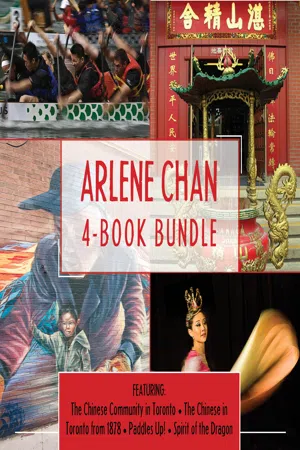
Third-generation Chinese-Canadian Arlene Chan shares the rich histories of Toronto's Chinese-Canadian communities in this special four-book bundle. Includes: The Chinese Community in Toronto
The history of the Chinese community in Toronto is rich with stories drawn from over 150 years of life in Canada. Stories, photographs, newspaper reports, maps, and charts will bring to life the little-known and dark history of the Chinese community, showing how the Chinese make a significant contribution to the vibrant and diverse mosaic that makes Toronto one of the most multicultural cities in the world. The Chinese in Toronto from 1878
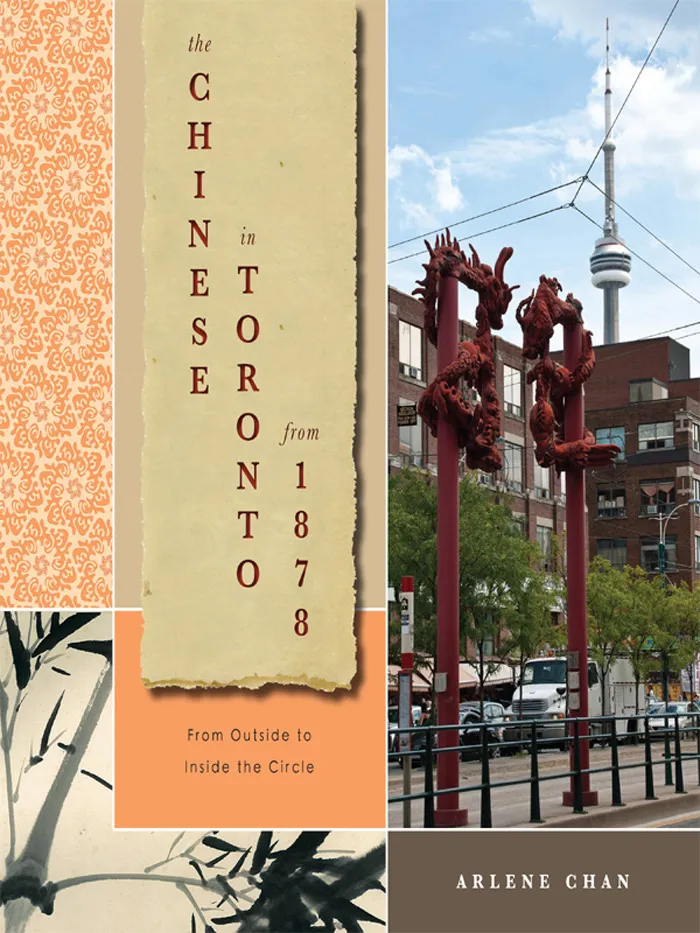
In 1894 Toronto's Chinese population numbered 50. Today, no less than seven Chinatowns serve the second-largest visible minority in the city, with a population of half a million. With their many achievements, the Chinese have become a vibrant part of the diverse mosaic that makes Toronto one of the most multicultural cities in the world. Paddles Up! Dragon Boat Racing in Canada
Paddles Up! provides an in-depth look at dragon boating from its beginnings in ancient China to the modern-day prominence of Canadian teams on the international scene, as told in the words of top coaches of men's and women's teams, experts and enthusiasts, and sports health professionals across Canada. Spirit of the Dragon: The Story of Jean Lumb
The Order of Canada, the country's highest honour, is awarded to those who have made a distinct contribution to Canadian life. The late Jean Lumb received the Order of Canada, among other awards, for her role in changing Canada's immigration laws that separated Chinese families, and for her contribution in saving Chinatowns across Canada.
eBook - ePub
Arlene Chan 4-Book Bundle
The Chinese Community in Toronto / The Chinese in Toronto from 1878 / Paddles Up! / Spirit of the Dragon
- 751 pages
- English
- ePUB (mobile friendly)
- Available on iOS & Android
eBook - ePub
Arlene Chan 4-Book Bundle
The Chinese Community in Toronto / The Chinese in Toronto from 1878 / Paddles Up! / Spirit of the Dragon
About this book
Information
Subtopic
North American HistoryIndex
HistoryThe Chinese in Toronto in 1878
CONTENTS
ACKNOWLEDGEMENTS
INTRODUCTION
ONE…The Gold Rush and the Canadian Pacific Railway, 1858–1885
TWO…The Birth of Toronto’s Chinatown, 1885–1922
THREE…Early Organizations and the Great War, 1885–1922
FOUR…The Bachelor Society and the War Years, 1923–1947
FIVE…Saving Chinatown, 1947–1966
SIX…The Changing Face of Chinatown from 1967
SEVEN…Ethnoburbs in the 1980s
EIGHT…Diversity in the 1990s and 2000s
NINE…Inside the Circle
AppendixI
Chinese Canadians (Greater Toronto Area) Appointed to the Order of Canada, 1976–2010
AppendixII
Chinese Canadians (Greater Toronto Area) Appointed to the Order of Ontario, 1991–2010
NOTES
SELECTED BIBLIOGRAPHY
ABOUT THE AUTHOR
ACKNOWLEDGEMENTS
I am grateful to so many individuals who took time to tell me their stories of life in Chinatown and to share their memories and photographs from precious family albums. Many thanks to Nelson Wong, Wendall Chin, Victor Wong, Mavis Garland, Gordon Chong, Albert Lee, Harry Tang, Shirley Hune, Bernice Hune, Doug Hum, Linda Chan, Monica Ssutu, Alfie Yip, Lin Yip, Roberta Lau, Keira Loughran, Stephen Siu, Harry Chong, and Susan Chong. My gratitude also extends to Ruth Lor Malloy, Lou Manning, and Matthew Law, who granted permission to include their photographs, but especially to Jens Ronneberger and Tam Kam Chiu, who brought my wish list to life with their cameras. Valerie Mah’s landmark works on the early Chinese in Toronto were invaluable. The incredible resources of the Toronto Public Library — particularly the Urban Affairs Library and Toronto Reference Library — and the Toronto Archives helped my research immensely. The Multicultural History Society of Ontario was accessible and I thank Carl Thorpe, Dora Nipp, and Emily Beliveau for their advice, diligence, and patience. I am grateful to the scholars, researchers, historians, and journalists who have written about the Chinese diaspora, providing me with rich resources to tell the story of the Chinese in Toronto. One challenge was to shortlist the individuals and organizations that are described in this book, to the exclusion of so many others that merit a book on their own.
Barry Penhale, publisher emeritus of Dundurn, has been my guiding light for this book and other adventures. I thank him for his warm encouragement over the past 10 years. Special thanks are reserved for Jennifer McKnight and Matt Baker and their meticulous editing.
The scope of my research was limited almost exclusively to English language sources despite the increasing availability of information in Chinese, particularly on the Internet. I thank my husband, Leo, for his translations, and both Leo and my sister, Janet, for being my sounding board and wise counsels.
And, finally, I would like to acknowledge the thousands of Chinese men and women, whose labours and tribulations have contributed so much to the colourful and celebrated cultural mosaic of Toronto.
INTRODUCTION
A journey of a thousand miles begins with a single step.
—CONFUCIUS
—CONFUCIUS
The story of the Chinese in Toronto has roots in an ancient civilization and branches that extend to one of the youngest countries. Canada was in its infancy, not yet having celebrated a birthday, when the first wave of Chinese arrived on its shores in 1858. Toronto was younger still, with its first Chinese recorded in 1878 as laundryman Sam Ching.
The arrival of these early immigrants from China marked the first step in “a journey of a thousand miles” that would take years in an arduous climb up the untravelled cliffs of what came to be known as “Gold Mountain.” The contributions of these pioneer immigrants forged the foundation of Canada’s multicultural mosaic. Their legacy, pre-dating Confederation and spanning 150 years in the country, comprises only a fraction of their homeland’s civilization — marked in history by millennia. And yet their impact can be felt in the flourishing communities of present-day Toronto, which has a thriving population of Chinese Canadians. Chinatown is no longer an ethnic enclave that sheltered the early Chinese from a hostile host society. There are now many Chinese communities that have broken out of the Chinatown mould and have successfully established themselves in many areas of the city.
There are many stories to tell. Some are told in the words of individuals from the past and present, others as excerpts from novels, poems, and biographies that reflect Chinatown both real and imagined. No one story alone can fully describe the societal disadvantages that shrouded the Chinese in Canadian society. The hardships of early immigrant life and injustices of the government and society are brought to light not so much to inspire shame as to show lessons learned.
A country that has gained a worldwide reputation for compassion and human rights was historically less than compassionate, and this is worth exploring. Individual decisions of public officials alone, such as parliamentarians, police officers, judges, and even prime ministers, did not create the hostile environment. Rather, institutional and systemic racism was entrenched in the official policies and legislation of the day. Why the Chinese made the decision to leave their families and homeland in mass numbers becomes clear when the factors that pushed them out of China and pulled them to Canada are explained.
More than 17,000 Chinese labourers, mostly from one province in Southern China, came to Canada to make their fortunes. Their dreams were not unlike those of other newcomers, who wanted to own their own land and businesses and to make a life with their families. They fled conditions that were filled with war, poverty, and starvation. These immigrants were a small portion of the single biggest migration out of China in its long history. Many departed for Southeast Asia. Many went to the United States. Some came to Canada in hopes of striking gold or working as labourers for the Canadian Pacific Railway.
The Chinese struggled under extreme hardship as they tried to find employment in a harsh environment filled with state-sanctioned hostility, hatred, and discrimination. They moved eastward across Canada in search of more welcoming towns and cities. Subsequent waves of immigration were shaped by immigration laws that restricted and excluded Chinese almost exclusively. Canadian government and businesses exploited Chinese labour but resisted the acceptance of Chinese into Canadian life. The established white society viewed the Chinese as foreigners who could be imported or expelled as needed. The great irony of the Chinese Canadian experience has been that success was as dangerous as failure. Whenever the Chinese excelled as labourers or businessmen, efforts arose to depict their contributions not as a boon to Canada, but as a threat. The federal government succumbed to public demand, first with a series of head taxes, and, finally, with the infamous Chinese Exclusion Act, which slammed shut the doors to Canada for 24 years.
After the Second World War and the repeal of the Exclusion Act, several waves of Chinese immigrants entered Canada at different times and for different reasons. The People’s Republic of China was established in 1949. The Nationalist Party fled and set up headquarters in Taiwan. Civil unrest in Southeast Asia brought boatloads of refugees into Canada. Hong Kong and Macau were handed back as special administrative regions of the People’s Republic of China. All of these historic events shaped the immigration patterns to Canada.
The telling of the story of the Chinese in Toronto has been a personal journey for me. The phrase “outside the circle” is a reference made by my mother, Jean Lumb, a Torontonian, as she reflected on her childhood years at a segregated school. “Why are we being treated this way? Why can’t I do what other people do? The most important thing at that time was being accepted into the circle. I didn’t want to be outside looking in. I wanted them to accept me in this circle.”
The Chinese in Toronto were kept outside the circle for decades by decision-makers at the municipal, provincial, and federal levels, by the media, and by Canadian society. The modest beginnings of Chinese in Toronto and the development of Chinatown are due to the completion of the Canadian Pacific Railway in 1885, after which time Chinese labourers fled eastward from a hostile British Columbia in search of employment and a more welcoming place. In 1894 the Chinese population in Toronto numbered 50. Today, no less than seven Chinatowns serve the city’s largest visible minority, with a population just short of half a million. After English, Chinese is the most spoken language in the Toronto area.
Chinatown was, for a time, in a constant state of flux, reacting to a history notched with varying restrictions, exclusions, and periods of immigration that destroyed or re-located its physical centre. Despite these tumultuous setbacks, the story of the Chinese in Toronto has a happy ending. Today, the Chinese communities are flourishing — a testament to resilience and endurance of those early settlers seeking a better future for their families. While the promised land of Gold Mountain never materialized, they paved the way for their descendants to reach undreamed of heights.
As a third-generation Chinese Canadian, I was born, raised, and educated in Toronto. I spent my childhood in what is now called Old Chinatown, at Elizabeth and Dundas streets. My parents were the co-owners of the Kwong Chow Restaurant, at the time considered one of the “big four” Chinese restaurants in the city. Beforehand, they had operated a grocery store in the Junction at the west end. Our family moved to a house at the intersection of Dundas and Beverley streets, where I attended public school and Chinese school.
The arrival of my maternal grandfather in 1899 was followed a few years later by that of my grandmother; they were both from Taishan. My father paid the $500 head tax for entry in 1921. Nanaimo, British Columbia, was the birthplace of my mother, who also experienced, first-hand, the...
Table of contents
- Cover
- Spirit of the Dragon
- Paddles Up!
- The Chinese in Toronto in 1878
- The Chinese Community in Toronto
- Copyright
Trusted by 375,005 students
Access to over 1.5 million titles for a fair monthly price.
Study more efficiently using our study tools.
Frequently asked questions
Yes, you can cancel anytime from the Subscription tab in your account settings on the Perlego website. Your subscription will stay active until the end of your current billing period. Learn how to cancel your subscription
No, books cannot be downloaded as external files, such as PDFs, for use outside of Perlego. However, you can download books within the Perlego app for offline reading on mobile or tablet. Learn how to download books offline
Perlego offers two plans: Essential and Complete
- Essential is ideal for learners and professionals who enjoy exploring a wide range of subjects. Access the Essential Library with 800,000+ trusted titles and best-sellers across business, personal growth, and the humanities. Includes unlimited reading time and Standard Read Aloud voice.
- Complete: Perfect for advanced learners and researchers needing full, unrestricted access. Unlock 1.5M+ books across hundreds of subjects, including academic and specialized titles. The Complete Plan also includes advanced features like Premium Read Aloud and Research Assistant.
We are an online textbook subscription service, where you can get access to an entire online library for less than the price of a single book per month. With over 1.5 million books across 990+ topics, we’ve got you covered! Learn about our mission
Look out for the read-aloud symbol on your next book to see if you can listen to it. The read-aloud tool reads text aloud for you, highlighting the text as it is being read. You can pause it, speed it up and slow it down. Learn more about Read Aloud
Yes! You can use the Perlego app on both iOS and Android devices to read anytime, anywhere — even offline. Perfect for commutes or when you’re on the go.
Please note we cannot support devices running on iOS 13 and Android 7 or earlier. Learn more about using the app
Please note we cannot support devices running on iOS 13 and Android 7 or earlier. Learn more about using the app
Yes, you can access Arlene Chan 4-Book Bundle by Arlene Chan,Susan Humphries in PDF and/or ePUB format, as well as other popular books in History & North American History. We have over 1.5 million books available in our catalogue for you to explore.