![]()
CHAPTER 1
The Early Years
Three unidentifiable people, shrouded in hoods and mystery, would regularly come walking up the street toward our home in Toronto when I was a child. I didn’t know if they were men or women, but they would come up from Queen Street, just below Dundas. They would proceed slowly and eventually come to a stop outside our apartment building on Simcoe Street. After a pause, they would come up the walkway, frightening and unknown to me. They would enter the house in complete silence, without ever exchanging a word between them. My parents never seemed to be around or to notice. And then, slowly, they would start climbing the stairs toward my bedroom as my mind raced, my little heart pounded, and my fears exploded. Then I’d awaken with a start from that persistent dream, and they would be gone.
From time to time when I wake up in the middle of the night, even today at age eighty-four — eight decades later — I still revisit that chilling scene in my sleep, and it leaves me with a sense of fear and uncertainty. In many ways, those three figures have never been gone. I’m sure psychologists would have a field day trying to sort out the symbolism of that dream. I have spent a good amount of time engaged in my own analysis of it. The one constant is that this vision has remained with me throughout my life, and I’ve wondered if it can be interpreted as an unconscious motivating force, something always lurking deep in my psyche, reminding me that I was under a surveillance of sorts and so I was required to behave a certain way. I had to set and strive for high goals, and all the while I couldn’t allow my colour to restrain me or give me excuses for not pursuing excellence. Otherwise, I could expect one of those night visits.
I wonder if that dream is the sort of imagery we all share. Some of us suppress it. Some of us can’t shake it. You’ve got your family, your colleagues, your union, your place of worship, and any number of support systems. But the message, the bottom-line truth, is that deep in our consciousness we all know we are accountable to ourselves, and within us the motivating force — our own versions of the three hooded figures in black, with their gowns swaying as they walk — will be there to remind us of that.
In truth, if that interpretation is accurate, then the messages are really the ones my mother drilled into my head from the earliest age. For it was she, Mae Rose Royale, a maid born in Jamaica, who really imparted to me those core lessons that endure to this day. When I look back at her circumstances, I am filled with wonder at her courage in advocating and encouraging the pursuit of such noble and lofty goals.
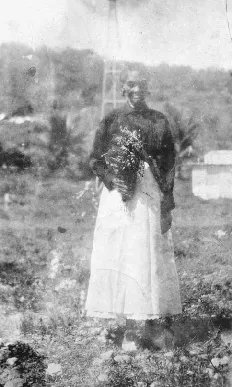
It’s rather worn out, but this is my grandmother on my mother’s side. Naturally, the picture is an important family memento.
While my family was living at 29 Draper Street in Toronto when I was born on January 21, 1922, my first recollections of that iconic dream go back to when we lived on Simcoe Street. My folks later moved to McCall Street in downtown Toronto and again later to Chatham Avenue in the east end of Toronto. While I don’t recall being overly traumatized by racial issues at the time, they existed in abundance. Indeed, there was no doubt in me from
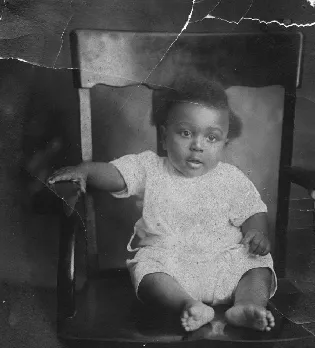
Here I am as a rather handsome young fellow in 1922 at age six months.
my earliest years of what it meant to be a visible minority, even though it would be decades later — in the 1960s and 1970s, in particular — before that term would become common. As a matter of fact, to the best of my memory I can recall only three other black families when I was growing up in the east end: the Abbotts, the Scotts, and the Berrys. When you consider the east end of Toronto of today, it is stunning to realize how much the city has changed in that regard.
Back then in Toronto there were certain places that, if you went there as a black, you had to be foolish. These places may not have been numerous, but you knew to avoid them. Nevertheless, as I would later discover, it was nothing like Harlem in New York, where I would spend almost three of my formative years. The scene in Toronto at that time wasn’t violent, though you had to know your place and govern yourself accordingly.
So, not surprisingly, one of my favourite phrases — “black is beautiful” — just wasn’t the case in those days. Getting work was difficult, if not impossible. Lots of black people were reduced to doing jobs such as plucking feathers from chickens, being maids, or taking on squalid and demeaning labour. In this respect, for many people, there was not a lot of promise in life. After all, this was the WASP Toronto of the 1920s, where people with my parents’ and my colour of skin were barely sufficient in number to constitute a minority group. Blacks at that time made up a sliver-thin portion of the city’s population, and racial prejudice abounded. That environment clearly defined for my parents the kind of employment opportunities they could expect. Theirs was not a world filled with workplace options, so they settled on careers that were largely the default jobs for blacks at that time. For my mother, it would mean toiling as a maid or doing similar domestic work. She chose to work as a maid. My father, Lincoln MacCauley Alexander Sr., was a carpenter by trade, but he had little hope of pursuing that career here in Canada. He took work as a railway porter and, from what I gather, thrived at it. In any case, both lines of work were better than not working, and they were not among the squalid options.
As if the odds at the time were not adequately stacked against them, more pressure soon arrived in the shape of the Great Depression, though it turned out that monumental economic catastrophe did not affect them greatly. Fortunately, they were both committed and industrious, and throughout that difficult time both my parents continued to work and provide a home for me and for my brother, Hughie, two years my junior. Despite the economic and racial pressures my parents encountered in those early years, or that I had to face as I grew up, I will say emphatically to the day I die that I am overwhelmingly happy that they chose to leave the West Indies for Canada. My mom was born in Jamaica and my father in St. Vincent and the Grenadines; their paths brought them to Canada, where they met and started to build a life. My mother, whom I remember as strong-willed and determined, came to Canada at the height of the First World War and risked being attacked by German U-boats to get to the North American continent. That experience alone should present a pretty potent illustration of her firm character.
As much as I idolized my mother, as a youngster I also had immense respect for my father, though later events would cause that respect to erode to a significant extent. He had arrived in Canada about the same time as my mother. To a little kid, my six-foot-four father was a source of awe. They called him Big Alex. He cemented that awe in me one time when Hughie and I were playing in the yard in front of our apartment building. Even though we had a balcony on our second-floor apartment, we often came down to the yard to play outside. A disheveled drunk had come wandering up the street, staggering and mumbling and talking to no one in particular. My father told him to move along and leave us alone. To the drunk’s later dismay, I’m sure, he chose not to leave us alone, so my father decked him with one punch, and the guy went down like a ton of bricks, out cold. I remember thinking, Wow, that was my dad. That was my dad coming to the rescue of his two little sons. It made one heck of an impression on me.
After coming to Canada from St. Vincent, my father had tried his hand on the East Coast, where he had a brother, but he eventually moved to Toronto. As I understand it, he left the East Coast because he didn’t approve of some of the things going on there: the folks there were involved in something illicit, such as rum-running or smuggling. So my dad gravitated to one of the few decent industries open to blacks in postwar Canada — the railway. Working the rails took him away from his wife and family for days on end, but it provided us all with the necessities of life and a modicum of dignity. In time, I was ready for school, and in Toronto I went first to Earl Grey Public School. I remember when it was time to go to kindergarten that first day another child came by, a nice black boy named Desmond Davis. (Desmond Davis later fathered Carl Davis, who is now an inspector in the equestrian division of the Toronto Police Service.) He was in Grade 2 and, being older, he came to take me to school and guide me across University Avenue.
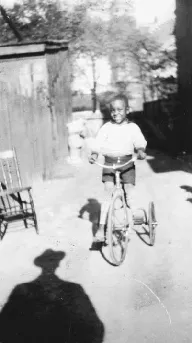
Me with my hot tricycle in the late 1920s.
There were not a lot of cars back then, not like today, but there were still enough vehicles rolling along the streets to create some danger. I remember that event as clearly as if it were yesterday — my first day of school.
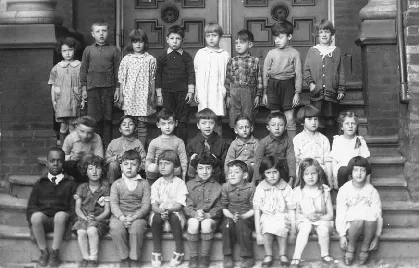
Here I am in my Grade 1 class photo in 1928. I’m front row left.
At the same time, I enjoyed another first: my first puppy love. I can still picture it. We were all in class sitting in a circle and — remember, I was the only black kid in the class — this little girl sort of took a liking to me, and she grabbed me by the hand and we walked around the circle. I forget what game we were playing, but it was typical of those games you play when you are in kindergarten. It’s funny the memories you can never shake, no matter how young you were when they happened. And that is one I’ve never forgotten, because it really struck me, even though I was a young child, that this was such a warm, friendly gesture that this girl offered. Oh, my, I was in love.
Despite such gestures of friendship, dealing with being the different one among my classmates was a constant for me, and it was never easy. Far from it. Throughout my education in Canada, from public school to my secondary and post-secondary studies, I was usually the only black face in my class. Despite that, I can tell you that I never raced home from school and cried. That was unacceptable. What mattered was gaining respect, and with the right kind of support from family, certain teachers,
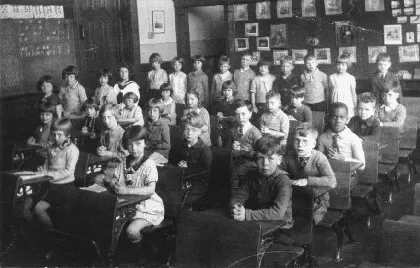
This was, I believe, my Grade 2 class at Earl Grey Public School. I’m third in the row on the right.
and other children, I was able to get that respect in a variety of ways. I can’t fight anymore, of course, but as a kid I would often have to fight, and I’m not ashamed to say that I had my fair share of entanglements. I wish it could have been otherwise, but at the time I had to stick up for myself. That taught me to always walk tall, and with a certain bearing, so people knew I meant business.
In the 1920s and ’30s, there were several hundred (although some estimates put it as high as seven thousand) blacks in Toronto, and racism was simply a grim fact of everyday life. You could be confronted with it anywhere from your job, to school, to out on the street. I felt I had to make it clear that I would not accept being called any of those insulting names — nigger, coon, whatever. If those issuing the insults couldn’t accept that, I had to resort to duking it out, and I can recall throwing the first punch, commonly known as a sucker punch.
When I started high school in Toronto, I went to Riverdale Collegiate, and, not surprisingly, yet again I was one of only a handful of black students. I was often singled out for name-calling and other insults, and that meant I again had to fight for respect. The results of these altercations were always the same: I’d win because no one else could fight like me. Of course, what’s wrong with that picture is the fact I had to fight at all. From that time to the present, I’ve been required to take whatever measures were necessary to assert my dignity and my right to respect — from scrapping in the schoolyard to calling out the dean of my law school for a public racial slur. Like it or not, confronting racism is a lifelong enterprise in which I have been engaged both personally and at the organizational level.
When I was young, I started piano lessons, essentially because my dad wanted me to be the next Duke Ellington. I wonder what he would have thought about me meeting Count Basie and the Duke in Harlem and then later on in Toronto. My father loved music and he loved the jazz of those years. I can’t recall whether he was disappointed to learn I just didn’t have any interest in the piano. I imagine he must have been somewhat let down. It wasn’t so much that I wasn’t musical. In fact, I can say without boasting that I do have a musical bent, not with an instrument but with my voice. That has been evident from time to time, such as during my 1960 trip to Africa when my fellow travellers and the native Africans couldn’t seem to get enough of my singing. But as a youngster, propped at the piano plunking away at boring scales, I’d look out the window and see the other boys playing softball and all kinds of other sports. Sitting in front of the piano was the last place I wanted to be when there was a ball or puck in sight. Some people have the right combination of talent and drive to play the piano, but I didn’t. I was fortunate enough to realize that and to give it up. I’d like to be able to play the piano now, but I’d have to practise a lot, and I am not interested in taking the time for that. You have to want it more than I did.
Instead, as youngster, I was very involved in extracurricular activities. I loved sports, to the detriment of piano. I used to run the hundred-yard dash in track, and I also played soccer, hockey, and softball — I even boxed. I loved it all, though I recognized I wasn’t all that gifted an athlete. I was tall and skinny with big feet, and as a result my co-ordination may not have been my strongest athletic asset. I was pretty good at sports, but, as a gangly youth, I didn’t excel. Nevertheless, even today I have a real love of sport because I think there’s great value in challenging yourself. Sport does that. It makes demands of you, and that can’t be a bad thing.
I can remember as a child being out on an outdoor rink in Toronto all by myself. I loved to skate, loved to hear the sound of the blades cutting and slashing through the ice. I liked crossing over my feet making turns and hearing the crunch of the ice. I eventually got a very good pair of CCM skates, which greatly enhanced my regular visits to the outdoor ice palaces. I liked to stickhandle the puck, too. Moving in and out with that rubber disc, zigging and zagging at top speed — well, my top speed — was such a thrill, with that brilliant winter air filling my lungs. It’s quite likely that the attraction was that being on the ice, with fresh air, speed, and exhilaration, delivered a fantastic sense of freedom.
I also tried lacrosse, but in recent years my greatest sports interest has become basketball, which is natural given my involvement with the Toronto Raptors Foundation, of which I am the chairman.
As kids, we used to walk from Chatham Avenue over to Riverdale Park to bobsled in the winter. We’d carve tracks out of hills and go careering like crazy, defying mortality. During the hot summer days, we would take that daredevil attitude and apply it to the track, where we raced our homemade go-karts. We’d make them out of old crates with roller skates for wheels, and we’d race them on the streets. I also did a lot of cycling when I was a kid. The point is that I was a pretty active youngster, as I think most children were at the time, and I worry that today c...