![]()
An Edmonton Album
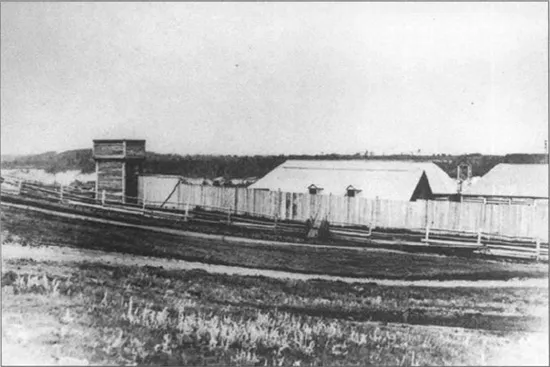
The original Fort Edmonton was built by the Hudson’s Bay Company in 1795, near present-day Fort Saskatchewan. The outpost was relocated four times in as many decades, however, before settling in 1830 upon the ideal site: near what would become Alberta’s Legislative grounds.
The fort, established as a fur-trading post, was part of the Hudson’s Bay Company’s westward expansion in an effort to compete with the rival North West Company. It proved to be a strategic trading position, and a natural distribution centre for the western prairies.
Fort Edmonton, circa 1871.
City of Edmonton Archives (COEA) EA-267-455.
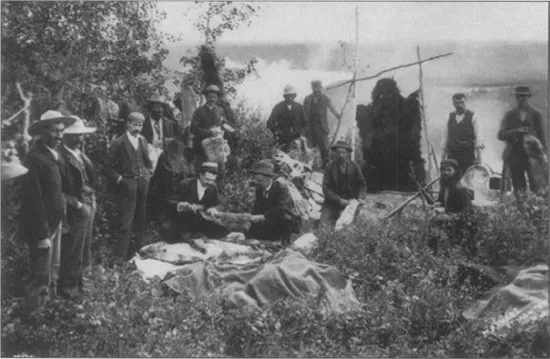
When Fort Edmonton was first established as a trading centre, traditional currency had no place in the west. The barter system was used in all transactions, with fur being the favoured medium of exchange.
The value of goods was determined in “made-beaver” pelts. A good horse was worth twenty made-beaver; a large axe was worth four. One made-beaver would get you any of the following: eight buffalo tongues, one and one-half feet of Canadian roll tobacco, one hundred pounds of grease, a scalping knife, ten balls of ammunition, or one quarter-pound of gunpowder.
Fur traders, circa 1900.
COEA EA-9-318.
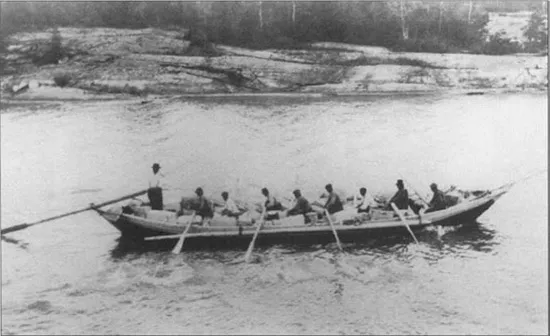
These were the boats sent out from York Factory by the Hudson’s Bay Company; each one carrying up to five tons of goods that could be traded to the Natives for furs and buffalo meat. York boats could be sailed when the wind was favourable, or rowed when it was not. Occasionally, the boats were “tracked,” or, literally, towed upstream by men walking along the shore.
York boat on the North Saskatchewan River, circa 1900.
COEA EA-1 12-12.
The notice ran in the Edmonton Bulletin:
Those having children of school age please remember that school will open precisely at 9 o’clock on Tuesday morning next, under the supervision of Mr. J. Harris. Terms — nothing. Books, slates, etc. should be got in readiness beforehand.
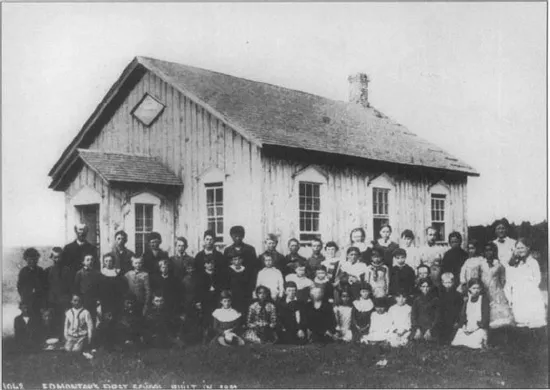
On January 3, 1882, Edmonton’s first schoolhouse opened to an enrollment of twenty-five boys and three girls. The rough frame building had been constructed at a cost of $968, solicited from members of the community. An additional $500 was raised to pay the teacher. Still, supplies were few and comforts were fewer, and Edmonton’s first school had a rocky start.
James Harris, the teacher, died within a few weeks, and two replacements had to be found before the term was through. The Hudson’s Bay Company reclaimed the iron box stove, and freezing students were sent home until another could be found. Classes also had to be cancelled on the occasions when district court was held in the schoolhouse.
In that first rough semester, students studied reading, writing, arithmetic, geography, dictation, spelling, history, and grammar. And though certain hardships had to be endured, Edmonton’s one-room schoolhouse served its purpose.
Edmonton’s first school, circa 1890.
COEA EA-10-909.
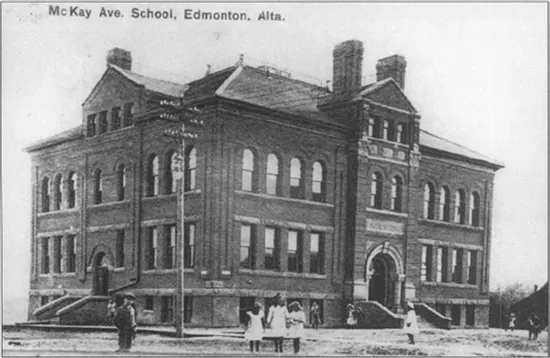
In 1904, on the site of Edmonton’s original schoolhouse, McKay Avenue School was built. The eight-room brick and stone structure bears the name of a Hudson’s Bay Company surgeon, Dr. William Morrison MacKay, although it will forever be misspelled “McKay” on the carved sandstone tablet above the doors.
McKay Avenue school carries the distinction of having housed the first two sessions of the Provincial Parliament. It has also seen a number of students move on to fame and fortune, including Supreme Court Justice Ronald Martland, actor Leslie Nielsen, and Clarence Campbell of the National Hockey League.
Today, McKay Avenue School has been restored, and is used as an educational archives and museum.
McKay Avenue School.
COEAEA-10-868.
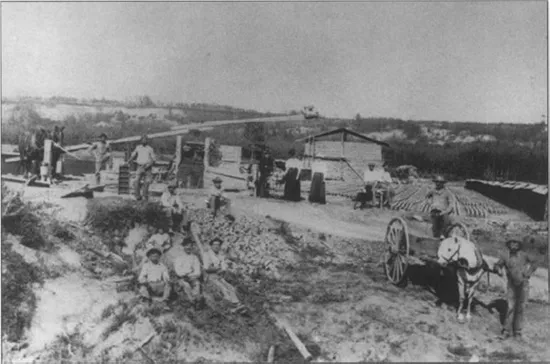
As Edmonton grew from a northern trading post to a modern city, brick was one of the popular and practical building materials. A Scottish businessman named James B. Little recognized the growing need and, with a single horse-powered machine and ten acres purchased on the Riverdale Flats in 1892, established a successful brickyard.
Business boomed and, within a decade, Little required an additional twenty acres and numerous mechanical upgrades to keep up with demand.
J. B. Little’s Brickyard.
COEA EA-47-01.
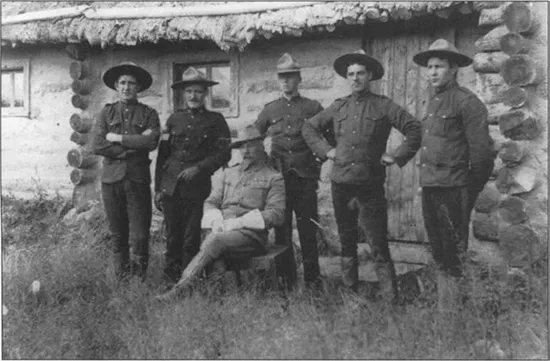
When six members of the North West Mounted Police posed outside a log cabin for this photo, it had been only eleven years since the first detachment of twenty Mounties reached Fort Edmonton.
North West Mounted Police, circa 1885.
COEA EA-10-871.
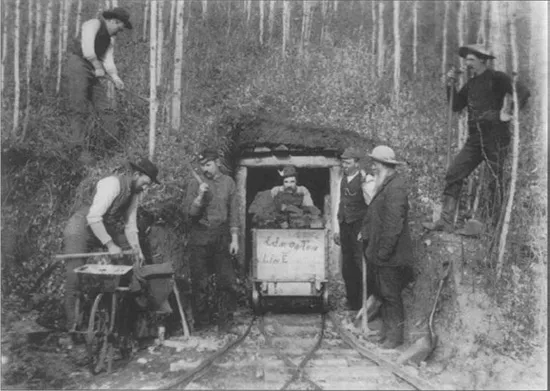
A coal car exits the Donald Ross Tunnel, November 6,1891.
COEAEA-10-1180.
Edmonton’s early settlers found all the coal they needed by digging small “gopher-holes” in the riverbank. By the 1880s, however, with the introduction of steam boats, saw mills, and other fuel-eating machines, increasing coal consumption gave birth to a true industry. Mining remained part of the econo...