Following a disastrous campaign in 1777, the alliance between the Six Nations and the British Crown became seriously strained. Relations were made even more difficult by the hands-off stance of Quebec's governor, General Guy Carleton, which led to the Native leaders developing their own strategies and employing traditional tactics, leading to a ferocious series of attacks on the frontiers of Vermont, New York, and Pennsylvania, supported by Loyalist and Regular troops. Among these were two infamous actions, referred to as "massacres" by American historians — attacks on the Wyoming and Cherry Valleys. This destructive campaign prompted the Continental Congress to mount three major retributive expeditions against the territories of the Six Nations and their allies the following year. In Fire and Desolation, Gavin Watt details individual historical conflicts, illustrates the crushing tactical expertise of the Senecas and their Loyalist allies, and provides a fresh perspective on Canada's involvement in the American Revolution and the unfolding events of 1778.
eBook - ePub
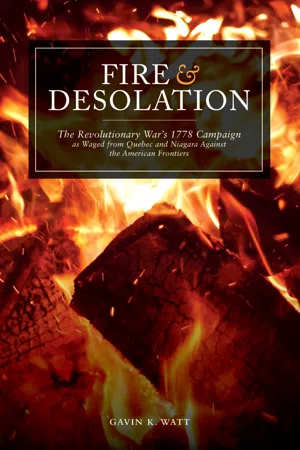
Fire and Desolation
The Revolutionary War's 1778 Campaign as Waged from Quebec and Niagara Against the American Frontiers
- 400 pages
- English
- ePUB (mobile friendly)
- Available on iOS & Android
eBook - ePub
Fire and Desolation
The Revolutionary War's 1778 Campaign as Waged from Quebec and Niagara Against the American Frontiers
About this book
Trusted by 375,005 students
Access to over 1.5 million titles for a fair monthly price.
Study more efficiently using our study tools.
Information
Notes
Chapter One: Lake Champlain, Upper Hudson River, and Lower Quebec
1. Whitcomb: Mike Barbieri, “Living History” (hereafter Whitcomb), Rutland Historical Society Quarterly 8.4 (Fall 1978), 25–39; Robert K. Wright, Jr., The Continental Army (Washington: Army Lineage Series, Centre of Military History, United States Army, 1989), 200.
2. Gavin K. Watt, Poisoned by Lies and Hypocrisy: America’s First Attempt to Bring Liberty to Canada, 1775–1776 (Toronto: Dundurn Press, 2014), 86, 129–46, 152; http://en.wikipedia.org/wiki/Timothy_Bedel.
3. Caleb Star, trans. and ed., Memoir and Official Correspondence of Gen. John Stark, with Notices of Several Other Officers of the Revolution… (hereafter Stark Correspondence) (Concord, NH: G. Parker Lyon, 1860), 142; Max M. Mintz, The Generals of Saratoga, John Burgoyne and Horatio Gates (New Haven: Yale University Press, 1990), 228; Paul L. Stevens, “His Majesty’s ‘Savage’ Allies: British Policy and the Northern Indians During the Revolutionary War: The Carleton Years, 1774–1778” (hereafter “Allies”) (PhD diss., State University of New York at Buffalo, 1986), XXIII, 1530; Wright, 122fn. Wright cites letter from Hazen to Gates, October 26, 1977.
4. Journals of Congress, 1777–78, vol. 3, 10; E.P. Walton, ed., Records of the Council of Safety and Governor and Council of the State of Vermont, to which are prefixed the Records of the General Conventions from July 1775 to December 1777 (hereafter Vermont Minutes) (Montpelier, VT: Steam Press of J. & J.M. Poland, 1873), I, 217n.
5. Conway cabal: http://en.wikipedia.org/wiki/Conway_Cabal.
6. Mintz, 229, 230; www.ushistory.org/valleyforge/served/lafayette.html.
7. Board of War to Lafayette, January 20, 1778, Library of Congress, Manuscript Division, George Washington Papers.
8. Rebel occupation, 1775–76: Gustave Lanctot, Canada and the American Revolution, 1774–1783, trans. Margaret M. Cameron (Toronto: George G. Harrap & Co. Ltd, 1967); Watt, Poisoned, 162.
9. Stevens, “Allies,” XXI, 1437, 1438.
10. Stevens, “Allies,” XXIII, 1532, 1536; Colin G. Calloway, The American Revolution in Indian Country: Crisis and Diversity in Native American Communities (Cambridge, U.K.: Cambridge University Press, 1995), 73.
11. Vermont Minutes, I, 227–29; Stevens, “Allies,” XXIII, 1532.
12. Ebenezer Mack and Jules Cloquet, The Life of Gilbert Motier de La Fayette, etc., (2013), 65–69, https://books.google.ca/books/The_Life_of_Gilbert_Motier_de_Lafayette.html?id=Zx)RAAAAYAAJ&redir_esc=y.
13. Vermont Minutes, I, 225.
14. Ibid., 226. For details of the men’s services under Burgoyne and after, see Gavin K. Watt, The British Campaign of 1777 — Volume 2: The Burgoyne Expedition — Burgoyne’s Native and Loyalist Auxiliaries (Milton, ON: Global Heritage Press, 2013).
15. Warner: Walter S. Fenton, “Seth Warner,” Proceedings of the Vermont Historical Society, New Series, VIII.4 (1940), 346. Curiously, this promotion was not recognized in later documentation. Warner had been favoured with a 1775 appointment as colonel of the Green Mountain Regiment over the flamboyant Ethan Allen. However, Ethan’s brother Ira harboured great resentment and, from his key role in postwar government, may have been instrumental in having Warner’s promotion removed from historical documentation. Ibid., 335; Vermont Minutes, I, 74.
16. Barbieri, Whitcomb.
17. Michael Barbieri research; Abby Maria Hemenway, ed., The Vermont Historical Gazetteer, 3 vols. (Claremont, NH: Claremont Manufacturing Co, 1877), III, 1082–83.
18. Stevens, “Allies,” XXIII, 1533; Carleton to Germain, June 19, 1778, in Historical Section of the General Staff, ed., “The War of the American Revolution, The Province of Quebec under the Administration of Governor Frederic Haldimand, 1778–1784,” in A History of the Organization, Development and Services of the Military and Naval Forces of Canada From the Peace of Paris in 1763 to the Present Time with Illustrative Documents (hereafter HSGS), vol. 2 (Canada: King’s Printer, n.d.), II, 256, ex LAC, CO, Series Q, V.15, 256.
19. Stevens, “Allies,” XXIII, 1532, 1533.
20. Vermont Minutes, March 6 and 8, 1778, I, 228. A “block-fort” was built by Ethan Allen in 1773 in New Haven, on the falls of Otter Creek, ibid., 228n.
21. Ida H. and Paul A. Washington, Carleton’s Raid (hereafter Washingtons) (Canaan, NH: Phoenix Publishing, 1977), 25–27; Vermont Minutes, I, 227, 245–46; Paul L. Stevens, Louis Lorimier in the American Revolution, 1777–1782: A Mémoire by an Ohio Indian Trader and British Partisan (Naperville, IL: The Center for French Colonial Studies, Inc., 1997), 4, 5. Philo: Possibly Lieutenant Philo Hurlburt, QLR. Prior to the war, he had been a Green Mountain Boy who came away with Samuel Adams of Arlington in early 1777. For details of his service, see Watt, Burgoyne’s Auxiliaries, 158n17. Another possibility is Philo Hard, perhaps of Arlington, who was chosen as 2Lieut in Brownson’s Coy, Warner’s Regt, but chose not to serve. He served Burgoyne as a conductor of wagons during the expedition. Details of his later service have not been found. See Watt, ibid., 72; Stevens, “Allies,” XXIII, 1533, 1534. Stevens postulates the raid was led by a Royal Highland Emigrants’ officer, with some men of his regiment and other loyalists, probably Queen’s Loyal Rangers. He claims the RHE officer was killed, along with Chamilly de Lorimier and a warrior. He claims further that the party had eight wounded, five killed, and six captured. I have found nothing to substantiate these contentions, and believe that Captain Sawyer would have reported such a triumph and mentioned whether Tories had participated. I contend that Lorimier conceived and led the raid, acting upon Philo’s intelligence, and employed his band of loyal Kahnawakes, likely with Campbell’s specific permission. To further my theory, I consulted Kim Stacy, who has spent decades researching the two RHE battalions (“No One Harms Me with Impunity: The History, Organization, and Biographies of the 84th Regiment of Foot [Royal Highland Emigrants] and Young Royal Highlanders, During the Revolutionary War 1775–1784” [manuscript in progress, 1994.]) Stacy searched his database and found no reference to the death of an RHE subaltern in 1778, nor to an RHE raiding party against Shelburne, Vermont.
22. Stevens, “Allies,” XXIII, 1534, 1535.
23. Schuyler to Laurens, Albany, March 15, 1778, in Maryly B. Penrose, ed., Indian Affairs Papers, American Revolution (Franklin Park, NJ: Liberty Bell Associates, 1981), 120–21.
24. Vermont Minutes, I, 246.
25. Ibid., 247, 248.
26. Ibid., 248–50; http://en.wikipedia.org/wiki/Elisha_Payne. Cumberland County: “Cumberland county, the first established in the grants, was erected by the legislature of the Province of New York, July 3, 1766, and comprised about the district of territory now occupied by Windsor and Windham counties. It probably received its name from Prince William, the Duke of Cumberland…. At the first session of the legislature of Vermont, in 1778, the State was, on the 17th of March, divided into two counties, the division line being fixed February 11, 1779, the territory on the western side of the mountains being called Bennington county, and that on the eastern, Unity county, though the latter name was changed back to Cumberland on the 21st of the same month.” Gazetteer and Business Directory of Windsor County, Vt., for 1883–84, vol.1, 21–25.
27. Vermont Minutes, I, 251.
28. Ibid., 252, 253.
29. Ibid., 253, 254. Smith: ibid., in Warner’s 1775, see 6, 7. As major, 5th regiment, May 28 1778, see 260.
30. Vermont Minutes, I, 6, 256–59. Brownson: Gideon Brownson of Sunderland was the fifth captain in Warner’s Regiment, appointed July 26, 1775. He was later a major in the Continental service, and then a militia general.
31. Gates to Conway, Fishkill, May18, 1778, Stark Correspondence, 143.
32. Gates to Stark, Fishkill, May 18, 1778, and Commissioners to Stark, Albany, May 18, 1778, Stark Correspondence, 144.
33. Barclay to Stark, Albany, May 20 1778, and Stark to Gates, May 21, 1778, Stark ...
Table of contents
- halftitle
- titlepage
- copyright
- contents
- acknowledgements
- timetable
- abbreviations
- chapterone
- chaptertwo
- chapterthree
- chapterfour
- chapterfive
- notes
- bibliography
- image_credits
Frequently asked questions
Yes, you can cancel anytime from the Subscription tab in your account settings on the Perlego website. Your subscription will stay active until the end of your current billing period. Learn how to cancel your subscription
No, books cannot be downloaded as external files, such as PDFs, for use outside of Perlego. However, you can download books within the Perlego app for offline reading on mobile or tablet. Learn how to download books offline
Perlego offers two plans: Essential and Complete
- Essential is ideal for learners and professionals who enjoy exploring a wide range of subjects. Access the Essential Library with 800,000+ trusted titles and best-sellers across business, personal growth, and the humanities. Includes unlimited reading time and Standard Read Aloud voice.
- Complete: Perfect for advanced learners and researchers needing full, unrestricted access. Unlock 1.5M+ books across hundreds of subjects, including academic and specialized titles. The Complete Plan also includes advanced features like Premium Read Aloud and Research Assistant.
We are an online textbook subscription service, where you can get access to an entire online library for less than the price of a single book per month. With over 1.5 million books across 990+ topics, we’ve got you covered! Learn about our mission
Look out for the read-aloud symbol on your next book to see if you can listen to it. The read-aloud tool reads text aloud for you, highlighting the text as it is being read. You can pause it, speed it up and slow it down. Learn more about Read Aloud
Yes! You can use the Perlego app on both iOS and Android devices to read anytime, anywhere — even offline. Perfect for commutes or when you’re on the go.
Please note we cannot support devices running on iOS 13 and Android 7 or earlier. Learn more about using the app
Please note we cannot support devices running on iOS 13 and Android 7 or earlier. Learn more about using the app
Yes, you can access Fire and Desolation by Gavin K. Watt in PDF and/or ePUB format, as well as other popular books in History & Early American History. We have over 1.5 million books available in our catalogue for you to explore.