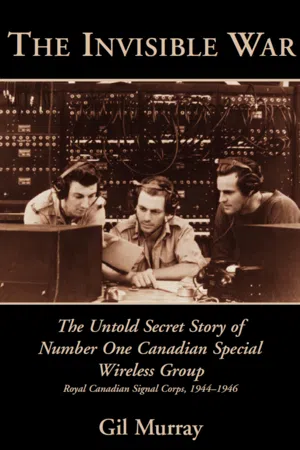
![]()
Book One:
Canada’s Key Role
in the War in the Pacific
![]()
Chapter 1
Canada Joins the Pacific War
A blinding flash, a single thunderclap, and a crash signalled the violent end of the clandestine wartime operations of some homesick Canadian radio spies perched on the northern coast of Australia, across the narrow Timor Sea from the Dutch East Indies and a now-defeated enemy. It was October 1945, and the war in the Pacific was over.
The lightning bolt might have been one last supreme effort by the kamikaze, the divine wind of Shinto, to send an avenging blast from the heavens, albeit two months too late to save Nippon, over the vast scene of Imperial Japan’s defeat. Whatever it was, it knocked down the 100-foot-high radio antenna tower of Number One Canadian Special Wireless Group, Royal Canadian Signal Corps (1CSWG—or the even more concise SWIG—for short) early on that morning of the new peace.
It was the very day that we 336 expatriates were to abandon the top-secret eavesdropping station we’d built outside Darwin, in the wilderness of Australia’s Northern Territory, to intercept military message traffic emanating from Japanese forces deep in the jungles of New Guinea, scattered among the islands off the northern coast of Australia, and reaching all the way to Tokyo. Our mission was over and it was time to head back home, having played a significant, if unsung, part in the war.
To most Canadians of the time—and ever since—“the war” meant the dust-up that had taken place in Europe and North Africa and which ended in May 1945. But to us misplaced Canadian Army volunteers who had stepped forward twice over for active service, “the war” was the one that raged on half a world away from Canada. That war had officially ended in August 1945, aboard the United States Navy battleship Missouri, anchored in Tokyo Bay. But in 1CSWG’s assigned area, the Japanese troops continued to hold out for two more months.
The Pacific war was one that few outside military circles—and even many on the inside—knew Canada was actively involved in. In India and Burma, Royal Canadian Air Force (RCAF) units were actively attacking Japanese strongholds. Throughout Asia—in Malaya, parts of China, and many of the Pacific islands—there were also a few hundred Canadians attached to British, Australian, and American special forces, carrying out top-secret activities of many kinds. There were other Canadians based elsewhere in Australia, such as RCAF members providing radar training to Australian forces. And the Royal Canadian Navy cruiser Uganda and smaller Canadian warships were also active in the Pacific theatre. But no Canadian Army unit had been risked in the Pacific since the government of Mackenzie King sent an ill-trained force of two thousand to Hong Kong just before the outbreak of the Pacific war in December 1941. All of those men were killed or captured in the Japanese attack that ensued.
Number One Canadian Special Wireless Group would be the first and only complete Canadian Army unit to be active in the South West Pacific theatre. It had started out as a secret, belated, token commitment by Ottawa to put the country somewhat in line with its allies and to satisfy a request from the Australian High Command for help in monitoring Japanese military signals. It would become the last complete Canadian Army unit active in a theatre of war after May 1945, and the last to return intact from overseas.
Simply put, 1CSWG’s job was to help intercept Imperial Japanese military messages to produce up-to-the-minute information on shipping movements, troop strengths, military supplies, and anything else upon which Allied army, navy, and air forces could take action. And successful action the Allied forces did take, time and again—no doubt to the mystification of Japanese commanders who had no idea their wireless codes had long since been cracked by Allied cryptanalysts.
Close co-operation among Australian, British, Dutch, and American eavesdropping units had made possible the invisible branch of the Allied military effort known as signals intelligence. Its reach covered every place that the Japanese forces had penetrated in 1942. By the 1990s, electronic technology had changed the face of warfare so that only minimal forces—themselves heavily aided by technology—would be required for ground attack. In the Pacific war it was still necessary to commit manned military units to do battle, but signals intelligence, with its advance knowledge of the enemy’s plans, greatly reduced Allied casualties and made strike actions more effective.
The main task assigned to 1CSWG was to monitor Japanese signals throughout the 2,000-mile chain of islands known as the Dutch East Indies—later Indonesia—where nearly a million Japanese troops were lodged in the jungles and along coastlines. The Canadians were to concentrate on naval and supply-shipping signals. They would relay the information they obtained to the Central Bureau (CB) in Brisbane, the great signals clearinghouse for the entire South West Pacific Area (SWPA). Equipped with two banks of IBM computers—arguably the earliest military use of that new invention in history—CB’s cryptanalysts crunched Japanese codes to extract vital intelligence from the thousands of messages it received each day from Allied monitoring stations scattered throughout the SWPA.
In the 1980s, Major Stan Clark, a veteran traffic analyst of Australian Special Wireless and one of the founders of CB, told me: “Along with the other intercept groups, the Canadian Special Wireless Group kept the volume of intercepted traffic at a tremendously high level, which was essential if the cryptanalysts were to succeed. Depth in volume in any code or cipher was essential to their study.”
Major Clark, who was second-in-command at CB under Lieutenant-Colonel A.W. Sandford—another key figure in signals intelligence—echoes the sentiments of U.S. Navy Lieutenant-Commander R.J. Fabian, the man who smuggled the Allies’ only Japanese “Purple” coding machine out of the Philippine fortress of Corregidor in 1942. Commander Fabian had regarded the analysis of radio traffic activity as a much more important source of intelligence than the actual deciphering of the messages’ content. By studying tremendous volumes of message traffic, analysts could spot repetitions of names, call signs, and technical jargon that offered valuable clues to the meaning of a newly introduced enemy code. And locations that were responsible for a heavy flow of communications could be identified as having strategic military importance.
The crash of our radio tower in the early hours of our last day at Darwin, which jolted us out of our iron cots in the pre-dawn dark, was a deafening “Vic Eddy,” or end of message, into the electronic ear of 1CSWG. We didn’t know whether to laugh at the coincidence or marvel at the power of the unknown.
For more than two months after the official Japanese surrender, 1CSWG’s assignment was revised from the pirating of Japanese messages to the sending of orders of surrender from Australian high command to those scattered Japanese forces still holding out among the Pacific islands. Only after the final capitulation by these hard-core Japanese units did the necessity for 1CSWG cease to exist, and only then was the station shut down.
A Canadian Army unit in the South West Pacific? Whoever heard of such a thing? The answer: very few. And deliberately so. The fact that such a unit existed was given no public exposure anywhere, during or after the war, although many books published in the decades that followed would unveil the secret wartime work of the Magic and Ultra programs. Canada’s part was buried along with the failed Japanese war effort.
Special Wireless, as our temporary profession was called in the Royal Canadian Signal Corps, was top secret. In February 1946, when our unit arrived at Camp Chilliwack in British Columbia to be officially disbanded, commanding officer Lieutenant-Colonel Harry D.W. Wethey made a final speech to the gathered Swiggers. In it, he gave his final order: that we were not to utter a word about the reason for 1CSWG’s presence in Australia, even after we’d been fully discharged from the army. Otherwise, the Royal Canadian Mounted Police would follow through accordingly.
Under the Official Secrets Act, no mention of the unit was to be made for the next thirty years. Even in civilian life we would not be beyond the reach of the long arm of military—or civilian—law. And it would seem that we Swiggers did keep a tight lip: until the 1990s, no public mention was ever made of 1CSWG, or of the kind of work it did. Even then, only one reference surfaced, in the official history of the Royal Canadian Signal Corps, where it was noted that a Canadian unit served in Australia during World War II. Information about specific battles made possible by 1CSWG’s close monitoring of Japanese military signals has long since vanished, along with wartime daily operational records. But unqualified appreciation of the Canadian unit’s role in countering Japanese manoeuvres has been expressed by top-ranking generals and other Allied officials in more confidential records.
In 1980, when I went to the National Archives in Ottawa and the Directorate of Military History in search of the unit’s war diary, I was promised a copy. First of all, my request would have to be cleared by the minister of Defence, even though it had been thirty-four years since the unit was phased out. When that was done, I was told over the next year that the war diary existed but that it had been lost somewhere in the archives because a clerk couldn’t remember where he’d put it. Although the diary had been examined and declassified, it was beginning to seem as if my mission to get at the record of 1CSWG’s accomplishments would be hopeless.
In time I would be sent the wrong diary, then finally an innocuous document that told me next to nothing about the battle effects of 1CSWG’s daily operations. But all wasn’t lost: in the meantime I’d already borrowed Lieutenant-Colonel Wethey’s personal diary, and I also had my own illicit, detailed diaries. Other sources would later come through with valuable information, and even more has appeared in recent years due to the Signal Corps’s interest in 1CSWG.
Given the strange lack of information volunteered by authorities through the 1980s and 1990s, I can’t help but draw a parallel between the vanishing of 1CSWG and the case of the wartime Camp X, which had been situated east of Toronto along the shore of Lake Ontario. There, most of the Allies’ secret agents and saboteurs were trained in what was then largely bush country. As recounted in William Stevenson’s 1976 book A Man Called Intrepid, every trace of Camp X was erased after the war, and the fact that it had ever existed faded from all nearby residents’ memories. Similarly, 1CSWG’s training camp on Mills Road, deep in the forest north of Victoria and a few miles west of Sidney, British Columbia, has completely disappeared, forest and all.
In 1944, the northern part of Vancouver Island’s Saanich Peninsula was heavily forested with old-growth trees, effectively hiding what had originally been an abandoned prewar army camp. It was an ideal location for our top-secret training. When I returned to the area in 1992, I expected to see, perhaps, recent residential housing nestled in a thinned-out forest. Not only did I find no housing and no trace of a camp, but there was hardly a single tree still standing from the old, dense forest. There were one or two aged farmhouses in distant fields and a paved road running through the site of the vanished woodland.
When I asked a man in Sidney where our camp had been located, he shook his head and said he’d never heard of an army camp anywhere nearby. We even consulted an old map, with no luck. Whether deliberately or through the march of time, 1CSWG’s birthplace had been absolutely obliterated. One could perhaps draw the conclusion that someone in the Canadian government wanted to make sure no trace was left in Canada of the means of training Allied forces in unorthodox, top-secret methods of defeating the enemies who threatened the nation. In any event, until 2001, no effort was made to commemorate the unique work of the people who dedicated themselves to defeating the Imperial Japanese enemy in the Pacific and the Nazis in Europe.
A case in point was the “discovery” in October 1999 of the grave of one of 1CSWG’s officers, Lieutenant J.D. Miller, by members of a newly formed Canadian Army task force sent to Darwin to help deal with unrest on the island of Timor, three hundred miles off the northern coast of Australia. At first the Canadian soldiers were understandably mystified as to why a Canadian army officer would be buried in 1945 in such a remote and far-off place. Obscure records revealed part of the story, but nothing about Miller’s reason for being there.
To those of us who formed Miller’s burial party in 1945, there was no mystery. The lieutenant had died of acute encephalitis during 1CSWG’s stay in Darwin, and we were obliged to bury him in an Australian military cemetery. Oddly, when the Canadian U.N. peacekeepers came across the headstone fifty-four years later, it was in a military cemetery at Adelaide River, seventy-five miles south of Darwin. The Canadian U.N. detachment held a memorial ceremony at the grave site. A full account of Lieutenant Miller’s burial will be given later. After the hostilities in Europe ended in May 1945, the Canadian government displayed a short-lived burst of enthusiasm for the Pacific war. There was a great to-do about forming a Pacific Force, made up of veterans of the European conflict, to bring Canada into line alongside its allies. By that time, 1CSWG had already been in the Pacific theatre for seven months, and was still to remain there for a further six. Our unit had been formed more than a year before for the express purpose of going to the Pacific, but of course this fact never came to light publicly thanks to 1CSWG’s top-secret status.
When we in Darwin heard about the new Pacific Force, which promised higher pay and a Pacific Star medal to all volunteers, we naturally assumed that we would form the nucleus of the new force and get a boost in pay—not to mention the medal. No such luck. To reveal that a Canadian unit was already well ensconced in the Pacific would have prompted newspaper inquiries into what we were doing there. By the time Canada managed to attract enough recruits for the new Pacific Force, the atomic bomb had put an official end to the war. We heard nothing further about the Pacific Force, and we got no pay raise. Even in the year 2001, some veterans of 1CSWG were still trying, without success, to pry the higher Pacific pay out of the government. On the other hand, the Pacific Star medal was distributed to all 1CSWG survivors, thanks to the efforts of my son, Alan, in 1976, on my behalf and later of SWIG member Ronald O’Reilly in 1998. That would seem to be an official recognition that the members of 1CSWG had actually served in the Pacific theatre; it would also make a case for us to receive the long-denied pay raise, which Pacific Force volunteers were already drawing in 1945 without even going there.
![]()
Chapter 2
How Special Wireless Began
In 1929, long before the attack on Pearl Harbor, U.S. Secretary of State Henry Stimson said, “Gentlemen don’t read other people’s mail,” and put a temporary stop to American cryptanalysts’ work on decoding Japanese military messages disguised as diplomatic despatches. Given Canadians’ long-standing reputation for being mild-mannered and polite, the idea that a group of them were eavesdropping on anyone—even during mankind’s most vicious war—would have been hard to swallow. After all, Canadians hadn’t been considered sophisticated enough to be part of the greatest weapons system of World War II, Magic and Ultra.
In fact, the Royal Canadian Corps of Signals, the Royal Canadian Air Force, and the Royal Canadian Navy had been secretly monitoring Imperial Japan’s radio communications since the outbreak of World War II. Australian units were doing the same. The British Special Operations Executive had been busy since before the war monitoring German signals through the Ultra system, and they quickly established Special Liaison Units in India, Burma, and other points in Asia. For whatever reason, the Americans may have not wanted it known that allies such as Canada and Australia were deeply involved in eavesdropping and might have insisted on permanent top-secret classification for these “minor” groups. There may also be something to the suggestion that Prime Minister William Lyon Mackenzie King, given his obsessive opposition to British colonialism, didn’t want to advertise the fact that Canadians had been sent to the Pacific during the war, making him party to helping Britain regain such colonies as Hong Kong and the Malay Peninsula.
Royal Canadian Signal Corps intercept stations were located early at Gordon Head on Vancouver Island, Grande Prairie, Alberta, and Leitrim, near Ottawa. Canadian army, navy, and air force eavesdroppers began monitoring in 1940. Two years earlier, British and U.S. signals units had begun scrutinizing Japanese communications after the Japanese “Blue Code” was deciphered and the “Purple” encoding machine was duplicated by an American team.
The Canadians at Gordon Head, and later at Mills Road camp on Vancouver Island’s Saanich Peninsula, also were experienced at monitoring signals coming from the midst of the Japanese-Canadian fishing fleet innocently going about its business in Canadian waters. Hidden amongst those vessels, Imperial Japanese nav...