Bosworth marked the end of the reign of Richard III and the rise of the Tudor dynasty.
Bosworth Field saw the two great dynasties of the day clash on the battlefield: the reigning House of York, led by Richard III, against the rising House of Tudor, led by Henry Tudor, soon to become Henry VII.
On August 22, 1485, this penultimate battle in the War of the Roses was fought with the might of the Yorkists ranged against Henry Tudor's small army. This book describes how these two great armies came to meet on the battlefield and how the tactics employed by Tudor and his captains eventually led to the defeat and the death of King Richard III.
Through quotes and maps, the text explores the unfolding action of the battle and puts the reader on the frontline. If you truly want to understand what happened and why — read the Battle Story.
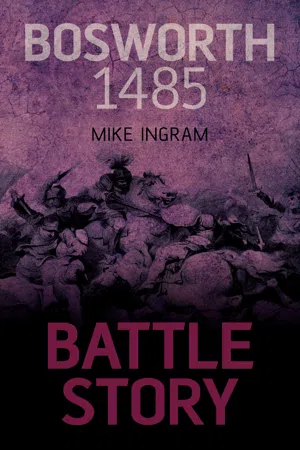
- 160 pages
- English
- ePUB (mobile friendly)
- Available on iOS & Android
eBook - ePub
Bosworth 1485
About this book
Information
THE ARMIES
The English are all good archers and soldiers …
This nation is cruel and bloodthirsty and they
even fight among themselves in the same way,
waging great battles.
Gilles de Bouvier, c. 1450
The English had built a fearsome reputation as soldiers during the Hundred Years War, with victories such as Crécy, Poiters, Agincourt and Verneuil which were celebrated throughout the kingdom. Many of the men who fought in the Wars of the Roses would have had fathers, grandfathers and uncles who would have taken part in these great battles. However, by the time of the Battle of Bosworth, after many years of relative peace under Edward IV, the number of experienced soldiers and commanders was dwindling. Those that did have experience usually learned their trade from fighting the Swiss and French in the service of Burgundy.
Richard III
Born on 2 October 1452 at Fotheringhay Castle in Northamptonshire, Richard was the youngest son of Richard Plantagenet, Duke of York, and Cecily Neville. Following the death of his father and elder brother at the Battle of Wakefield, Richard and his brother George were sent to Burgundy for their own safety. However, after the Battle of Towton they were both recalled to England. At Edward’s coronation in June 1461, Richard was created Duke of Gloucester and his brother George, Duke of Clarence. Although only 9, Richard was given liberal grants of land and office, including appointment as Lord Admiral. In 1469, when Richard Neville, Earl of Warwick, and his brother George rebelled against Edward, Richard remained loyal and was rewarded with a lifetime appointment as constable of England. In August 1470 Warwick and Clarence fled the country. The tables were turned when the rebels returned in October and forced Edward to flee; Richard was one of a handful of supporters who accompanied Edward to exile in Burgundy. Returning to England with Edward in March 1471, Richard, now 18, commanded the vanguard of the Yorkist army at both the Battle of Barnet and the Battle of Tewkesbury. Marriage to Anne Neville, Warwick’s younger daughter, brought Richard more wealth and land. By 1480, thanks to his Neville connections, his brother’s support and his own abilities, Richard had a loyal and extensive following in the north, which he governed on Edward’s behalf.
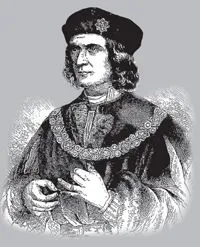
3. Richard III. (Author’s collection)
Henry Tudor
Henry Tudor, Earl of Richmond, was the son of Edmund Tudor, Earl of Richmond, a maternal half-brother of Henry VI and Margaret Beaufort, a cousin of Henry VI. He was born on 28 January 1457 at Pembroke Castle, three months after his father’s death and just before his mother’s fourteenth birthday. As well as having a distant claim to the throne through his mother, Henry was also descended from the French royal family, his paternal grandmother being Catherine of Valois, daughter of King Charles VI of France. Henry spent his early years in Wales under the protection of his paternal uncle, Jasper Tudor, Earl of Pembroke. In September 1461, as Yorkist forces secured Wales for Edward IV, Pembroke fled, and 4-year-old Henry was made the ward of William Herbert, Edward’s chief lieutenant in Wales. He was kept at Raglan Castle, where he was raised and educated with Herbert’s children. When Warwick restored Henry VI to the throne in the autumn of 1470, Pembroke, once again, took charge of his nephew. After the Battle of Tewkesbury, Henry and his uncle fled to France; however, storms blew them off course and they landed in Brittany, where they were welcomed by Duke Francis II. In 1476, an English embassy under Bishop Robert Stillington convinced Francis to surrender Richmond. Henry was taken to St Malo where a ship waited to take him back to England, but he feigned illness and escaped to sanctuary in a local church. Henry eventually returned safely to the Breton court, where he remained in honourable confinement until Edward IV’s death in 1483.
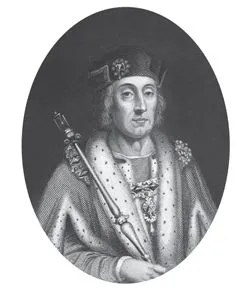
4. Henry VII. (Author’s collection)
The Commanders
Fifteenth-century commanders were expected to personally lead their men into battle and to inspire them with deeds of valour and personal bravery. The military experience and reputation of a commander, whether a king or nobleman, could boost the morale of an army and give it the edge in hand-to-hand combat. Unlike today, a commander did not have a bird’s-eye view of events as they unfolded, and instead only had the height advantage of a horse or, if they were lucky, higher ground. Consequently, they would have seen little more than the enemy’s front line, or if they were in the thickest of the fighting, virtually nothing at all. Nobles learned to fight from an early age, so by the time they reached maturity, using a sword or pollaxe was second nature. Similarly, being given their first suit of armour whilst they were very young also meant that as an adult, providing it was made especially for them, they could manoeuvre and fight under its immense weight.
Richard’s training in the art of war began at an early age under the tutelage of the Earl of Warwick. His first real experience of warfare came in 1469, aged 16, when he accompanied the king as he marched towards Newark to deal with a rebellion led by ‘Robin of Redesdale’, a supporter of Warwick, the Kingmaker. However, the rebel army was larger than expected and Richard and the king were forced to retreat to Nottingham. His first independent command came in December the same year, when he was sent by his brother to deal with an uprising in Wales. As part of the campaign, Richard was given full power and authority to ‘reduce and subdue’ the castles of Carmarthen and Cardigan in south Wales, and to deal with the local rebels. Whilst he was in Wales, another rebellion erupted in Lincolnshire, instigated by Sir Robert Welles, another supporter of Warwick and Clarence. Edward successfully defeated the rebels at Empingham in a battle now known as ‘Lose-coat’ Field, and a few days later Warwick and Clarence were proclaimed traitors. It has been suggested that Lord Stanley, Warwick’s brother-in-law, was en route to join Warwick when some of his men bumped into Richard, who was on the way to join his brother. A ‘matter of variance’ between Richard and Lord Stanley followed, although we do not know the details, and it would be the first of several altercations Richard would have with the Stanleys. Richard commanded the vanguard, which was on the right flank and facing the ‘battle’ (division) of Sir Henry Holland, Duke of Exeter. Richard immediately encountered difficulties when, on a fog-shrouded battlefield, he could not properly align with the opposite ‘battle’. Eventually he found Exeter and, marching uphill, collided with it at an angle, hitting the ‘battle’ in the flank. During the hand-to-hand fighting that followed Richard was wounded and Exeter’s men were chased from the battlefield. It would also be his first encounter with John de Vere, Earl of Oxford. Less than a month later, Richard’s timely intervention against Somerset’s ‘battle’ may well have been the deciding factor at the Battle of Tewkesbury when the Yorkists triumphed over a Lancastrian army led by Margaret of Anjou.
Henry, on the other hand, was the complete opposite; his first experience of battle as a 12-year-old boy saw him witness the slaughter of the Welsh nobility at the Battle of Edgecote, where he had to be rescued by Sir Richard Corbet (who would later join him at Bosworth). He was on the receiving end again in 1471, when, whilst at Pembroke Castle with his uncle Jasper, the castle was besieged for over a week by Morgan Thomas. No doubt he had some form of military training befitting his status, but he still lacked practical experience. However, like all military commanders, Henry would have formed a council of war, bringing all his most experienced commanders such as Oxford, Anthony Woodville and Philbert de Chandée together. It was these men who would advise Henry on his best course of action, although it may not have been until Henry met with the Stanleys that the final plans were drawn up.
The Stanleys
Thomas Stanley, Earl of Derby (c. 1435–1504), was the ultimate fe...
Table of contents
- Title
- Acknowledgements
- List of Illustrations
- Introduction
- Timeline
- Historical Background
- The Armies
- The Days Before Battle
- The Battlefield: What Actually Happened?
- After the Battle
- The Legacy
- Orders of Battle
- Further Reading
- Copyright
Trusted by 375,005 students
Access to over 1.5 million titles for a fair monthly price.
Study more efficiently using our study tools.
Frequently asked questions
Yes, you can cancel anytime from the Subscription tab in your account settings on the Perlego website. Your subscription will stay active until the end of your current billing period. Learn how to cancel your subscription
No, books cannot be downloaded as external files, such as PDFs, for use outside of Perlego. However, you can download books within the Perlego app for offline reading on mobile or tablet. Learn how to download books offline
Perlego offers two plans: Essential and Complete
- Essential is ideal for learners and professionals who enjoy exploring a wide range of subjects. Access the Essential Library with 800,000+ trusted titles and best-sellers across business, personal growth, and the humanities. Includes unlimited reading time and Standard Read Aloud voice.
- Complete: Perfect for advanced learners and researchers needing full, unrestricted access. Unlock 1.5M+ books across hundreds of subjects, including academic and specialized titles. The Complete Plan also includes advanced features like Premium Read Aloud and Research Assistant.
We are an online textbook subscription service, where you can get access to an entire online library for less than the price of a single book per month. With over 1.5 million books across 990+ topics, we’ve got you covered! Learn about our mission
Look out for the read-aloud symbol on your next book to see if you can listen to it. The read-aloud tool reads text aloud for you, highlighting the text as it is being read. You can pause it, speed it up and slow it down. Learn more about Read Aloud
Yes! You can use the Perlego app on both iOS and Android devices to read anytime, anywhere — even offline. Perfect for commutes or when you’re on the go.
Please note we cannot support devices running on iOS 13 and Android 7 or earlier. Learn more about using the app
Please note we cannot support devices running on iOS 13 and Android 7 or earlier. Learn more about using the app
Yes, you can access Bosworth 1485 by Mike Ingram in PDF and/or ePUB format, as well as other popular books in History & British History. We have over 1.5 million books available in our catalogue for you to explore.