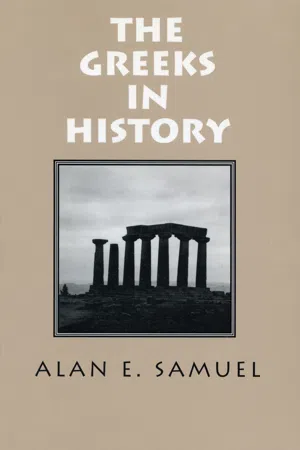
Breaking away from traditional chronological recitals of the Greek experience, this unusual new history relates the important events and personalities to themes of broad interest.
- 208 pages
- English
- ePUB (mobile friendly)
- Available on iOS & Android
eBook - ePub
Greeks In History
About this book
Information
1 Why Greek History?
One of the most famous episodes in Greek history is the story of Croesus, king of Lydia. When he asked the oracle at Delphi what would happen if he attacked Persia, it told him that if he did that, “he would destroy a great kingdom.” The oracle was right, but the kingdom destroyed as a result was Croesus’ own. There is another oracular story: Hippias, the son of the tyrant of Athens, and who had been tyrant in his own right, was told that he would be buried in Athenian soil. When he was very old, and after he had been expelled from Athens, he was part of a Persian force invading Attica, confident of success because of the prediction of Hippias’ eventual location. As the troops landed, Hippias sneezed, and one of the old man’s teeth fell out. It was the only part of Hippias to be buried in Athenian soil, and the invasion failed.
So oracles worked, and the gods knew the future of Greece. People did not, however, and they repeatedly sought prophetic revelations. There is a bit of logical inconsistency here, however: if prophecy can work, what good does it do? If the universe is to unfold, what is the advantage of knowing in advance what cannot change? The Oedipus story is a case in point. Oedipus’ parents, king and queen of Thebes, received a prophecy that their son would kill his father and sleep with his mother. Trying to evade that doom, they ordered a shepherd to take the infant and leave him to die in the wilderness. Pity for the child led to his being let live, and eventually he found his way into the family of the king and queen of Corinth, where he was raised as that couple’s child. He then heard of the prediction of his terrible future, but thinking he was actually the son of the parents he knew, he left the palace to avoid fulfilling the prophecy. In his travels, he met his (birth) father on the road and killed him, and later found his way to the city where he had been born, and married his mother, the widowed queen.
So prophecy was fulfilled, and human attempts to evade it futile. But they are more than futile—they are logically inconsistent. If you believe in prophecy enough to have an infant killed, why do you not believe in it enough to abandon the attempt to evade it? Greeks, I suggest, did not worry so much about this logical inconsistency, or even the logical problems created by a belief in fate. These are issues of real importance only when the issues of divine goodness and free will emerge as critical Christian problems, and I do not intend to deal with them here. Rather, I want introduce these oracular stories as a reminder that the Greeks had very different mental constructs to deal with issues they had in common with us. Dealing with oracles is another way of treating questions of choice and chance, and these are matters at the heart of history.
To ask the question “Why study History?” is to make so general a query as to call for too vague an answer. Why study Greek History? works as well, because it allows for some specific answers to fill out the response to the wider question. But even the more specific question requires some clarification about the subjects of study. Do we mean events, all events, social, cultural, personal and economic, or just political events, or some but not all of these? And do we mean to study only those events which come to public notice, or seem to relate to public events, so that a politician’s sexual habits are of interest, even though private matters, while those of his brother-in-law’s second cousin once removed are of no interest to history? Or is it not events we study, but causation, in order to understand why things happen, perhaps to help us in decisions in the future, as some ancient Greek historians thought as they sat down to write.
Actually, worrying about all these matters is a little silly; they are questions historians tend to ask as they work up to speed on their keyboards or as a kind of running in place before lectures start in earnest. Important questions about Greek history, or history in general, however, are those implied by the stories of prophecy and oracles like those of Croesus, Hippias and Oedipus. Take the story about Hippias, for example. The fulfilment of the oracle of his burial in Athenian soil was achieved when his tooth fell to earth. So the prophecy was true, but had been misunderstood, and the invasion, which had been thought to be supported by Hippias’ future, failed. But what would have happened if Hippias had not sneezed? Was the sneeze itself a matter of chance, or was it in fact part of the unfolding future only partly revealed by the oracle? Was Hippias himself a matter of chance—the outcome of the nearly 50-50 lottery which at conception produces male or female offspring? These questions can be, and have been, phrased in different ways about different periods of history, and there are, essentially only two ways of answering them. To a question, “Would the world have been a fundamentally different place in the nineteenth century if Napoleon had not been born? we can answer yes or no. If we answer “yes” we are lining ourselves up with a view of history that sees it as influenced at least in part by chance, undeterministic, allowing for the effects of human will and choice at least in part. This view asserts that at any given point in the flow of history, there are different possibilities for the future. Some may be more probable than others, and some may be almost impossible in view of the status quo at time of thinking. But of the “probable futures,” the one that is actually realized will be due to some combination with chance and volition.
The other answer, “no,” asserting that the world would have followed the same course regardless of the presence or absence of Napoleon, is predicated on a completely different concept of the relationship between past, present and future and the impetus events give to their successors. It is a concept endorsed by belief in the truth of oracles, and it is a deterministic concept, although it may present itself in more attractive terms and verbal descriptions. In the form fashionable today, the deterministic view would say of Napoleon and his impact something like, “If Napoleon himself had not existed, someone would have occupied his place and the flow of history in the nineteenth century would have been essentially the same.” This view asserts that the sum total of social, economic and political conditions will constrain future social, economic and political developments within very narrow limits. It can be asserted in another way: the material condition of the world at any time determines the possibilities and ideas which can exist at that time. That means that the material condition of the world, in determining possibilities and ideas, also eliminates chance and choice as influences. In the context of Napoleonic times, the material condition of the world established the ideas which allowed for and led to the conflict between European powers, and excluded ideas and possibilities of cooperation and idealization of peace. The European wars of the early nineteenth century were the necessary outcome of the conditions obtaining in 1800, and an alternative arrangement, let us say a half-century of peace, while conceptually possible, was in fact historically impossible given the state of the world at the time. Note that this view asserts not that the outcome was unlikely or improbable, but claims that conditions made it impossible.
While I personally believe in the first of these two alternatives, accepting chance and choice in affecting the future, a conception of the influence of the past in no way depends on that choice. In the first alternative, knowledge of the past—or lack of knowledge—influences the choices made in the present to create the future. At the very least, a knowledge of the past affects attitudes about the nature of the human being and what it is to be human, and those attitudes affect decisions. If we read Thucydides and conclude with him that the holders of power grip that power with a tenacity that obliterates feelings of pity and mercy or kindness for fellow human beings, then our opinions about dealing with those in power will rest on that assumption. If, on the other hand, we are Socratic in our confidence that no one does evil knowingly or willingly, we are rather more likely to try reason for a very long time before reaching for the sword. And those opinions, attitudes and decisions will influence the state of the world in its next stage.
On the other hand, if we believe that the state of the world at any instant leads relentlessly to its next state, determined by the sum effect of all its conditions (presumably we could, like an oracle, know it, if we knew all the existing conditions), history still has a force. For, under those circumstances, the knowledge of the past becomes one of the conditions of the present and one of the phenomena that lead inexorably to the next state of the world, so that knowledge of history, or at least, conceptions of what took place in the past, are a factor in the creation of the future.
There is nothing difficult about any of this, and, once stated it all becomes obvious. But it is just as well to state it, so that no one will think any of it is left out of consideration in approaching the study of Greek history. It is also well to have these considerations in mind as we turn to actual decisions about what we do in the study of history, whether we are studying as scholars and historians or are contemplating a period about which we intend to acquire basic information.
I have in mind an episode from the beginning of my own historical activity. I was writing about the organization of the Macedonian calendar in Egypt in the period after 300 B.C., and I had occasion to refer to the death of Alexander the Great. At that time, Alexander’s death was generally given as June 13, 323 B.C., a calculation made with some accuracy from the information available to us in ancient sources. Discussing the implications of the allusions to the event in the sources with Otto Neugebauer, a distinguished historian of mathematics at Brown University, I was told “No, no, no. Not June 13, but June 10.” Neugebauer showed me a transcription and translation of a contemporary Babylonian clay tablet giving the day of the (ancient) month as 29, equivalent to June 10. It was a fortunate find for me, because “day 29” confirmed my theory about the way the calendar worked, but it also meant that, as a contemporary source, we had a new date—three days earlier—for Alexander’s death. Historians of Alexander, who hitherto had been unaware of the Babylonian text, from then on began to give June 10 as the date of the king’s death.
The point of this story is to raise the question, “did it matter, and does it matter?” The information was useful to me for my calendar work, but the change in date for Alexander’s death seems to me a completely inconsequential fact, unless someone can show how the difference affected later events. By inconsequential, I mean that the events after Alexander’s death would have been the same whether he had died on June 13, as we used to think he he did, or on June 10, as we now think, and that our assessment of Alexander and his effects remains the same regardless of the date. If my view of this matter is right, it is not an urgent matter to spend time on such details for historical purposes; that is, in Aristotle’s mode, we should decide that some forms of precision are less necessary than others for historical research. This is not to say we should not use precise dates or facts in history, or use them as a matter of course if doing that does not entail an unnecessary effort, but rather to say that there is no requirement to be more precise than needed to make a statement of consequence. In example, the two following statements are equally acceptable: (1) The Persian Wars at the beginning of the fifth century B.C. laid the groundwork for the growth of Athenian power; and (2) The Persian Wars between 490 and 479 B.C. laid the groundwork for the growth of Athenian power.
This is to say that the investigation of facts and details for their own sake and for the sake of an abstract accuracy plays the same role in “History” as the imposition of the rules for rhyme in sonnets plays in “Poetry.” If you want to write a certain kind of poetry, a Petrarchian sonnet, say, then you must use rhyme in the patterns established by Petrarch. If you do not, then you have not written a Petrarchian sonnet, even if what you have written is still poetry. Thus historical writing with the aim of improving or teaching precise data about the past can be a form of “History,” but it is not the only kind of historical writing with legitimacy. And as practiced today, it is something of an extension from the days of St. Jerome, who was concerned in the first place to establish dates not so much for their own sakes as to make possible an understanding of sequence for the centuries before the Christian era in order to erect a consistent and broadly applicable chronological framework.
Greek historical writing has been particularly occupied with establishing data, with “the importance of getting things right” as a colleague described the effort to me years ago. The reason for this is, of course, the number of items of data about which we have lost precision over time. The problem is not new. Plutarch, writing at the end of the first century or beginning of the second, noted, for example, serious chronological difficulties involved in dating Solon’s activity, and here, in fact, the decisions on dating, ranging today over a twenty-year period from about 590 to 570 B.C. influence one’s interpretation of events. With regard to the early lawgiver of Sparta, Lycurgus, Plutarch’s assessment of the dating problem makes it so severe that he proposes the hypothesis of “two Lycurguses.” Now, almost two thousand years after Plutarch, it is small wonder that we still notice the chronological anomalies, or argue about the existence of a fifth-century B.C. “Peace of Callias” mentioned by one source and not another.
It is also the case that in the last 150 years we have obtained more new information about Greek history than in the preceding 1500 years. Whole cities have been unearthed. Greek history has been pushed back a millenium, into the Bronze Age, and tons, literally, of stone inscriptions now give us many details about public and private life. Even books have come to light, as papyrus texts from the sands of Egypt give us works such as Aristotle’s history of the constitution of Athens, plays of the fourth-century B.C. dramatist Menander, and fragments of lyric poetry from before the fifth century. The excitement of discovery inspired more searches which in turn brought more discoveries, and all the discoveries molded a form of history which could use them. A type of history which its practitioners like to think of as scientific and which can now best be called “technical” history evolved to fit the new data into, and in turn create, a picture of antiquity.
There is nothing wrong with this technical history. It is intellectually stimulating and provides the possibility of a more objective basis for reputations to take aspiring middle-class academics all the way to the professoriate. The skills to pursue it are teachable, and within reasonable limits, learnable by anyone. Best of all, it can be seen to inspire the use of, and teaching of, critical thinking, as historical understanding becomes a matter of comprehending and manipulating the evidence. Even its weaknesses, often related to the proliferation of evidence more and more difficult to master, can be thought to have the merit of refining conclusions as data accumulates.
However, the value and interest of technical history ought not to invalidate the practice of other kinds of historical writing. I do not refer here to the kind of history referred to, often derogatorily, as “popular,” or “textbook” history, written for non-specialist, i.e., non-academic, readers, or for students—“students,” that is, defined as people taking courses for credit. There is also nothing wrong with this kind of history writing, taking the findings and publications of technical history and turning them into writing of a more general, and perhaps more palatable, nature. However, there is still another kind of history, rarely written today except by journalists like William Shirer. We are familiar with this kind of history, and in fact, we read it as a part of our study of antiquity. Thucydides wrote it; so did Herodotus, and Tacitus. Later on, Orosius wrote it, and in more modern times, Gibbon and George Grote. It is opinionated history, permeated by its authors’ views about the nature of the world and the people in it, written to express moral and cosmological opinions and even to mold the attitudes of readers. Hardly technical in itself, it still influenced the attitudes of the great founders of technical history like Theodor Mommsen, and it was the kind of historical writing and thinking which provided the basis from which writers like Marx, Freud and Nietsche levered thought into the modern world.
The ancient Greek experience is particularly suitable to the writing of this kind of history. In the first place, as I have written in another context, the attitudes and writings of Hellenism have been so influential in the development of western culture that they have molded some of our most basic attitudes, and in so doing, they have insured that Greek works remain understandable and accessible to us. We do not understand the Oresteia, Homer, Plato and Herodotus intuitively; we understand them because they provide some of the bases of our own attitudes. We do not have to study for years, or learn Greek, to do this. Sophocles is as close to us, perhaps even closer, than Shakespeare, and we have only to compare our cultural familiarity with Hellenism against the mystique of Egyptian antiquity, or even the Semitic experience, to make the point. In this respect Moses Finley’s insistence on the “desperately foreign” quality of the ancient world is the insight of a technical historian. A second reason for the Greek experience suiting this kind of history is its relative simplicity. There were not many players, or we do not know many players, on the stage of Greek history, and their lines are relatively clear. The stories of the Persian Wars and of the Athenian Empire are short and sweet, and both had the advantage of superb narration, the Persian Wars by a historian with a magnificently broad and deep cosmological view, and the Athenian Empire by a great moral historian.
The Greek experience also provides wonderful evidence for this kind of history. From the shelves of the studies of classics professors come a large number of works involving an interpretation of human behavior and activity and of the relationship between the human being and the environment, or, as a Greek might say it, between humanity and the cosmos. Yet it is not all abstract, a disembodied mind full of ideas, expressing itself like Ionescu’s “Mouth.” What Greeks thought and wrote existed in a context about which we know a good deal, certainly enough to understand the ideas and what their authors meant. In one sense, the history of the Greek experience can be an account of an experiment in human living, a closed experience traceable in its broad outlines from an obscure beginning through its evolution into a great culture. Taking another tack, an account of Hellenism can provide us with a number of human enterprises in which we can see events and ideas interacting. Or moving laterally, we can see Greek culture not in political or ideological terms, but in its artistic expression, or religious, or purely literary development. Only in music are we excluded from sharing experience with the occupants of the Greek peninsula from 900 to 300 B.C.
With all this at hand, the Greek experience has the potential of providing us with the material for deeply meaningful history. If history can be an art form for commenting on the present, there is in Hellenism plenty of sources of comment. Approaching the writing of history in this way means, of course, allowing personal interpretations, even personal opinions, into the discussion. More than that, it inevitably has the lack of objectivity created by omission, a lack of objectivity more subtle and thus potentially more dangerous than the open espousal of opinions and value judgements. Still, with all the dangers, I will try out this kind of history in this volume. I will examine a number of aspects of Hellenism as it developed and existed from about 800 to 300 B.C., a half-millenium of time, and I will do this with a focus on the aspects themselves, rather than on the availability or nonavailability of evidence. So if I write of “Homer” or Hesiod, I will permit myself the liberty of mere acknowledgement of the paucity of data about their context, and I shall not worry about filling the reader in on obscure events if they do not cast light on a theme I am pursuing. I will also completely ignore chronology, in the sense of trying to tell a story in a sequential way. I do this partly as an experiment, to see if some of the significance of Hellenism is clearer if themes rather than sequence are pursued, and partly as a deliberate device to eliminate the urge of the writer or the reader to present or seek information just to fill out a narrative or provide “completeness.”
Furthermore, this book focuses especially on those aspects of the Greek experience which seem to be of interest today because of their relation to modern problems. The Athenians advanced further along the road to citizen-government than have any other people until the end of the eighteenth century of our era; their successes and failures are enlightening when large parts of the world are embarking on the path to “democracy.” The concept is imperfectly understood at best, and even in those regions with 200 years of experience with the idea, there is serious questioning of goals and values, and perhaps a reshaping of political myths by which people live. The consideration of the Greek experience, while not likely to solve our problems or answer our questions, will at least have the merit of making many of them clear.
2 City and Citizen
So far as we can tell about the societies of the ancient Mediterranean outside Greece, and in Greece itself before the first millenium B.C., authority was unitary and most people were subjects of government, rather than participants in it. It is hardly surprising that such should be the case, for this has been the prevailing mode of government in human society in most places and times. Apart from the ideology of “democracy” in modern times, notions of citizen-government have appeared rarely: ancient Greece, Berber villages in North Africa, some European communities in late medieval and early renaissance times come to mind.
In Greece itself, government was, apparently, unitary until the first millenium. The patterns of authority in the eastern Mediterranean were essentially the same everywhere, in Egypt, in the river valleys of Syria and Babylonia, in the promised land of Canaan and in the highlands of Anatolia, government was in the control of single individuals who might be thought of primarily as kings or as priests, but who in fact exercised the ultimate authority in what we would call political matters, and often were the chief religious figures as well. In Greece, during the Mycenaean period, as the Bronze Age is called there, palace-focused centres seem to have pro...
Table of contents
- Cover
- Title
- Copyright
- Contents
- Maps
- Preface
- 1. Why Greek History?
- 2. City and Citizen
- 3. “We Know How to be Greek”
- 4. Greek Imperialism
- 5. Civic Values
- 6. The Oppressive Society
- 7. One-Man Rule
- 8. Hellenism and Culture
- 9. Forward from the Greeks
- Bibliographical Note
- Chronological Table
- Index
Trusted by 375,005 students
Access to over 1.5 million titles for a fair monthly price.
Study more efficiently using our study tools.
Frequently asked questions
Yes, you can cancel anytime from the Subscription tab in your account settings on the Perlego website. Your subscription will stay active until the end of your current billing period. Learn how to cancel your subscription
No, books cannot be downloaded as external files, such as PDFs, for use outside of Perlego. However, you can download books within the Perlego app for offline reading on mobile or tablet. Learn how to download books offline
Perlego offers two plans: Essential and Complete
- Essential is ideal for learners and professionals who enjoy exploring a wide range of subjects. Access the Essential Library with 800,000+ trusted titles and best-sellers across business, personal growth, and the humanities. Includes unlimited reading time and Standard Read Aloud voice.
- Complete: Perfect for advanced learners and researchers needing full, unrestricted access. Unlock 1.5M+ books across hundreds of subjects, including academic and specialized titles. The Complete Plan also includes advanced features like Premium Read Aloud and Research Assistant.
We are an online textbook subscription service, where you can get access to an entire online library for less than the price of a single book per month. With over 1.5 million books across 990+ topics, we’ve got you covered! Learn about our mission
Look out for the read-aloud symbol on your next book to see if you can listen to it. The read-aloud tool reads text aloud for you, highlighting the text as it is being read. You can pause it, speed it up and slow it down. Learn more about Read Aloud
Yes! You can use the Perlego app on both iOS and Android devices to read anytime, anywhere — even offline. Perfect for commutes or when you’re on the go.
Please note we cannot support devices running on iOS 13 and Android 7 or earlier. Learn more about using the app
Please note we cannot support devices running on iOS 13 and Android 7 or earlier. Learn more about using the app
Yes, you can access Greeks In History by Alan Samuel in PDF and/or ePUB format, as well as other popular books in History & European History. We have over 1.5 million books available in our catalogue for you to explore.