The Second Battle of El Alamein was one of the most decisive Allied victories of the Second World War.
The Second Battle of El Alamein marked a major turning point in the Western Desert Campaign of the Second World War.
El Alamein saw two of the greatest generals of the war pitted against each other: Rommel and Montgomery. Through key profiles and a chapter devoted to "The Armies," El Alamein 1942 explores what made these men inspired leaders and what led to their respective defeat and victory.
Montgomery's success ensured that the Axis army was unable to occupy Egypt and therefore gain control of the Suez Canal or the Middle Eastern oil fields, thereby preventing a major source of income and power coming to them. The background and impact of the battle are explored in separate chapters, offering the reader clear insight into why what happened in this remote part Egypt was so central to the Allied cause. Through quotes and maps, the text explores the unfolding action of the battle and puts the reader on the front line. If you truly want to understand what happened and why — read the Battle Story.
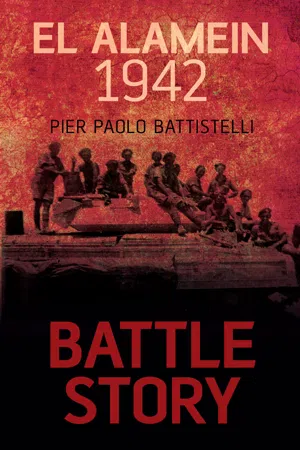
- 160 pages
- English
- ePUB (mobile friendly)
- Available on iOS & Android
eBook - ePub
El Alamein 1942
About this book
Information
THE BATTLEFIELD:
WHAT ACTUALLY HAPPENED?
The Break-in
23 October | |
Operation Lightfoot commences, Axis defences are attacked in the north and the south. | |
9.40pm | XXX Corps’ artillery opens fire on Axis artillery positions |
9.55pm | Infantry of XXX Corps’ units reaches the start line |
10pm | XXX Corps’ artillery starts its barrage on the Axis frontline; XIII Corps attacks in the south |
10.07pm | XXX Corps’ infantry starts to advance |
11pm | Axis units are alarmed |
Right before dusk the British and Commonwealth units of XXX Corps, like those of X Corps behind them and the XIII Corps in the south, started to move to their forward positions each following a familiar pattern; every battalion formed for the night movement and the assault with the two leading companies followed by battalion HQ and the two follow-up companies. Since every unit was expected to be able to fight for at least 24 hours without any hope of resupply, infantry soldiers were well laden; each one carried, apart from the usual small pack with a white St Andrews cross on it to aid recognition in the darkness, an extra weight including 50 rounds of ammunition, two hand grenades, Hawkins mines and four sandbags. While the men lay down in wait and the tank crews started the engines of their vehicles, at 9:40pm on 23 October the 457 artillery pieces of XXX Corps started the first part of their heavy bombardment that was to last for about 5½ hours. The first target, the enemy artillery and gun positions, was hit for 15 minutes with incredible precision and accurate timing. Such a concentration of fire had partly been made possible by a simple trick used to synchronise fire from all the artillery batteries: using the BBC radio signal to check their watches. Meanwhile, RAF bombers dropped about 125 tons of bombs on their targets. At 9.55pm the firing stopped and, while the soldiers moved to the start lines and prepared to jump forward at zero hour, at 10pm the artillery started to fire again, this time delivering a precise barrage on the enemy positions ahead of the Eighth Army’s units. After 7 minutes of fire, the barrage started to lift forward, following different patterns for each one of the divisional advance lanes.
ARTILLERY AT EL ALAMEIN, PART ONE
Eighth Army’s artillery enjoyed superiority not only in guns, but also in ammunition. During the battle the field guns fired an average of 102 rounds per day, for a total of 1,008,500 rounds, while medium guns fired an average of 140 per day, for a total of some 83,500.
When the sound of exploding shells began to move away, the spearheading units of the four infantry divisions started to advance: the battle had begun. Every division attacked in line, on a two-brigade front with the third brigade following up, along with the armoured support provided by the battalions of the 23rd Brigade equipped with their Valentine tanks (each one with the 9th Australian, 51st and 1st South African divisions), while the entire 9th Armoured Brigade supported the 2nd New Zealand Division. As the soldiers moved forward, checking the enemy and the mines, it became clear that the men of the Panzer Army Africa had been taken completely by surprise. There were no great difficulties in overcoming the German and Italian outposts and soon the spearheading units reached the main line of resistance. As recalled by Captain Grant Murray, 5th Seaforth Highlanders (152nd Brigade, 51st Infantry Division):
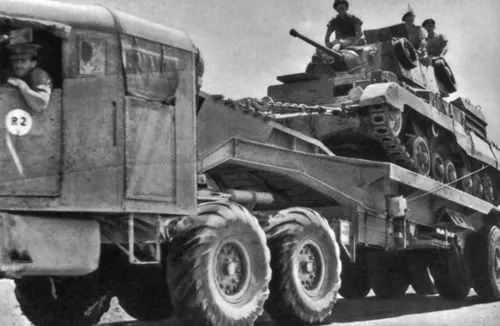
25. A Valentine tank carried by a Scammell tractor.
To our front all was quiet apart from a Verey light or two and some machine-gun fire. As zero drew near I twisted round and looked back towards our lines. Suddenly the whole horizon went pink and for a second or two there was still perfect silence, and then the noise of 8th Army’s guns hit us in a solid wall of sound, that made the whole earth shake. Through the din we made out other sounds – the whine of shells overhead, the clatter of the machine guns… and eventually the pipes. Then we saw a sight that will live for ever in our memories – line upon line of steel-helmeted figures with rifles at the high port, bayonets catching in the moonlight, and over all the wailing of the pipes… As they passed they gave us the thumb-up sign, and we watched them plod on towards the enemy lines, which by this time were shrouded in smoke. Our final sight of them was just as they entered the smoke, with the enemy’s defensive fire falling among them.
From Carver, El Alamein, here
In the sector of the 9th Australian Division, stretching south of the Tell el Eisa station, things went rather smoothly; while on the right wing of the division a composite force advanced to protect the northern flank, the division advanced with the 26th Brigade on the right and the 20th on the left. Ten minutes after midnight their leading battalions had reached the first objectives, with just 15 minutes delay, and at 12.55 on 24 October the follow-up units took over the lead. In the 26th Brigade area some enemy resistance was encountered, along with some problems due to anti-personnel mines; however, some 15 minutes before 4am the spearheading companies reached the positions on the Oxalic Line and started to dig in. Things did not go so smoothly in the 20th Brigade sector; leading companies ran into strong German-held positions and, while still trying to clear the deep minefields, a fierce struggle started. With the leading companies pinned down in front of the German positions, the order to withdraw and reorganise was eventually given and at dawn the brigade’s leading battalion was still about 1km short of the Oxalic Line.
The 51st (Highland) Division in the midst of its baptism of fire, was also advancing on the wider lane stretching for about 2.5km; on the right flank the 153rd Brigade (with the 5th Black Watch leading), moving forward at the sound of the bagpipes, immediately ran into heavy enemy resistance from a battalion of the German 164th Division. The same fate occurred to the leading battalions of the 154th Brigade, with the consequence that heavy casualties were suffered, and some of the leading companies were down to a strength of some sixty men. At dawn the two brigades were still short of their final objectives on the Oxalic Line, with the 154th closer to them on the left wing, but with the 153rd Brigade held far behind. Although the division overall performed well, the troubles with 153rd Brigade were to cause a considerable delay in opening the corridor through which the 1st Armoured Division was supposed to move, right across the southern and northern shoulders of the 9th Australian and 51st divisions. The 2nd New Zealand and the 1st South African divisions shared a common objective, the Miteirya Ridge which formed the southern shoulder of the whole front; the New Zealanders’ advance was carried out by the 5th Brigade on the right and the 6th on the left; here too leading battalions ran into difficulties, namely enemy resistance and minefields, but at dawn both brigades had managed to secure positions behind the ridge close to the Oxalic Line, with the exception of the 6th Brigade’s 28th (Maori) Battalion that ran into heavier enemy resistance and was held up before the ridge. 1st South African Division, allotted a smaller section of the front and mainly tasked with securing the left wing of the offensive, was not as successful; resistance from an Italian battalion and minefields delayed the advance of the 2nd Brigad...
Table of contents
- Title
- Acknowledgements
- List of Illustrations
- Introduction
- Timeline
- Historical Background
- The Armies
- The Days Before Battle
- The Battlefield: What Actually Happened?
- After the Battle
- The Legacy
- Orders of Battle
- Further Reading
- Copyright
Trusted by 375,005 students
Access to over 1.5 million titles for a fair monthly price.
Study more efficiently using our study tools.
Frequently asked questions
Yes, you can cancel anytime from the Subscription tab in your account settings on the Perlego website. Your subscription will stay active until the end of your current billing period. Learn how to cancel your subscription
No, books cannot be downloaded as external files, such as PDFs, for use outside of Perlego. However, you can download books within the Perlego app for offline reading on mobile or tablet. Learn how to download books offline
Perlego offers two plans: Essential and Complete
- Essential is ideal for learners and professionals who enjoy exploring a wide range of subjects. Access the Essential Library with 800,000+ trusted titles and best-sellers across business, personal growth, and the humanities. Includes unlimited reading time and Standard Read Aloud voice.
- Complete: Perfect for advanced learners and researchers needing full, unrestricted access. Unlock 1.5M+ books across hundreds of subjects, including academic and specialized titles. The Complete Plan also includes advanced features like Premium Read Aloud and Research Assistant.
We are an online textbook subscription service, where you can get access to an entire online library for less than the price of a single book per month. With over 1.5 million books across 990+ topics, we’ve got you covered! Learn about our mission
Look out for the read-aloud symbol on your next book to see if you can listen to it. The read-aloud tool reads text aloud for you, highlighting the text as it is being read. You can pause it, speed it up and slow it down. Learn more about Read Aloud
Yes! You can use the Perlego app on both iOS and Android devices to read anytime, anywhere — even offline. Perfect for commutes or when you’re on the go.
Please note we cannot support devices running on iOS 13 and Android 7 or earlier. Learn more about using the app
Please note we cannot support devices running on iOS 13 and Android 7 or earlier. Learn more about using the app
Yes, you can access El Alamein 1942 by Pier Paolo Battistelli in PDF and/or ePUB format, as well as other popular books in History & 20th Century History. We have over 1.5 million books available in our catalogue for you to explore.