Louis Riel / James Wilson Morrice / Vilhjalmur Stefansson / Robertson Davies / James Douglas / William C. Van Horne / George Simpson / Tom Thomson / Simon Girty / Mary Pickford
Louis Riel / James Wilson Morrice / Vilhjalmur Stefansson / Robertson Davies / James Douglas / William C. Van Horne / George Simpson / Tom Thomson / Simon Girty / Mary Pickford
Presenting ten titles in the Quest Biography series that profiles prominent figures in Canada's history. The important Canadian lives detailed here are: painters Tom Thomson and James Wilson Morrice; explorer Vilhjalmur Stefansson; frontiersman Simon Girty; railway baron William C. Van Horne; early politicians George Simpson and James Douglas; revolutionary Metis leader Louis Riel; writer Robertson Davies; and early movie star Mary Pickford.
On a hot summer day, when he was six years old, Robertson Davies was playing in the attic of the family home in Renfrew, Ontario — a red-brick, two-storey house with indoor plumbing (a rarity at the time). He was pretending to work a newspaper press, like his father Rupert, when he heard a faint scratching from behind. At first he ignored it, thinking it was a bird that had alighted on an eave outside, but when it persisted he finally looked around in annoyance.
He frowned slightly. A few feet ahead of him stood a low, wooden closet, and the persistent scratching was coming from inside. It had to be a mouse or squirrel. How fortunate the closet door was closed. When he went downstairs he would tell his mother about this pest and they would lay some traps and ...
His blood froze. The light in the room was somehow brighter, yet had a blood-red tinge to its edges. The room’s temperature was noticeably cooler and he felt he was not in the house any longer but was a million miles away from his mother and ... safety. And that was strange. Although the closet door was still decidedly in place, a glow was suddenly coming from inside it and ... How weird! He could see inside! And what was that?... A figure of some sort was taking shape ...
He almost screamed. An ancient woman was staring out at him, gnarled and misshapen and with a look of pure malevolence. She smiled slowly, her few teeth yellow and disfigured with decay. He could not move. He could not blink. His lungs refused to take in breath.
For what seemed like half an hour — although it might have been a matter of seconds — the pair of them continued to stare at each other, the witch never altering her malignant expression. Then, without warning, just as Davies thought she was going to blast him with a spell, she disappeared. One moment she was there; the next she was gone.
Davies felt himself to check his bones were intact then glanced furtively around the room. The light was back to normal now and warm to the touch. His mother’s voice was drifting up from the kitchen — she was warbling Tosti’s “Goodbye.” And the closet was just a closet now, with nothing but a few trunks containing old clothes. He sighed with relief and made his way to the steps.
Even as he ran downstairs, however, he knew this visitation had been real and things, normal things, were not what they seemed.
1
Childhood
What really shapes and conditions and makes us is somebody only a few of us ever have the courage to face: and that is the child you once were, long before formal education ever got its claws into you — that impatient, all demanding child who wants love and power and can’t get enough of either and who goes on raging and weeping in your spirit till at last your eyes are closed and all the fools say, “Doesn’t he look peaceful?” It is those pent-up, craving children who make all the wars and all the horrors and all the art and all the beauty and discovery in life, because they are trying to achieve what lay beyond their grasp before they were five years old. (The Rebel Angels)
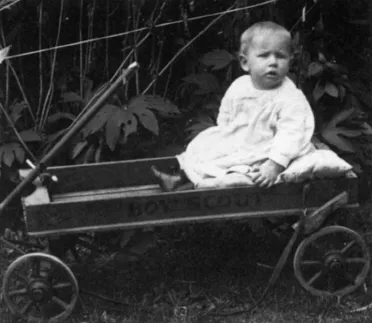
Robertson Davies at the age of one.
It’s a wise child that knows his father, but it’s one child in a million who knows his mother. They’re a mysterious mob, mothers. (What’s Bred in the Bone)
Aware that yet another life of William Robertson Davies is being written, the Lesser Zadkiel and the Daemon Maimas have decided to meet. As the Angel of Biography, Zadkiel wishes to question Maimas, who served as Davies’s guardian spirit while the writer was alive.
“So we meet again, Maimas. Has long has it been?”
“That’s an easy one, Zadkiel. We last congregated when my old charge, Robertson, was working on his novel What’s Bred in the Bone in the early 1980s and happened to invoke us.”
“Did he know at the time that we truly existed? More important, did he have any inkling that, the same way you were Francis Cornish’s protective daemon, so too were you his guardian and source of inspiration?”
“You could never tell with Robertson. For all his book-learning, theatricality, and crusty mannerisms, he was deeply attuned to the supernatural. That was partly my doing, you know. I made sure that at an early age he’d be sensitive to realities beyond the humdrum facts.”
“That’s what I want to ask you about. Davies has always puzzled me. He belonged to that generation that witnessed so many changes, and on top of that his father was a journalist and all over the news, as he himself was for over twenty years. And yet he often ignored the events around him and fixed his eyes on ... something else.”
“Yes. Quite right, Zadkiel. Unlike most people his age, Davies experienced a journey that was internal more than anything else. I decided early on in the game that he would be primarily a novelist by occupation — a chronicler of the human spirit and its fascinating peregrinations. There is a pattern to his life. In other words ...
“Be a good fellow and point it out to me, Maimas.”
“Nothing would give me greater pleasure, Zadkiel.”
Robertson Davies would become known as one of Canada’s most daring and imaginative writers — a strong proponent of feeling and artistic accomplishment over reason and bland common sense. It is greatly ironic, therefore, that at the very start of his story — his family’s origins — characters appear who do not seem the type to produce a cast of mind as whimsical as Davies’s. His ancestors, his parents included, while interested in literature and art, were hard-headed, practical people who were first and foremost concerned with earning a living and placed little stock in artistic achievement. And who could blame them? Their circumstances had been very hard, and romantic notions about the artist’s “inner journey” would have compromised their ability to survive.
On his mother Florence’s side, Davies was the descendant of English, Dutch, and Scottish pioneers. In the late eighteenth century her English ancestors had retreated to Canada along with other United Empire Loyalists when the American colonies were battling the English throne. One relative in particular, Mary Jones Gage, had lost her husband to the fighting and canoed with her two children to the western half of the province of Quebec (to be known one year later as Upper Canada) where she bought herself a farm near the city of Hamilton. Some years later the famous battle of Stoney Creek was fought on her property during the War of 1812.
Florence’s Scottish forebears had been deprived of their land in the Scottish Highlands and been sold to the British, who had transported them to the James Bay region. This area had been isolated, infertile, and bone-numbingly cold and, desperate to escape it, they made their way by foot to the southern part of modern-day Ontario, enduring incalculable hardships en route. Understandably, the relations on this side of the family had been pragmatic, joyless, and hostile to the arts, and had passed this sour attitude down to their children and their children’s children. Florence’s own father had been a particularly explosive character: addicted to morphine, which he had initially taken for his asthma, he suffered furious temper tantrums during which he occasionally chased his wife with a carving knife in hand.
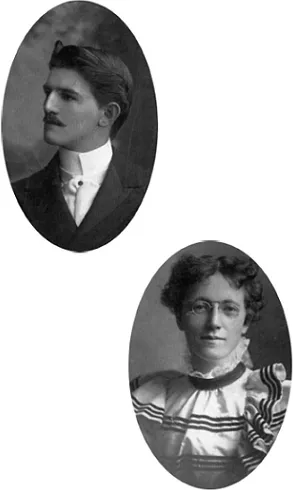
Rupert Davies, Robertson. Davies’s father, taken about 1900. Davies’s mother, Florence McKay, in 1898.
Davies’s father, Rupert, was similarly marked by his background. His family had owned a modest tailor business in Welshpool, Wales. Despite Spartan living conditions — the family of seven lived in quarters above the store — Rupert’s childhood had been comfortable enough. In the early 1890s, however, an agricultural depression affected business. Rupert’s father, Walter, could no longer provide for all five children and encouraged the fifteen-year-old Rupert and his older brother Percy to immigrate to Canada in 1894. As a young, vulnerable immigrant, Rupert happily accepted work in a stable. Greatly taken with the newspaper business, in which he had no experience, he embarked on an apprenticeship at the age of seventeen as a junior printer in Brantford, Ontario.
After passing difficult exams for the Typographical Union in 1900, he worked in Toronto and New York as a printer, but returned to Brantford because he missed his family. He then fell in love with Florence McKay, admiring her no-nonsense attitude, and married her on October 16, 1901, despite her family’s apprehensions that he would never amount to much. Over the next few years he fathered two sons and worked as a typesetter and journalist until, in 1908, he purchased the Thamesville Herald. The acquisition of this paper marked the start of his career as a publisher, and in subsequent decades he would earn himself a tidy fortune, procure himself an estate in Wales, and, in 1947, become a member of the Canadian Senate.
Although raw talent and native intelligence carried him forward, his hard-headedness and willingness to work impossible hours were primarily responsible for his noteworthy success. While very fond of theatre and the arts, and imbued with the Welsh facility for language, he was decidedly more a businessman than he was a literary craftsman.
Towards the end of his life Davies would write about his relatives in his novel Murther and Walking Spirits. In this book, the ghost of murdered Connor Gilmartin watches a series of films that chronicle in detail the lives of his (and Davies’s) ancestors. At the end of the proceedings, Connor comments to himself:
My festival has taken me into the past, though not really very far into the past, of my own forebears. Taken me into the eighteenth century, which is no distance in the pr...
Table of contents
Cover
Louis Riel
James Wilson Morrice
Vilhjalmur Stefansson
Robertson Davies
James Douglas
George Simpson
Mary Pickford
Simon Girty
Tom Thomson
William C. Van Horne
Copyright
Trusted by 375,005 students
Access to over 1.5 million titles for a fair monthly price.
Study more efficiently using our study tools.
Frequently asked questions
Yes, you can cancel anytime from the Subscription tab in your account settings on the Perlego website. Your subscription will stay active until the end of your current billing period. Learn how to cancel your subscription
No, books cannot be downloaded as external files, such as PDFs, for use outside of Perlego. However, you can download books within the Perlego app for offline reading on mobile or tablet. Learn how to download books offline
Perlego offers two plans: Essential and Complete
Essential is ideal for learners and professionals who enjoy exploring a wide range of subjects. Access the Essential Library with 800,000+ trusted titles and best-sellers across business, personal growth, and the humanities. Includes unlimited reading time and Standard Read Aloud voice.
Complete: Perfect for advanced learners and researchers needing full, unrestricted access. Unlock 1.5M+ books across hundreds of subjects, including academic and specialized titles. The Complete Plan also includes advanced features like Premium Read Aloud and Research Assistant.
Both plans are available with monthly, semester, or annual billing cycles.
We are an online textbook subscription service, where you can get access to an entire online library for less than the price of a single book per month. With over 1.5 million books across 990+ topics, we’ve got you covered! Learn about our mission
Look out for the read-aloud symbol on your next book to see if you can listen to it. The read-aloud tool reads text aloud for you, highlighting the text as it is being read. You can pause it, speed it up and slow it down. Learn more about Read Aloud
Yes! You can use the Perlego app on both iOS and Android devices to read anytime, anywhere — even offline. Perfect for commutes or when you’re on the go. Please note we cannot support devices running on iOS 13 and Android 7 or earlier. Learn more about using the app
Yes, you can access Quest Biographies Bundle — Books 21–30 by Julie H. Ferguson,Tom Henighan,Nicholas Maes,Wayne Larsen,Sharon Stewart,Valerie Knowles,D.T. Lahey,Edward Butts,Peggy Dymond Leavey in PDF and/or ePUB format, as well as other popular books in History & Historical Biographies. We have over 1.5 million books available in our catalogue for you to explore.