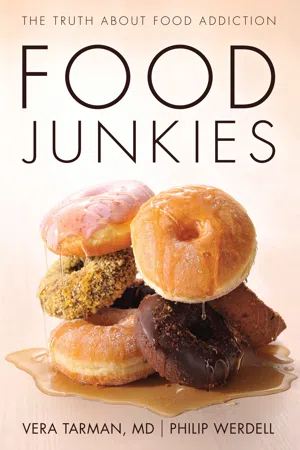
A fact-filled guide to coping with compulsive overeating problems by an experienced addictions doctor who draws on many patients' stories of recovery.
Overeating, binge eating, obesity, anorexia, and bulimia: Food Junkies tackles the complex, poorly understood issue of food addiction from the perspectives of a medical researcher and dozens of survivors. What exactly is food addiction? Is it possible to draw a hard line between indulging cravings for "comfort food" and engaging in substance abuse? For people struggling with food addictions, recognizing their condition — to say nothing of gaining support and advice — remains a frustrating battle.
Built around the experiences of people suffering and recovering from food addictions, Food Junkies offers practical information grounded in medical science, while putting a face to the problems of food addiction. It is meant to be a knowledgeable and friendly guide on the road to food serenity.
- 256 pages
- English
- ePUB (mobile friendly)
- Available on iOS & Android
eBook - ePub
About this book
Information
Topic
MedicineSubtopic
Health Care Deliverychapter one
EATING, EATING, EATING: WHAT IS THE PROBLEM WITH ME?
It is 1979, late at night. I have been awake for sixteen hours and I’m exhausted and agitated. I pace between the bed and my desk. Should I write my term paper, go out for a run, or recalculate my daily allotment of calories to see if I can afford just one more slab of chocolate? Or just go to sleep, if that’s even possible.
I am twenty-three years old and experiencing something I have in common with 25 percent of the female population at Canadian universities — an obsession with weight and food. I am beside myself. My mind is scurrying between one option and another, all in an effort to feel better. I cannot settle. I cannot sit for one minute. Each of my options implies relief, but I know in my gut that none will last beyond even one half hour. Thirty short minutes. How will I ever make it through the night, filled with so many half hours?
All I have to do is make it to the morning. Daytime will bring the relief of distractions, a break from this incessant ruminating. Meanwhile, I feel as if there is a creature inside me, breathing heavily, filling up my insides like a balloon getting bigger and more menacing. It wants to eat ferociously, but if I give it food, even the smallest bit, it will rear up and demand to eat everything in sight. It does not care whether I am full or if I plead with it to stop, my stomach engorged with food, gas, terror. In that moment, I am just a thin layer of skin containing this monster. It paces and with every slight movement I feel gut-wrenching pain and excruciating anxiety.
I just have to make it to the morning.
Thirty-five years later, having been at this juncture too many times to count, I have found a way to quell the beast. It came only after repeated trial and error and having tried many strategies: after many failed attempts to control my urges by creating rules such as eating junk food only on Saturdays, or eating only low-fat, low-calorie items or eating only in the company of others. I had tried drugging my cravings with alcohol. I tried working non-stop until the cravings passed. Most of the time, though, I just gave in.
Eventually, I found a solution that tamed this creature inside. It was the most effective, yet it was the very last thing I wanted to do, and after each relapse I had to rediscover this truth. Each time, it seemed too ridiculously simple to be true, but at the same time, I thought the solution shouldn’t have to be so extreme.
I had to stop eating my favourite foods, the ones that provided immediate relief: the doughnuts, the croissants, the ice cream. Just stop. Whenever I lapsed and tried to revert to what I thought of as the “common sense” notion, that I just needed to learn how to eat properly, I soon slipped back to the same obsessive unmanageability. I would try to have just one smallish dessert each night with a nutritious meal. It might take one night, or it might take three weeks of white-knuckling it, but eventually I gave in to the same old pattern of voracious eating. I would start with a slightly bigger dessert the next night; a week later I was eating two desserts a day; the following week it became desserts instead of nutritious meals.…
No matter which set of rules I gave myself (only on holidays, only on Saturdays, only low-fat), soon enough the rules dissolved and the obsession was back. So, I finally asked myself, what price was I willing to pay for peace of mind?
I had to see my favourite foods as drugs, despite being aware that most would think the idea preposterous. But it worked. If I did not drink alcohol, I did not want more. If I did not eat the first cookie, I did not want a second, then a third, then more. The trick was simply not to start eating these trigger foods, because I would just stop, re-start, stop again. A lifetime of struggling with a solution that had seemed so unpalatable yet was so successful.
Today, I say that I am an addict. A respectable addict, of course. Not like the desperate addicts who have cashed in their mortgage, the last of their retirement savings, even cigarette money to get their drug. After all, my drug is cheap, the cheapest of all drugs, and therefore the most pernicious. After all, a bag of day-old doughnuts and a case of root beer costs less then five dollars. And my drug is everywhere I look: in the drive-though gas station’s convenience store, in the supermarket, on the lusciously displayed menu of an exclusive restaurant. And my friends, family members, and colleagues are all users. In fact, almost everyone I know abuses food in some way, although if I suggested it they would say, “What, me an addict? No way!”
In those voices I hear my own years of rationalizations. I would tell myself that we all need to eat food, that it is an essential social activity, that I just require better discipline, or that I have had a bad day and deserve a treat. My “common sense” thinking that food cannot be an addiction repeatedly led me straight to yet another relapse, with its secret closet eating, hoarding of food, furtive digging through yesterday’s garbage, the bingeing and gorging on pizzas, bagels with cream cheese, bags of chips.
Even at the best of times, when things were going well in my life, I was continually distracted by the thought of food. At lunch, while my friend excitedly told me about her promotion at work, I silently counted the calories of the cheesecake I had just eaten. Could I squeeze in another piece of cake or tactfully get a nibble of hers? I continually forgot, or put off, the resolution that I made the day before never to eat this way again. Whenever I would tell myself this was normal behaviour, it was the addict in me talking. In my heart I knew I was laying the groundwork for the next binge.
All this finally ended a decade ago, when I gave up sugar. Today, whenever I tell myself that I can share one small dessert with a dinner companion, I think, Who am I kidding?
This is my story. It may not be yours, but I wonder if you can relate to some parts of my tale. Most people can, having felt the lure of some foods that compel them to eat, even against their better judgment. Maybe it’s cookies or peanut butter cups. Maybe it’s the tease of the ice cream tub in your freezer promising to soothe you at the end of a rough day. Have you ever wondered why you automatically reach for the chips instead of the celery to munch on while watching TV? Or felt guilty that you wanted more cookies and ended up polishing off the bag after planning to eat only two or three? You are not alone. As the food industry is well aware, most people are vulnerable to these temptations.
What can explain this phenomenon? When we consider that more than 60 percent of the population is overweight, it is clear that there is something happening on a grand scale that is affecting a majority of people. Is it addiction? Is it simply poor willpower? Is it something in the food?
Certainly, the quality of foods that we have been eating has changed over the last thirty years. Much of what we eat contains more sugar, high-fructose corn syrup, and salt than ever before. As I will outline in the next chapters of this book, we are essentially biological creatures motivated by pleasure who, through evolutionary selection, now also happen to think. As such, we are wired to desire the more energy-dense foods that will provide us with immediate energy as well as storage for the anticipated spells of famine. In short, we are programmed to like sugar and fat. We are at the mercy of our evolutionary heritage even though, in developed countries, the parts of our brain that regulate appetite and hunger have not caught up to the twenty-first century, where famine is no longer the norm. Food is abundant; in fact, it is too readily available, especially artificially created, energy-dense food — junk food.
David Kessler’s book The End of Overeating, and, more recently, Michael Moss’s Salt, Sugar, Fat: How the Food Giants Hooked Us argue that the food industry is deliberately hijacking this universal biological imperative, making our foods so tasty, so deliberately engineered to target the primal part of our psyche, that few of us can resist them. The food industry is skillful at this; it’s their business and they make good profits from our vulnerabilities.
Our social behaviour further supports eating patterns that are often to our detriment. Think of all the supersize orders and free extras, reassuring us that it is okay to loosen our belts and go for more rather than get up from the table. Eating small amounts seems almost quaint in our era of all-you-can-eat buffets and price deals. At the end of a restaurant meal, the tantalizing dessert that the waiter describes to us with great animation tempts us. We may try to resist, but often give in, shamefacedly and somewhat guiltily. At many work events or family dinners, office co-workers or family members cajole us, even diabetics who are warned by their doctors not to eat sweets, to “have just a taste.”
Try not to eat in such social milieus! Saying no to food during celebrations such as those at Christmas or Thanksgiving or on birthdays is especially difficult. How many people have gone on a diet only to find that, despite the success of significant weight loss, they simply cannot maintain their austerity? It is the rare person who will draw unwanted attention to herself by refusing her own birthday cake or the Christmas butter cookies made just for her. The refrain, “Have one! You don’t have to be good all the time,” follows every dieter. Not surprisingly, it is the rare person who can keep a significant amount of weight off for longer than a year.
Wait a Minute! Does Enjoying Food Mean I Am a Food Addict?
Why is it is so hard to say no to savoury foods despite our better judgment? Is it just peer pressure or do environmental triggers overwhelm our good intentions? More to the point: When does eating food for pleasure become a problem?
We believe there is something more fundamental than external pressures at work here. The universal human experience of wanting to eat more, especially when delectable foods are on the table, suggests that there is a common dynamic underlying our eating behaviour. For the most part, we have not labelled it an addiction. After all, not everyone who can’t resist the lure to eat hyper-palatable foods is a food addict. We are all prone to the lure of food.
What distinguishes addictive behaviour is its extreme nature: the degree to which a person is compelled to eat, is obsessed with eating. Some people are merely tempted, giving in occasionally. Willpower works for them. The sight of a buffet is enough to entrap others, causing them to fill plate after plate of food even after they’ve stopped enjoying it. Some of us appear more susceptible to this seduction than others.
As humans, we all sit somewhere on a continuum, with desire at one end and addiction at the other. Some of us eat for healthy reasons — for nutrition, as part of social interaction and, yes, for pleasure. Others eat because they are driven by an insatiable need to eat, regardless of hunger or health. A need that is beyond willpower or common sense. It becomes a need that is disconnected from nutrition, interaction, or even pleasure. When an eating behaviour leads to a self-destructive end point, when there is a desire to eat that has no “stop” switch, that trajectory points to the dynamic of addiction.
Let’s explore the pleasure of eating, as well as its dangers. It is helpful at the outset to understand why food is so enjoyable in the first place and how that pleasure can overwhelm us and lead to the frustrations that so many dieters experience. When does pleasure become so compelling that it looks like an addiction?
chapter two
I JUST LIKE TO EAT! — EATING AND OVEREATING
“Hey, if you wore the right clothes and put on makeup, you would look just like Princess Diana!”
Janet shyly smiles at the memory of this comment. We are sitting at the round table in her mother’s kitchen talking about the trials of dieting. Janet is wearing a pair of blue jeans and a print blouse. She has large square sunglasses on her head and wears a thin silver bracelet on her wrist. She isn’t interested in looking like Princess Diana. She isn’t a showy person and cares little about current fashions. Even the laser eye surgery she had done years ago was not, she insists, for cosmetic reasons; she wanted to swim in the lake without worrying about her glasses slipping off her nose. Facelifts, Botox, even dyeing her hair are not in the cards for her. Vanity is not her thing.
Janet tells me that she is content with her life. A stressful job and the occasional bouts of nausea that afflict her are the only obstacles she has towards feeling really happy. Although she weighs sixty pounds more than she would like to weigh, she says that her excess weight doesn’t affect her happiness very much. “I would be happier if I weighed less,” she concedes, “but it is not my main focus.”
That’s not entirely true, though. Sometimes she wishes that she would pay more attention to her weight. When she sees a picture of herself she feels motivated to diet. When she stands on the scale at her local Weight Watchers meeting and sees that her weight has crept up another two pounds she starts to fret. But this lasts for only a couple of days and then she is, again, blissfully unconcerned.
Janet has always been a “chunky” girl and has been on various diets throughout her life. Looking around her parents’ kitchen, where she spent her childhood, the wallpaper has been modernized to a light blue pattern, the stove and fridge upgraded, but she can still see herself as a seventeen-year-old asking her older sister how to diet. They had studied various strategies and she had lost weight with those attempts. “How did I do that?” she asks, recalling those memories of her first diets.
Janet recalls how she always prepared her food ahead of time. She was able to refuse desserts without any distress. She diligently counted and recorded her calories. With each new dietary regime, she typically lost sixty pounds and kept to her new weight for a few years. But then she would stop following the diet, and as the weight crept back on, her motivation would wane.
At first there were good reasons to get off her diets. She developed gestational diabetes during her first pregnancy. Her doctor insisted that she stop dieting and eat as much as she wanted. Janet smirks, brushing crumbs from the table. “So I ate. I saw it as permission to eat whatever I wanted. I gained all that weight back.”
She remembers her husband laughing when he said, “Janet has a new favourite four-letter word: Food!” After her second child, she did not even bother trying to control her weight. Her interest just seemed to fizzle.
Janet joined Weight Watchers in her early forties. She was ready to tackle that annoying sixty pounds once more. Some co-workers from her office agreed to join with her. They all followed the same food plan, shared notes and recipes, and encouraged each other. Janet even convinced her family to follow her meal plan. To her delight, her husband, who was a big man, lost even more weight than she did. Everything was in sync: the family, her friends at work, and her health; it all seemed so simple then. Sighing, she says: “Why can’t I do that now?”
Illness derailed her regime. Janet developed an extreme case of vertigo that still plagues her whenever she is under stress at work. She gets dizzy and sick to her stomach and sometimes even has to leave work. Reading or watching television made her feel just as sick, and she would typically end up having to lurch off to bed. “I grew to be afraid of these attacks,” she says, the anxiety obvious in her voice. “So I ate.” She learned that the only thing making these episodes bearable, even preventable, was food. When she felt an attack coming on, she would reach desperately for something to eat, regardless of whether it was healthy. Anything solid settled her stomach. The bottom line, she tells me, is that she has become more afraid of these attacks than she is about her weight gain. So the weight came back, creeping up even higher than before.
A few years ago, she became alarmed when she saw that her weight had climbed above two hundred pounds, so she returned to Weight Watchers. Shaking her head, she tells me, “I have never been that high.”
But Janet discovered what many people who return to dieting find: it seems to get harder each time you go back to it. At first you’re inspired but soon you’re discouraged again. She remembers her first weigh-in after a week of dieting. She had expected to see the typical five-pound fluid loss (both salt and carbs retain water), but instead found she had lost nothing. Not even one pound. “My motivation just deflated then,” she says. “It took me one whole month to lose five pounds.” Burying her face in her hands, she adds, “All that work for five pounds? Now, I come home and think that I should prepare tomorrow’s lunch, but I’m too tired.”
Why Is Eating so Pleasurable?
Enjoying food is not the same thing as being addicted to food. Our brains are wired to enjoy food.[1] It is a primal survival mechanism. In fact, we enjoy foods that are high in fat and sugar for that very reason — they’re energy-dense and ensure our survival by enticing us to eat more for immediate energy and storage purposes. Even the recovered food addict still enjoys food.
Overeating isn’t necessarily a sign of addiction either. We all enjoy feasting on massive amounts of food. Even if we are full, there are certain times and occasions when we want more. After a satisfying meal, we can usually find room for dessert. This is especially the case when a new food is introduced, because our desire to eat is rekindled by something novel and unexpected. This is why we tend to overeat at buffets. With so many exotic choices, though, we may fill up on one dish we suddenly find we have room for the yet another tasty tidbit. We leave the buffet with our stomachs bursting, wondering how we could possibly have eaten that much. Our actions are a legacy of our primitive ancestors, who were always aware that food available today might be in short supply tomorrow.
Since consuming food is essential to survival, it is the pleasure of eating that ensures we do so. Think of it: without the enjoyment, would you bother to buy food (or hunt and gather or grow it), take the time to prepare it, eat it at the risk of becoming bloated and, possibly suffering the effects of halitosis, diarrhea, or constipation? When people have colds and are unable to taste and enjoy their food, they often find that they need to “force themselves” to eat. Certain basic human survival needs, like sex and sleep, are related to natural pleasures built into our DNA blueprint; we experience pleasure to ensure we don’t ignore our needs. Water is the primary example of this. When you are parched, a cold glass of water is delicious. When you are no longer thirsty, another glass of water has no appeal and can actually be unpleasant. The same is true for food. When we are hungry, the thought of food is pleasurable and the experience of eating even more so. When you are really hungry, even a plate of steamed broccoli is immensely enjoyable. When you are full, your desire for the vegetable wanes.
Our hormones and our neurochemicals exist as part of a biochemical feedback loop programmed to make sure that this survival strategy occurs. [2], [3] As our stomach empties, our hunger hormone, ghrelin, is released and tells our brain we are hungry. We begin to feel uncomfortable as the ghrelin increases. The increase in ghrelin levels stimulates the production of the neurochemical dopamine, which makes us start thinking about food. We may think about the approaching dinnertime, about the preparations, about the actual eating experience. Our mouths begin watering, anticipating the pleasure once we finally sit down to eat. The hungrier we are, the more motivated we become. As the motivation intensifies, it can distract us from whatever else we might be doing. The hungrier we get, the harder it becomes to concentrate on reading, driving, conversation.…
If we don’t eat at this point, hunger actually becomes painful. Thoughts of food become even more prominent, crowding out other thoughts and distracting us from actions that don’t lead us to the dinner table. This is the work of insulin, another key hunger hormone. Since sugar is essential to our brain, insulin, the key hormone that transports sugar to our ...
Table of contents
- Cover
- Dedication
- Table of Contents
- preface
- this book, bite size
- chapter one
- chapter two
- chapter three
- chapter four
- chapter five
- chapter six
- chapter seven
- chapter eight
- chapter nine
- chapter ten
- chapter eleven
- chapter twelve
- chapter thirteen
- chapter fourteen
- chapter fifteen
- epilogue
- acknowledgements
- notes
- bibliography
- Copyright
Trusted by 375,005 students
Access to over 1.5 million titles for a fair monthly price.
Study more efficiently using our study tools.
Frequently asked questions
Yes, you can cancel anytime from the Subscription tab in your account settings on the Perlego website. Your subscription will stay active until the end of your current billing period. Learn how to cancel your subscription
No, books cannot be downloaded as external files, such as PDFs, for use outside of Perlego. However, you can download books within the Perlego app for offline reading on mobile or tablet. Learn how to download books offline
Perlego offers two plans: Essential and Complete
- Essential is ideal for learners and professionals who enjoy exploring a wide range of subjects. Access the Essential Library with 800,000+ trusted titles and best-sellers across business, personal growth, and the humanities. Includes unlimited reading time and Standard Read Aloud voice.
- Complete: Perfect for advanced learners and researchers needing full, unrestricted access. Unlock 1.5M+ books across hundreds of subjects, including academic and specialized titles. The Complete Plan also includes advanced features like Premium Read Aloud and Research Assistant.
We are an online textbook subscription service, where you can get access to an entire online library for less than the price of a single book per month. With over 1.5 million books across 990+ topics, we’ve got you covered! Learn about our mission
Look out for the read-aloud symbol on your next book to see if you can listen to it. The read-aloud tool reads text aloud for you, highlighting the text as it is being read. You can pause it, speed it up and slow it down. Learn more about Read Aloud
Yes! You can use the Perlego app on both iOS and Android devices to read anytime, anywhere — even offline. Perfect for commutes or when you’re on the go.
Please note we cannot support devices running on iOS 13 and Android 7 or earlier. Learn more about using the app
Please note we cannot support devices running on iOS 13 and Android 7 or earlier. Learn more about using the app
Yes, you can access Food Junkies by Vera Tarman,Philip Werdell in PDF and/or ePUB format, as well as other popular books in Medicine & Health Care Delivery. We have over 1.5 million books available in our catalogue for you to explore.