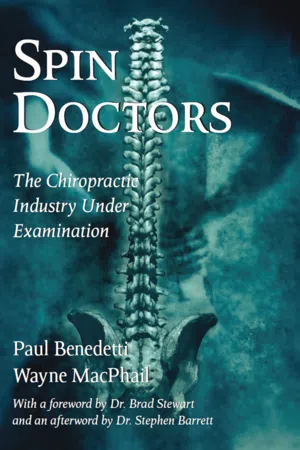
Canadians visit chiropractors about 30 million times a year, and surveys show that patients are generally satisfied with their treatment. But studies also show that as many as two hundred Canadians a year suffer strokes brought on by neck manipulation. Spin Doctors takes a hard, dramatic, and spine-chilling look into the world of chiropractic medicine. You will be surprised to learn what chiropractors treat and why and how much it costs you as a taxpayer. Most importantly, you'll learn how to protect yourself and your family from dangerous adjustments, practice-building tactics, bogus treatments, and misleading information.
- 300 pages
- English
- ePUB (mobile friendly)
- Available on iOS & Android
eBook - ePub
About this book
Information
Topic
MedicineSubtopic
General Health1
A HOUSE DIVIDED
How Canadian D.D. Palmer Built the Faulty Foundation of Modern Chiropractic
Old Dad Chiro
Chiropractors will proudly tell you that their form of “drugless health care” has been around for more than a century. They’re much more secretive about how little it has changed in all those years. Chiropractic was born in the nineteenth-century American midwest amidst a dust squall of religious revivalism, quackery, spiritualism, and anti-medical sentiment. It was invented by a deeply religious “magnetic healer,” Daniel David Palmer, who mixed his religion with samplings of the folk medicine theories he experienced around him in Davenport, Ohio, on the banks of the Mississippi River. After dabbling in spiritualism, mesmerism, and even phrenology, he came to see the spine as a lightning rod for God’s healing power. D.D. Palmer, as he is most commonly known, has become a cult hero of chiropractic. He’s called “Old Dad Chiro”1 even today. His writings are taken by many chiropractors as gospel truth. That’s so much the case that it’s really impossible to understand modern chiropractic without exploring the story of how Palmer came up with the “big idea” of chiropractic all those years ago. That story begins in Canada, near Port Perry, Ontario.
D.D. Palmer was born on March 7, 1845, in Brown’s Corners, Ontario.2 That tiny (now vanished) hamlet was a few kilometres from present-day Port Perry, just east of Toronto. Palmer’s grandparents, Stephen and Abigail, had settled in the Toronto area decades earlier at a time when, as Palmer writes in The Chiropractic Adjuster, “there was but one log house, the beginning of that great city. That region was known as ‘away out west.’” Palmer’s father, Thomas, was an Adventist, one of only about forty-two apocalyptic evangelicals in the area at that time. The founder of the Adventist movement, William Miller, had predicted that Christ would return to earth in 1844. The Adventists were forced to reassess their doctrine, for obvious reasons. Adventists like D.D. Palmer’s father took the Bible literally and abstained from alcohol and tobacco. It’s likely that, on occasion, the Saturday services of the small group of faithful in the Port Perry area would have been held at the Palmer’s one-storey wooden frame home on Concession Road 7, as there was no Adventist church in the vicinity. Adventism was only one of dozens of religious movements that were bringing a strong sense of religious revival to North America in the nineteenth century. As we’ll see, the sense of personal relationship with God and the spiritual conversion that were at the base of the revivalist movements would help lay the groundwork for chiropractic’s birth.
Despite his father’s deep religion, D.D. Palmer writes that his mother had the lion’s share of unscientific thought in the family. “My mother was as full of superstition as an egg is full of meat, but my father was disposed to reason on the subjects pertaining to life,” Palmer explains in a memoir he wrote in 1910.3
Thomas Palmer, D.D.’s father, was born in 1815, the youngest of four children. He was twelve years younger than his brother Henry, who became a shoemaker. Thomas followed in his older brother’s footsteps — but, it appears, with much less success. In his personal journals, Palmer writes of his “father failing in business.”4 As a result, D.D., the eldest of six children, had to work to help support the family. He attended school until he was eleven and from then on appears to have been self-taught. Actually, Palmer’s education is the subject of both speculation and legend in chiropractic circles. His younger brother T.J.’s autobiography tells the story of how he and D.D. were prodded by a “brutish taskmaster, one John Black” to tackle eighth-grade work when they were nine and eleven. They were then, according to the younger Palmer, “launched into the study of high school subjects that included the physical sciences.”5 Other sources suggest that D.D. Palmer got little formal schooling and was basically self-educated. He had no medical training. But census records indicate that a John Black did teach in a log school near the Palmers, so he may well have taught the two boys when he was in his late twenties.
Magnetic Healing on the Mississippi
After the end of the U.S. Civil War in 1865, Thomas Palmer moved his family to the coal mining town of What Cheer, Iowa, about 150 miles west of Chicago. The elder Palmer probably hoped the post-war economy would offer him and his family better opportunities.
In 1871, D.D. Palmer married his first wife (of five), Abba Lord, and purchased ten acres of land near New Boston, Illinois. He kept his family fed by teaching in rural schools, raising bees, and growing fruit. The Mason jar having just been invented, Palmer made a decent living from selling preserves. He also cultivated a new variety of blackberry called Sweet Home, which canned well. Palmer marketed the bushes throughout the United States by mail order. He also developed a curious interest in goldfish, which he raised and sold. In 1874, Palmer married again, this time to a southern widow, Louvenia Landers. Little is known about what happened to his first wife, though she may have died in childbirth.6
By 1881, Palmer and his new wife had moved closer to his family in What Cheer and opened a grocery store, the ninth in what had become a prosperous small town. Palmer’s business failed and he moved again, this time to Letts, Iowa, where he went back to teaching school. Three years later, Louvenia died. Palmer was left to care for an eleven-year-old from his second wife’s previous marriage, two daughters, aged eight and six, and his first biological son, Bartlett Joshua Palmer. B.J. Palmer, as he is most often known, would grow up to become the great popularizer of chiropractic. The elder Palmer’s relationship with his son would prove to be a hostile and difficult one, and the effects of it would shape much of what chiropractic has become. Six months after Louvenia’s death, D.D. Palmer married again, this time to Martha Henning.
Around this time, spiritualism, theosophy, and magnetic healing began to fascinate Palmer. Spiritualists held that it was possible to talk to the dead through séances and other mystical means. Theosophists studied ancient and contemporary religions and sciences searching for synthesis. Magnetic healers believed they could treat a variety of ailments by diverting and clearing pathways for animal magnetism, which they believed flowed through the body like a liquid.
The most charismatic magnetic healer was Franz Anton Mesmer. In 1774, Mesmer, a German physician and a friend of Mozart, came to the conclusion that the universe was filled with increasingly refined fluids. The spaces between grains of sand, Mesmer wrote, could be filled with water; the spaces in water could be filled with air. The air itself (and everything else) was permeated by invisible ether. That ether, Mesmer said, was suffused with a perfectly refined substance, which, when present in a living being, he called animal magnetism. Using words Palmer would later re-employ, Mesmer wrote, “The animal body experiences the alternative effects of [animal magnetism], and is directly affected by its insinuation into the substance of the nerves.”7 Mesmer thought this pervasive, subtle force (which no scientist had observed or measured) obeyed the laws of magnetism. For Mesmer, disease was the result of obstacles that blocked the flow of the universal fluid, or animal magnetism, in the body. The blockages impinged the contraction and dilation of blood vessels and so reduced the body’s ability to conduct life. A body with animal magnetism ebbing and flowing easily within it would be free of disease. A skilled healer could clear blockages in this natural flow. That healer allowed the animal magnetism to heal the body naturally. Mesmer explains how he worked in his 1784 text, Catechism on Animal Magnetism.
First of all, one must place oneself opposite the patient, back to the north, bringing one’s feet against the invalid’s; then lay two thumbs lightly on the nerve plexes which are located in the pit of the stomach, and the fingers on the hypochondria [region below the ribs]. From time to time it is good to run one’s fingers over the ribs, principally towards the spleen, and to change the position of the thumbs. After having continued this exercise for about a quarter of an hour, one performs in a different manner, corresponding to the condition of the patient.…It is always necessary that one hand is on one side, and the other hand is on the opposite side. If the sickness is general, the hands — made into a pyramid with the fingers — are passed over the whole body, starting at the head and then descending along the two shoulders down to the feet. After this one returns to the head: from the front and from the rear, then over the abdomen and over the back.
While Mesmer used actual magnets in some of his more public treatments, it’s clear that he didn’t consider them important or necessary. He believed that animal magnetism, being all-pervasive, could be controlled by a healer’s will without touching a patient. He also believed it could be used as a medium for telepathy and precognition.8
Mesmer saw magnetism not just in human bodies but also in all animate and inanimate things. Early in his career, he related the ebbs and flows of animal magnetism in the body to the gravitational influence of the planets. So, for Mesmer, animal magnetism linked man to the universe. That belief tied him, philosophically, to a long line of vitalists (people who believe that life is driven by an invisible, spiritual force). Diverse healing systems, like acupuncture and, these days, therapeutic touch are all vitalist in nature.
Mesmer began his career as a magnetic healer in Vienna. With his charismatic and theatrical style and his hypnotic influence he was a sensation, especially with the female aristocracy. These rich women believed all manner of fashionable illnesses had been effectively treated by Mesmer’s ministrations to their blocked and fragile animal magnetism. In fact, Mesmer was simply treating psychosomatic illnesses with sham treatments, which depended on the placebo effect and his natural showmanship and sex appeal. Viennese doctors quickly decried the flamboyant Mesmer as a fraud. In 1794, King Louis XVI appointed a commission (including Benjamin Franklin) to investigate Mesmer’s techniques. The commissioners found no scientific support for the showman’s methods, and his star began to wane in Europe.
In the America of the 1880s, though, magnetic healing was still a popular treatment for a host of illnesses. It became intermixed with the religious revivalism that was in the air, especially in rural areas of the country. Its key proponents in D.D. Palmer’s part of the country were Paul Caster and his son. In the late 1880s, Palmer took courses from the Casters and became a doctor of magnetic healing.9 In 1886, he opened his first office on Jefferson Street in Burlington, Iowa, a small town on the Mississippi River. He found himself in competition with doctors, homeopaths, purveyors of botanical cures, occultists, and the popular Casters. He didn’t stay long, nor, it seems, did his third wife, Martha, who walked out on him. A year later, he opened up a new practice in Davenport, Iowa, a few miles north of Burlington. He took rooms in the Ryan Building and advertised himself as “D.D. Palmer, Cures Without Medicine.” Palmer was in heavy debt when he opened the new business, but it soon became a moneymaker for him, thanks to word of mouth, testimonial advertising, and a 138-foot-long sign that could be seen by the passengers on board ships plying the Mississippi.
Palmer, much like Mesmer before him, treated a diseased organ by placing one hand under it and the other above it so that “magnetic radiation” could flow from hand to hand. But Palmer insisted that while other magnetic healers rubbed and slapped the entire body during a treatment, he isolated only the ailing organ and poured his magnetic healing energy directly into it. Palmer’s clinic eventually filled forty rooms. Out-of-town patients could stay overnight, have meals, and take treatments in Palmer’s drugless infirmary. Oddly, Palmer dedicated one room to his old passion, goldfish. He was adamantly opposed to drugs and surgery and took what would now be called a natural approach to healing, although in the late nineteenth century he was called a “drugless practitioner.” In 1888, Palmer married Villa Amanda Thomas, his fourth wife. The new Mrs. Palmer took care of many of the clinic’s administrative details but, ironically, had a drug addiction problem.10 She died of a morphine overdose in 1904.
Heroic Medicine, Common Men, and Hellfire
To really appreciate Palmer’s success and his relationship to the medicine of the doctors of the time, it’s worthwhile pulling the lens back from his burgeoning clinic on the bank of the Mississippi and taking a wide-angle look at the state of medicine and the society of nineteenth-century America, especially after the Civil War.
It was a time of remarkable social, religious, and medical upheaval in the United States. American Protestant religions had already passed through two “Great Awakenings” of religious spirit and passion. While it was primarily Calvinists who drove the First Great Awakening from the northeastern United States, the Second Great Awakening, from about 1790 to 1830, was definitely a product of Southern Methodists and Baptists (who had learned some revival techniques earlier from Presbyterians). It was a time of fervent camp meetings, dramatic public response to the gospel, and “fire and brimstone” oratory that appealed more to the heart and the emotions than the intellect.11 By the end of the Civil War, religious fervour had passed from the more established religions into the hands of newer movements like the Pentecostals, the Fundamentalists, the Holiness Movement, and the Adventists, like the Palmer family. These movements focused on the imminent arrival of Christ (who would establish a New Jerusalem in America), the need for a personal relationship with God, and the transcendent experience of giving yourself over to Jesus through a sudden spiritual epiphany.
The growth of these people’s religions was fuelled by two social trends. The first was a late-blooming interest in European Romanticism throughout America during the middle of the nineteenth century. Writers like Thoreau, Whitman, Emerson, Hawthorne, and Melville captured the spirit of American Romanticism. This movement rejected science, intellectualism, and proscriptive religions like Calvinism. It celebrated the common man, simplicity, and harmony with nature. It considered Truth to be subjective, not tied to rigorous experiments and data. It also gave rise to “intentional communities,” or communes, like the Shakers, who returned to simpler values in reaction to society’s growing interest in progress, commerce, and industrialization.12 The second social trend, closely linked to Romanticism, was the idealistic notion of democracy that grew out of War of Independence hero Andrew Jackson having been elected the seventh president of the United States in 1829. Jackson held himself up as the spokesman for the common man. Earlier presidents, like Jefferson, had been more intellectual and aristocratic than the self-made Jackson, who pushed for democratic reform throughout his two terms.
The blend of Jacksonian democracy, Romanticism, and Revivalism left late-nineteenth-century Americans suspicious of science, especially of intellectuals like doctors. What’s more, the state of American medicine during and after the Civil War wouldn’t have played in the doctors’ favour.13 At the beginning of the nineteenth century, American doctors were ruled by a belief that all disease resulted from overstimulation of nerves and blood. To deal with this, they used what were called “heroic” measures: bleeding patients, creating blisters, and administering purgatives and laxatives. Heroic medicine was often painful, traumatic, disfiguring, and useless. It was also, as can be imagined, very unpopular with patients. Up until the 1...
Table of contents
- Cover
- Title
- Copyright
- Contents
- Dedication
- Acknowledgements
- Foreword
- Introduction
- 1 A House Divided
- 2 The P.T. Barnum of Chiropractic
- 3 Subluxation: The Phantom Menace
- 4 The Not-So-Well-Adjusted Child
- 5 Neck Manipulation and Stroke
- 6 The Forgotten Death of Lana Dale Lewis
- 7 Courting York — The Unsuitable Suitor
- 8 Are Chiropractors Back Doctors?
- 9 So, How Did They Become Doctors Anyway?
- 10 Gizmos, Parlour Tricks, and Nonsense
- 11 A Profession Out of Control
- Conclusion
- Afterword
- Notes
Trusted by 375,005 students
Access to over 1.5 million titles for a fair monthly price.
Study more efficiently using our study tools.
Frequently asked questions
Yes, you can cancel anytime from the Subscription tab in your account settings on the Perlego website. Your subscription will stay active until the end of your current billing period. Learn how to cancel your subscription
No, books cannot be downloaded as external files, such as PDFs, for use outside of Perlego. However, you can download books within the Perlego app for offline reading on mobile or tablet. Learn how to download books offline
Perlego offers two plans: Essential and Complete
- Essential is ideal for learners and professionals who enjoy exploring a wide range of subjects. Access the Essential Library with 800,000+ trusted titles and best-sellers across business, personal growth, and the humanities. Includes unlimited reading time and Standard Read Aloud voice.
- Complete: Perfect for advanced learners and researchers needing full, unrestricted access. Unlock 1.5M+ books across hundreds of subjects, including academic and specialized titles. The Complete Plan also includes advanced features like Premium Read Aloud and Research Assistant.
We are an online textbook subscription service, where you can get access to an entire online library for less than the price of a single book per month. With over 1.5 million books across 990+ topics, we’ve got you covered! Learn about our mission
Look out for the read-aloud symbol on your next book to see if you can listen to it. The read-aloud tool reads text aloud for you, highlighting the text as it is being read. You can pause it, speed it up and slow it down. Learn more about Read Aloud
Yes! You can use the Perlego app on both iOS and Android devices to read anytime, anywhere — even offline. Perfect for commutes or when you’re on the go.
Please note we cannot support devices running on iOS 13 and Android 7 or earlier. Learn more about using the app
Please note we cannot support devices running on iOS 13 and Android 7 or earlier. Learn more about using the app
Yes, you can access Spin Doctors by Paul Benedetti,Wayne MacPhail in PDF and/or ePUB format, as well as other popular books in Medicine & General Health. We have over 1.5 million books available in our catalogue for you to explore.