![]()
CHAPTER 1
The Journey Begins:
Slavery and Freedom at the Head of the Lake
On Wednesday March 21, 1793, Peter Martin, a free Black man employed by Colonel John Butler, entered the Council Chamber at Navy Hall in Newark, the temporary capital of Britain’s new province of Upper Canada. His Excellency, Lieutenant-Governor John Graves Simcoe, and members of the Executive Council of Upper Canada were meeting. Present were Simcoe, Chief Justice William Osgoode, and Peter Russell, receiver-general of the province. The man who entered the chamber, Peter Martin, was a former slave of Colonel John Butler and a veteran of Butler’s famous Rangers who had served so faithfully in the King’s forces in the American Revolution.
Butler and Martin had originally come from New York State, but when the revolution broke out, Butler had sided with the British, and the enslaved Martin and his brother Richard, along with the rest of Butler’s “property,” were confiscated and sold at public auction. However, the brothers had managed to escape and they later enlisted with Butler, who in the meantime had raised a corps of provincial raiders popularly known as Butler’s Rangers. If this seems strange, it was not. It represents the fluid situation in which many enslaved people found themselves during the revolutionary period, particularly after Sir Henry Clinton issued his 1779 proclamation, which promised to free any African slave who fled behind British lines during the war.1 Untold thousands did just that. When the war ended, the Martin brothers were discharged from the army in 1783. They were given land grants in the Niagara area along with other soldiers and officers of the British contingent.2
Peter Martin informed the Executive Council who were present that a “violent outrage” had recently been committed against an enslaved Black woman named Chloe Cooley by her owner, William Vrooman. Martin testified that Cooley, who had been residing with Vrooman near Queenston, was bound and transported across the Niagara River and sold to someone in the United States against her will. William Grisley, a white inhabitant of “Messissague point,” witnessed the entire incident and corroborated Martin’s story, stating that it had taken three men — Vrooman, his brother, and another man named Venevry (sic) — to force Cooley into the boat. He added that once on the American side, “she screamed violently, and made resistance, but was tied [with a rope] ...” and delivered to a man standing on the bank of the river. Grisley added that he had seen another Black man tied up in a similar fashion and had heard other slave owners in the area say that they too planned to sell their slaves in the United States. The Council resolved that Attorney General John White prosecute Vrooman for this “violent breach of the public peace.”3
In actuality, Simcoe had no grounds on which to prosecute Vrooman because, as a slave owner, the latter was perfectly within his rights to sell Cooley to whomever he wished. Simcoe immediately moved to limit slavery in the new province of Upper Canada. Although Simcoe believed in the abolition of slavery and had wanted to abolish it outright, many in his government did not. At least six members of the Legislative Assembly owned slaves, as did various officials in Simcoe’s administration and his Executive Council. This included Peter Russell, who was present when Peter Martin made the initial report against Vrooman.4
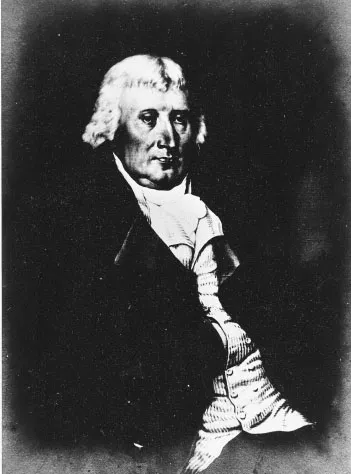
The Honourable Peter Russell, president and administrator of Upper Canada, 1796–99, shown in a black and white image of a painting by George Theodore Berthon, circa 1882.
Courtesy of Archives Ontario, S 2168, Government of Ontario Art Collection Acc. No. 693124.
The seizure and sale of Chloe Cooley, her resistance, and Peter Martin’s act to inform the Executive Council changed the course of history in Upper Canada. These events would have an impact on the institution of slavery, particularly its duration, across the new province, including at the Head of the Lake, Hamilton’s future home. Most slaves in Upper Canada lived in the Detroit-Windsor area, the Niagara peninsula, the settlements around Kingston, and eastward along the St. Lawrence River. Of course, slavery was first practised by the French regime beginning in the 1500s, and the first people to be enslaved on Canadian territory were the aboriginal people, commonly known as Panis. The earliest record of Africans being introduced into Quebec was that of a young boy from Madagascar, later christened Olivier Le Jeune, who was sold to a Quebec clerk in 1628.5 By the early 1700s, there were hundreds, if not thousands, of enslaved Africans in New France, an area that covered much of what is today Ontario and Quebec. French-Canadian historian Marcel Trudel counted 4,092 enslaved people — 2,692 aboriginal and 1,400 African slaves — in his more recent study of slavery in New France. This represented the total number of enslaved people over the entire course of New France’s history.6 When the British took over jurisdiction of France’s territory in 1760 after the battle on the Plains of Abraham at Quebec City, slavery was given legal status in the Treaty of Paris. Slaves continued to be bought and sold along with other items at their owners’ will. Moreover, slavery came more and more to be identified with a single race — the Africans.
The only area that seems to have kept reliable statistics on slavery was Detroit, which remained part of Upper Canada until 1796. However, the numbers of aboriginal versus African slaves represented by these statistics is not known. The authorities enumerated 33 slaves in 1750, 83 in 1773, 138 in 1779, and 179 in 1782. Included were those located on the south shore of the Detroit River where Windsor is now living.7 Trudel counted 528 aboriginal and 128 African slaves at Detroit over time, but we have no specific dates associated with his numbers.8 In Niagara, three censuses were conducted between 1782 and 1783, indicating that the numbers of slaves rose from one to ten in the space of one year.9 They were most likely all Black. In the Kingston area, a census for the new townships along the St. Lawrence River indicated ninety slaves among the disbanded troops and Loyalists there.10 These slaves were most likely all African as they were brought in by Loyalists from the American colonies, and slavery there had long since become associated with the African race.
In 1793, Lieutenant-Governor Simcoe moved the capital of Upper Canada from Newark — what is today Niagara-on-the-Lake — to York, on the northern shores of Lake Ontario. The new capital would later be renamed Toronto. With the removal of the government, officials and settlers relocated, moving their household goods and slaves with them. This included Peter Russell and William Jarvis, the first provincial secretary of Upper Canada. Both families were slaveholders.
A “List of Inhabitants” of York, and including the townships of Scarborough and Etobicoke, provides a count of those who were Black, but does not distinguish between slaves and free people. However, based on what is known about the Jarvis and Russell slaves, those Blacks can be counted as part of the enslaved population. In 1799, there were twenty-five people of African descent in York, ten known to be the slaves of Russell and Jarvis. In 1800, there were seventeen Blacks, eleven of whom were Russell’s and Jarvis’s slaves. In 1801, there were seventeen Blacks, five belonging to Russell or Jarvis, and, in 1802, there were eighteen Blacks at York, six of whom were enslaved in the households of Russell and Jarvis.11 Beginning in 1801, Blacks in York were listed separately at the end of the list, but by 1804 there was no indication of the race of York inhabitants. It wasn’t until decades later that some Black residents of Toronto were again identified as such in the city directory, with the term “col’d” or “coloured” printed in brackets beside their names.
Most Blacks who first entered the province that became Upper Canada did so during and after the American Revolution. The Imperial Act of 1790, passed by Britain to encourage immigration to her colonies in North America, Bermuda, and the Bahamas, permitted the importation of “Negroes, household furniture, utensils of husbandry or cloathing.”12 Free Blacks were not encouraged. Although some, like Peter and Richard Martin, had fought in British regiments and had obtained their freedom for doing so, the majority of Africans entering the province were slaves. Some of the enslaved came in with drovers, who also brought in horses, cattle, and sheep for the purchase of the troops and the settlers. Colonel Clarke of the 2nd Lincoln Militia recalled that his father was one of a number of people who purchased slaves — three males and one female — from one of these drovers.13 But as was the case in the Niagara region, York (Toronto), and the settlements along the St. Lawrence River, slavery at the Head of the Lake came into being with the advent of the Loyalists.
The Loyalists consisted primarily of European-American settlers who wished to remain loyal subjects to the British Crown. They left en masse to settle in British North America and other British colonies. The United Empire Loyalists, as they were named, packed up as many of their possessions as they could muster, and made the arduous trek across land, lake, and river to the border and across into Canada. Along with the furniture, livestock, clothing, and other belongings came human property in the form of slaves.
One of these Loyalist families that headed north was the William and Hannah Davis family of North Carolina. They had heard that the new lieutenant-governor of Upper Canada was none other than John Graves Simcoe, whom they had befriended during the British occupation of Yorktown, Virginia. Simcoe, a British officer, had commanded the New York regiment called the Queen’s Rangers light infantry unit. In 1792, therefore, they loaded up a covered wagon with carpets, a grandfather clock, and other fine pieces of furniture, and began the nearly eight- hundred-mile journey with twenty horses, their eight children, and “several faithful slaves.”14 They first settled at Chippewa, above Niagara Falls, on the Niagara River. However, the following year, Hannah Davis fell ill with fever and died. Devastated, William Davis moved his family to a drier part of the country, and, on the brow of the Niagara Escarpment now known as Hamilton Mountain, they established a home overlooking one of the most picturesque vistas in the province. The family was given a generous grant of eight hundred acres to compensate them for the loss of their southern plantation during the Revolution. Today, part of this land grant comprises a good portion of the City of Hamilton, including the Glendale Golf Course.15
Unfortunately, little is known about the slaves who made the journey with the Davis family. We don’t know their names, genders, nor exactly how many made the journey north. We also do not know why they remained with the Davises. However, of the first two log structures that were built on the land, one was inhabited by these enslaved individuals. Much of the work involved in clearing the land, building houses, planting and growing crops, and making sure that everyone was fed and clothed for the harsh winters would have been performed by the slaves. A new home, which was named “Harmony Hill Manor,” was soon built to replace the Davis’s original log cabin. It was a more palatial residence with colonial pillars and a second-floor ballroom, and its similarity to a Southern colonial mansion suggests the possibility that African slaves were the builders. In addition, the Davis family built a sawmill and gristmill on their property to serve not only themselves, but the surrounding farm community “although,” as a descendant of the Davis family noted, “they were neither millwrights nor carpenters ...”16 The slaves could well have been involved in the building and operation of these enterprises. Fifty years later, former slave and Black leader Josiah Henson and other abolitionists established the manual labour school called the British American Institute at Dawn, where Dresden, Ontario, is today. In that instance, a Black millwright from South Carolina designed and built the sawmill.17 Therefore, it is quite conceivable that the bondsmen and women on the Davis establishment were not only heavily involved in the construction of the operations, but also in their actual design as well, given that African slaves often were the master builders of these early industries.
Unlike the Davis slaves, the names and ages of two of another early Niagara-area resident, Adam Crysler, were recorded for posterity. Adam Crysler served first as a lieutenant in Butler’s Rangers and then joined Captain Brant’s Indian Company under Colonel Guy Johnson. Because the Cryslers remained loyal to Britain, they were forced to make a hasty departure from their home in Schoharie, New York. The family settled near St. David’s, Niagara Township, in 1784, when it was a vast area of forest. Adam Crysler purchased at least two slaves after he and his wife Ann Mary and their children arrived in the province. “A Negro Wench named Sarah about nine Years old” he purchased for £40 New York Currency, and later added “a Negroe man named Tom aged about Thirty Years” to his inventory for £90 New York Currency.18
When they first arrived, the Crysler family was living at Fort Niagara, which was actually located on the American side before the terms of the Treaty of Paris obliged them to move to the other side of the river. Ho...