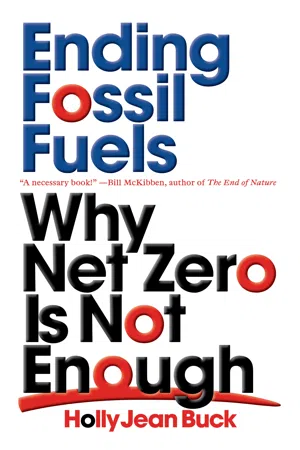
Around the world, countries and companies are setting net-zero carbon emissions targets. But "net-zero" is a term that conveniently obscures multiple futures. There could be a version of net-zero where the fossil fuel industry is still spewing tens of billions of tons of CO2 into the atmosphere, and has built a corresponding industry in sucking it back out again. Holly Buck argues that focusing on emissions draws our attention away from where we need to be looking: the point of production.
It is time to plan for the end of fossil fuel and the companies that profit from them. Fossil fuels still provide 80% of world energy and ceasing their use before there are ready alternatives brings risks of energy poverty. The fossil fuel industry provides jobs, as well as a source of revenue for some frontline communities. Conventional wisdom says that fossil fuels will be naturally priced out when cheaper, but this raises as many problems as it addresses. Ending Fossil Fuels tackles these problems seriously and also sets out a roadmap that offer opportunities for more liveable, inclusive future.
- 208 pages
- English
- ePUB (mobile friendly)
- Available on iOS & Android
eBook - ePub
About this book
Information
Topic
BiowissenschaftenSubtopic
Umwelt- & EnergiepolitikPart I. The Cruel Optimism
of “Net Zero”
of “Net Zero”
1
How to Not Say the F Word
Net zero is both tedious and a hot trend. Net zero has the effect of being able to instantly transform the exciting, terrifying work of our times into something numb and boring. Net zero is the stuff of webinars, white papers, consultant reports. But it’s also popular. At the time of this writing, at least six countries have a target of net-zero emissions by mid-century solidly in law, several others have them in proposed legislation, and another dozen have net-zero targets in policy documents. Scores of cities and subnational jurisdictions have also announced net-zero goals. Many of the world’s largest companies, from tech giants like Apple to fossil fuel producers and utilities, have also jumped aboard the net-zero train. Microsoft aims to be not just net zero but carbon negative by 2030, and remove all of its historical emissions since its founding in 1975.
Even the Green New Deal, a conceptual innovation that links climate change with broader social goals, begins with the climate math. House Resolution 109—the resolution introduced in the House that serves as a sort of vision document —kicks off by reporting findings from the Intergovernmental Panel on Climate Change’s Special Report on 1.5°C. Keeping temperatures below 1.5°C will require “(A) global reductions in greenhouse gas emissions from human sources of 40 to 60 percent from 2010 levels by 2030; and (B) net-zero global emissions by 2050,” it states. The resolution talks about achieving “net-zero greenhouse gas emissions through a fair and just transition for all communities and workers.”1 It’s a tremendous document. But it doesn’t lead with ending fossil fuel production. In fact, it doesn’t even mention the words “fossil” or “fuels.”
Neither does the landmark Paris Agreement. Read the texts, and you’ll be struck by this weird verbal jujitsu of documents aimed at ending this thing that they can’t even name. The European Green Deal is not much better, either: it does address fossil fuels a few times and call for phasing out subsidies to fossil fuels, but it certainly does not center production.2 Rather, these—and most climate policy—center emissions, the byproduct of combustion, thus skipping right past production.
This isn’t a new observation. The Indigenous Environmental Network, for example, released a statement that strongly rejected the net-zero emissions language in the resolution. While they were grateful to see legislative support for climate action, they could not fully endorse the resolution until it made explicit the demand to keep fossil fuels in the ground. “Furthermore, as our communities who live on the frontline of the climate crisis have been saying for generations, the most impactful and direct way to address the problem is to keep fossil fuels in the ground,” they wrote. “We can no longer leave any options for the fossil fuel industry to determine the economic and energy future of this country.”3
While activists pointed out the omission of references to fossil fuels, the Green New Deal was still generally celebrated as an important step. The innovation of the Green New Deal is the way it broadens concern to include the “several related crises” the resolution goes on to list: declining life expectancy, income inequality, and racial and gender wealth and earnings gaps. But what starts out as a remedy for inequality may end up as a carbon accounting exercise.
Rather than jump into figuring out the nuances of a just supply-side climate policy—which is really hard!—well-meaning climate and sustainability professionals may spend several years wandering in the thickets of “net zero.” Again, net zero, at its simplest, means balancing some amount of positive greenhouse gas emissions with negative emissions or removals. Well, what amount of positive greenhouse gas emissions are we talking about? That often remains conveniently unclear. Goldman Sachs, for example, estimates 25 percent of current emissions would remain. They state that these anthropocentric greenhouse gas emissions are not currently abatable using available large-scale commercial technologies, calling for both innovation and investment in sequestration technologies to achieve net zero.4 A quarter of current emissions is still a lot of emissions. Decarbonization roadmaps set out by countries and cities tend to be vague on this point, when they even exist, but many of them include 10–20 percent of baseline emissions as “residual” emissions, or remaining positive emissions, which will need to be compensated for by removals. This is a looming political fight, though in some places, it has already been decided: New York State, for example, has set the maximum residual emissions at 15 percent of 1990 levels; Massachusetts law similarly requires an 85 percent reduction from 1990 levels.
Is net zero really more ambitious than what preceded it? Net-zero targets have replaced earlier targets, which often took nonintuitive goals, such as an 80 percent reduction of greenhouse gases from 1990 levels by 2050. Replacing these reduction goals with net-zero targets has generally been welcomed as a strengthening of ambition. But it may not be in all cases: in theory a country could have a net-zero target that is less than an 80 percent reduction of greenhouse gas emissions from some earlier point, as long as those positive emissions can be compensated for by negative ones.
Net zero by 2050 is an ambitious goal relative to the pace of climate action thus far. Achieving it would be incredible. But there are also ways in which it is the wrong goal. The concept of net zero offers balance and stability. It also offers ambiguity that can be exploited.
Cleaner Fossil World or Near-Zero World?
Imagine a world that has reached net zero near the end of this century. Let’s call it “Cleaner Fossil World.” Cleaner Fossil World still has fossil fuel companies, particularly oil and gas companies. They have shifted their portfolios and are now producing fossil fuels with lower carbon intensity. Oil is still produced for aviation, shipping, and industry. The companies have invested in systems to capture billions of tons of carbon dioxide from the atmosphere, injecting it underground and turning it into fuel, an energy intensive process. This allows a class of people in the developed world to keep internal combustion vehicles with drop-in fuels. Meanwhile, energy has become more expensive, as fossil fuel companies have passed the cost of all their new carbon-capturing equipment down to consumers, and many people live in energy poverty, carefully rationing the solar power they have access to.
But this Cleaner Fossil World has achieved net-zero emissions by sucking up tremendous amounts of carbon. Vast tree plantations that have decimated biodiversity provide a portion of those negative emissions. Land is routinely appropriated for carbon storage and renewable energy generation. The companies and platforms that finance, arrange, and perform the industrial services of removing all this carbon hold tremendous power, because people rely on them for climate stability. Cleaner Fossil World might align with the International Energy Agency’s Sustainable Development Scenario or Shell’s Sky scenario. In this world, there’s a circular carbon economy and a continued role for oil and gas, but oil and gas production is decarbonized.
Now imagine a second world that has also reached net-zero emissions near the end of the century. In Near-Zero World, the remaining greenhouse gas emissions arise primarily from agriculture. The need for negative emissions is lower, and they can be generated through modest infrastructures. Near-Zero World might follow along with the International Energy Agency’s Net Zero by 2050 scenario, which paints a world that quintuples investment in solar photovoltaic technology by 2030, shuts down most coal plants, electrifies half the vehicle fleet by 2030, retrofits buildings, and sees significant behavioral changes.
Cleaner Fossil World and Near-Zero World might sound pretty much the same. Anyone could be forgiven for thinking they are the same, if they heard about them casually. Both of these worlds have attained net zero. But which is more livable? Which is more plausible? What “net zero” does is allow companies and policymakers to conveniently ignore the choices between these worlds and countless others. Net zero may be a temporary state on the way toward a fossil-free future, or it may be a permanent condition where fossil fuels continue forever, re-interpreted as part of sustainable carbon management. Net zero does important work: it shifts attention entirely onto emissions, counting and balancing them. This draws attention away from the point of production, which is where we need to also be focusing.
The argument here is this: without deliberately phasing out fossil fuels, we’re more likely to end up in Cleaner Fossil World. But that’s not even all that likely. What’s even more plausible is that the world never reaches net zero at all. The structures of power in place would only half-heartedly go about decarbonizing fossil fuels and call partway “good enough,” leaving us with a devastating 3°C of warming. Conversely, the chances for a livable planet are much higher if we frame our goals around ending production, aiming for an actual fossil-free world this century. Arguments about ending fossil fuels tend to read as Puritan ones: no compromise, total abolition—and so they get laughed off by “serious folks” as ideological or unachievable. The set of arguments in this book come from a different rationale.
2
Inventing Net Zero
What is “net zero,” and how did it get into policy ambitions? Whose ambitions are these, anyways? It seems like the “net” just kind of crept in, quietly, over the past few years and attached itself to zero, like a little invisible demon or imaginary friend. But like all concepts, it was designed by people in particular places with particular visions of the future.
Climate Home News editor Megan Darby traces the net zero concept to an informal network of women—climate activists, lawyers, and policy professionals—who met at a Scottish country estate in 2013 and discussed what would be a workable yet ambitious goal in the wake of the failures of the earlier Copenhagen climate summit.1 Net-zero thinking made its most recent debut in the 2015 Paris Agreement, in which nations agreed on the goal of limiting warming to 2°C above preindustrial temperatures and striving to limit warming to 1.5°C. Key idea here: the Paris Agreement aims to do this by reducing emissions as soon as possible, “to achieve a balance between anthropogenic emissions by sources and removals by sinks of greenhouse gases in the second half of this century.”2
The earth is a spinning ball of flows between atmosphere, soil, plants, oceans. Those flows have to be broken down into accountable numbers belonging to national territories in order to set up a regime of responsibility for managing them, as policy researchers Eva Lövbrand and Johannes Stripple chronicle. The United Nations Framework Convention on Climate Change negotiations in the 1990s began these accountings of emissions and removals.3 Northern forest countries introduced net emissions logics into negotiations, which crystallized in the 1997 Kyoto Protocol agreement that opened up the possibility of using land-based carbon sinks to comply with their reduction targets.4 The Kyoto Protocol embodied centralized, top-down, compliance-based logic.5 The “national carbon sink” as a resource and idea was born. The net accounting system was part of the compromise of Kyoto, but it remained the subject of intense controversy. What counts as a forest? Can the amount of carbon in a forest accurately be measured? Does anyone actually want to pay to protect and grow forests?
Carbon cowboys, junk credits, land grabs: the chicanery, violence, and misery of the early carbon trading era has been well documented. There are two types of carbon markets: voluntary markets (supported by companies that decide, out of corporate sustainability or other motivations, to offset their emissions) and compliance markets, which are mandated by law under cap-and-trade schemes, such as in the European Union and California. The EU Emissions Trading Scheme experienced early significant failures, prompting questions about the success of markets. But the market rationale kept churning on in the private sector, and several voluntary carbon offset standards have evolved, some of which aim to treat earlier problems.
Today, both voluntary and compliance markets are rising. The EU’s Emissions Trading System has seen carbon prices soar, hitting record highs in early 2021 of nearly 40 euros per ton of CO2 equivalent (US$49). In 2020, carbon markets reached a value of 229 billion euros, which is a fivefold increase from 2017.6 Is this an indicator of climate action going mainstream? Does it show that companies are speculating that emissions allowances will be constrained? It seems that is part of it. The belief in successful climate policy could even produce a rush for carbon futures, so that companies can lock in cheaper offsets or removals now, which, if it happened, could drive speculative land grabbing. The flip side of such a rush is that the money pouring into carbon futures could pay for the development of the technologies needed to remove carbon.
At the time of writing (April 2021), there’s a renewed interest in both carbon offsets and carbon removals, as well as widespread confusion about the distinction. An offset involves credits from projects that avoid or reduce emissions. This involves proving that whatever action a project took avoided something that would have happened anyway—for example, if someone protected a forest, to get a carbon credit, they would have to prove that the forest was in danger of being cleared. For this reason, the offset market is not well set up to manage removals; too much of it focuses on calculating this counterfactual future. A removal, on the other hand, is capable of removing carbon already in the atmosphere. Some actors—including technology companies like Microsoft or Stripe—have recognized the problems with offsets and are moving away from them and trying to catalyze a market for carbon removals instead. All the companies that made net-zero commitments will be groping around for carbon removals. Right now, there is a reinvigorated enthusiasm for forest sinks, and virtually no supply for long-term carbon removals. But this is changing as big companies seek to partner with industrial projects that can permanently store carbon.
The Paris Agreement also brings the potential for a new international carbon market, where emissions reductions could be traded between countries. Article 6.2 in the Paris Agreement enables the transfer of “international mitigation outcomes,” which offers the prospect of carbon unit trading, and Article 6.4 offers the ground for a Sustainable Development Mechanism. Article 6 has been called “something of a miracle” by Shell climate advisor David Hone, because there was no carbon pricing or carbon-market language in the draft text as late as the day before the final adoption of the agreement.7 Article 6 is at least better than the previous situation under the Clean Development Mechanism, in that the Paris Agreement explicitly forbids double-counting. It also ushers in a new wave of quantification as nations define their Nationally Determined Contributions (the pledges they make). So on a global governance scale, the international architecture has opened the way for a new system of trading carbon offsets as well as removals.
The vibe now in climate governance is described by words like “polycentric,” “fragmented,” “flexible,” “networked,” and “pluralist.” But to understand why we seem to be back in the same place, with what sounds like the same type of approaches that haven’t worked for the past three decades, we have to appreciate a basic feature of decarbonization: the capacity to decarbonize is unequal. For one, it’s unequal geographically. If a country has forest resources that connote large removal capacity, and another country has none, should there be some way of trading?
Net zero, at its best, is the dream of a world in balance. Different nations have different capacities for how much they can decarbonize and how much carbon they will be able to remove. Not every nation can build an industrial carbon removal infrastructure, access hydropower, or plant carbon-sucking forests. Nations have different historical responsibilities and capabilities, too. A progressive version of net zero could be an instrument of climate justice. Imagine a better version of the United States, one that has built infrastructure for sucking carbon from the atmosphere and injecting it underground. This better version doesn’t use that technology to compensate for the emissions of the highest payer, but rather uses it to compensate for nitrous oxide from fertilizer applications in sub-Saharan Africa, as one part of payback for climate damages. “The US would never do that.” Probably not soon, but we should demand more. There’s a version of net zero that could actually be an instrument of fairness and repair. The status quo version is that the US will develop giant carbon storage fields offshore and charge other countries for putting CO2 in them, if it’s even still capable of large infrastructure projects.
The capacity to decarbonize is also unequal when it comes to sectors. For years, analysts have been breaking down the decarbonization puzzle into pieces, looking at the capacity to decarbonize each sector. Most famously, Stephen Pacala and Robert Socolow at Princeton published a 2004 article in Science, as part of a project funded by Ford Motor Company and BP, which proposed...
Table of contents
- Cover Page
- Halftitle Page
- Title Page
- Copyright Page
- Contents
- Introduction: Controlled Demolition
- Part 1. The Cruel Optimism of “Net Zero”
- Part II. Five Ways of Looking at Fossil Fuel Phaseout
- Part III. A Phaseout Toolbox for the 2020s
- Epilogue
- Acknowledgments
- Notes
Trusted by 375,005 students
Access to over 1.5 million titles for a fair monthly price.
Study more efficiently using our study tools.
Frequently asked questions
Yes, you can cancel anytime from the Subscription tab in your account settings on the Perlego website. Your subscription will stay active until the end of your current billing period. Learn how to cancel your subscription
No, books cannot be downloaded as external files, such as PDFs, for use outside of Perlego. However, you can download books within the Perlego app for offline reading on mobile or tablet. Learn how to download books offline
Perlego offers two plans: Essential and Complete
- Essential is ideal for learners and professionals who enjoy exploring a wide range of subjects. Access the Essential Library with 800,000+ trusted titles and best-sellers across business, personal growth, and the humanities. Includes unlimited reading time and Standard Read Aloud voice.
- Complete: Perfect for advanced learners and researchers needing full, unrestricted access. Unlock 1.5M+ books across hundreds of subjects, including academic and specialized titles. The Complete Plan also includes advanced features like Premium Read Aloud and Research Assistant.
We are an online textbook subscription service, where you can get access to an entire online library for less than the price of a single book per month. With over 1.5 million books across 990+ topics, we’ve got you covered! Learn about our mission
Look out for the read-aloud symbol on your next book to see if you can listen to it. The read-aloud tool reads text aloud for you, highlighting the text as it is being read. You can pause it, speed it up and slow it down. Learn more about Read Aloud
Yes! You can use the Perlego app on both iOS and Android devices to read anytime, anywhere — even offline. Perfect for commutes or when you’re on the go.
Please note we cannot support devices running on iOS 13 and Android 7 or earlier. Learn more about using the app
Please note we cannot support devices running on iOS 13 and Android 7 or earlier. Learn more about using the app
Yes, you can access Ending Fossil Fuels by Holly Jean Buck in PDF and/or ePUB format, as well as other popular books in Biowissenschaften & Umwelt- & Energiepolitik. We have over 1.5 million books available in our catalogue for you to explore.