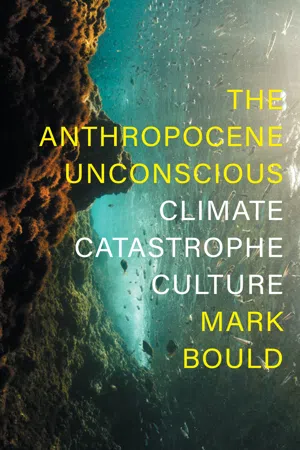
The art and literature of our time is pregnant with catastrophe, with weather and water, wildness and weirdness. The Anthropocene - the term given to this geological epoch in which humans, anthropos, are wreaking havoc on the earth - is to be found bubbling away everywhere in contemporary cultural production. Typically, discussions of how culture registers, figures and mediates climate change focus on 'climate fiction' or 'cli-fi', but The Anthropocene Unconscious is more interested in how the Anthropocene and especially anthropogenic climate destabilisation manifests in texts that are not overtly about climate change - that is, unconsciously. The Anthropocene, Mark Bould argues, constitutes the unconscious of 'the art and literature of our time'.
Tracing the outlines of the Anthropocene unconscious in a range of film, television and literature - across a range of genres and with utter disregard for high-low culture distinctions - this playful and riveting book draws out some of the things that are repressed and obscured by the term 'the Anthropocene', including capital, class, imperialism, inequality, alienation, violence, commodification, patriarchy and racial formations. The Anthropocene Unconscious is about a kind of rewriting. It asks: what happens when we stop assuming that the text is not about the anthropogenic biosphere crises engulfing us? What if all the stories we tell are stories about the Anthropocene? About climate change?
- 176 pages
- English
- ePUB (mobile friendly)
- Available on iOS & Android
eBook - ePub
About this book
Information
1
Chum to the Maw
In mid-summer 2013, Hurricane David swept up the west coast of Mexico, driving unprecedented numbers of sharks north into unfamiliar waters. On 11 July, the storm approached Santa Monica, forcing the disoriented predators into the shallows, where they attacked surfers and swimmers. Just minutes later, the hurricane hit. A prodigious storm surge raced inland, through West Los Angeles and beyond, spewing the voracious fish into the flooded streets. At the same time, the first of three massive water-spouts that would tear through the city formed and hurled sharks at unsuspecting Angelenos.
It was the first recorded sharknado.
Produced by mockbuster powerhouse the Asylum, and debuting on Syfy, the $1 million Sharknado underperformed, attracting just 1.37 million viewers, a hundred thousand fewer than expected for one of the channel’s consciously cheap and laughably ‘original’ movies. However, live-tweeting by minor celebrities and others – reaching up to 5,000 tweets per minute – set it trending, and audiences for the repeat screenings grew, attracted as much by the social media frenzy, itself widely covered online and in more traditional media, as by the film. Thus, an action-comedy-revenge-of-nature-disaster-movie mash-up, whose star only took the role to pay for his family’s health insurance, became a phenomenon. It spawned a sequel every year for five years, becoming sillier and – which is not necessarily the same thing – increasingly science-fictional.1
The first movie introduces the divorced former surfing champion turned bar-owner Fin Shepard, played by Ian Ziering, who brings an utterly unwarranted Tom Cruise– like intensity to the role. Aided by Nova, a waitress who was orphaned by sharks, he must save – and reunite – his broken family.
In the second, three sharknadoes converge on New York, where Fin must once again quell the storms to save his no-longer-ex-wife April, his family and the city.
In the third, multiple Atlantic sharknadoes threaten the whole of the ‘Feast Coast’. Fin, his estranged ex-astronaut father, Gil, and the heavily pregnant April fly into orbit to activate mothballed SDI weapons that will quash the storms – and to fight sharks hurled into space by the extreme weather. Re-entering the atmosphere inside a shark, April gives birth to a son, also called Gil, but she is then crushed and killed by falling shuttle debris.
The fourth is set five years later. Unknown to Fin, April’s mad-scientist father has transformed her into a Terminator-quoting flying cyborg, which, beyond giving her a more active role, is a brilliant solution to affectless Tara Reid’s inability to play anyone even remotely resembling a human being. When an innovative nationwide sharknado-suppression grid fails, sharknadoes plough through west coast and mid-western cities before the rebooted system can dissipate them. However, after one electrically enhanced sharknado – a lightningnado – hits the Perry Nuclear Plant, Fin and April must build a quantum box around Niagara Falls to shut down this nukenado (I have no idea what this means or how it works, but neither does the script).
The globetrotting fifth film begins in the cave system beneath Stonehenge. Fin and Nova – who quit waitressing to found the black-clad Sharknado Sisterhood, a secret organisation comprised entirely of generically hot chicks in tight costumes – unearth an ancient sharknado-suppression technology, a network connecting sacred sites around the world, but unintentionally disable it. A sharknado containing a dimensional vortex makes off with young Gil. His parents, in hot pursuit, are deposited in Switzerland, Australia, Brazil, Italy, Japan – where a giant radioactive Sharkzilla stomps Tokyo and kills Nova – and finally Egypt. In the pyramids of Giza, Fin and April unleash the devastating power of the ancients, stopping the global sharknadoes but accidentally destroying the world. Fin, the last man alive, wanders the ruins with the April’s severed-but-still-active cyborg head in a bag. One day, a vehicle appears, driven by Gil, who is now a grizzled old man. Thrown into the distant past by the sharknado/vortex, it took him decades to invent time travel …
While travelling forward through time, Gil rescued characters who died in the earlier movies, snatching them up in the split second before their deaths and depositing them safely in sundry historical periods. And so the sixth movie opens 65 million years in the past, just minutes before the K-T asteroid impact. Fin, Nova (who did not die in the fifth movie), human-April (who did not die in the third) and cyborg-April’s head shut down the first ever sharknado. They leap forward in time, pursuing iterations of the young-but-growing-older Gil and fighting sharknadoes in Camelot, the American War of Independence, the Wild West and 1950s Santa Monica (where Fin encourages his parents to hook up). In 1997 San Francisco Nova saves her grandfather, but the sharks that had killed him instead devour her and April. Fin and Skye (his childhood sweetheart, who did not die in the second movie) misdial their flux capacitor, arriving in a post-apocalyptic 20,013 of April clones and flying robot sharks, ruled over by the now evil cyborg-April head.
Somehow, Fin makes it back to that first deadly summer, reworks the opening of the original movie and brings an end to the sharknado threat for good. And all this chrononautical malarkey has irrevocably altered the world. This time around, Fin and April worked on their marriage and did not alienate their children, families and friends; and Nova, no longer an orphan, has no reason to hate sharks.
The Sharknado movies are salvage artefacts, composed of the flotsam and jetsam of American TV. News footage of floods, disasters and accidents – sometimes dressed with shoddy CGI storms, airborne sharks and other meteorological phenomena – collides with hastily shot, green-screen-heavy location and studio scenes, similarly subjected to deliberately unconvincing digital enhancement.
Through this visual patchwork flows a torrent of allusions to TV series – Baywatch, Taxi, The Twilight Zone – and movies – Airplane!, Back to the Future, Evil Dead 2, Invasion of the Body Snatchers, Jaws, The Lady and the Tramp, Mission: Impossible, Network, Raiders of the Lost Ark, Roman Holiday, Scarface, The Sound of Music, Space Cowboys, Star Wars, The Texas Chain Saw Massacre, Toy Story, The Wizard of Oz and that bit from Independence Day pastiching Laurence Olivier’s Henry V. Some of these riffs, nods, plagiarisms and petty larcenies become recurring in-jokes. Others – April’s reworking of the Action Comics #1 cover, the reference to The Adventures of Buckaroo Banzai Across the Eighth Dimension – are unexpected, possibly even obscure. But none of them are subtle.
At the same time, the screen is packed with half-remembered faces, drawn from the ranks of – often former – child actors, soap stars, talent show contestants, fauxality grafters, news and weather presenters, chat show hosts, authors, rappers, country and western singers, rock guitarists, Vegas crooners, comedians, veejays, bounty hunters, magicians, scientists, drag queens, figure skaters, skiers, divers, skate-boarders, wrestlers, the Chippendales, supermodels, glamour models, spokesmodels, romance novel cover models, right wing pundits, a Republican congresswoman,2 a possessed 1958 Plymouth Fury, Star Trek alumni, character actors who have done and should know better, writers and directors of crappy movies (including these ones), members of the crew, people whose fifteen minutes of fame were just too long ago, random cleavages, charisma vacuums, the dead-faced victims of ill-advised cosmetic surgery … Many of them play themselves, and some bring family along for the ride. And like the incessant allusions, they are there to be noticed, pointed at, exclaimed over.
The Sharknado movies are not unified or coherent. They eschew bourgeois textual norms and demand the retention of disbelief. They have no interest in absorbing the viewer, no aspiration to illusionism. They are Brecht gone bad. Digressive, dispersible and composed almost entirely of exit points, they interpellate differently. They bombard us with scattershot textual moments intended to draw attention to themselves, to prompt pleasures of recognition, groans of incredulity, cries of mockery and, more importantly, tweets, posts, memes, buzz. They are epiphenomena of commercially networked global media, glimpses of the informational hyperobject.
The franchise churns through cultural detritus, resuscitating and recirculating it, making it into capital once more.
Everything is chum to its maw.
But this rapacious, indiscriminate appetite for distraction means the sprawling, repetitive nine-hour Sharknado dreamwork cannot avoid talking about climate change. The term itself is used just once, in an easy-to-miss background TV news report, but as Sharknado 5: Global Swarming’s subtitle suggests, we do not have to look far to see climate change and other anthropogenic crises folded into the movies’ constantly self-unpicking fabric.
There are depictions of illegal overfishing and extinction events. Stray references to refugees, migrations and borders. Fantasies of hi-tech magic bullets and geoengineering solutions. Disruptions of space and time, shifts of magnitude and intensity, which figure the asynchronous, non-linear, tipping-point causality of climate change. And the narrative is repeatedly interrupted by news updates in which (real-world) presenters perform their (real-world) uncritical, platitudinous, sentimental, hyperbolic-yet-bored fascination with crisis, normalising extreme weather events even as they grow in size and frequency.
And there are the sharknadoes themselves.
Ludicrous, crudely rendered images of climate disruption and destabilisation, they gesture towards the weirdness and excessiveness of our changing weather.3 They are big dumb reminders that we share the world with other species.
The franchise shows recorded human history taking place in a period when – and because – sharknadoes are artificially suppressed. This implies that a climate inhospitable to humans is the terrestrial norm, that human civilisation developed in a period of climatic stability unusual in the planet’s history, and that climate chaos is destined to return. In the real world, we call that stable period the Holocene, and we are now poised on the edge of what will come after it, some of which we have already made unavoidable.
When we watch a movie, we inhabit a contradiction. We surrender to a fiction we know is fictional. Visual effects heighten this interplay of credulity and incredulity: they show us things we know cannot possibly be real. This pleasurable hesitation is often upset when effects fail to convince, and even the most cutting-edge accomplishments soon fade, become obvious, look fake.
But something different happens in the Sharknado movies.
Minimally concerned with the illusion of the real, their special effects are deliberately crafted to be amusingly inept. Their function is not to persuade but to titillate.
However, the movies’ overall tone and aesthetic is potentially disturbed by dependence on stock footage. A traditional economy for the low-budget filmmaker, stock footage is a just-good-enough way of avoiding location shooting and the costly staging of spectacular events. But, like visual effects work, stock footage produces its own set of contradictions. It is usually part of a visual rhetoric intended to maintain the viewer’s suspension of disbelief in the narrative and story world but, simultaneously, the visible differences in image quality draw disruptive attention to the movie’s artifice.
In the Sharknado movies, the contrasts between stock footage, narrative footage and the maladroit CGI with which they intercut and are often adorned are excessively evident. Such disjunctures underscore the actuality of the stock footage. Real catastrophe lurks beneath the surface. It emerges as out-of-place verité fragments, but is quickly swept away by remorseless torrents of distraction.
The repressed, however, always returns. Here, as exorbitant meteorological–ichthyological symptoms, as climate parapraxes, as anthropocenic slips of the tongue.
The franchise’s reluctance to say ‘climate change’ aloud is no bashful qualm.
The Asylum and Syfy promulgate an image of themselves as being fun, not serious, so as to justify the rubbish they deliberately produce and broadcast. And they obey a commercial imperative to maximise their niche audience segment by remaining superficial. At the same time, the franchise enacts – and speaks to – a habituated desensitisation to the ever-present existential threat of anthropogenic climate destabilisation. But whatever its source, this disinclination, this peculiar silence, does not mean that the franchise is not about climate change.
This should come as no surprise.
The fantastic expresses our fears and anxieties, our desires and sometimes even our hopes. Frankenstein’s monster embodies terrors of reproduction, foreshadows proletarian and anti-colonial revolution. King Kong rampaging through Manhattan enacts white fears of black masculinity and colonial comeuppance. Bodysnatching aliens are avatars of consumerist conformism. Robots are our dehumanised selves. Godzilla is the bomb.
So the first thing you should always ask of a monster is: what does it represent? 4
In Danny Boyle’s 28 Days Later… (2002), humans infected with the Rage virus burst out from a lab. The contagion spreads rapidly across Britain. It cannot be cured, controlled or contained. Infrastructure remains intact. Nonhuman life obliviously persists. But nearly every last Briton who is not dead is undead.
In a stately home near Manchester, barricaded against zombie assault, half a dozen soldiers sit around pondering when things will get back to normal. Sergeant Farrell corrects them: ‘If you look at the whole life of the planet … man has only been around for a few blinks of an eye. So if the infection wipes us all out, that is a return to normality.’
More typically, monster movies contrast the brevity of human existence with the age of the planet by conjuring creatures from the distant past. By excavating crashed alien things from ancient polar ice and carelessly defrosting them. By unsealing dinosaurs from lost worlds or engineering them from fossilised DNA.
In Guillermo del Toro’s Pacific Rim (2012), creatures from another dimension open a portal between tectonic plates in the Pacific, and from this Breach kaiju emerge to smash, stomp and generally destroy. But they have been here before. A throwaway exchange reveals that dinosaurs were actually part of an earlier attempt to colonise the Earth, defeated by the inhospitable terrestrial climate. However, anthropogenic climate change has now made the planet habitable for them.
As arithmetic, let alone history, this is nonsense. Dinosaurs were around for about 165 million years and were the dominant vertebrates for 135 million; Homo sapiens only speciated from Homo erectus (or an intermediate species) 350,000 years ago, about 1/400th as long.
This absurdity is not inconsequential. It indicates the terrifying rate at which humans are transforming the atmosphere. If we take Clark’s longest of Anthropocenes (1.6 million years), we have been at it for just one per cent of the ti...
Table of contents
- Cover Page
- Halftitle Page
- Title Page
- Copyright Page
- Dedication
- Contents
- Acknowledgements
- Introduction: The Anthropocene, the Unconscious
- 1. Chum to the Maw
- 2. Serious Literary Silences
- 3. The Sound of Silence
- 4. The Life Aquatic
- 5. We Am Groot
- Conclusion: The Dialectics of Dominic Toretto
- Notes
- Index
Trusted by 375,005 students
Access to over 1.5 million titles for a fair monthly price.
Study more efficiently using our study tools.
Frequently asked questions
Yes, you can cancel anytime from the Subscription tab in your account settings on the Perlego website. Your subscription will stay active until the end of your current billing period. Learn how to cancel your subscription
No, books cannot be downloaded as external files, such as PDFs, for use outside of Perlego. However, you can download books within the Perlego app for offline reading on mobile or tablet. Learn how to download books offline
Perlego offers two plans: Essential and Complete
- Essential is ideal for learners and professionals who enjoy exploring a wide range of subjects. Access the Essential Library with 800,000+ trusted titles and best-sellers across business, personal growth, and the humanities. Includes unlimited reading time and Standard Read Aloud voice.
- Complete: Perfect for advanced learners and researchers needing full, unrestricted access. Unlock 1.5M+ books across hundreds of subjects, including academic and specialized titles. The Complete Plan also includes advanced features like Premium Read Aloud and Research Assistant.
We are an online textbook subscription service, where you can get access to an entire online library for less than the price of a single book per month. With over 1.5 million books across 990+ topics, we’ve got you covered! Learn about our mission
Look out for the read-aloud symbol on your next book to see if you can listen to it. The read-aloud tool reads text aloud for you, highlighting the text as it is being read. You can pause it, speed it up and slow it down. Learn more about Read Aloud
Yes! You can use the Perlego app on both iOS and Android devices to read anytime, anywhere — even offline. Perfect for commutes or when you’re on the go.
Please note we cannot support devices running on iOS 13 and Android 7 or earlier. Learn more about using the app
Please note we cannot support devices running on iOS 13 and Android 7 or earlier. Learn more about using the app
Yes, you can access The Anthropocene Unconscious by Mark Bould in PDF and/or ePUB format, as well as other popular books in Literature & Literary Criticism & Nature. We have over 1.5 million books available in our catalogue for you to explore.