This history of early medieval Britain sheds light on the real King Arthur and settles longstanding historical misconceptions about the period.
The Long War for Britannia examines some two centuries of 'lost' British history, while providing decisive proof that the early records of the time are far more reliable than many scholars believe. Historian Edwin Pace also demonstrates that King Arthur and Uther Pendragon are the very opposite of medieval fantasy—even if different British regions had very different memories of these post-Roman British rulers.
Some remembered Arthur as the 'Proud Tyrant', a monarch who plunged the island into civil war. Others recalled him as the British general who saved Britain when all seemed lost. The deeds of Uther Pendragon replicate the victories of the dread Mercian king Penda. Pace demonstrates how these authentic—yet radically different—narratives have distorted the historical record in way that persist today.
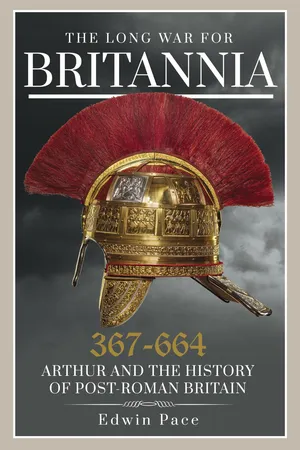
eBook - ePub
The Long War for Britannia 367–664
Arthur and the History of Post-Roman Britain
- 352 pages
- English
- ePUB (mobile friendly)
- Available on iOS & Android
eBook - ePub
About this book
Information
Topic
HistoireSubtopic
Histoire de la Grande-BretagnePart I
The Last of the Romans
Chapter 1
Island of Tyrants
367 – The Consulship of Lupicinus and Jovinus
On a cold autumn morning in 367, a Roman armada set sail for the island of Britain. Dozens of transports dotted the waters, their sterns rising like the tails of great leviathans. Roman legionaries crowded the decks. On one vessel, men carried the red shield of the Batavians, an elite unit in the Roman Army. Blue shields on another ship identified the troopers as Jovians. More vessels lumbered nearby. But none of these legionaries expected riches from this campaign. They were not sailing to conquer some new territory for the empire. This was instead a rescue mission. The Roman diocese of Britanniae was in peril, and only a massive amphibious force could save it.
The commander of this fleet was a man called Flavius Julius Theodosius. On that morning in 367, he wore the regulation dress of a high-ranking Roman officer. His red woollen cloak was held in place by a gilded crossbow brooch, while his chest and back were protected with heavy scaled armour. Finely tooled leather boots protected his feet from the chill breezes of the sea. Even the design on his shield proclaimed him as a Comes – a senior rank in the imperial army.
After many hours, the coast of Britanniae appeared through the mist like a dark, threatening wave. As Theodosius gazed at the distant shore, he doubtless had many thoughts. Most were practical ideas on how he would carry out his mission. But in the back of his mind was a question, a question he still could not answer: just how had barbarians overrun an entire Roman diocese? Why had Rome’s forces simply melted away? The reports made no sense. Nectaridus, the Commander of the Coast, was dead; Fullofaudus, the General of Land Forces, was missing in action. Bands of Irish and Pictish pirates roamed the countryside. Still worse, Rome’s army in Britain had put up no resistance. Some soldiers had even joined the invaders.
It all seemed very strange. If Theodosius was asked what sort of trouble he might expect from Britanniae, he would have replied, ‘an army mutiny’, as the Roman soldiers of the island diocese had a reputation for rebellion. Indeed, they gloried in it. Half a century before, the great Christian emperor Constantine had put down one such mutiny – only to begin another against the emperor in Rome.
Theodosius knew that Irish and Pictish pirates had ravaged the coasts of Britanniae many times in the past, capturing thousands of Roman citizens to sell into slavery. But these had been pin-prick raids, not an invasion. That so many barbarians might conspire to take over an imperial diocese was unthinkable. The Picts and Irish spoke different languages, they were divided into many feuding tribes and most of these were separated by hundreds of leagues of sea. Yet somehow these varied peoples had put together an effective coalition. Their Saxon and Frankish allies were raiding even farther afield – all the way to the coast of Gaul. Romans were already calling it ‘the Barbarian Conspiracy’.
Something else worried Theodosius on that day, but it had nothing to do with Britanniae. Theodosius hailed from Hispania, and had brought officers from that province on the expedition. Two were his own kinsmen. The first was a distant relation, Magnus Maximus. Intelligent and forceful, Maximus was already a high-ranking officer. The second was Theodosius’ own son, called Theodosius the younger. The boy had chosen to emulate his father and follow a military career – a dangerous profession in itself. But the elder Theodosius knew that danger came not just from fierce barbarians. The emperor Valentinian might prove a far worse threat. Rome’s supreme ruler was a tough soldier who had fought his way to power over the bodies of all who stood in his path. A ruthless disciplinarian, he expected results and would tolerate no failures. If Theodosius’ expedition did not succeed, it meant certain disgrace – even execution. Valentinian had burned men alive for less.
Neither was success any guarantee of safety. Emperors feared victorious generals even more than failures. Success might be proof of ambition – ambition to be much more than just a general. So Theodosius must succeed in this mission, but he must do so in a way that did not alarm the emperor.
Already Theodosius was teaching these harsh lessons to his son. He could only pray to his God, the Risen Christ, that there would be enough time to teach the boy all he needed to know.
Earlier that year, Roman Britain’s defences collapsed almost overnight. This was deeply unsettling – and not just to Comes Theodosius.1 The island’s two military leaders, Nectaridus and Fullofaudus, had failed. This was obvious. But the disaster was in no way due to the shortcomings of two high-ranking officers. Rather, it was the failure of something more basic: Rome’s strategy. The bitter truth was that the empire faced foes far different from the Gauls and Germans of Julius Caesar’s day. The barbarians had learned much over recent centuries, and they now threatened Rome’s very existence.
Downsizing
The roots of the debacle went deep. Indeed, they extended to the beginning of the empire. Rome had begun like all ancient empires, as a kind of military–financial pyramid scheme. Brilliant generals like Scipio and Marius had first conquered lands around the Mediterranean. Pompey and Julius Caesar then extended Rome’s borders to the dark forests along the Rhine and the Danube. Success led to further success as countless captured slaves and unprecedented amounts of booty flowed into the empire. By the dawn of the Christian era, Rome was entering its golden age. It was a vast, multi-ethnic imperium – an empire.
In AD 43, Britain was added to the hit-list. The emperor Claudius conquered the island. But significantly, Britain was one of Rome’s last major acquisitions. This had important results, as with no new conquests, the flow of slaves and booty ceased. Rome now had to live within its borders, and thus within its means. Over the following centuries, some thirty legions held the line on the Rhine and the Danube. Safe behind its defences, the empire tried to ignore the unconquered ‘barbarians’ to the north. But the barbarians did not ignore Rome. They watched from across the great rivers and schemed how they might obtain the empire’s wealth for themselves. By the third century, barbarian attacks were a serious threat, with large armies sometimes penetrating deep into the imperial hinterland.
This forced a change in strategy. Rome could no longer afford to defend every mile of its frontier. By the reign of the first Christian emperor, Constantine the Great, Rome had adopted a new strategy. Major cities were encircled with strong walls, while a thin line of ‘trip-wire’ units was left to guard the frontiers. The key to the strategy was the creation of a few powerful formations made up of the empire’s best troops. These mobile field armies deployed fast-moving cadres of cavalry and infantry. The concept was simple: the ‘trip-wire’ units destroyed small raiding parties at the frontier, but when larger groups broke through, the mobile field armies lured them into Rome’s hinterland. While Roman citizens waited out the crisis inside fortified cities, Rome’s elite troops destroyed the barbarians, often by simply denying them food. It was sensible, even clever. But most of all, it was cheap.2
For both the imperial government and Roman landowners, this last advantage was critical. Over two-thirds of the imperial budget was spent on the army. But this revenue first had to be collected by the municipal councils in every Roman district, or civitas. The emperor might command the army, but it was the decurion on the councils who collected the taxes to pay his soldiers. This left these local officials in an ambiguous position. Unscrupulous decurions might line their pockets once they fulfilled their quota, but if they failed to deliver, they were also legally bound to make up the difference. Unsurprisingly, decurions welcomed any measure that eased their heavy burden.
For the first half of the fourth century, this cheaper defensive strategy worked well. Indeed, we see the results in Britain’s archaeology. A small number of elite families began to construct an unprecedented number of opulent villas – the stately homes of their day. Other levels of society did not share in this new-found wealth, with the life of the great majority of Britons, the peasantry, going on much as before. They continued to dwell in their wattle and daub roundhouses, tilling the soil and tending to their livestock. But the nouveau riche were different. They surrounded themselves with beautiful furniture and statues. They installed hypocausts – centrally heated floors that kept them warm in the coldest winters – painted their walls with brightly-coloured murals of birds and animals, and strolled across tiled floors crowded with scenes from Roman mythology.
Life was far more than just outward show, however. Many used their leisure to study the great literature of the past. Vergil seems to have been a favourite among educated Romano-Britons. But even a century after the end of Rome, we find Britons referring to a much wider range of writers.3
Significantly, these villas were not fortified. In Gaul, repeated barbarian raids had taught Gallo-Romans that their villas needed strong defences. Indeed, looking across the Channel at a relatively peaceful Britain, more than a few had packed their bags and headed there. As so often in Britain’s history, the island became a magnet for refugees.
Another venerable British tradition also prevailed at this time: country life was seen as superior to town life. Roman authors contrasted the otium (leisure) of country life with the negotium (business) of town life. Leisure was invariably portrayed as the desired option, but there was a health aspect to this as well. In an age when any large human settlement was the habitat of a fantastic assortment of deadly microbes, life on a country estate was healthier.4
Just where much of this wealth came from is also clear. The largest customer on the island was the Roman Army. Any local landowner who could get on the good side of Fullofaudus or Nectaridus had an excellent chance of obtaining a lucrative army contract. Archaeology testifies that a fourth-century ‘military–industrial complex’ was alive and well in Britain.5
While little besides the names of the two unfortunate Roman commanders of 367 has survived, we do know something about their class. By now, few military officers came from the old senatorial class, or even from Italy. The typical officer was more likely a citizen from one of the frontier provinces, or even a barbarian. Fullofaudus is a Germanic name, and Nectaridus may be also.6 Both had probably served a long apprenticeship in various field commands. There, they had shown promise. More importantly, however, they had made themselves useful to the right senior officers. These were the sort of men who led Rome’s armies in the fourth century.
Nectaridus was ‘Count of the Coast’. Like Theodosius, he held the exalted rank of Comes. This suggests that he commanded a centralized system designed to repel seaborne attacks by both the Picts and the Irish. His defensive system deployed watchtowers on land and swift galleys at sea, both of which could give early warning of the approach of enemy vessels. Nectaridus’ other assets included strong forts stationed at the mouths of Britain’s major rivers. These had several functions: they discouraged barbarians from sailing into the interior of the island; they served as secure command and control centres; and they acted as collection points for the grain that fed the army, both in Britain and elsewhere.
If Nectaridus’ ‘trip-wire’ units failed, Fullofaudus’ ground forces came into play. Stationed farther back, they performed a mission analogous to the mobile field armies on the continent. If they arrived in time, they destroyed the barbarians in pitched battle; but their very existence meant that most raiders dared not tarry long on land. Together, Nectaridus and Fullofaudus employed a cost-effective, carefu...
Table of contents
- Cover
- Title
- Copyright
- Contents
- Maps
- Fake News and King Gormand
- Part I: The Last of the Romans
- Part II: A Chosen People
- Part III: Struggle for Imperium
- Part IV: The Lament of Heledd
- Part V: History Wars
- Appendix: Could Geoffrey have made up Camlann?
- Notes
Trusted by 375,005 students
Access to over 1.5 million titles for a fair monthly price.
Study more efficiently using our study tools.
Frequently asked questions
Yes, you can cancel anytime from the Subscription tab in your account settings on the Perlego website. Your subscription will stay active until the end of your current billing period. Learn how to cancel your subscription
No, books cannot be downloaded as external files, such as PDFs, for use outside of Perlego. However, you can download books within the Perlego app for offline reading on mobile or tablet. Learn how to download books offline
Perlego offers two plans: Essential and Complete
- Essential is ideal for learners and professionals who enjoy exploring a wide range of subjects. Access the Essential Library with 800,000+ trusted titles and best-sellers across business, personal growth, and the humanities. Includes unlimited reading time and Standard Read Aloud voice.
- Complete: Perfect for advanced learners and researchers needing full, unrestricted access. Unlock 1.5M+ books across hundreds of subjects, including academic and specialized titles. The Complete Plan also includes advanced features like Premium Read Aloud and Research Assistant.
We are an online textbook subscription service, where you can get access to an entire online library for less than the price of a single book per month. With over 1.5 million books across 990+ topics, we’ve got you covered! Learn about our mission
Look out for the read-aloud symbol on your next book to see if you can listen to it. The read-aloud tool reads text aloud for you, highlighting the text as it is being read. You can pause it, speed it up and slow it down. Learn more about Read Aloud
Yes! You can use the Perlego app on both iOS and Android devices to read anytime, anywhere — even offline. Perfect for commutes or when you’re on the go.
Please note we cannot support devices running on iOS 13 and Android 7 or earlier. Learn more about using the app
Please note we cannot support devices running on iOS 13 and Android 7 or earlier. Learn more about using the app
Yes, you can access The Long War for Britannia 367–664 by Edwin Pace in PDF and/or ePUB format, as well as other popular books in Histoire & Histoire de la Grande-Bretagne. We have over 1.5 million books available in our catalogue for you to explore.