This is the biography of man who rose from humble beginnings to become one of the most influential figures in modern religious history.John Huss was a preacher in 15th century Europe who amassed followers and made enemies due to his then radical views, condemning the extravagant wealth and unlimited power of the Catholic Church, and claiming that the only truth should be taken from Scripture.A Papal bull excommunicated Huss but he continued to preach, until he was eventually lured by the Council of Constance and burned at the stake for false accusations of heresy, to which he responded "I would not for a chapel of gold retreat from the truth!", and was heard singing psalms as he burned.His execution ignited twelve years of what became known as the Hussite wars, and his teachings laid the ground for Protestant Reformation.
Author David Schaff narrates the life and death of Huss to the last detail. He describes how he began and rose to prominence, the aftermath of his execution, and the lasting effect his teachings have on European history."The Roman Catholic communion cannot forget that his personality and teachings occupied the attention of the famous Council of Constance and was the concern of the great theologians and churchmen of his age, and that his sentence to death as a heretic threatened the permanent alienation of Bohemia from the apostolic see and also involved that country in some of the most lamentable religious wars Europe has seen."
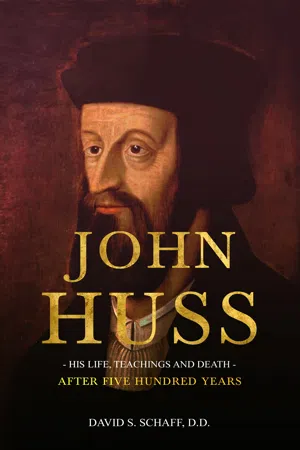
- 292 pages
- English
- ePUB (mobile friendly)
- Available on iOS & Android
eBook - ePub
About this book
Information
Topic
Theology & ReligionSubtopic
Religious BiographiesCHAPTER I
The Age in Which Huss Lived
Summa philosophia est Christus, deus noster, quem seguendo et discendo sumus philosophi.—Wyclif, de Ver. Scrip., 1:32.
The supreme philosophy is Christ, our God, and in following him and learning from him we are philosophers.
In John Huss, Bohemia has made its one notable and permanent contribution to the progress of Western culture and religious thought. Other names the general student associates with its people are Jerome of Prague, Charles IV and the blind King John. Jerome’s name is linked with the name of Huss. Charles IV acted an important part in the history of his time through the university which he founded and his patronage of letters, which made Prague a centre of study. The blind king of Bohemia, John of Luxemburg, occupies a place in the romance of English history. He fell in the thick of the fight at Crécy, 1346, and furnished to the coat of arms of the Prince of Wales the motto, Ich dien, I serve, which the Black Prince appropriated.
Strange to say, the honor so freely accorded to Huss in Protestant circles is still denied him by the vast majority of his own countrymen. Not two percent of the population of Bohemia is Protestant. Outside of that small and respectable circle a change has been taking place in the last few years in the feelings of Bohemia toward its eminent citizen. Once the idol of his people, his memory was for centuries obscured by religious prejudice. Every memorial of him, where possible, was destroyed and the Bohemian people were taught to believe that he, “whose heart beat so warmly for his own nation and for God’s law,”1 was its worst enemy, an emissary of evil, not of good. This change has been going on since 1848, when religious liberty was granted by the Austrian government. Huss has come to be looked upon in ever widening circles as the chief of Bohemian patriots, and his patriotism is celebrated with bonfires in Southern Bohemia yearly on July 6, the supposed date of his birth. This is in spite of the unbroken attachment which prevails in that section to the Roman Catholic Church. There is also a group of free-thinking persons in Prague, not closely bound to Catholic institutions, who go further in honoring his memory. They have been foremost in making preparations to commemorate the five-hundredth anniversary of Huss’s birth by the erection of a monument on the public square of Prague, with which Huss’s own cause and the career of his followers are so closely identified. This fifth centenary, occurring in 1915, will serve to call attention afresh to the debt which the religious institutions of the West and the cause of religious toleration owe to the Bohemian reformer. It is doubtful, if we except the sufferings and death of Jesus Christ, whether the forward movement of religious enlightenment and human freedom have been advanced as much by the sufferings and death of any single man as by the death of Huss. Augustine, Bernard, Luther—to speak only of religious characters—exercised their influence by their lives and writings; Huss chiefly by his sufferings in prison and the flames. Paul’s death was an incident in his career. In dying, Huss accomplished more than he did by living.
Huss’s career belongs to a movement which was going on during the two centuries separating the productive period of the Middle Ages and the period of the Reformation. During these two hundred years—1300 to 1500, or from the reign of Boniface VIII to Luther’s theses, 1517—a forward impulse of thought manifested and maintained itself leading away from the compulsory authority of the church and the hierarchy of the Middle Ages, and pushing toward the intellectual and religious freedom of modern times. The mind of Europe was striving to get rid of the sacramental fetters with which it had become bound by the papal decrees and the speculations of the Schoolmen and to find its way to the assertion of the right of the individual to immediate communion with God and individual sovereignty in matters of conscience. The dissatisfaction with the old mediæval order found isolated but strong expression from individuals here and there, and at the same time gleams of the new order about to be introduced in the sixteenth century shot forth suddenly like Northern lights, though they as suddenly disappeared.
By the year 1300 the faculty for governmental construction and the theological ingenuity of the mediæval mind had exhausted themselves. For two hundred years before that date the Crusades had been actively prosecuted from the conquest of Jerusalem, 1099, to the abandonment of the last foot of soil possessed by the Crusaders in the Holy Land, 1391, a period which witnessed the complete development of the mediæval papacy and church. During the next two hundred years, up to the time of the Reformation, single individuals from Italy to England protested against these constructions. In the end they succeeded, while the armies of the Crusades failed. The former two hundred years, the period of the Crusades, saw the rise of the great Mendicant orders, the full bloom of the scholastic theology, the establishment of the papal inquisition, and the perfection of the sacramental system which was regarded as being as essential to salvation as fire is to heat a cold body or medicine to cure sickness. The latter period of two hundred years heard protests against the existing order which were based on Scripture, reason and history—a new tribunal. These were stifled one after the other till the voice was heard as from another Nazareth, the voice from the North, a region from which little good was expected to come. John Huss was one of those who joined this protest against the mediæval order, who helped to discredit the infallible authority of the papal monarchy and to advance the cause of individual rights in matters of belief and practice.
The three mighty constructions of mediæval thought, if we omit the universities and the cathedrals, were the absolute papacy, the sacramental church and the inquisition. The famous bull, Unam sanctum, issued by Boniface VIII, 1302, constitutes an epoch in the history of papal dominion and the coercive jurisdiction claimed for the church. It gave final expression to the theory of the jurisdiction of the papacy. Intended to break down the opposition of Philip IV of France, who was asserting the independent rights of kings, it set forth in unambiguous terms the pope’s claim to supreme authority in all mundane affairs and made salvation to depend upon personal submission to him. Boniface was giving expression to no new assumption. In compact statement he gathered up the claims which his predecessors had been constantly making for more than two centuries. The strongest champions of these claims had been Gregory VII and Innocent III. These pontiffs affirmed that the papal office founded in Peter combined supreme authority in the church and also over princes. They compared the ecclesiastical and the civil powers—sacerdotium and imperium—to the sun and gold on the one hand, and to the moon and lead on the other hand. Gregory, 1073-1085, solemnly announced that the state had its origin in evil—greed and ambition, cruelty, plunder, and murder. The church is an institution of divine appointment established when Christ said to Peter: “Thou art Peter and upon this rock I will build my church,” Matt. 16:18. This masterful ruler found the pope’s right to set up and depose kings authorized in the Old Testament, quoting with peculiar delight the words of the prophet Jeremiah, 1:10: “See, I have this day set thee over the nation and over the kingdom, to pluck up and to break down, and to destroy and to over throw, to build and to plant.” In his conflict with the emperor Henry IV, he not only deposed that monarch, the heir of Charlemagne, but released his subjects from allegiance and had a rival emperor elected to take his place. Gregory died in exile, not defeated and not a Victor.
Innocent III, 1198-1216, who died in the full possession of his power, declared that, as Peter alone went to Jesus on the water, so the pope has the unique privilege of ruling over the nations of the earth. As the moon gets its light from the superior orb, the sun so the emperor and princes get their authority from Christ’s vicegerent on earth. The pope judges all and is judged by no man. To the tribunal of God alone is he responsible. Innocent’s bull, per Venerabilem,2 claiming for the pope the plenitude of power—plenitudo potestatis—was quoted in later times as the authoritative statement of papal rule over both realms. This principle was well expressed by Thomas à Becket addressing the clergy of England: “Who presumes to doubt that the priests of God are the fathers and masters of kings, princes, and all the faithful?” About the same time the monk Cæsar of Heisterbach gave voice to the popular opinion when he compared the church to the firmament, the pope to the sun, the emperor to the moon, the clergy to the day, bishops and abbots to the stars and the laity to the night. Innocent’s favorite figure for illustrating the relation of church and state was taken from the head and the body. As the head contains all the faculties that control the body so the papacy possesses all prerogatives necessary to rule the church.
The supremacy over both realms, which the papacy coveted, it got. If Gregory VII’s conflict with Henry IV ended in a drawn battle, the conflicts of subsequent pontiffs with secular princes had a better issue. The house of Hohenstaufen fought in vain against their supreme jurisdiction and so did John of England. The valiant Frederick Barbarossa was brought to terms by Alexander III at the Peace of Venice, 1177. The painting in the doge’s palace and another in the Vatican, depicting this event on large canvases, represent Alexander sitting on a throne with his feet on Barbarossa’s right shoulder as the emperor lies prostrate. The Venetian picture contains the words: “Thou shalt tread upon the lion and the adder,” Psalm 91:13. The able Frederick II, excommunicated again and again by two popes, and by the decree of Innocent IV deprived of the allegiance of his subjects, died without an army and with his empire in revolt. John of England, forced by the interdict and the rebellion of his nobles, yielded his crown as a fief to Innocent III, and for the pledge of a yearly tribute to be paid by himself and his successors received the crown back again.
Boniface VIII’s bull of 1302 exceeded in its arrogant language the edicts of his predecessors, but not the extravagance of their claim for the apostolic office. It was issued at a time when the fresh atmosphere of a new age was beginning to be felt. It was a brave retort that the king of France made when he bade Boniface remember that the church was made up of laymen as well as clerics. The Catholic historian, Cardinal Hergenröther, accurately presents the case when he says that Boniface did not deviate from the paths of his predecessors nor overstep the legal conceptions of the Middle Ages.3 The Unam sanctam declared that in the power of the church lay the two swords, the spiritual and the material; the spiritual to be used by the church, the material for the church and at its nod. The temporal power, if it deviate from the right path, is judged by the spiritual, whose executive is the pope. He is subject alone to the judgment of God. Going beyond this assertion of jurisdiction over princes, Boniface declared that for the salvation of every human creature it is altogether necessary that each be subject to the Roman pontiff.
The prerogatives asserted by the popes were buttressed with theological arguments by the corypheus of the Schoolmen, Thomas Aquinas, d. 1274. He took the position that as to Christ himself, so all princes and kings are subject to his vicar, the Roman pontiff, and it is necessary to salvation to yield submission to the pope.4 The language used by Boniface was simply other terminology for what the great theologian had advocated.
This bull was a battle-ground of discussion for the next two centuries and its twofold assertion the bomb which helped to shatter the mediæval theory of authority. Wyclif, Huss and other writers referred to it again and again to contest its truth and condemn its audacity.
If the absolutism of the papacy was doubted and discredited after 1300, likewise was the theory of the church as elaborated by the Schoolmen. According to them, the church is a visible institution for dispensing salvation. Its boundaries are the boundaries of the kingdom of heaven on earth and are as distinctly marked as were the boundaries of the republic of Venice. The sacraments, which it is in the power of the church to administer, have an efficiency in themselves and, like drugs and food, impart to the sinner spiritual life and continue to maintain him in life. They introduce him into the kingdom of the faithful, nourish him during his earthly pilgrimage, and with the viaticum and the cleansing of the oil of extreme unction send him on the way to the other country. This sacramental efficiency is dependent upon the dispensation of a sacerdotal order receiving its authority and its grace by ordination, so that, no matter how immoral the priest may be, his words accomplish the transubstantiation of the bread and wine and render the other sacraments dispensed by his act efficient in the recipient.
This imposing construction of the church reared by dexterous scholastic reasoning, which ignored entirely or misinterpreted a large body of apostolic teaching, was subjected to rational doubt and free Scriptural inquiry after the death of Boniface VIII and the last of the greater Schoolmen, Duns Scotus, d. 1308. The Schoolmen subjected the reason to church authority. They applied to the Scriptures no independent investigation. They knew no Hebrew or Greek. They presented the opinions of the Fathers, collecting them into an iron-clad body of dogmas. Their theological sophistry threatened to bury the Scriptures in the tomb of doctrinal tradition, but men here and there again began to study the sacred text and to measure ecclesiastical dogmas by its plain teaching and common sense. This is what Wyclif, Huss and others did.
Next to the papacy and the church the third great elaboration of the period of the Schoolmen was the inquisition, the machinery for the abolition of ecclesiastical dissent. Heretical depravity it was called, for heresy was not an intellectual opinion only: it was depravity. This inquisition followed from the definition of the prerogatives of the papal office and the functions of the church. Here the great Schoolmen and the great popes again speak. To both alike, heresy—that is, dissent from the dogmatic teachings issued by the church and disobedience to the rule of the hierarchy—was a crime. Thomas Aquinas’s Summa of Theology was in full accord with the decrees of the Fourth Lateran Council presided over by Innocent III, 1215. A heretic, having no rights in the church, has also no rights whatever on earth—not even the right to live.
The church acquired rights over the individual by baptism and these rights extended to the deprivation of life. Innocent likened heretics to Joel’s locusts and to the foxes which spoil the vines. Like clippers of coin, they are to be burned, affirmed Thomas Aquinas. To quote this theologian: “They are not only to be separated from the church by excommunication but also excluded from the world by death.” The spiritual authority might consign heretics to perpetual imprisonment, and, as it was forbidden to execute the death penalty, it turned them over to the civil tribunal with the full understanding that they were to be punished, if necessary, unto death. This penalty it made sure by threatening with extreme church punishments civil tribunals which failed to administer it. The codes of Frederick II and the law of Louis IX of France enacted that heretics condemned by the church should be executed out of the world.5
These three institutions—papal absolutism, the church as an organization dispensing life and the absolute right to dispose of heretics by death, inherited from the age of the great popes and the great Schoolmen—controlled the official thought of Western Europe until attacked by Luther. Six months before he nailed up his theses, Leo X solemnly reaffirmed the pretensions of Boniface VIII’s famous bull. But in the meantime these three institutions were questioned or openly assailed by individuals who may be grouped in five different groups. To one of these groups John Huss belonged, and he represented the attack against all these three institutions, the papal monarchy, the church, and the inquisition. In this opposition there was a movement running in the direction of the recognition of the supreme authority of Scripture and the rights of conscience, for both of which Huss stood.
The first of these groups was the group of pamphleteers who flourished in the first half of the fourteenth century and assailed first the temporal claims of the papacy and then its spiritual claims. Its most eminent representative was Dante, d. 1321, who in his tract entitled Monarchy, and in other writings, wrote in favor of the independent authority of the empire and the supremacy of its jurisdiction within the civil sphere. He accepted the accuracy of the tradition that Constantine, in reward for his baptism by Sylvester and his recovery from leprosy by that pope’s cure, bestowed upon the pope the government of Rome and all the regions of the West. This falsehood was distributed through Europe about 850 by the spurious Isidorian Decretals and was for centuries believed to be as true as the Gospels themselves. It was not until the close of the fifteenth century that Laurentius Valla proved the whole story a fraud. Dante went no further than to pronounce Constantine incompetent to bestow such power upon a pope. That right belonged to God alone, who had made the two spheres distinct. He rejected the figure comparing the two powers respectively to the sun and the moon. His famous lines might well have been quoted by Huss in his Treatise on the Church, where be emphasized the ills which had come to it through Constantine’s fictitious gift.
“Oh! Constantine, how much ill was cause
Not thy conversion, but those rich domains
Which the first wealthy pope received of thee.”
—Inferno, 19:115.
Dante freely put popes in hell, including the simoniac Boniface VIII.
In France, moved by the controversy which Philip IV was having with Boniface, the Dominican John of Paris, d. 1306, and jurisconsults like Peter Dubois, d. after 1321, struck the same note. These publicists insisted the church should keep itself clear of “Herod’s old error”6 and follow Christ who, in his earthly career, disclaimed worldly authority. John refuted forty-two reasons given for the pope’s omnipotence in temporal affairs. The pope is the representative of the church, not its lord, appointed to be the moral teacher of mankind and the overseer of men’s spiritual concerns. The contrary view, the view of Innocent III, was represented by other publicists who were concerned to defend Boniface’s bull and memory. Amongst those who went farthest were Alexander Triumphus and Alvarus Pelayo, who ascribed infallibility to the pope and extended his jurisdiction beyond the confines of Christendom and over the heathen. Along the line of this contention was the action of the council of Vienne, 1312, which forbade sovereigns to allow their Mohammedan subjects to exercise the rit...
Table of contents
- Preface
- Testimony of the University of Prague to John Huss
- CHAPTER I The Age in Which Huss Lived
- CHAPTER II Huss and the Bethlehem Chapel
- CHAPTER III Huss’s Debt to Wyclif
- CHAPTER IV Huss as a National Leader
- CHAPTER V In Open Revolt Against the Archbishop
- CHAPTER VI Huss Resists the Pope
- CHAPTER VII Huss’s Withdrawal from Prague
- CHAPTER VIII Huss Before the Council of Constance
- CHAPTER IX Before the Council of Constance
- CHAPTER X Condemned and Burned at the Stake
- CHAPTER XI Huss’s Place in History
- CHAPTER XII Huss’s Writings and the Hussites
- APPENDIX I Chronological List of Events in Huss’s Life or Bearing Upon It
- APPENDIX II A Spurious Account of Huss’s Journey to Constance and Trial
Trusted by 375,005 students
Access to over 1.5 million titles for a fair monthly price.
Study more efficiently using our study tools.
Frequently asked questions
Yes, you can cancel anytime from the Subscription tab in your account settings on the Perlego website. Your subscription will stay active until the end of your current billing period. Learn how to cancel your subscription
No, books cannot be downloaded as external files, such as PDFs, for use outside of Perlego. However, you can download books within the Perlego app for offline reading on mobile or tablet. Learn how to download books offline
Perlego offers two plans: Essential and Complete
- Essential is ideal for learners and professionals who enjoy exploring a wide range of subjects. Access the Essential Library with 800,000+ trusted titles and best-sellers across business, personal growth, and the humanities. Includes unlimited reading time and Standard Read Aloud voice.
- Complete: Perfect for advanced learners and researchers needing full, unrestricted access. Unlock 1.5M+ books across hundreds of subjects, including academic and specialized titles. The Complete Plan also includes advanced features like Premium Read Aloud and Research Assistant.
We are an online textbook subscription service, where you can get access to an entire online library for less than the price of a single book per month. With over 1.5 million books across 990+ topics, we’ve got you covered! Learn about our mission
Look out for the read-aloud symbol on your next book to see if you can listen to it. The read-aloud tool reads text aloud for you, highlighting the text as it is being read. You can pause it, speed it up and slow it down. Learn more about Read Aloud
Yes! You can use the Perlego app on both iOS and Android devices to read anytime, anywhere — even offline. Perfect for commutes or when you’re on the go.
Please note we cannot support devices running on iOS 13 and Android 7 or earlier. Learn more about using the app
Please note we cannot support devices running on iOS 13 and Android 7 or earlier. Learn more about using the app
Yes, you can access John Huss by David S. Schaff in PDF and/or ePUB format, as well as other popular books in Theology & Religion & Religious Biographies. We have over 1.5 million books available in our catalogue for you to explore.