The Elizabethan and Jacobean era are known for many things, but they would be incomplete without the works of John Marston; English playwright, poet and brilliant satirist.Known for his vigorous, obscure, and controversial works, Marston began his literary career in 1598 with an erotic poem titled, "The Metamorphosis of Pigmalions Image and Certaine Satyres." Marston's works were often so controversial or "problematic" that "The Scourge, " one of his satires, was burnt by the Archbishop of Canterbury.There are not a lot Playwrights who dared to break convention in the 16th century, but Marston did that fearlessly and relentlessly. In this book, you will find one of his most acclaimed works "The Insatiate Countess, " based on Bianca Maria, a countess executed for adultery, and known as his most erotic play. As well as two other vital 16th century plays – "Princelye Pleasures at the Courte at Kenelwoorth" and Udall's "Ralph Royster Doyster".
eBook - ePub
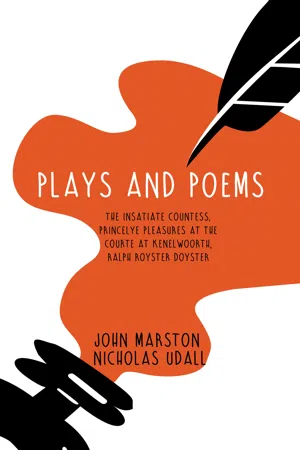
Plays and Poems
The Insatiate Countess, Princelye Pleasures at the Courte at Kenelwoorth, Ralph Royster Doyster
- 224 pages
- English
- ePUB (mobile friendly)
- Available on iOS & Android
eBook - ePub
Plays and Poems
The Insatiate Countess, Princelye Pleasures at the Courte at Kenelwoorth, Ralph Royster Doyster
About this book
Information
Subtopic
British DramaIndex
LiteratureACT I.
SCENE 1.—Venice.—A Chamber.—The Countess of Suevia, discovered sitting at a Table covered with black, on which stand two, black Tapers, lighted: she in Mourning.
Enter ROBERTO, ROGERO, and GUIDO.
Guido. What should we do in this Countess’s dark hole? She’s sullenly retired, as the turtle; every day has been a black day with her, since her husband died; and what should we unruly members make here?
Rog. As melancholy night masks up heaven’s face,
So doth the Ev’ning Star present herself
Unto the careful shepherd’s gladsome eyes,
By which unto the fold he leads his flock.
Guido. Zounds, what a sheepish beginning is here! ’Tis said, true love is simple; and it may well hold; and thou art a simple lover.
Rob. See, how yon star, like beauty in a cloud,
Illumines darkness, and beguiles the Moon
Of all her glory in the firmament.
Guido. Well said, Man i’the Moon! Was ever such astronomers! Marry, I fear none of these will fall into the right ditch.4
Rob. Madam.
Countess. Ha, Anna! what, are my doors unbarr’d?
Guido. I’ll assure you, the way into your ladyship is open.
Rob. And, God defend that any prophane hand
Should offer sacrilege to such a Saint!
Lovely Isabella, by this duteous kiss,
That draws part of my soul along with it,
Had I but thought my rude intrusion
Had wak’d the dove-like spleen harbour’d within you,
Life and my first-born should not satisfy
Such a transgression, worthy of a check!
But, that immortals wink at my offence,
Makes me presume more boldly. I am come
To raise you from this so infernal sadness.
Countess. My lord of Cyprus, do not mock my grief,
Tears are as due a tribute to the dead,5
As fear to God, and duty unto Kings,
Love to the just, or hate unto the wicked.
Rob. Surcease!
Believe, it is a wrong unto the gods;
They sail against the wind, that wail the dead;
And, since his heart hath wrestled with death’s pangs,
From whose stern cave none tracts6 a backward path,
Leave to lament this necessary change,
And thank the gods, for they can give as good.
Countess. I wail his loss! sink him ten cubits deeper,
I may not fear his resurrection!
I will be sworn upon the holy writ,
I mourn thus fervent, ’cause he died no sooner.
He buried me alive,
And mew’d me up, like Cretan Dædalus;
And with wall-ey’d jealousy kept me from hope
Of any waxen wings to fly to pleasure;
But now his soul her Argus’ eyes hath clos’d,
And I am free as air. You of my sex,
In the first flow of youth, use you the sweets
Due to your proper beauties; ere the ebb
And long wane of unwelcome change shall come!
Fair women play; she’s chaste whom none will have.—
(Aside.) Here is a man of a most mild aspéct,
Temp’rate, effeminate,7 and worthy love,
One that with burning ardour hath pursued me;
A donative he hath of ev’ry god;
Apollo gave him locks; Jove his high front;
The God of Eloquence, his flowing speech;
The feminine deities strow’d all their bounties
And beauty on his face: that eye was Juno’s;
Those lips were hers8 that won the golden ball;
That virgin-blush, Diana’s; here they meet,
As in a sacred synod.—My lords, I must entreat,
Awhile, your wish’d forbearance.
Omnes. We obey you, lady.
[Exeunt Rogero and Guido.
Countess. (To Roberto.) My lord, with you I’d have some conference.
I pray, my lord, do you woo ev’ry lady
In this phrase you do me?
Rob. Fairest, till now,
Love was an infant in my oratory.
Countess. And kiss thus, too?
[Kisses him.
Rob. I never was so kiss’d; leave thus to please;
Flames into flames, seas thou pour’st into seas.
Countess. Pray frown, my lord; let me see how many wives
You’ll have.9 Heigh-ho! you’ll bury me, I see.
Rob. In the swan’s -down, and tomb thee in arms.
Countess. Then folks shall pray In vain to send me rest.
Away! your’e such another meddling lord.
Rob. By heav’n, my love’s as chaste as thou art lair,
And both exceed comparison! By this kiss,
That crowns me monarch of another world,
Superior to the first, fair, thou shalt see,
As unto heav’n my love, so unto thee.
Countess. Alas, poor creatures! when we are once o’ the falling hand,
A man may easily come over us;
It is as hard for us to hide our love,
As to shut sin from the Creator’s eyes.
I’faith, my lord, I had a month’s mind unto you,
As tedious as a full-rip’d maidenhead;
And, Count of Cyprus, think my love as pure
As the first opening of the blooms in May,
Your virtues’ May;—nay, let me not blush to say so.
And see, for your sake, thus I leave to sorrow;—
Begin this subtle conjuration with me;
And as this taper, due unto the dead,
I here extinguish, so my late dead lord
I put out ever from my memory,
That his remembrance may not wrong our loves;
[Puts out one of the Tapers.
As bold-fac’d women, when they wed another,
Banquet their husbands with their dead loves’ heads.
Rob. And, as I sacrifice this to his ghost,
With this e...
Table of contents
- JOHN MARSTON.
- EPISTLE DEDICATORY.
- THE INSATIATE COUNTESS
- PROLEGOMENA.
- DRAMATIS PERSONÆ.
- ACT I.
- SCENE 1.—Venice.—A Chamber.—The Countess of Suevia, discovered sitting at a Table covered with black, on which stand two, black Tapers, lighted: she in Mourning.
- ACT II.
- SCENE 1.—Venice—An Apartment in the House of Roberto.
- SCENE 2.—Venice.—An Apartment in the House of Mizaldus.
- SCENE 3.—Venice.—Roberto’s House.
- SCENE 4.—A Hall in Roberto’s House.—A trampling of Horses heard.
- ACT III.
- SCENE 1.—A Street in Venice.—Claridiana and Mizaldus being in readiness, are received in at one another’s houses by their Maids.
- SCENE 2.—Pavie.—A Room in the Countess’ House.
- SCENE 3.—Venice.—Claridiana’s House.
- SCENE 4.—Pavia.—A Room in the Countess’ House.
- ACT IV.
- SCENE 1.—Venice.—The Senate House.
- SCENE 2.—Pavia.—Enter the COUNTESS, followed by GNIACA.
- SCENE 3.—Venice.—Lady Lentulus’ House.
- SCENE 4.—Pavia.—A Street.
- ACT V.
- SCENE 1.—Pavia.—The Castle Green—a Scaffold, &c.
- SCENE 2.—Venice.—The Senate House.
- PRINCELYE PLEASURES AT THE COURTE AT KENELWOORTH
- THE PRINTER TO THE READER
- A BRIEFE REHEARSALL, OR RATHER A TRUE COPIE, OF AS MUCH AS WAS PRESENTED BEFORE HER MAJESTIE AT KENELWORTH, DURING HER LAST ABOADE THERE, AS FOLLOWETH
- ACTUS I. SCENA i.
- ACTUS I. SCENA ii.
- ACTUS II. SCENA i.
- ACTUS II. SCENA ii.
- ACTUS II. SCENA iii.
- ACTUS II. SCENA iv.
- ACTUS II. SCENA VLTIMA.
- RALPH ROYSTER DOYSTER
- PROLEGOMENA.
- THE PROLOGUE.
- DRAMATIS PERSONÆ
- ACTUS j. SCÆNA j.
- ACTUS j. SCÆNA ij.
- ACTUS j. SCÆNA iij.
- ACTUS j. SCÆNA iiij.
- ACTUS j. SCÆNA v.
- ACTUS ij. SCENA i.
- ACTUS ij. SCENA ij.
- ACTUS ij. SCENA iij.
- ACTUS ij. SCÆNA iiij.
- ACTUS iij. SCÆNA j.
- ACTUS iij. SCÆNA ij.
- ACTUS iij. SCÆNA iij.
- ACTUS iij. SCÆNA iiij.
- ACTUS iij. SCÆNA v.
- ACTUS iiij. SCÆNA j.
- ACTUS iiij. SCÆNA ij.
- ACTUS iiij. SCÆNA iij.
- ACTUS iiij. SCÆNA iiij.
- ACTUS iiij. SCÆNA v.
- ACTUS iiij. SCÆNA vj.
- ACTUS iiij. SCÆNA vij.
- ACTUS iiij. SCÆNA viij.
- ACTUS v. SCÆNA j.
- ACTUS v. SCÆNA ij.
- ACTUS v. SCÆNA iij.
- ACTUS v. SCÆNA iiij.
- ACTUS v. SCÆNA v.
- ACTUS v. SCÆNA vj.
Trusted by 375,005 students
Access to over 1.5 million titles for a fair monthly price.
Study more efficiently using our study tools.
Frequently asked questions
Yes, you can cancel anytime from the Subscription tab in your account settings on the Perlego website. Your subscription will stay active until the end of your current billing period. Learn how to cancel your subscription
No, books cannot be downloaded as external files, such as PDFs, for use outside of Perlego. However, you can download books within the Perlego app for offline reading on mobile or tablet. Learn how to download books offline
Perlego offers two plans: Essential and Complete
- Essential is ideal for learners and professionals who enjoy exploring a wide range of subjects. Access the Essential Library with 800,000+ trusted titles and best-sellers across business, personal growth, and the humanities. Includes unlimited reading time and Standard Read Aloud voice.
- Complete: Perfect for advanced learners and researchers needing full, unrestricted access. Unlock 1.5M+ books across hundreds of subjects, including academic and specialized titles. The Complete Plan also includes advanced features like Premium Read Aloud and Research Assistant.
We are an online textbook subscription service, where you can get access to an entire online library for less than the price of a single book per month. With over 1.5 million books across 990+ topics, we’ve got you covered! Learn about our mission
Look out for the read-aloud symbol on your next book to see if you can listen to it. The read-aloud tool reads text aloud for you, highlighting the text as it is being read. You can pause it, speed it up and slow it down. Learn more about Read Aloud
Yes! You can use the Perlego app on both iOS and Android devices to read anytime, anywhere — even offline. Perfect for commutes or when you’re on the go.
Please note we cannot support devices running on iOS 13 and Android 7 or earlier. Learn more about using the app
Please note we cannot support devices running on iOS 13 and Android 7 or earlier. Learn more about using the app
Yes, you can access Plays and Poems by John Marston, Nicholas Udall in PDF and/or ePUB format, as well as other popular books in Literature & British Drama. We have over 1.5 million books available in our catalogue for you to explore.