- 136 pages
- English
- ePUB (mobile friendly)
- Available on iOS & Android
eBook - ePub
About this book
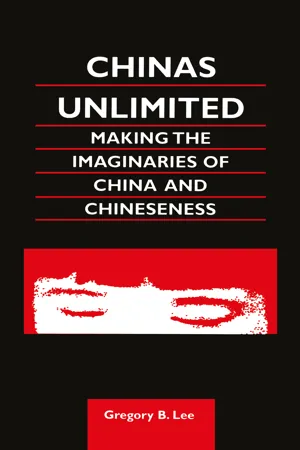
A socio-cultural study of the historical representation of China and Chineseness over the past hundred years or so, much of this book discusses the Orientalizing and crude racist ideologies that have formed the foundations of the way people in the west, both popularly and scientifically, have imagined China.
Information
1 CHINESE REVERIES, ENGLISH RAILINGSReimagining Twentieth-Century Histories
DOI: 10.4324/9781315028996-1
But reverie does not tell stories. Or, at least, there are reveries so deep, reveries which help us to descend so deeply into ourselves that they relieve us of our history. They liberate us from our name. They deliver us, these solitudes of the present, to our first solitudes. Those first solitudes, those solitudes of childhood, leave, in certain souls, indelible marks. For them the whole of life is receptive to poetic reverie, to a reverie that knows the price of solitude …… The task before us calls for a poetico-analysis which help us reconstitute in ourselves the being of emancipatory solitudes. Poetico-analyses will return to us all the privileges of the imagination. Memory is a field of psychological ruins, a jumble of recollections. Our whole childhood has to be re-imagined, and in re-imagining it we have the possibility of rediscovering it in the very life of our dreams of solitary childhood.Gaston Bachelor1
The sense of ‘Chinese reveries’ in the title of this chapter is doubtless quite clear: Chinese dreams, dreams about China. Yet, reveries are something more than this. They are also daydreams, musings, wishful thinking. As to the second part of the title, ‘railings’ constitute one of the concrete central images of the story I discuss here. In the story an old alligator is kept behind railings in a zoo in a small and ancient English seaside town. But the railings may also be read as a metaphor for the incarcerating impulse of English colonialism, and of Western cultural dominance in general. In other words, the railings stand as a trope for the attempt to restrain and to impose closure on narratives large and small. In this story, as we shall see, there are several efforts to interrupt the storytelling of the protagonist, but such efforts are rebuffed as stories are told and retold and divergent versions are recounted.
At another level, the story constructs a space within which to represent the confused and scattered detritus of political and cultural dreams and nightmares of modernity, and the beginnings of an attempt to re-imagine, by what Bachelard has called ‘reveries of will’ (les rêveries de la volonté), the narratives that have recounted twentieth-century history in China and elsewhere.2 In the story I address here the space where this re-imagining happens lies within the railings. ‘Railings’ establish enclosures, but still leave spaces between the bars for the wilful to squeeze through. And then ‘railing’ etymologically can also signify abusive scolding; the Latin from which rail is presumed to derive indicated the act of braying or neighing. In this story such railing is done by the English who must stand metonymically for the West and the Whiteman. But there is also the railing about the English by the Other, by the non-English, and this railing invokes other senses of the word; in early French and English the word referred to ‘mocking or joking.’ All of these senses seem appropriate to my reading of the railings in the story entitled ‘Going Home.’ It is a text written a decade ago by the Chinese poet, essayist, fiction writer and playwright Duoduo.3 Duoduo by sheer coincidence left China for a reading tour of England and Holland on the morning of June 4th 1989, after the night of the Tiananmen massacre he had witnessed. Having recounted his experience to the British media, he was unable to return to China and found himself in involuntary exile. The story ‘Going Home’ was written a year or so after the author’s arrival in Europe, around the time he turned forty. It is a story about being Chinese in England, about the concurrence of Chineseness and of Englishness (neologisms that cannot be uttered without evoking multiple questions and contradictions) and such stories have always interested me.
But before presenting my reading of Duoduo’s Chinese text, I beg the reader’s indulgence while I set it aside for an instant so as to preface Duoduo’s story with a story about another Chinese man, and about myself, the author of this book. I am obliged to make this diversion so as to explain where my own interest in Chinese comes from, and why I perceive my career as an intersection, a historical conjunction of small and large histories of the last hundred years or so.
I am often asked, as are many white-looking people who are engaged in Asian studies, how and why I became interested in Chinese studies. As a schoolboy I was an innocent yet keen reader of modern French and Spanish poetry, of Latin American novels, and so I would often tell people that I took pleasure in learning languages, and having learned French and Spanish wanted to try something more challenging. I had also read some Chinese poetry in translation and wanted to be able to do so in the original. Neither reason, however, was the principal one.
The fact is that my grandfather was a Chinese who emigrated to Britain, and settled in Liverpool. I tell his story, and analyse the difficulty of narrating it, in the final chapter of this book. However, there are a few details that are immediately necessary to the discussion that follows on how we read and write texts.
As a child I lived in my grandfather’s house. He and my grandmother looked after me while my mother worked. He often took me to Chinatown. My grandfather died when I was seven or eight.
After his death, I realized that no-one was really very familiar with who he had been, or what he had done. He was educated. He interpreted for Chinese seamen in trouble with the authorities in the English courts. He negotiated disputes in Chinatown. He visited people. He gambled. But he was a sober man, perhaps one would even say dour.
The lack of family knowledge about him made me inquisitive. I was interested in what his life was about, what ideas and ideologies ran through his head, what constituted the imaginary of this old Chinese man who had washed up on Merseyside. But all that were left behind were traces of his speech, his turns of phrase, an occasional negative comment about the dislodged anti-communist Chinese leader Chiang Kai-shek, some newspaper cuttings of the Long March. But that was not quite all that remained.
After he died I inherited a notebook, or rather I took possession of it. It was small and black with a red spine. On the front was the word ‘Cash’ in florid gold script. Inside there some twenty or so pages of writing, Chinese writing. This was the only writing by my grandfather that survived him. As a boy I first used the unfilled pages as an album for bubble gum cards featuring allied news photographs of the Second World War. They were like baseball cards but with pictures of soldiers and amphibious landing craft rather than ball players. The cards had captions such as:
‘HIT AND RUN: NORWAY-DECEMBER 27, 1941’,‘FOX ON THE RUN: LIBYA-DECEMBER 14, 1942’,‘THE NOOSE TIGHTENS: TUNISIA-APRIL 23, 1943’,‘TOKYO EXPRESS: SAIPAN-MAY 19, 1945’.
A white heroic mythology pasted into an old Chinaman’s notebook.
Later I used some of the pages for ornithological notes. They are written in a childish ungainly hand, two or three words to a page:
dark red head
and moustache
green back
stiff pointed
tail
large hand-
some bird
high pitch
laughing call
long strong
bill
Only later did the Chinese words, the characters in the notebook seem important or interesting.
The subsequent course of my adult life could be explained as the pursuit of a grail, the attempt to decode a history, to ‘decipher’ a few years of an old man’s life observed at first hand only from the perspective of a three-foot high child who had not known what questions to ask. But more precisely, and perhaps subconsciously, I had been aiming to engage in a more literal decoding at a textual level: a decoding of writing, the written Chinese characters of the little black cash book that excluded me from the power of reading, and from what I perceived then as the power of knowing. Over the subsequent decades, that desire to read the written Chinese word was subsequently fulfilled, but also multiply displaced into the decoding of other Chinese texts; the necessity to know was diverted into other Chinese contexts and transtexts. During the first four years or so of my sinological training I was content to acquire the power to read poems written in classical Chinese. Yet, after I had actually lived and studied in China I quickly realized that what interested me were the texts, contexts and transtexts of China’s modernity, a modernity that was a product of Western colonialism. I understood also that the academic training I had received with its emphasis on the ‘tradition’ and its suspicion of the modern was a means of continuing or submitting to a practice of Western colonial masking of the China the West had produced in the nineteenth and twentieth centuries. That is not to say studying China’s past is of no interest, but at that point in time, and from my own position it was not. Sinology’s neglect of the temporarily and spatially near, the modern, and the close-to-home (Britain’s occupation of Hong Kong, and the presence and cultural practices of Chinese people in Britain was of no concern to British sinology whatsoever) except as an object of the state-sponsored social scientific gaze, seemed to me part of that process, and so I devoted my time to the study of modern Chinese literary culture, and then to the contemporary. It was only then that I understood that the ‘nativist’ interrogators of colonial power and history themselves, the Chinese intellectuals, had engaged in their own project of invention and masking, a project of writing a univocal literature of China in celebration of official history, especially in its metanarrative of progress and modernity, a project equal in its effect to the monologic construction of official Chinese dynastic discourses and of the official canon that sustained them.
The cultural and intellectual history of twentieth-century China can be read as a linear history which parallels the history of China’s efforts to compensate for the effects of the technological and economic uneven development so brutally foregrounded by Western and Japanese, but in particular British, imperialist aggression in ‘opening up’ China. This would be a linear, nationalist, grand narrative, or metanarrative, extending over a hundred and fifty years and interrupted with regularity by internal struggles and wars.
We can also find in that same period of China’s intellectual and political history, the attempt to break out of feudal modes of thought and their cultural reproduction, and simultaneous attempts to mediate and assimilate a model of modernity imposed from outside. This would be less of a linear model and more a conceptualization of this period of time as a long moment, a longue durée; a useful French historiographical concept popular since the Second World War. Within such a framework, concerns about the condition of modern China’s culture and the wider questions relating to modernity converge as the problems of postcolonialism in general.
More specific and shorter moments can also be isolated. In terms of major political, social and cultural crises and turning points, there would be perhaps 20 to 30 such moments since the mid-nine-teenth century, and 10 to 15 such moments over the forty years separating 1949, the year of the establishment of the People’s Republic of China and 1989 the year of its ultimate ideological unmasking in the debacle at Tiananmen Square.
With the idea of the long durée, comes the notion of stable history. But in the history of modernity such stability has become increasingly rare. The histories of the twentieth century are complex and stability cannot be understood in the same way; especially for the semi-colonized, semi-modernized society that has been China. In the field of cultural production such historical conditions have produced cultural histories of instability. Western modern literary endeavours produced novels which were negotiations and textual representations of the longues durées of history, of the moments when bourgeois national cultures produced the necessary conditions for the writing of such novels, for the reproduction of class and national identities. They were also moments during which national vernacular languages were available to the literary producer. China did not share such conditions and it should not be surprising that from the mid-19th to the mid-20th century Chinese writers produced few novels, but rather a plethora of short fiction. It was not until the 1930s and 1940s that writers negotiated the representation of the turmoil that was everyday life in the form of longer fiction. The novel by Qian Zhongshu entitled Weicheng or Besieged City stands out; the story of a young student returned after five years overseas with only a fake diploma to his name and his gradual journey to ruin, it is something like a modern Chinese rake’s progress, a tale of disenchantment with new social and cultural conditions.
At the level of language, the same invention and consolidation of language that had been proceeding in France for two hundred years and in Italy and other new nation-states for a much shorter time, was suddenly also demanded in China. At this level China’s intellectuals, its writers, were engaged in the basic labour of constructing a new national language. By this wilful action of textual production they sought the realization of a reinvented China, China reinvented as modern nation-state. But new language, new means of verbal representation was needed even by those who questioned the new nationalism and statism of modern China, who contested the closed linear strategy constituted by the mimicry of the model of modernity presented by the Western powers and Japan.
Poetry had need of new language, new forms, new modes to overcome the now tortured formalistic legacy of inappropriately anachronistic modes of writing at the end of the 19th century. It was not until the mid 1940s that a new language with which to engage modernity became fully and powerfully available. And then the tutelage of the bureaucratic state and the rhythmic certainty of socio-cultural instabilities diverted and warped the new language, so that after Mao, from the mid 1970s onwards, the process of language creation, reinvention, renovation began again, as it did in Germany after the defeat of Nazism.
In the early part of this century new language was seen as necessary not only to cultural but also to social renovation, and those who were interested in the new language were not only the enlightened literati but the politicians. If China were to be rebuilt as a new nation-state on the model of Europe and America and Japan, then like these nation–states China required a national vernacular language, and language, literature and culture were destined to be instruments of nationalization. In that sense even the cultural modernists and the feminists, critics of the metanarrative of this French Jacobin and Soviet Russian inspired, centralizing modernization, were trapped within the nationalizing and totalizing discourse. While on mainland China the May Fourth Movement, that was mounted in reaction to the imperialist and racist treatment of their ally China by the great powers at the Versailles Peace Conference of 1919, spearheaded a cultural and linguistic revolution and promoted multiple practical steps to make the new nationalizing literature and language instruments of state reform, revolution, and reinvention, on Formosa, Taiwan, then a Japanese colony, the popularization of a new and vernacular Chinese written language was based not as on the mainland on northern Chinese, but on the local Minnan language. Where necessary, characters were invented to facilitate this language-making process, just as today characters are created or improvised in written Hong Kong Cantonese on a daily basis. The reality, a reality viewed with suspicion and fear by centralist ideologues, is that there is no linguistic impediment to the development of a dozen different written vernacular Chinese regional languages. But while initiatives tending to linguistic diversification have been taken on Taiwan, and in part in Hong Kong, the dominant trend amongst intellectuals has been to accept without question the centralization and standardization of language. This twenti...
Table of contents
- Cover Page
- Half-Title Page
- Title Page
- Copyright Page
- Table of Contents
- Preface
- Acknowledgements
- 1. Chinese Reveries, English Railings: Reimagining Twentieth-Century Histories
- 2. Addicted, Demented, and Taken to the Cleaners: The White Invention and Representation of the ‘Chinaman’
- 3. Re-taking Tiger Mountain by Television: Televisual Socialization of the Contemporary Chinese Consumer
- 4. Paddy’s Chinatown, or The Harlequin’s Coat: A Short (Hi)story of a Liverpool Hybridity
- Notes
Trusted by 375,005 students
Access to over 1.5 million titles for a fair monthly price.
Study more efficiently using our study tools.
Frequently asked questions
Yes, you can cancel anytime from the Subscription tab in your account settings on the Perlego website. Your subscription will stay active until the end of your current billing period. Learn how to cancel your subscription
No, books cannot be downloaded as external files, such as PDFs, for use outside of Perlego. However, you can download books within the Perlego app for offline reading on mobile or tablet. Learn how to download books offline
Perlego offers two plans: Essential and Complete
- Essential is ideal for learners and professionals who enjoy exploring a wide range of subjects. Access the Essential Library with 800,000+ trusted titles and best-sellers across business, personal growth, and the humanities. Includes unlimited reading time and Standard Read Aloud voice.
- Complete: Perfect for advanced learners and researchers needing full, unrestricted access. Unlock 1.5M+ books across hundreds of subjects, including academic and specialized titles. The Complete Plan also includes advanced features like Premium Read Aloud and Research Assistant.
We are an online textbook subscription service, where you can get access to an entire online library for less than the price of a single book per month. With over 1.5 million books across 990+ topics, we’ve got you covered! Learn about our mission
Look out for the read-aloud symbol on your next book to see if you can listen to it. The read-aloud tool reads text aloud for you, highlighting the text as it is being read. You can pause it, speed it up and slow it down. Learn more about Read Aloud
Yes! You can use the Perlego app on both iOS and Android devices to read anytime, anywhere — even offline. Perfect for commutes or when you’re on the go.
Please note we cannot support devices running on iOS 13 and Android 7 or earlier. Learn more about using the app
Please note we cannot support devices running on iOS 13 and Android 7 or earlier. Learn more about using the app
Yes, you can access Chinas Unlimited by Gregory B. Lee in PDF and/or ePUB format, as well as other popular books in Social Sciences & Ethnic Studies. We have over 1.5 million books available in our catalogue for you to explore.