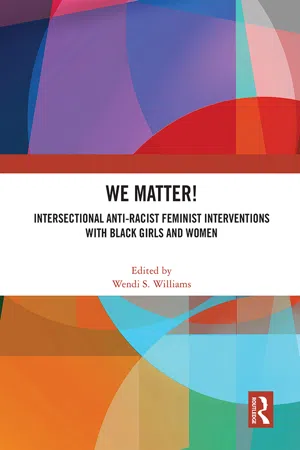
WE Matter!
eBook - ePub

WE Matter!

Intersectional Anti-Racist Feminist Interventions with Black Girls and Women

  1. 282 pages
  2. English
  3. ePUB (mobile friendly)
  4. Available on iOS & Android
eBook - ePub

WE Matter!

Intersectional Anti-Racist Feminist Interventions with Black Girls and Women

About this book

Increasingly, social, cultural, and political discourse is deeming Black women and girls to be a critical group to engage. We are told their lives should matter, and yet, there is also overwhelming evidence that Black women and girls continue to be what Malcolm X declared, "The most neglected person in America". This critical volume engages a conversation at the intersection of the fields of education and psychology among recognized Black women scholars that contemporizes the discourse about Black women's and girls' diversity, their sociocultural contexts, and various approaches to communal and clinical work with them to support their mental health, wellness, and thrivance.

WE Matter!: Intersectional Anti- Racist Feminist Interventions with Black Girls and Women is a significant new contribution to Black Studies, Mental Health, and Gender Studies, and will be a great resource for academics, researchers, and advanced students of Sociology, Psychology, Education, and Politics.

The chapters in this book were originally published as a special issue of Women & Therapy.

Frequently asked questions

Yes, you can cancel anytime from the Subscription tab in your account settings on the Perlego website. Your subscription will stay active until the end of your current billing period. Learn how to cancel your subscription.
No, books cannot be downloaded as external files, such as PDFs, for use outside of Perlego. However, you can download books within the Perlego app for offline reading on mobile or tablet. Learn more here.
Perlego offers two plans: Essential and Complete
  • Essential is ideal for learners and professionals who enjoy exploring a wide range of subjects. Access the Essential Library with 800,000+ trusted titles and best-sellers across business, personal growth, and the humanities. Includes unlimited reading time and Standard Read Aloud voice.
  • Complete: Perfect for advanced learners and researchers needing full, unrestricted access. Unlock 1.4M+ books across hundreds of subjects, including academic and specialized titles. The Complete Plan also includes advanced features like Premium Read Aloud and Research Assistant.
Both plans are available with monthly, semester, or annual billing cycles.
We are an online textbook subscription service, where you can get access to an entire online library for less than the price of a single book per month. With over 1 million books across 1000+ topics, we’ve got you covered! Learn more here.
Look out for the read-aloud symbol on your next book to see if you can listen to it. The read-aloud tool reads text aloud for you, highlighting the text as it is being read. You can pause it, speed it up and slow it down. Learn more here.
Yes! You can use the Perlego app on both iOS or Android devices to read anytime, anywhere — even offline. Perfect for commutes or when you’re on the go.
Please note we cannot support devices running on iOS 13 and Android 7 or earlier. Learn more about using the app.
Yes, you can access WE Matter! by Wendi S. Williams in PDF and/or ePUB format, as well as other popular books in Social Sciences & Mental Health in Psychology. We have over one million books available in our catalogue for you to explore.

Information

Complexifying What it Means to be Black and Female

Black Women: Then and Now

Diane M. Adams and Elana H. Lott

ABSTRACT

Social media and traditional resources were used to examine discourse about the role and position of Black women during the civil rights movement of the 60s and the #BlackLivesMatter movement. Discourse in both eras highlighted persistent issues with the gendered oppression of Black women, systems of patriarchy and misogyny supporting that oppression, and conflicts about the role of feminism. Common themes included in past and contemporary discourse included issues of invisibility, vulnerability, colorism, and negative stereotyping. The clinical implications of this discourse for Black women and of the current movement’s emphasis on an intersectional approach are discussed.
There was considerable discourse during the civil rights movement of the 60s and 70s about the role and position of Black women within the movement, the place of feminism in the movement, and Black male-female relationships. As two Black women, a mother and daughter, generations apart, we were curious and somewhat dismayed to find as we talked that in the new civil rights movement of today, the #BlackLivesMatter movement, there continues to be discourse about these same three domains of concern. Now, over 50years later, some of the same paternalistic issues and rhetoric have surfaced again. Our curiosity and dismay prompted us to delve deeper; has this discourse evolved, what’s changed, what’s remained the same, and importantly, what can we learn from this discourse about the gender oppression of Black women? Although much of the literature written about Black women focuses on White racism and the forms and systems of White racism perpetuated against Black women, much less attention has been paid to sexism and misogyny within the Black community. However, these have been persistent issues for Black women. In this article, we examine the discourse around these issues and explore the systems of misogyny and paternalism affecting Black women within the Black community. This is a topic that is often taboo. However, due to hetero-patriarchal ideologies and power relationships within the Black community, we believe it is important to consider the historical and political relationships of Black women to Black men, as well as to White women, and White men when considering the position that Black women occupy in U.S. society. These relationships and ideologies are internalized and can be the source of a great deal of mental anguish and conflict.
In examining the discourse about Black women in the 60s civil rights movement and in the #BlackLivesMatter movement, we use intersectional and social movement theory as lenses for discussion. We explore the evolution of this discourse and its meaning for understanding the confluence of gender and race in the oppression of Black women. We found that our exploration of this discourse served to highlight some of the major psychosocial concerns of young Black women and to illustrate how they are situated both within the Black community and within the larger fabric of U.S. society.

Social Movements and Discourse

Social movement theory holds that social movements create competing discourses within a society (Brush, 1999). However, both the Black and feminist movements of the 70s failed to provide a counter dialog articulating the gender oppression of Black women. Neither movement provided discourse that legitimized Black women’s experience of gender oppression or the language to articulate it (Brush, 1999). The inattention of feminism to racism and the inattention of the Black Movement to sexism resulted in a subordination of Black women’s concerns during this time (Crenshaw, 1991; Davis, 1983). Discourse during the Black civil rights movement of the 60s and 70s focused on racism and Black liberation, not on gender oppression. Discussions of sexism, particularly those involving misogyny in the Black community, were discouraged and suppressed (Wallace, 1980). In contrast, the #BlackLivesMatter movement started over 50years later with a stated intention to affirm the experiences of Black individuals marginalized in the earlier Black liberation movement (Garza, n.d., “Broadening the Conversation,” para. 1). Although certain themes persist, this intersectional approach has in some ways changed the discourse. Discourse in the Black Lives Matter movement has also been affected by the digital age. Online interactions have altered communications and served to broaden and publicize numerous types of discourse and issues affecting the movement. As we examine discourse in the #BlackLivesMatter movement, we will turn to social media to capture the contemporary voices of the Black community and Black women.

The Civil Rights Movement of the 60s and 70s

The Black civil rights movement of the 60s and 70s was a defining time in the development of a Black consciousness and identity. It provided a competing discourse about Blacks in this society, about their African heritage and ancestry, their history of oppression, and the structures and beliefs within this society that support that oppression. Discourse about Black history, pride, and solidarity became the source of a new collective identity and provided language, symbols, and ideas used to articulate, celebrate, and protest the Black experience (Brush, 1999). However, in some ways, the dialog about Black women perpetuated and legitimized the gender oppression of Black women (Staples, 1979; Wallace, 1980). This discourse centered on the three domains of concern we identified earlier: the role and position of Black women; Black male-female relationships; and the role of feminism in the movement. We briefly recap this discourse as a basis for comparison when we examine similar topics and discourse in the current #BlackLivesMatter movement.

The Role and Position of Black Women in the Movement

Discourse on the role and position of Black women in the 60s and 70s centered on Black women taking a backseat. Black women were behind-the-scene leaders, yet Black men took the lead in articulating the needs of the Black community (Brush, 1999, p. 124). The role of the Black woman was marginalized and overshadowed in favor of the Black male experience (Cazenave, 1983; Chisholm, 1972), and Black women were actively encouraged to step back and take a backseat to Black men in the public’s eye and in leadership. This rhetoric was fueled by the myths of the Black matriarchy (Moynihan, 1965) and the powerful privileged Black woman (Wallace, 1980). The myth of the powerful, privileged Black woman characterized Black women as inordinately tough, domineering, bitchy, and lacking the fears and weaknesses of other women (Wallace, 1980).
This characterization was compounded by the myth of the Black matriarchy which emerged during the 60s and instigated by a government report by a White social scientist (Moynihan, 1965), which called attention to a so-called crisis in the Black family and community and blamed the position of Black women as heads of household. These myths, coupled with earlier images that portrayed Black women as loud, overbearing, and emasculating, were used to justify the need for Black women to take a back seat to correct the damaged image of Black men and to heal strained Black male-female relationships (Cazenave, 1983; Wallace, 1980). Although these myths were partially debunked (Rodgers-Rose, 1980; Wallace, 1980), they were paradoxically enacted in the politics of the day with pronouncements that it was time for Black women to step back and let Black men take the lead (Chisholm, 1972).

Black Male-Female Relationships

A great deal of dialog centered on Black male-female relationships, much of it uncomplimentary. The Black woman was viewed as being complicit in compromising the manhood of Black men (Wallace, 1980). During the civil rights movement, the restoration of Black men’s image and authority was a goal Black women were expected to support. Black women accepted this premise and, for the most part, kept silent and lent their support. There were allegations that Black women had participated in the “social” castration of Black men and in keeping the Black man down (Cazenave, 1983). Black women were blamed for alleged negative relationships between Black women and men. And, while this time period rang with the slogan “Black is beautiful” and the appellation Black African Queen was liberally applied to Black women in the Black community, differential standards in beauty, both within and external to the Black community, and persistent issues of colorism belied these proclamations.

The Role of Feminism in the Movement

During the civil rights movement, talk about feminism and misogyny was suppressed. Many Black women at the time took the position that the “Women’s movement was a White woman’s thing and the role to which White women were assigned was of no concern to Black women” (Chisholm, 1972, p. 125), or the point of view also prevalent at the time that women’s liberation wasn’t for Black women because Black men needed Black women supporting them in the fight for liberation of the race (Brush, 1999). Emphasis was placed on Black men and women presenting a united front. Discourse about racism trumped discourse about gender oppression, liberation first critics exclaimed (Chisholm, 1972).

Gender, Race, Oppression and Intersectional Theory

The civil rights movements of the 60s and 70s focused on Blacks as a group and the oppression of Black people because they were Black rather than for any other reason. Well-known discourses at the time pointed to White society’s lack of distinction in class, gender, or education when it came to discrimination against Blacks. The conversation went that it did not matter whether or not you had a Ph.D., you were still just another Black person, although Black was not the word used, and subject to oppression for that reason. “It was...

Table of contents

  1. Cover
  2. Half-Title Page
  3. Title Page
  4. Copyright Page
  5. Contents
  6. Citation Information
  7. Notes on Contributors
  8. Introduction
  9. Complexifying What it Means to be Black and Female
  10. Conversations across Generations
  11. Clinical and Training Implications
  12. Index