This book explores how the Volga Tatars, the largest ethnic minority within the Russian Federation, a Muslim minority, achieved a great deal of autonomy for Tatarstan in the years 1988 to 1992, but then lost this autonomy gradually over the course of the Putin era. It sets the issue in context, tracing the history of the Volga Tatars, the descendants of the Golden Horde whose Khans exercised overlordship over Muscovy in medieval times, and outlining Tsarist and Soviet nationalities policies and their enduring effects. It argues that a key factor driving the decline of greater autonomy, besides Putin's policies of harmonisation and centralisation, was the behaviour of the minority elites, who were, despite their earlier engagement in ethnic mobilization, very acquiescent to the new Putin regime, deciding that co-operation would maximise their privileges.
eBook - ePub
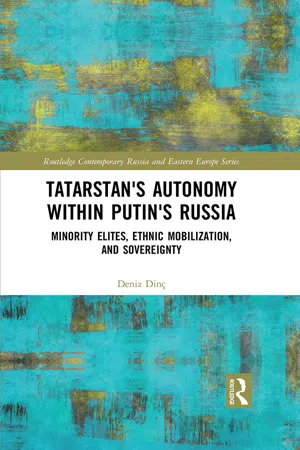
Tatarstan's Autonomy within Putin's Russia
Minority Elites, Ethnic Mobilization, and Sovereignty
- 214 pages
- English
- ePUB (mobile friendly)
- Available on iOS & Android
eBook - ePub
Tatarstan's Autonomy within Putin's Russia
Minority Elites, Ethnic Mobilization, and Sovereignty
About this book
Information
1 Introduction
DOI: 10.4324/9781003204718-1
Men make their own history, but they do not make it as they please, they do not…The tradition of all dead generations weighs like a nightmare on the brains of the living.Karl Marx1
When Valery Tishkov saw the demands of the Tatar committee during the negotiations for the February Treaty, he asked me: “Will you leave Russia?” I replied to him: “Staying inside Russia was not our choice, so separating from it will not be our choice, either.” Then, he asked me again to clarify the point: “As far as I understand you do not want to separate from Russia, but you do not want to be a part of Russia?” I replied to him “exactly”.
Indus Tagirov2
Both universalism and particularism are two ineradicable dimensions in the making of political identities, but the articulation between them is far from being evident.
Ernesto Laclau3
There are more nations than states in the modern era. The concepts of nation and state are considered as inextricable notions. In fact, a state is an apparatus of governance whereas a nation is a political-cultural community. Some cautious estimates claim that there are now more than 3,000 nations in the world, while 192 states are represented at the United Nations. Moreover, only 20 states out of 192 are ethnically homogenous. It is also claimed that only 3 percent of the world’s 6,000 national groups have achieved statehood.4 Although stateless nations constitute a significant proportion of the global population, they are omitted and marginalized by state centric international politics. The demands for recognition by minorities have largely caused ethnic conflicts since the majority nationality discourses of the nation-states consider such demands to be a security threat. The state centric officials generally perceive diversity and multinationality to be a source of instability. Hence, the nation-states oscillate from assimilating diversity to accepting and accommodating it under several forms of autonomy. Federalism and regional autonomy are the highest stages of types of governance which aim to accommodate diversity. In fact, 39 percent of the global population are living under a form of federalism or autonomy in the modern world.5
Even under a form of federalism or high-level autonomy, central governments are reluctant to share power with the autonomous units. Most of the governments of multinational states are under the influence of state-centric traditions. Naturally, they consider the relationship between state and ethnic groups to be a zero-sum game, rather than a win-win situation.6 In fact, the national identities of stateless nations are multi-layered, similar to individual identities. The national identities of minority nations involve nested identities, including the national identity of the majority. In other words, a Tatar or a Catalan is at the same time Russian and Spanish, respectively. The minority-friendly liberal theory tends to approach stateless nations or minority nationalism in a positive manner. This paradigm highlights that minority nations have a significant potential to increase democratization in the nation-states. I agree with these approaches in the liberal theory and appreciate the significant works of authors, such as Lord Acton, James Tully, Willy Kymlicka, Michael Keating, and Bhikku Parekh. It is obvious that stateless nations possess incomparable structural paths to enhance the equality and liberty principles in comparison with the majority nations in Western democracies. In this book, I will attempt to pursue the issue of minority nationalism and federalism in the context of Russia. However, in the context of Russian federalism, I cannot see the similarities to the structural paths of the Western forms of federalism. The Russian Federation has its own sui generis federation model, which is distinct from Western democracies. In the Russian federalism context, the legacy of Soviet nationality policies has a crucial place that forms a historical-institutional structure. The Soviet Union’s ethnically codified legacy of the Soviet nationality policies created a high level of path dependency, which dramatically shaped the post-Soviet nationality policies of the Russian Federation. In other words, the structure of the ethnicity regime of the Soviet Union is overwhelmingly continuing in the post-Soviet Russia.
I believe that the Soviet Union implemented a sui generis nation-building model, which can be revealed better by differentiating between cultural and political nationalism. Although hierarchically institutionalized, the Soviet state allowed for the cultural and linguistic flourishment of the minority nations. For example, mother tongue education and research on history of the minority nations/ethnic groups were legal and subsidized by the Soviet government. The central support on cultural nationalism was organized hierarchically depending on the institutional status of the minority or titular nations. From top to bottom, the Soviet state was administratively organized as follows: Soviet Socialist Republics (SSRs), Autonomous Soviet Socialist Republics (ASSRs), Autonomous Regions, Autonomous Provinces, and Autonomous Districts.7 In this regard, Terry Martin emphasizes the cultural nationalism sphere of the early Soviet federalism under the title of “affirmative action policies”. According to Martin, in the period of Korenizatsiya (Nativization) the Soviet state initiated a huge project in favor of non-Russian nations and ethnic groups. The Soviet Union even converted some ethnic groups, which likely would not have been capable of developing as a nation in the natural progress of history.8 In contrast to the cold war arguments of the “Prison of Nations”, the Soviet Union not only allowed the usage of mother tongue, national education, and cultural rights, but also in some cases invented and consolidated infant nations. However, preferential treatment for non-Russians was stabilized under the concept of “Russians as first among equals” in the Stalin, era. The Stalinist regime, ceased affirmative action by remaining loyal to the Soviet template of its ethnically codified nation-building project. Nevertheless, the main template of the Soviet nationality regime had already been formed by the end of the 1930s including fixing ethnicity in identity documents.9 Although coding ethnicity/nationality in internal passports paved the way for the deportations of Stalin prior to and during the Second World War, the stabilization of the nationality policies of the Soviet Union continued until dissolution.10
With regard to political nationalism, Moscow strictly controlled the titular republics. The national ideologies that were articulated in different ideologies rather than the established order were harshly suppressed and punished by Moscow. Hence, the titular elites had to be loyal to the established order and Soviet communism in order retain power in the titular republics and other types of Soviet autonomous units. The alternative national discourses were generally labeled as “nationalist deviation” or “bourgeois nationalism” by the Soviet authorities. Even the national communism of Sultangaliev, which was influenced by the proto-dependency school ideas, was strictly suppressed and punished by the Soviet authorities.
By institutionalizing each ethnic group on a particular land, the Soviet government planted the seeds of secessionist ethno-nationalism, which would erupt in period of Glasnost and Perestroika and would facilitate the collapse of the Soviet state. Similar to the other titular republics of the Soviet state, the Tatar national movement and sovereignty mobilization emerged based on this ground. However, the titular nationalisms and sovereignty projects were restricted under the framework of the legacy of Soviet nationality policies. Even though the concept of path dependency is generally implemented to understand the patterns of the economic issues, the concept fits much better to the issue of nationality regimes.11 In other words, the legacy of the Soviet nationality policies had a crucial impact on the formation and future limitation of post-Soviet titular republics’ sovereignty movements.
Another significant issue which is also related to the Soviet nationality policies is the role of titular elites in the period of the dissolution of the Soviet Union. The Soviet nationality legacy created and empowered the native state elites in the titular republics. The already created titular national elites in the early Soviet period found a place to strongly flourish in the period of Brezhnev. The long tenure of the native leaders in the era of Brezhnev, in particular, consolidated the positions of non-Russian state elites in the union and autonomous republics, which I prefer to define as “ethno-national nomenklatura”. This ethno-national nomenklatura legacy marked the last years of the Soviet Union and post-Soviet politics with regard to the rapid transformation of Soviet politics. In the union and autonomous republics, ethno-national nomenklaturas skillfully instrumentalized nationalism in order to secure their elite positions in power. The weakened state capacity of Moscow allowed these ethno-national nomenklaturas to play safely in their own islands for their private gains. The transformation into a market economy resulted in the intensive transferal of state assets from the federal center to the titular republics. In addition, the privatization and control of the local state property facilitate the enrichment of the ethno-national nomenklaturas. Hence, the issues of minority nationalism, stateless nations, and democracy in the Western context are very distinct from the reality in the Eurasian context. For example, minority elites of stateless nations in the West constantly challenge the majority nationalisms to reveal their identities and take sovereignty concessions from the central authorities. For example, the cases of Catalonia, Quebec, and Scotland are significant examples that reflect the aforementioned point.12 However, in the Russian case, the ethno-national nomenklaturas of the autonomous republics were very submissive and they adopted the overcentralization policies of the Putin regime without any resistance. In other words, while small conflicts can create big storms in the West, in the Russian context, the ethno-national nomenklaturas remained very submissive, and were even in some cases supportive of the federalism hostile policies of the federal center in Russia.
Following the paths of the above-mentioned issues, this book focuses on the case of Tatarstan taking into account the sui generis character of Russian federalism. I will examine the rise and decline of ethnic mobilization and sovereignty in Tatarstan, taking into account the reproduction of Tatar ethno-national nomenklatura.13 At the beginning of the research journey of this book, I was influenced by the idea that the Volga Tatars could enhance the democratization of Russia similar to the other stateless nations in Western countries. However, I found an authoritarian regime that even on some occasions has similar or more authoritarian regional practices to that of the federal center in Moscow. When I questioned the autonomous authoritarian structure of Tatarstan, I witnessed the continuity of the nomenklatura structure. The ethno-national nomenklatura, which was also a product of the Soviet legacy, in fact creates a barrier preventing the democratization of Tatarstan similar to the authoritarian policies of the federal center that create a barrier for the democratization of Russia. Furthermore, I observed that the pragmatic self-interest based ethno-national nomenklatura was not sincere in terms of the demands for sovereignty. The local and federal state elites have very strong informal ties among themselves, which has led to integration under the control of Moscow. In other words, the ethno-national nomenklatura and the central nomenklatura are members of the same oligarchical club, which will always find a common ground even under the most conflict-ridden conditions. Hence, in this study, I argue that the Tatar ethno-national nomenklatura instrumentalized nationalism for their self-gain and to remain in power. For example, the state elites of Tatarstan retreat back when they do not need nationalism and they become very adoptive to the vertical power of the Russian state, which reveals how the Tatar regional elites instrumentalize nationalism and sovereignty discourses for their elite power. I pursued this argument from a micro and macro chronological perspective in the period of the rise and fall of ethnic mobilization and sovereignty. In terms of the micro research, I examine the rise and decline of ethnic mobilization period in a compressed period of time. The issue of sovereignty, however, is examined on the basis of a period of approximately three decades (1990–2020). The more than quarter century long post-Soviet sovereignty experience of Tatarstan proved how the ethno-national nomenklatura is still active and determinant in the regional politics of Tatarstan and also how they are open to collaboration Moscow even under the most disadvantageous conditions. At this point, the question of why I chose the Tatarstan case from the 21 autonomous republics in the Russian Federation leads us to an examination of the significance of the case of Tatarstan
Significance of the Tatarstan case
In the Soviet period, Tatarstan was an Autonomous Soviet Socialist Republic (ASSR). The borders of Tatarstan did not change in the post-Soviet period. Ta...
Table of contents
- Cover
- Half Title
- Series Page
- Title Page
- Copyright Page
- Table of Contents
- Tables
- Acknowledgements
- Abbreviations
- 1. Introduction
- 2. Political history of the Volga Tatars: From the medieval ages to the end of Soviet modernization
- 3. Institutional legacy of Tsarist and Soviet nationality policies
- 4. The rise and fall of ethnic mobilization in Tatarstan
- 5. The rise and fall of sovereignty in Tatarstan: From Yeltsin's to Putin's Russia (1990–2020)
- 6. Conclusion
- References
- Index
Trusted by 375,005 students
Access to over 1.5 million titles for a fair monthly price.
Study more efficiently using our study tools.
Frequently asked questions
Yes, you can cancel anytime from the Subscription tab in your account settings on the Perlego website. Your subscription will stay active until the end of your current billing period. Learn how to cancel your subscription
No, books cannot be downloaded as external files, such as PDFs, for use outside of Perlego. However, you can download books within the Perlego app for offline reading on mobile or tablet. Learn how to download books offline
Perlego offers two plans: Essential and Complete
- Essential is ideal for learners and professionals who enjoy exploring a wide range of subjects. Access the Essential Library with 800,000+ trusted titles and best-sellers across business, personal growth, and the humanities. Includes unlimited reading time and Standard Read Aloud voice.
- Complete: Perfect for advanced learners and researchers needing full, unrestricted access. Unlock 1.5M+ books across hundreds of subjects, including academic and specialized titles. The Complete Plan also includes advanced features like Premium Read Aloud and Research Assistant.
We are an online textbook subscription service, where you can get access to an entire online library for less than the price of a single book per month. With over 1.5 million books across 990+ topics, we’ve got you covered! Learn about our mission
Look out for the read-aloud symbol on your next book to see if you can listen to it. The read-aloud tool reads text aloud for you, highlighting the text as it is being read. You can pause it, speed it up and slow it down. Learn more about Read Aloud
Yes! You can use the Perlego app on both iOS and Android devices to read anytime, anywhere — even offline. Perfect for commutes or when you’re on the go.
Please note we cannot support devices running on iOS 13 and Android 7 or earlier. Learn more about using the app
Please note we cannot support devices running on iOS 13 and Android 7 or earlier. Learn more about using the app
Yes, you can access Tatarstan's Autonomy within Putin's Russia by Deniz Dinç in PDF and/or ePUB format, as well as other popular books in Social Sciences & Ethnic Studies. We have over 1.5 million books available in our catalogue for you to explore.