- 399 pages
- English
- ePUB (mobile friendly)
- Available on iOS & Android
eBook - ePub
About this book
This text deals with the concept that cavitation is the main limitation to the performance of hydraulic components. Topics covered include the vaporization of liquids due to high velocities or pressure fluctuations, and the effects of cavitation on the performances of rotary machinery. One chapter is devoted to cavitation noise which concerns many users, including surface ships and submarines, and the author finishes with some examples of the use of cavitation and subject-specific measuring techniques.
1
Phenomenon of Cavitation
1.1 INTRODUCTION
Cavitation is the phenomenon of vaporisation of fluids under the effect of depressurisation, i.e., low pressure caused by high flow velocity. It occurs in many hydraulic machines and components whose effective range of operation is limited by the appearance or development of the phenomenon.
Generally, the following undesirable effects are produced by cavitation:
- — generation of intense noise. When cavitation occurs the noise level increases by up to 20 to 40 dB;
- — damage to surfaces. Erosion necessitates frequent repair of machines even when they are correctly designed from a strict point of view of hydraulic performance;
- — loss in level of performance. When cavitation is well developed the machines undergo large losses in performance and may even become totally unusable.
One of the objectives of this book is to provide designers and users of hydraulic machines and components sufficient information that will give them a better understanding of the phenomenon of cavitation in practical situations.
After explaining the universal aspects of the phenomenon of cavitation, we shall describe the classical methods of characterisation of machines and components as well as the general aspects of similitude. Thereafter, we shall discuss the current state of theoretical and experimental knowledge of various aspects of cavitating flows in accordance with such characterisation. Next, we shall discuss the developments in the field of erosion and similitude. A chapter is devoted to cavitation noise and another to the thermodynamic effects. Finally, we shall present the methods of testing and the general manner of their implementation.
1.2 VAPORISATION
Vaporisation of a liquid is the change of phase that converts it into the vapour state. This transformation is mostly brought about by adding heat, as in the case of boiling in heating systems or more commonly in a casserole. It can also be achieved by depressurisation, for example in evaporators in desalination factories. In some cases, vaporisation is accomplished by a combination of heat addition and reduction in pressure.
The two types of vaporisation are illustrated in the thermodynamic p − v diagram of Fig. 1.1, showing pressure as a function of specific volume.
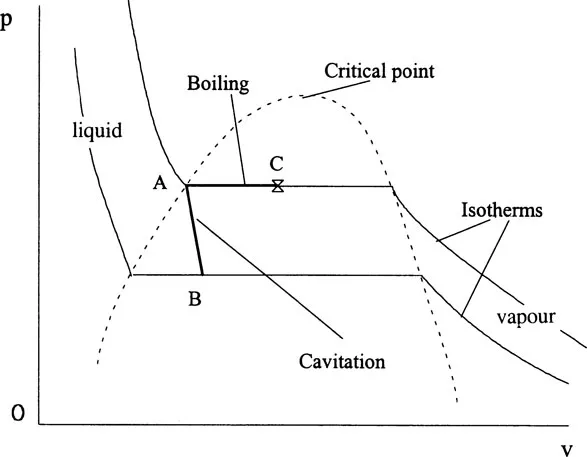
The transformation AC represents vaporisation at constant pressure attained by heat addition Q · AB represents vaporisation due to reduction in pressure. Both transformations need heat addition to provide for the latent heat of change of phase.
In the first case (AC) the heat is provided entirely by the surroundings and the mass of vapour produced is given by
where L is the latent heat of vaporisation of the liquid.
In the second case (AB) the transformation is globally adiabatic, i.e. there is no exchange of heat with the surroundings. Therefore, in order to produce vapour, the unevaporated liquid must get cooled; this is schematically shown in the figure by a shift from one isotherm (through A) to another (through B).
The pressure at which vaporisation occurs depends on the temperature. Fig. 1.2 shows the dependence of the vapour pressure of water on temperature.
Table 1.1 gives various physical properties of water of interest in the study of cavitation: pressure, temperature, latent heat, enthalpy of liquid and vapour, density of liquid and of vapour.
T °K | Pv bar | ρv kg/m3 | ρL kg/m3 | HLkJ/kg | HG kJ/kg |
|---|---|---|---|---|---|
273.15 | 0.00611 | 1.047 E-10 | 1000 | 0 | 2502 |
290 | 0.01917 | 0.0143 | 999 | 70.7 | 2532 |
320 | 0.1053 | 0.0715 | 989 | 196 | 2586 |
373.15 | 1.0133 | 0.596 | 958 | 419.1 | 2676 |
420 | 4.370 | 2.35 | 919 | 618.6 | 2742 |
470 | 14.55 | 7.35 | 868 | 838.2 | 2789 |
570 | 82.16 | 43.86 | 718 | 1382 | 2757 |
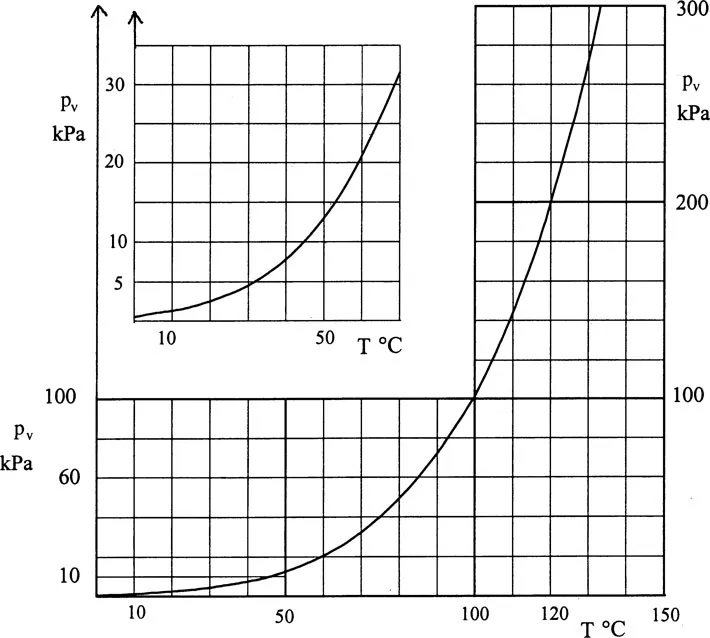
It may indeed be noted that the vapour pressure for water is very low at ordinary temperatures; hence, the density of vapour is extremely low. Therefore, production of a significant volume of vapour at low temperature needs a very small amount of heat addition and very often, in the case of cavitation in cold water, such heat addition is negligible.
All liquids are susceptible to cavitation as soon as the pressure attains a value equal to the vapour pressure. Water occupies a very important position, both because of its occurrence in numerous technical applications and because it is water that is used to simulate the behaviour of other fluids in most experiments.
The thermodynamic characteristics of several substances currently used in technical applications are given at the end of the book.
1.3 CAVITATION: SOME EXAMPLES...
Table of contents
- Cover
- Half Title
- Title Page
- Copyright Page
- Foreword to the English Edition
- Foreword to the French Edition
- Acknowledgements
- List of Symbols
- Table of Contents
- Introduction
- 1. Phenomenon of Cavitation
- 2. Parameter σ of Cavitation
- 3. Types of Cavitation
- 4. Single Bubble Life
- 5. Cavitation of a Hydrofoil
- 6. Travelling Bubble Cavitation
- 7. Fixed or Attached Cavitation
- 8. Other Types of Cavitation
- 9. Cavitation Noise
- 10. Thermodynamic Attenuation of Cavitation
- 11. Cavitation Erosion
- 12 Cavitation in Rotary Machines
- 13. Test Facilities
- 14. Instrumentation
- 15 Applications of Cavitation
- Some Physical Properties of Fluids
- References
- Index
Trusted by 375,005 students
Access to over 1.5 million titles for a fair monthly price.
Study more efficiently using our study tools.
Frequently asked questions
Yes, you can cancel anytime from the Subscription tab in your account settings on the Perlego website. Your subscription will stay active until the end of your current billing period. Learn how to cancel your subscription
No, books cannot be downloaded as external files, such as PDFs, for use outside of Perlego. However, you can download books within the Perlego app for offline reading on mobile or tablet. Learn how to download books offline
Perlego offers two plans: Essential and Complete
- Essential is ideal for learners and professionals who enjoy exploring a wide range of subjects. Access the Essential Library with 800,000+ trusted titles and best-sellers across business, personal growth, and the humanities. Includes unlimited reading time and Standard Read Aloud voice.
- Complete: Perfect for advanced learners and researchers needing full, unrestricted access. Unlock 1.5M+ books across hundreds of subjects, including academic and specialized titles. The Complete Plan also includes advanced features like Premium Read Aloud and Research Assistant.
We are an online textbook subscription service, where you can get access to an entire online library for less than the price of a single book per month. With over 1.5 million books across 990+ topics, we’ve got you covered! Learn about our mission
Look out for the read-aloud symbol on your next book to see if you can listen to it. The read-aloud tool reads text aloud for you, highlighting the text as it is being read. You can pause it, speed it up and slow it down. Learn more about Read Aloud
Yes! You can use the Perlego app on both iOS and Android devices to read anytime, anywhere — even offline. Perfect for commutes or when you’re on the go.
Please note we cannot support devices running on iOS 13 and Android 7 or earlier. Learn more about using the app
Please note we cannot support devices running on iOS 13 and Android 7 or earlier. Learn more about using the app
Yes, you can access Cavitation by Yves Lecoffre in PDF and/or ePUB format, as well as other popular books in Technology & Engineering & Physics. We have over 1.5 million books available in our catalogue for you to explore.