eBook - ePub
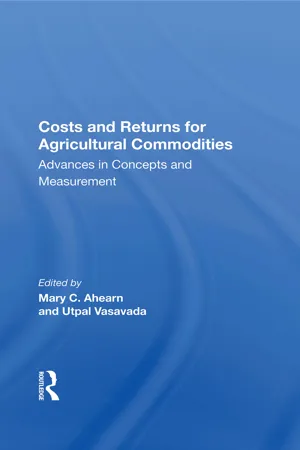
Costs And Returns For Agricultural Commodities
Advances In Concepts And Measurement
- 414 pages
- English
- ePUB (mobile friendly)
- Available on iOS & Android
eBook - ePub
About this book
Policymakers, farmers, managers of agriculture and others look to agricultural economists for accurate estimates of the costs and returns of individual agricultural commodities. But there is great diversity and disagreement among practitioners about the best method for such analysis. The contributors to this volume explore how different uses of estimates determine different methods of estimation, as well as evaluating what the preferred methods are for similar uses.
Information
PART ONE Contemporary Issues in Measuring Commodity Costs and Returns
DOI: 10.1201/9780429036385-2
1Varied Purposes and Implications for Measuring Costs and Returns
B. H. Robinson
DOI: 10.1201/9780429036385-3
Introduction
A review of the past often gives us a better perspective of the present. When the subject turns to the contemporary issues of cost of production (COP), history provides a perspective mired mainly in conflict. Indeed, like disputes over national boundaries, human rights, and conflicts between church and state, cost of production also must be considered a major source of conflict throughout history. Disputes over land values and rent, the value of the produce from land, and the subsequent taxes levied have long plagued societies.
A brief annotation of the past illustrates this age-old conflict, where some version of calculating the costs of production has been part of societies since trade developed. When societies shifted from mainly hunting to developing agrarian skills, rules were needed to control access to resources. We might say that rents derived initially from these earliest rules. Passages in the Bible discuss rules established to govern fair rents to landlords. In Rome, Greece, Egypt, and other ancient civilizations, records were kept on rents to landlords-the equivalent of our share rents today.
With the rules and rights came conflicts. In early recorded history, battles were fought for the rights to the scarcest resources-good land and access to water. Peasant revolts in Europe in the Middle Ages were often based on disputes about appropriate or fair rents (taxes) imposed by the Crown, or landed gentry. Similar uprisings in England occurred for the same reason-disagreements over taxes or rents imposed on tenants by landlords who controlled access to scarce resources. The flippant remark of Marie Antoinette to "let them eat cake" is considered to have been based on a disagreement over an excessive tax imposed by the French nobility on tenants for the use of land.
The contemporary issues in cost of production facing us today have their roots in two types of conflict that have a long history. The first is conflict over measurement of cost of production, and the methods employed in that endeavor. The second is a conflict over the use of estimates of cost of production. This historical perspective is important to keep in mind as we contemplate today's issues and the progress made thus far. Today's agricultural inputs are vastly more complex than at any time in the past; economic theory and empirical tests of theory are more sophisticated, and have enabled more precise measurement; and individuals have made considerable progress in articulating the need and purpose for accurate measurement of costs of production. Yet rents to fixed inputs such as land remain a critical and controversial subject.
In short, the job of resolving these contemporary issues rooted in old conflicts is not over. However, two developments have taken us farther along--the development of the agricultural economics discipline and the formal recognition in legislation of the need to develop sound measures of cost of production.
Attempts to Measure COP: The Development of a Discipline
Early economists such as Ricardo and Marx dealt with the issue of costs of production in their treatment of rents. In the late 1800s, however, a new discipline was beginning to emerge with its roots not in economics, but agronomy. The first stage in this metamorphosis was the emergence of farm management specialists. The major item on their agenda was to measure the cost of production at the farm level. Their goal was quite simple: "improve farm decisions by providing a means for assessing management strategies so that greater efficiency and ultimately, higher profits would result" (Taylor and Taylor).
Such were the origins of agricultural economics in the Department of Agriculture (USDA), when William Spillman organized the first Farm Management Branch in the Bureau of Plant Industries in 1902. Later established as the Office of Farm Management in 1905 with Spillman as head, the mission of this group was to provide an understanding of "the economics of individual farms, using cost accounting and farm surveys as methods of finding the most profitable enterprises and systems of farming" (Mighell). Notice that in 1905, at least one of the age-old conflicts appeared to have been resolved-cost of production was to be measured using cost accounting principles and farm survey data.
Land grant universities were also beginning similar work, and cooperative efforts between farm management specialists and educators emerged. Goals shifted from making two blades grow where only one grew before to bringing farmers out of the depression of the 1890s through improved management strategies. Cost of production measurements were considered a key tool in this endeavor.
The issues of use and purpose, though seemingly clear from the perspective of farm specialists in USDA and land grant universities, apparently differed from those of policymakers, so much so that Spillman resigned in 1918 (Mighell). After the United States entered World War I, the focus of farm specialist work inevitably turned to war-related problems such as labor supply and studies of early mechanization and their resulting impacts on profits and supply. Spillman's resignation over a controversy about the use of COP statistics rekindled old conflicts. Political forces were searching for a way to use COP measures as a means to justify an argument that farm prices should be equal to the cost of production plus a reasonable profit (Mighell).
Ironically, the development of agricultural economics actually contributed to the conflict of measurement. As this discipline developed, it took as its foundation the theory of the firm anchored in economics. As agricultural economists turned their attention to the subject of cost of production at the farm-firm level, a conflict thought to be resolved in 1905the issue of measurement-was once again ignited. Mixing cost accounting principles with economic principles of production cost decisions and behavior has been like mixing oil and water. And this conflict has only been aggravated over time by the introduction of theories from finance and financial accounting, as well as theories of risk behavior. Many of the dilemmas we face today stem from the disputes presented by mixing these theories.
Disputes Over Use of COP: Political and Economic Issues
The consequence of one dispute between policymakers and specialists in COP measurement has already been mentioned--the resignation of Spillman as head of the Farm Management Office in 1918. From 1918 until the abolishment in 1953 of the Bureau of Agricultural Economics (the predecessor of the Economic Research Service), some form of farm management office dealing with cost of production existed after Spillman resigned. From 1953 until 1961 when the Economic Research Service (ERS) was created, cost of production work was done by the Agricultural Research Service in USDA Throughout this whole period (1920s through the 1960s), work continued on the development of measures of cost of production as a basis for measuring supply response. A major part of the mission of ERS shortly after its creation focused on regional production adjustment studies in cooperation with land grant universities. These studies were the first of their kind, and led to the expansion of ERS predominantly for the purpose of studying cost of production and production adjustment.
But also during this period, policy changes were taking place and conflicts continued to arise over the purpose and need for accurate cost of production measures. In the early years, Peek's parity pricing concept emerged as farm policy. Policymakers originally sought an income parity measure, but without good measures of cost of production they shifted to price parity since prices were observable, and chose a "good and equitable base period." Over time, policymakers have toyed with using cost of production measures as a basis for farm policy, either directly or indirectly. No one can deny that production cost estimates have often guided policymakers in discussions and, eventually, decisions about what constitutes an appropriate support level. Under provisions of legislation governing farm policy from the 1940s through the 1960s regarding price supports, the Secretary had authority to set and adjust price supports within ranges based on percentages of parity (Lee). The rationalization for raising or lowering support prices within the permissible range was often attributed to cost of production.
Cost of production measures have been used in the administration of several programs within USDA. In the Federal Crop Insurance program, COP estimates have been used to help set rates and determine the types of insurance offered; FmHA has used cost of production measures as benchmarks for loan administration.
Cost of production estimates have often been used as a proxy for the welfare of farmers, and thus to rationalize changes in farm policy and programs. The concept of the "whole farm budget" was developed by agricultural economists to provide estimates of "farmer well-being"--an attempt by the profession to answer the need of policymakers. But the estimates were not deemed statistically reliable or flexible enough to answer pressing policy questions.
Two points emerge from this brief review of past disputes. The first is a lesson that has been learned both by economists and policymakers from decades of debate on farm policy: Measuring the cost of production in agriculture is easier said than done. The second is that if we are to resolve the contemporary issues that face us today, we must make progress on the twin conflicts of methods of measurement and varied purposes for cost of production.
Progress and the Road Ahead
Undoubtedly, many agricultural economists wish the profession could get out of the business of COP. An equal number probably wonder if there is any way to keep cost of production estimates from being inappropriately used in farm policy debates and decisions. But this wishful thinking is comparable to having the agency administrator follow Spillman's example and resign whenever policymakers meddle in ways that economists think inappropriate. The problems will not go away-indeed, they would get decidedly worse if sound economic principles are abandoned and the people that use them turn their efforts elsewhere (not to mention the turnover rate of administrators!).
In any event, progress has been made. We have learned a great deal over the past years and applied this knowledge to expand our theoretical and methodological base to provide better estimates of the cost of production. And in their own way, policymakers have made a contribution, by challenging economists to carefully document our data, methods, and limitations.
Important progress has come from decades of dispute. Until 1973, the United States had no formal program mandate to collect and maintain cost of production data, despite the key role that cost of production has played in influencing the direction of farm and food policy in the nation since the late 1800s. The Agricultural Act of 1973 changed that, directing the Secretary of Agriculture in cooperation with land grant colleges, commodity organizations, and individual farms to conduct a study of cost of production. The study would be directed at wheat, feedgrains, cotton, and dairy and would consider various production practices and establish a...
Table of contents
- Cover Page
- Half Title Page
- Title Page
- Copyright Page
- Contents Page
- Foreword Page
- Preface Page
- Acknowledgments Page
- About the Contributors Page
- Introduction
- PART ONE Contemporary Issues in Measuring Commodity Costs and Returns
- PART TWO Alternatives for Measuring Costs and Theoretical Considerations
- PART THREE Comparability of Predominant Methods
- PART FOUR Treatment of the Effects of Government Programs
- PART FIVE Estimating Costs of Land and Water Services
- PART SIX Estimating Costs of Non-Human Capital Services
- PART SEVEN Estimating Costs of Human Capital Services
- PART EIGHT The Future of Commodity Costs and Returns Estimation
- APPENDIX Computing Considerations
Trusted by 375,005 students
Access to over 1.5 million titles for a fair monthly price.
Study more efficiently using our study tools.
Frequently asked questions
Yes, you can cancel anytime from the Subscription tab in your account settings on the Perlego website. Your subscription will stay active until the end of your current billing period. Learn how to cancel your subscription
No, books cannot be downloaded as external files, such as PDFs, for use outside of Perlego. However, you can download books within the Perlego app for offline reading on mobile or tablet. Learn how to download books offline
Perlego offers two plans: Essential and Complete
- Essential is ideal for learners and professionals who enjoy exploring a wide range of subjects. Access the Essential Library with 800,000+ trusted titles and best-sellers across business, personal growth, and the humanities. Includes unlimited reading time and Standard Read Aloud voice.
- Complete: Perfect for advanced learners and researchers needing full, unrestricted access. Unlock 1.5M+ books across hundreds of subjects, including academic and specialized titles. The Complete Plan also includes advanced features like Premium Read Aloud and Research Assistant.
We are an online textbook subscription service, where you can get access to an entire online library for less than the price of a single book per month. With over 1.5 million books across 990+ topics, we’ve got you covered! Learn about our mission
Look out for the read-aloud symbol on your next book to see if you can listen to it. The read-aloud tool reads text aloud for you, highlighting the text as it is being read. You can pause it, speed it up and slow it down. Learn more about Read Aloud
Yes! You can use the Perlego app on both iOS and Android devices to read anytime, anywhere — even offline. Perfect for commutes or when you’re on the go.
Please note we cannot support devices running on iOS 13 and Android 7 or earlier. Learn more about using the app
Please note we cannot support devices running on iOS 13 and Android 7 or earlier. Learn more about using the app
Yes, you can access Costs And Returns For Agricultural Commodities by Mary Ahearn in PDF and/or ePUB format, as well as other popular books in Biological Sciences & Biology. We have over 1.5 million books available in our catalogue for you to explore.