eBook - ePub
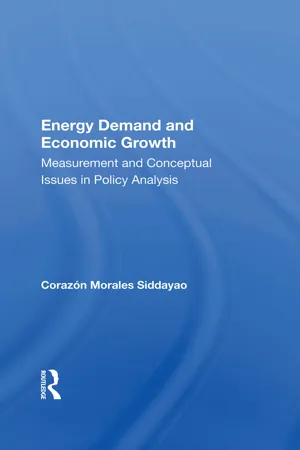
Energy Demand And Economic Growth
Measurement And Conceptual Issues In Policy Analysis
- 142 pages
- English
- ePUB (mobile friendly)
- Available on iOS & Android
eBook - ePub
Energy Demand And Economic Growth
Measurement And Conceptual Issues In Policy Analysis
About this book
The author examines the measurement and conceptual issues that complicate analytical work in the energy demand field. Successful policy decisions depend on the use of appropriate data and analytic methods; because the demand side of the energy-economy interaction is highly complex, this study focuses on the more basic economic and energy concepts and methods in demand analyses. He critiques measures used to analyze the relationship of energy to economic growth and summarizes the various demand estimation methods and their results. Highlighting the problems faced by analysts in developing countries who often have limited time and inadequate data, she discusses the serious implications of basing policy decisions on questionable analytic methods and data.
Information
1 Understanding the Concept of Energy
DOI: 10.4324/9780429038563-2
Energy is a derived demand. Users desire energy services (power, heat), and energy products are merely the means of obtaining those services. Understanding the demand for energy requires understanding both the technical aspects of energy as a concept and the technical aspects of energy as an input in the process of improving a community's national income or levels of satisfaction. A first step is to understand exactly what is meant by the words energy and demand. Although the specialist may assume that the concept of energy demand is clearly understood, applied work in the field demonstrates that this is not necessarily so.
A major problem in energy use analysis arises from what may be termed a definitional problem. Related to this is what might be referred to as an "indexing" problem. The two problems are not identical. The first refers to the boundaries or limits of the concept under consideration. The second refers to the means or method of signifying such limits as well as of aggregating energy forms of different qualities within any specified limits. It could also be called a "common unit" problem. Both give rise to measurement problems.
Defining Energy
In most contemporary literature, the term energy has been defined as the ability to do work or to produce heat.1 In fact, the term was intended to take account of the fact that heat and work are interchangeable. Although they are interchangeable, however, a given quantity of heat does not always yield the same quantity of work. Definitional problems thus arise principally because various energy forms have different capacities to do work. Several terms have been used to describe this condition; one of them is thermal efficiency. One might also refer to the problem as that of defining the level of effective energy. In addition, intertemporal considerations and interdependence within a system require recognition of the concept of embodied energy. These and other basic issues are summarized in this section.
The most important definitional question concerning energy arises from the vagueness with which the term is used. In most current discussions on the "energy problem," the principal focus tends to be on the heat quality of energy. However, energy is also stored work. The heat it produces may be intense enough to emit light. Heat, light, motive force, and chemical change induced by, or resulting in, electricity are all manifestations of energy. The combustible sources of energy may be transformed into electricity. Mechanical energy and electricity may also be derived from the kinetic energy of a mass of water that moves from one level to another (e.g., a dam, river falls, tides, waves) or from a mass of air that moves from a higher to a lower pressure area. Heat may be produced through combustion or fission of a suitable fuel, compression of a suitable liquid or gaseous medium, from the capture of the sun's rays, from hot rocks below the surface of the earth, from the passage of electricity through an appropriate material, or from certain exothermic chemical processes.2
Enthalpy, the heat content of a substance, H, is a thermodynamic property defined as the internal energy, E, plus the product of the pressure, P, multiplied by the volume, V, of that substance:
H = E + PV
It contains the units of energy and is usually expressed in calories (or kilocalories) or in British thermal units (Btus).3 (See Appendix 1.1) The joule is the only energy unit recognized by the SystSme International d'Unites (SI). It was first promulgated as the SI unit of energy in 1946 and then as the SI unit of heat in 1948 by the General Conference on Weights and Measures. It was introduced by members of the European Economic Community in 1978. The continued use of alternative units persists, however.
Not all units of heat are used effectively in performing work because losses occur in the conversion of the substance from one form to another. Energy stored in fossil fuels, for example, may be measured at the gross heat contents of the fuels (sometimes referred to as their gross calorific value) or at their net heat values. The gross heat content of the fuel is the total amount of heat that will be produced by combustion. Part of this is the latent heat that is lost in combustion when the water in the fuel evaporates or condenses. The difference between gross and net heat ranges from 2.5 percent in anthracite to 9-10 percent in lignite and from 7-9 percent in liquid hydrocarbons to about 10 percent in natural gas.
It is well known that different ...
Table of contents
- Cover Page
- Half Title Page
- Title Page
- Copyright Page
- Dedication Page
- Contents Page
- List of Tables and Figures Page
- Preface Page
- Introduction
- 1 Understanding the Concept of Energy
- 2 Understanding the Demand for Energy
- 3 The Energy/GDP Ratio as a Measure of Energy Demand: Shortcomings
- 4 Estimation Problems: Income and Price Elasticities of Energy
- 5 Estimation Problems: The Complementarity/Substitution Issue
- Conclusion
- Acronyms and Abbreviations
- Bibliography
- Index
Trusted by 375,005 students
Access to over 1.5 million titles for a fair monthly price.
Study more efficiently using our study tools.
Frequently asked questions
Yes, you can cancel anytime from the Subscription tab in your account settings on the Perlego website. Your subscription will stay active until the end of your current billing period. Learn how to cancel your subscription
No, books cannot be downloaded as external files, such as PDFs, for use outside of Perlego. However, you can download books within the Perlego app for offline reading on mobile or tablet. Learn how to download books offline
Perlego offers two plans: Essential and Complete
- Essential is ideal for learners and professionals who enjoy exploring a wide range of subjects. Access the Essential Library with 800,000+ trusted titles and best-sellers across business, personal growth, and the humanities. Includes unlimited reading time and Standard Read Aloud voice.
- Complete: Perfect for advanced learners and researchers needing full, unrestricted access. Unlock 1.5M+ books across hundreds of subjects, including academic and specialized titles. The Complete Plan also includes advanced features like Premium Read Aloud and Research Assistant.
We are an online textbook subscription service, where you can get access to an entire online library for less than the price of a single book per month. With over 1.5 million books across 990+ topics, we’ve got you covered! Learn about our mission
Look out for the read-aloud symbol on your next book to see if you can listen to it. The read-aloud tool reads text aloud for you, highlighting the text as it is being read. You can pause it, speed it up and slow it down. Learn more about Read Aloud
Yes! You can use the Perlego app on both iOS and Android devices to read anytime, anywhere — even offline. Perfect for commutes or when you’re on the go.
Please note we cannot support devices running on iOS 13 and Android 7 or earlier. Learn more about using the app
Please note we cannot support devices running on iOS 13 and Android 7 or earlier. Learn more about using the app
Yes, you can access Energy Demand And Economic Growth by Corazon M Siddayao in PDF and/or ePUB format, as well as other popular books in Social Sciences & Sociology. We have over 1.5 million books available in our catalogue for you to explore.