- 350 pages
- English
- ePUB (mobile friendly)
- Available on iOS & Android
eBook - ePub
About this book
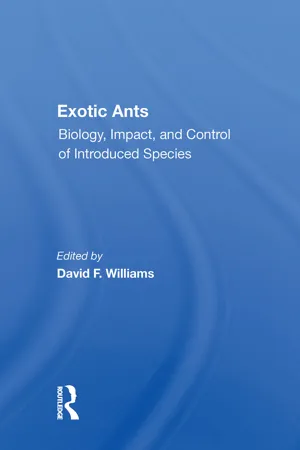
Originally published in 1994, this volume presents research findings from experts on introduced pest ant species.
Information
1The Galapagos Ant Fauna and the Attributes of Colonizing Ant Species
Carlos Roberto F. Brandão and Ricardo V. S. Paiva
DOI: 10.1201/9780429040795-1
The natural history of these islands is eminently curious, and well deserves attention. Most of the organic productions are aboriginal creations, found nowhere else; there is even a difference between the inhabitants of the different islands; yet all show a marked relationship with those of America, though separated from the continent by an open space of ocean, between 500 and 600 miles in width. The archipelago is a little world within itself, or rather a satellite attached to America, whence it has derived a few stray colonists, and has received the general character of its indigenous productions. Considering the small size of these islands, we feel the more astonished at the number of their aboriginal beings, and at their confined range. Seeing every height crowned with its crater, and the boundaries of most of the lava-streams still distinct, we are led to believe that within a period, geologically recent, the unbroken ocean was here spread out. Hence, both in space and time, we seem to be brought somewhere near to that great fact—that mystery of mysteries--the first appearance of new beings on this earth.
Charles Darwin, 1860
Introduction
Charles Darwin first realized the wealth of issues that could be investigated by consideration of the terrestrial faunas of oceanic islands. For instance, the establishment of a population in an area not previously occupied by a species often has dramatic effects in isolated environments.
Oceanic islands may be regarded as open sky laboratories for studying biological attributes of species, such as their differential abilities to colonize new environments, the genetics of colonizing propagules in relation to populations in nearby continents, and the effect of taxon cycles on biogeography. It is also possible to determine behavioral and other syndromes that allow tramp species to be, according to Carson (1987) "preadapted to movements over long distances and to quite literally establish beachheads on isolated and distant islands in the course of their normal dispersion".
Inspiration for studies of this type in the Galapagos archipelago can be obtained from research in the chronologically and spatially linear series of highly isolated islands of Hawaii. Here, ecological studies integrated with a multidisciplinary investigation of the Drosophilidae, made possible the tracing of both the continental and the inter-island origin of certain populations and species (Carson and Kaneshiro 1976).
The often quoted citation of Darwin which opens this article, does not hold true for all instances and groups. The Hawaiian Islands and Galapagos archipelago house very poor ant faunas, which are by no means specialized. In Hawaii, notwithstanding, the Drosophilidae attains its maximum diversity, while in Galapagos the sea birds are very much specialized in relation to the nearby continental fauna, and are more highly endemic than those of any other archipelago (Snow and Nelson 1984). The most important problem to understand is the significance of the poverty of species and the differentiation of so many forms that inhabit the islands (Patton 1984).
Thirty-six ant species have been recorded in Hawaii (none are endemic and most are widely distributed in other tropical places). For the Galapagos archipelago, we can not consider the ant fauna fully recorded. A better knowledge of the species occurring on each island must be obtained in a systematic and standardized survey. This will permit the monitoring arid management of the species considered to be introduced on each island as well as enable us to make comparisons between other islands and with nearby areas in continental South America.
Historical review of the ant collections in Galapagos
According to Wheeler (1919), the first ants recorded from Galapagos were three species of Camponotus (C. planus, C. macilentus and C. senex) that were collected by Charles Darwin on the "Beagle" voyage and by Cook in 1875. The species were identified by Frederick Smith in 1877. The record of C. senex, however, has been challenged by Wheeler since the species has not been recorded in the islands since.
Wheeler (1919) identified some Camponotus males collected by the Albatross Expedition to Albemarle and Charles Islands. An expedition by George Baur in 1891 resulted in the collection of ant species that were identified by Emery (1893) as Solenopsis geminata, Tetramorium guineense, Tapinoma melanocephalum, Odontomachus bauri and Camponotus peregrinus (considered later by him as a "variety" of C. planus). All of them were collected on Chatham Island, however with the exception of the first, thev were also recorded in the ship.
Wheeler (1919) published a list of the known Galapagos ants, including those collected during the Expedition of the California Academy of Sciences in 1905, and later voyages of the Albatross. The list includes material collected on 12 islands of the archipelago, and records 36 "forms", representing 12 species. At least six of them (Monomorium pharaonis, T. guineense, T. simillimum, Tapinoma melanocephalum, Paratrechina longicornis and P. vividula itinerans) are well-known "tramp" species. Others, like Solenopsis geminata, S. saevissima and C. senex, may have been introduced also.
The first ant specialist who collected in the Galapagos was William Morton Wheeler in 1923 as a member of the Williams-Beebe Expedition. In 1924 he published a list of the species collected, including 36 forms representing 18 species, 9 of which were considered to be endemic to the islands. Some years later Wheeler (1933) recorded the first occurrence of Crematogaster in the Galapagos. It was collected by the Templeton Crocker Expedition in 1932.
Clark et al. (1982) published the results of the first systematic collection of ants from one island of the archipelago, based on attraction to baits within a given area and for a definite time. They recorded 17 species on Santa Cruz Island (Indefatigable) and considered 4 of them endemic. Finally, Lubin (1984), published a list which included the ancient collections cited above plus her own collections. The list includes Cyphomyrmex and Leptogenys, both genera never recorded in the Galapagos before.
A comparison of the lists from Santa Cruz Island by Wheeler (1924) and Clark et al. (1982) revealed some interesting contrasts. All endemic species appear in both lists and, surprisingly, 4 introduced ones recorded by Wheeler are not found in Clark's list. On the other hand, Clark et al. recorded 8 new records on Santa Cruz Island, 3 of them new to the archipelago. Possibly some introduced species have disappeared or their populations have been drastically reduced and Clark's list reveals new introductions. It is altogether more plausible, that both lists represent subestimations of the fauna. According to Beebe (1924), the expedition in which Wheeler was the ant specialist, spent only 100 hours in the archipelago. Clark and his collaborators worked there nearly a month. Lubin collected ants with sticky traps and visual searches on many islands and had access to other collections as well. The techniques used by Wheeler were not made clear in his paper. Clark et al. used baits of sugar/water solutions on transects along altitudinal gradients for quantitative studies on Santa Cruz Island. In fact, consideration of any aspect involving the Galapagos ant fauna must bear in mind that our knowledge is still fragmentary. There are many places on the islands where the ant fauna has never been studied. This may be true for most animal groups we call "Invertebrates" (Kramer 1984).
The case of Wasmannia auropunctata
The notion that this species had been recently introduced is supported by the fact that it does not appear in old surveys, although we have already questioned their use as evidence. Silberglied (1972) was the first to describe the recent problems caused by W. auropunctata and dated the introduction at "sometime in the early part of this century". According to Lubin (1984), the original site of W. auropunctata in the Galapagos was la Tragica at San Salvador Island (1700m) around 1967. On Isabela it was "introduced between 1966 and 1967" in a shipment of clumps of elephant grass (Pennisetum purpurea).
The problems posed by the reported spreading of W. auropunctata, in at least two of the islands forming the Galapagos archipelago, is that it is still in the process of expanding its range and reducing the population densities of most other ant species and some other animals as well (Lubin 1984). We do not know, however, if the species is enlarging its distribution due to its own colonizing ability (which seems to be the case) or the environment is changing as to permit its expansion.
The case of Wasmannia seems to be one of primary colonization by this widespread species followed by naturalization to the Galapagos. Other ant species with large distributions occurring in the archipelago (Clark et. al. 1982) belong to the same category: Solenopsis geminata, S. saevissima, Monomorium pharaonis, Tetramorium simillimum, T. caldarium, Tapinoma melanocephalum, Paratrechina vividula, and P. longicornis. These colonizers do not seem to have undergone speciation. Other species, however, belong to lineages that became species rich after establishment of an ancestral immigrant. They are: Camponotus (Pseudocolobopsis) macilentus and C. (Myrmocladoecus) planus, both with many described varieties, each roughly corresponding to a major island with a related species occurring on the continental South America. Native and introduced species most likely have had more than one episode of introduction from already differentiated mainland stocks.
Biological attributes of introduced species
Behavioral and genetic studies in the grimshawi species complex of the picture-winged Drosophila of Hawaii, for instance, suggested that a colonizing species may arise as an "escape from specialism" and that the genetic basis which initiates the shift may in some cases be relatively simple (Carson and Ohta 1981).
A spreading population may be genetically constituted so that it can exploit many ecological opportunities or it may be rather specialized genetically but somehow, its niche becomes disseminated and the species follow it without much genetic change.
Although the definitions are rather imprecise and continuums of conditions certainly exist, primary colonization has been defined as the establishment of a population in an area not previously occupied by the species. In general, these areas have a recent origin or have suffered a recent catastrophe. Secondary colonization occurs in small confined areas usually less altered and less isolated from colonizing propagules, for instance, successions, forest clearings, etc.
Most ant species that are called tramps by biologists have a genome that permits expression of many phenotypic possibilities. It seems, in contrast, that many ant species with smaller distributions may be composed of several morphologically indistinguishable cryptic species, but genetically differentiated.
Tramp ants are characterized by several biological attributes: (1) polygyny (with queens, many times brachipterous or even wingless), (2) unicolonial (occupying patchy, species-poor or manmade environments), (3) relaxed discrimination among nestmates (and thus often non-territorialists), (4) opportunistic in regards to nest sites preferences, (5) omnivorous, (6) colonies founded by fission or budding (queens following groups of workers by foot) and (7) always aggressive in competitive encounters, The following example describes this last attribute.
In November 1990, J. Diniz and the senior author (unpublished observations) observed in a semi-arid locality in Northeastern Brazil ...
Table of contents
- Cover Page
- Half Title Page
- Title Page
- Copyright Page
- Contents Page
- Foreword Page
- Preface Page
- Acknowledgments Page
- Editorial Note Page
- 1 The Galapagos Ant Fauna and the Attributes of Colonizing Ant Species
- 2 Distribution and Impact of Alien Ants in Vulnerable Hawaiian Ecosystems
- 3 Characteristics of Tramp Species
- 4 Coexisting Patterns and Foraging Behavior of Introduced and Native Ants (Hymenoptera Formicidae) in the Galapagos Islands (Ecuador)
- 5 Perspectives on Control of the Little Fire Ant (Wasmannia Auropunctata) on the Galapagos Islands
- 6 Food Searching Behavior and Competition Between Wasmannia Auropunctata and Native Ants on Santa Cruz and Isabela, Galapagos Islands
- 7 The Ecology of Wasmannia Auropunctata in Primary Tropical Rainforest in Costa Rica and Panama
- 8 Relations Between the Little Fire Ant, Wasmannia Auropunctata, and Its Associated Mealybug, Planococcus Citri, in Brazilian Cocoa Farms
- 9 Biology and Importance of Two Eucharitid Parasites of Wasmannia and Solenopsis
- 10 Impact of Paratrechina Fulva on Other Ant Species
- 11 The Ecology and Distribution of Myrmicaria Opaciventris
- 12 Exotic Ants and Community Simplification in Brazil: A Review of the Impact of Exotic Ants on Native Ant Assemblages
- 13 Spread of Argentine Ants (Linepithema Humile), with Special Reference to Western Australia
- 14 Ant Pests of Western Australia, with Particular Reference to the Argentine Ant (Linepithema Humile)
- 15 Ant Fauna of the French and Venezuelan Islands in the Caribbean
- 16 Exotic Ants and Native Ant Fauna of Brazilian Hospitals
- 17 Big-Headed Ants, Pheidole Megacephala: Interference with the Biological Control of Gray Pineapple Mealybugs
- 18 The Impact and Control of the Crazy Ant, Anoplolepis Longipes (Jerd.), in the Seychelles
- 19 Control of the Little Fire Ant, Wasmannia Auropunctata, on Santa Fe Island in the Galapagos Islands
- 20 Foraging of the Pharaoh Ant, Monomorium Pharaonis: An Exotic in the Urban Environment
- 21 Impact of the Invasion of Solenopsis Invicta (Buren) on Native Food Webs
- 22 Impact of Red Imported Fire Ants on the Ant Fauna of Central Texas
- 23 Impact of the Red Imported Fire Ant on Native Ant Species in Florida
- 24 Control of the Introduced Pest Solenopsis Invicta in the United States
- 25 Biological Control of Introduced Ant Species
- About the Book and Editor
- List of Contributors
- Taxanomic Index
- Subject Index
Trusted by 375,005 students
Access to over 1.5 million titles for a fair monthly price.
Study more efficiently using our study tools.
Frequently asked questions
Yes, you can cancel anytime from the Subscription tab in your account settings on the Perlego website. Your subscription will stay active until the end of your current billing period. Learn how to cancel your subscription
No, books cannot be downloaded as external files, such as PDFs, for use outside of Perlego. However, you can download books within the Perlego app for offline reading on mobile or tablet. Learn how to download books offline
Perlego offers two plans: Essential and Complete
- Essential is ideal for learners and professionals who enjoy exploring a wide range of subjects. Access the Essential Library with 800,000+ trusted titles and best-sellers across business, personal growth, and the humanities. Includes unlimited reading time and Standard Read Aloud voice.
- Complete: Perfect for advanced learners and researchers needing full, unrestricted access. Unlock 1.5M+ books across hundreds of subjects, including academic and specialized titles. The Complete Plan also includes advanced features like Premium Read Aloud and Research Assistant.
We are an online textbook subscription service, where you can get access to an entire online library for less than the price of a single book per month. With over 1.5 million books across 990+ topics, we’ve got you covered! Learn about our mission
Look out for the read-aloud symbol on your next book to see if you can listen to it. The read-aloud tool reads text aloud for you, highlighting the text as it is being read. You can pause it, speed it up and slow it down. Learn more about Read Aloud
Yes! You can use the Perlego app on both iOS and Android devices to read anytime, anywhere — even offline. Perfect for commutes or when you’re on the go.
Please note we cannot support devices running on iOS 13 and Android 7 or earlier. Learn more about using the app
Please note we cannot support devices running on iOS 13 and Android 7 or earlier. Learn more about using the app
Yes, you can access Exotic Ants by David F Williams in PDF and/or ePUB format, as well as other popular books in Biological Sciences & Biology. We have over 1.5 million books available in our catalogue for you to explore.