eBook - ePub
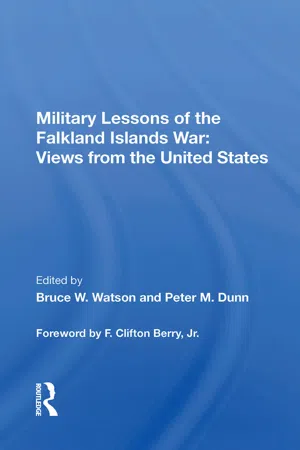
Military Lessons Of The Falkland Islands War
Views From The United States
- 198 pages
- English
- ePUB (mobile friendly)
- Available on iOS & Android
eBook - ePub
About this book
Contains analyses of the war by several prominent U.S. experts on national security affairs. Their observations reflect the continuing debate on such key issues in U.S. defence planning - and in Soviet defence planning as well - as the controversy over large versus small carriers, the advantages and dis advantages of a diesel-versus nuclear-powered submarine fleet, the effectiveness of the Harrier-type aircraft, the influence of high technology on amphibious warfare, and the ever increasing use of 'smart' weapons by all-purpose convectional armed forces.
Information
1 Submarine Lessons
DOI: 10.4324/9780429045424-2
William J. Ruhe
In the Falklands War, submarines were engaged in wartime action for the first time since World War II. Although they were involved in only a few incidents, we can draw some important lessons from this experience. The best way to reveal the influence of submarines in the overall action would be a chronological examination of submarine participation in the Falklands War.
The sequence of submarine events begins with the landing on March 19, 1982, of an Argentine party of purported scrap metal workers on South Georgia Island, 800 miles to the east of the Falklands. On the 26th of March, the Argentines, in response to the British insistence that these illegal workers be removed from the island, evacuated these people but clandestinely left a shore party behind. It then became evident that the Argentine government was very much behind the incident. By the 29th, when a diplomatic solution to this occupation seemed to be stalled, Admiral Sir John Fieldhouse ordered the nuclear submarine HMS Spartan to leave the exercise in which she was engaged, embark stores and weapons at Gibraltar, and deploy to the South Atlantic. On March 30th, the nuclear submarine Splendid was ordered to deploy from Faslane in the UK and Conqueror sailed a few days later. Instructions to covertly prepare a task force for South Atlantic operations were received on March 31st. When the Argentines invaded the Falklands on April 2nd, further preparations were Openly conducted.1
What is particularly significant about this sequence of prewar events is the fact that nuclear submarines were deployed rapidly and covertly toward a distant area of tension, with no effect on ongoing diplomatic negotiations. With their impressive speed and freedom from the impact of weather and sea conditions, nuclear submarines were also in the battle area well ahead of any surface forces, which were deployed at about the same time. And, if the political problem had been resolved satisfactorily prior to an outbreak of conflict, there was likely to be no evidence of pressure attributable to this threat from several nuclear submarines.
On April 12th, the British imposed a maritime exclusion zone of 200 miles around the Falklands, and on April 23rd they further warned that any threatening approach by Argentine forces which might interfere with the British mission in the South Atlantic would be dealt with appropriately. Well before this time, the British had revealed the presence of three nuclear submarines in the war area. This threat had effectively stopped Argentine reinforcement of the islands by sea since April 12th. However, it was revealed that despite the British blockade one Argentine resupply ship had arrived during this period.2 The Argentines then used the conventional submarine Santa Fe to haul relief supplies to the shore party on South Georgia. The British nuclear submarine Conqueror had been ordered to patrol off the island to prevent any sealifted Argentine reinforcements, while a group of Royal Marine commandos was covertly landed by helicopter on the 23rd. Thus, on April 25th, with the weather having cleared, a British helicopter spotted the surfaced Santa Fe approaching the main port of Grytviken. It would appear that the Santa Fe, which did not know about British operations in the vicinity, had evaded the Conqueror's patrol and was about to deliver its supplies when she was attacked by British helicopters using AS12 missiles and depth charges. The badly damaged Santa Fe limped to Grytviken and was beached nearby. An AS12 wire-guided, six-kilometer range missile with a sixty-three pound warhead, fired by a Lynx helicopter, hit the Santa Fe's conning tower, inflicting serious damage, while helicopter-launched depth charges apparently destroyed the submarine's watertight integrity.3
The role of the submarine for emergency resupply of beleaguered forces was reaffirmed. In addition, the conventional submarine's ability to remain afloat long enough to be beached, despite very close depth charges exploding at proper depth, was demonstrated.
On May 2nd, the most profound submarine incident of the Falklands War took place. The Conqueror located the Argentine cruiser General Belgrano and its escort of two destroyers south of the Falklands and" slightly beyond the 200-mile exclusion zone. The British felt that this small force, which was armed with Exocet missiles, posed a clear threat to the British task force. At the same time, other Argentine ships north of the zone were apparently conducting the same sort of probing action. Since the threat could not be ignored, Conqueror attacked the General Belgrano with torpedoes.4
With her high submerged mobility, the Congueror, in a periscope attack, gained an ideal attack position and, with a short torpedo run, put two MK VIII torpedoes into the cruiser, which subsequently sank. The MK VI11s were pre-World War II, straight running, forty-five-knot, 5,000-yard steam torpedoes. They were evidently chosen in preference to the modern, wire-guided, terminal homing Tigerfish torpedoes, which were also reported to be aboard the Congueror. Apparently, in the load-out of Conqueror at the beginning of the war, there were not enough Tigerfish torpedoes readily available, so she took on some of the older MK VII Is. Although the two destroyers dropped numerous depth charges after Conqueror's attack, there was no evidence of their actually having contact on Conqueror.
The decision of Conqueror's skipper to use these old torpedoes in preference to the Tigerfish attests to his appreciation of how a nuclear submarine's covert mobility relates to the weapons carried. The skipper recognized the proven reliability of the MK VIII; almost 4,000 of these torpedoes were used in World War II.5 Their shortcomings were well ironed out by the end of that war. In addition, the MK VII Is had 750-pound torpex warheads, approximating the destructive effects of the lighter Tigerfish torpedo warheads with their more efficient explosive. Although the MK VIII produces a good wake as opposed to the wakelessness of the electrically driven Tigerfish torpedo, the skipper evidently knew that he could approach undetected to close range and hit with the MK VII Is» and the torpedo run would be so short that the cruiser would be unable to evade the torpedoes even if the wakes were promptly sighted.
The lesson illustrated by this selection of torpedoes seems to be that the high mobility of the nuclear submarine allows the use of simple, very low cost torpedoes in the anti-ship role—and even against warships under many circumstances. A second lesson is that a quiet nuclear submarine's speed and mobility allow it to make undetected approaches to targets which would be considered well escorted in the traditional sense, but which cannot begin to handle this new type of submarine threat.
After the sinking of the General Belgrano, Argentine naval surface forces stayed within twelve miles of the Argentine coast for the remainder of the war. The sinking of the cruiser was such a clear demonstration of nuclear submarine capability that no further attempt was made to risk any major Argentine warship outside of coastal waters. But at the same time, British nuclear submarines patrolled the coast to provide intelligence on aircraft sorties from Argentina which could mean likely air attacks on British forces. An examination of the waters in which the British nuclear submarines operated shows depths of twenty fathoms in spots and usually less than fifty fathoms where they could effectively use their periscopes for detecting aircraft.6
The British fleet's lack of an AEW aircraft capability was thus being remedied in part by stationing her nuclear submarines close to Argentine coastal airfields to provide early warning of large aircraft raids directed at the British forces in the Falklands area. But this was apparently a far from efficient operation, since a large-scale air raid caught the British with little warning and resulted in the loss of two landing ships which were in the process of being offloaded.
Another lesson from these forward operations is the need to ensure that today's submarines are efficient in shallow water operations and particularly at periscope depth. With waters under 100 fathoms all the way out to the Falklands from the Argentine coast, even the blockade against Argentine shipping had to be carried out in shallow waters.
Throughout the Falklands War, questions were continuously being asked about Argentine conventional submarines. What were they doing? Argentina started the war with four diesel-electric boats. Two were US fleet submarines transferred to the Argentine Navy, the Santa Fe (ex-USS Catfish) and the Santiago del Estero (ex-USS Chivo), and two were German-built 209-type submarines. The Santa Fe was quickly put out of action and virtually destroyed. The Santiago del Estero was laid up at a naval base and never saw action. But the two 209s which were in some sort of refit status at the start of the war were buttoned up and quickly deployed for sea operations. Little was reported about their operations except that they claimed to have shot at the British carrier Invincible and other targets but suffered torpedo trouble and failed in their attacks.
These two ten-year old submarines have non-magnetic hulls, a special feature of German submarines. They are of 1,285 submerged tons and have eight torpedo tubes with a reload of eight more torpedoes. They have a submerged speed of twenty-two knots and a small complement of only thirty-two men.7 They carry the German twenty-one inch SST4 antiship torpedo, which has a 260-kilogram warhead, is battery driven with a speed of about thirty-four knots, and is wire-guided with both active and passive terminal homing.8 Interestingly, this torpedo has a three-dimensional sonar for homing—which is particularly useful for submarine targets but is a needless complication against surface ships.
what these two conventional submarines accomplished is summed up in Sir John Fieldhouse's despatch to the Minister of Defence:
Attacks on the Task Force by enemy submarines (the 209s) were a significant and ever present threat, which was recognized by the inclusion of anti-submarine Sea King helicopters in the air order of battle. A number of torpedo attacks were carried out by these aircraft against underwater contacts classified as possible submarines. Results of the actions are not known, but the high intensity flying rates of this helicopter force throughout the operations were an essential part of Fleet antisubmarine warfare defences.9
In his articles entitled "Navies in War and Peace," Admiral Gorshkov observed that in World War II there were twenty-five Allied ships and 100 aircraft involved in ASW operations for each German submarine at sea. The same disparate use of ASW forces to handle the threat of only two small conventional enemy submarines seems to have taken place off the Falklands Islands. The appalling weather, which created much surface noise, plus the high density of marine life in the waters off the Falklands combined to make ASW operations extremely difficult, resulting in a high incidence of false contacts. The tiny shrimp-like krill which breed in the cold Antarctic waters are found in huge tightly packed schools which return convincing echos from action sonars— and they reportedly make a lot of noise with their massed tiny squeals. That the British warships expended large amounts of ASW ordnance on false contacts in this environment is highly likely. The magnetic anomaly detection (MAD) gear on British ASW aircraft was apparently of little use for classifying the non-magnetic-hulled 209s. The detectable magnetic signatures of these submarines were probably too weak to make a determination of sub or non-sub in an environment where other masses of marine life could produce low magnetic signatures.
The experience of the Argentine 209s suggests that a highly complex antiship torpedo which requires a large number of electrical settings and a complex fire control system is difficult to use in war—particularly if there has been little or no opportunity to test out a torpedo's fire control system before going into war operations. Such torpedos are also almost impossible to use manually if there is a failure in the electrical firing sequence. The preference of the Conqueror's skipper for a torpedo which lends itself well to manual firing may also be an indication of this hazard in the use of today's sophisticated weapons.
That the 209 skippers were riot certain whether the Invincible had been fired at would ...
Table of contents
- Cover Page
- Half Title Page
- Title Page
- Copyright Page
- Contents Page
- FOREWORD Page
- ACKNOWLEDGMENTS Page
- INTRODUCTION
- 1 SUBMARINE LESSONS
- 2 LARGE VERSUS SMALL CARRIERS
- 3 SURFACE COMBATANT LESSONS
- 4 AIR POWER LESSONS
- 5 AMPHIBIOUS LESSONS
- 6 GROUND WARFARE LESSONS
- 7 SMART WEAPONS
- 8 INTELLIGENCE AND WARNING LESSONS
- 9 LESSONS LEARNED AND UNLEARNED
- APPENDIX: A DIARY OF THE FALKLANDS CONFLICT
- ABOUT THE CONTRIBUTORS
- INDEX
Trusted by 375,005 students
Access to over 1.5 million titles for a fair monthly price.
Study more efficiently using our study tools.
Frequently asked questions
Yes, you can cancel anytime from the Subscription tab in your account settings on the Perlego website. Your subscription will stay active until the end of your current billing period. Learn how to cancel your subscription
No, books cannot be downloaded as external files, such as PDFs, for use outside of Perlego. However, you can download books within the Perlego app for offline reading on mobile or tablet. Learn how to download books offline
Perlego offers two plans: Essential and Complete
- Essential is ideal for learners and professionals who enjoy exploring a wide range of subjects. Access the Essential Library with 800,000+ trusted titles and best-sellers across business, personal growth, and the humanities. Includes unlimited reading time and Standard Read Aloud voice.
- Complete: Perfect for advanced learners and researchers needing full, unrestricted access. Unlock 1.5M+ books across hundreds of subjects, including academic and specialized titles. The Complete Plan also includes advanced features like Premium Read Aloud and Research Assistant.
We are an online textbook subscription service, where you can get access to an entire online library for less than the price of a single book per month. With over 1.5 million books across 990+ topics, we’ve got you covered! Learn about our mission
Look out for the read-aloud symbol on your next book to see if you can listen to it. The read-aloud tool reads text aloud for you, highlighting the text as it is being read. You can pause it, speed it up and slow it down. Learn more about Read Aloud
Yes! You can use the Perlego app on both iOS and Android devices to read anytime, anywhere — even offline. Perfect for commutes or when you’re on the go.
Please note we cannot support devices running on iOS 13 and Android 7 or earlier. Learn more about using the app
Please note we cannot support devices running on iOS 13 and Android 7 or earlier. Learn more about using the app
Yes, you can access Military Lessons Of The Falkland Islands War by Bruce W. Watson in PDF and/or ePUB format, as well as other popular books in Politics & International Relations & Politics. We have over 1.5 million books available in our catalogue for you to explore.