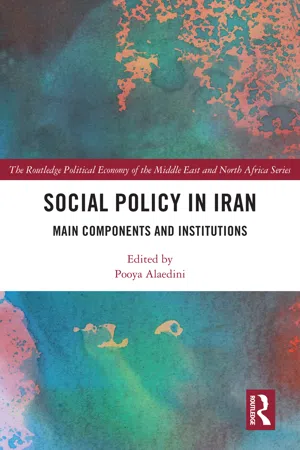
This book provides in-depth analyses of the main social policy components and institutions in Iran. Its focus is on the period since 1979, although many of the developments are inevitably traced back to their pre-revolutionary origins. The first part of the book investigates socioeconomic trends and institutional developments—including the significant role played by post-revolutionary para-governmental organizations in the delivery of social programs. The remaining chapters analyze the achievements and challenges of health, education, social insurance, housing, and employment policies as well as the macroeconomics of poverty.
- 264 pages
- English
- ePUB (mobile friendly)
- Available on iOS & Android
eBook - ePub
About this book
Trusted by 375,005 students
Access to over 1.5 million titles for a fair monthly price.
Study more efficiently using our study tools.
Information
1 Social policy in Iran
An introduction
Pooya Alaedini
DOI: 10.4324/9781003096757-1
Context and challenges of social policy in Iran
Social policies in the Middle East have been found to differ in significant ways from both the Western welfare state and the East Asian developmentalist models (Karshenas and Moghadam, 2006, 2009). The main observation is that many countries in the region have leveraged their oil revenues—often in the form of populist redistributive initiatives—toward state-building and political legitimation rather than upholding citizen rights to social services or directly supporting economic development goals. In these economies, social policy benefits are likely to be viewed as handouts rather than entitlements created through taxes paid by the citizens and managed by the government. As such, their development impacts remain low. This is the case even for education, notwithstanding its rapid expansion over the past half a century from a base significantly lagging behind other regions. While the literacy rates and average educational attainment in the Middle East remain comparatively low, there is a tendency to overemphasize tertiary education. Yet this focus is said to be more about credentialism and justification of patronage in formal sector hiring than pursuing the national goals of development and industrialization (Ibid.). Substantial gender biases are also highlighted for the case of Middle Eastern countries—which limit the region in adequately benefiting from its development opportunities, including the current demographic window of opportunity (Ibid.).
As suggested by Silva et al. (2013:110–111), the level of subsidies on food and fuel is comparatively high in the Middle East. While these mostly untargeted subsidies are regressive and exaggerate the total social policy expenditures, non-subsidy spending remains low. Informed by charity and benevolence or rentierism, social welfare services are also likely to focus on economic vulnerability only and be provided in an incomplete manner—notwithstanding the guise of administrative universalism (Jawad et al., 2019:248–249). Some services are accessible to formal sector employees only or to those deemed as suffering from an absence of a male guardian. Under these circumstances, reduced life satisfaction and a sense of injustice associated with access to rents, jobs, services, and rights can exacerbate grievances against the governance structures (World Bank, 2015:29–34). This observation has been made for the case of Arab countries and in the more recent period, but it can partially describe the context associated with Iran’s 1979 Revolution as well. Despite significant achievements in the pre-revolutionary period in terms of economic growth along with the expansion of education and health services, a strong sense of social injustice appears to have influenced the 1978–1979 revolutionary events and their aftermaths.
These reflections on social policy in the Middle East region call for additional country investigations. A number of studies have addressed social policy in Iran as a whole—including Messkoub (2006), Harris (2017), Qarakhani (2018), and a recent book chapter by Tajmazinani (2021). A few others have probed specific initiatives, institutions, or circumstances. However, the field remains understudied. This book contributes to these debates by providing in-depth analyses of the main social policy components and institutions in Iran. Its focus is on the period since 1979, although many of the developments are inevitably traced back to their pre-revolutionary origins. The Islamic Republic Constitution is specific about addressing the plight of the downtrodden and emphasizes government responsibilities in providing employment, education, housing, and social services for all citizens. In the initial post-revolutionary period, these objectives were largely translated into populist redistribution policies. The activities would succeed in garnering support for the nascent political system despite their unsystematic nature. However, they would also preclude the emergence of a rights-based or developmentalist social policy framework in the country. The outbreak of the Iran–Iraq War, continued political turmoil, and reduced oil revenues significantly decreased per capita incomes in the 1980s. Yet the government was successful in running a rationing system during this period, which to some extent acted as a minimal social safety net. Influenced by political, social, and economic developments, the various components of social policy in Iran have undergone a series of transformations in the post-war period until now.
The pre-revolutionary social policy framework largely focused on insurance schemes for formal sector employees. In ...
Table of contents
- Cover
- Half-Title
- Series
- Title
- Copyright
- Contents
- List of figures
- List of tables
- List of contributors
- Acknowledgment
- Abbreviations
- 1 Social policy in Iran: An introduction
- 2 Development of Iran’s social welfare institutions
- 3 Iran’s health policy and healthcare system: Achievements and challenges
- 4 Education policy in Iran: Developments over the past four decades
- 5 Pension funds in Iran: Challenges and options
- 6 Iran’s housing policies for low-income and vulnerable groups: A critical assessment
- 7 Employment challenges in contemporary Iran: A growing social policy conundrum
- 8 Poverty and macroeconomic policies in Iran: A microsimulation study
- Index
Frequently asked questions
Yes, you can cancel anytime from the Subscription tab in your account settings on the Perlego website. Your subscription will stay active until the end of your current billing period. Learn how to cancel your subscription
No, books cannot be downloaded as external files, such as PDFs, for use outside of Perlego. However, you can download books within the Perlego app for offline reading on mobile or tablet. Learn how to download books offline
Perlego offers two plans: Essential and Complete
- Essential is ideal for learners and professionals who enjoy exploring a wide range of subjects. Access the Essential Library with 800,000+ trusted titles and best-sellers across business, personal growth, and the humanities. Includes unlimited reading time and Standard Read Aloud voice.
- Complete: Perfect for advanced learners and researchers needing full, unrestricted access. Unlock 1.5M+ books across hundreds of subjects, including academic and specialized titles. The Complete Plan also includes advanced features like Premium Read Aloud and Research Assistant.
We are an online textbook subscription service, where you can get access to an entire online library for less than the price of a single book per month. With over 1.5 million books across 990+ topics, we’ve got you covered! Learn about our mission
Look out for the read-aloud symbol on your next book to see if you can listen to it. The read-aloud tool reads text aloud for you, highlighting the text as it is being read. You can pause it, speed it up and slow it down. Learn more about Read Aloud
Yes! You can use the Perlego app on both iOS and Android devices to read anytime, anywhere — even offline. Perfect for commutes or when you’re on the go.
Please note we cannot support devices running on iOS 13 and Android 7 or earlier. Learn more about using the app
Please note we cannot support devices running on iOS 13 and Android 7 or earlier. Learn more about using the app
Yes, you can access Social Policy in Iran by Pooya Alaedini in PDF and/or ePUB format, as well as other popular books in Social Sciences & Regional Studies. We have over 1.5 million books available in our catalogue for you to explore.