- 256 pages
- English
- ePUB (mobile friendly)
- Available on iOS & Android
eBook - ePub
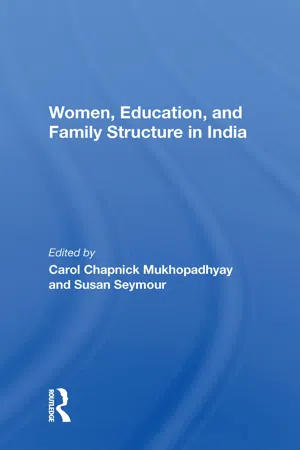
Women, Education, And Family Structure In India
About this book
Five decades of independence have produced dramatic increases in womens' educational achievements in India; but education for girls beyond a certain level is still perceived as socially risky. Based on ethnographic data and historical documents, this book explores the origins of that paradox. Contributors probe the complex relationships between traditional Indian social institutions the joint family, arranged marriage, dowry, and purdah, or sexual segregation and girls schooling. They find that a patrifocal family structure and ideology are often at the root of different family approaches to educating sons and daughters, and that concern for marriageability still plays a central role in womens' educational choices and outcomes.
Information
1 Introduction and Theoretical Overview
Carol C. Mukhopadhyay and Susan Seymour
DOI: 10.4324/9780429268649-1
The 19th and 20th centuries have seen the rapid spread of Western-style schooling1 throughout much of the nonwestern world. Indeed, in the post-colonial era the institutionalization and spread of this kind of education has become an important marker of national development and modernization and, concomitantly, rates of female literacy and educational achievement have become one set of measures of women's participation in such development.2 Markers of educational achievement are also commonly-used cross-national indicators of gender equity and the status of women. Thus, international surveys of women's status routinely contain statistics on female literacy and years of schooling, along with statistics on such other factors as work, health, and political participation.3 Similarly, studies that address women and development issues commonly include some discussion of women's more restricted access to education and lesser educational achievement as compared with men.4
While education is assumed to be of paramount importance to the socio-economic status of women nationally and internationally, there is a surprising paucity of studies in the women and development literature focused specifically on education. Fewer yet try to address the complex linkages between women's participation in this particular area of the public domain and the more private world of kinship and family that women are assumed to inhabit.5 Yet, an analysis of such linkages may help to explain the disparity between men's and women's rates of literacy and educational achievement in much of the developing world, as well as the mixed results of education-oriented efforts to improve women's status.6 The purpose of this volume is, then, to explore connections between the more public institutions of education and the more private institutions of family and marriage for one contemporary society, India. In India, as elsewhere, these linkages have remained relatively unexamined despite the government's post-Independence emphasis on education and despite the inclusion of women's education as a central element in that nation's drive for modernization. While the societal focus here is on India, we believe that many of the factors relevant to women's educational achievement explored in this volume have significant implications for other societies as well.
The paucity of research exploring linkages between women's participation in formal education and the fundamental institutions of family, kinship, and marriage is, in part, due to specialization within the academic community. For example, there has tended to be a division of labor between the "domestic" and "public" spheres of life, and between the study of micro-level and macro-level institutions. Thus, anthropologists working in India have generally conducted intensive, long-term studies of small communities, usually villages, focusing on those "domestic" institutions and processes—family, marriage, kinship, and caste—central to traditional village and community life. They have left to other scholars the study of more formal, pan-Indian cultural traditions and institutional structures and processes—in particular, the relatively "modern" political, economic, and social forms that emerged during the British and post-Independence era.7
This division of labor is strikingly apparent in the research on education in India and, specifically, on women's education. Until recently, anthropologists have shown little interest in the Indian educational system or in the potential linkages between women's educational choices and issues of family, kinship, marriage, sexuality, and caste.8 Even anthropologists concerned with processes of modernization and culture change have generally been preoccupied with other topics.9 Similarly, prominent studies of India's contemporary educational system, such as Rudolph and Rudolph (1972), are concerned principally with education in relationship to macro-level political processes; issues of gender, family, kinship, and marriage are generally not addressed. The body of scholarship on gender and education in India is, then, relatively small and has come primarily from Indian scholars formally trained in macro-level educational research (e.g., educational sociology or econometrics) and who are affiliated with educational or women's research institutes. Their work tends to focus on broad institutional processes and statistical analysis rather than upon the micro-level contexts where the educational decisions that affect women are made.10
This traditional academic division of labor, while understandable, has tended to discourage systematic investigation in India of the potentially powerful interrelationships between women's involvement in Westernstyle educational institutions, on the one hand, and such indigenous social institutions as the joint family, arranged marriage, dowry, and purdah (female seclusion), on the other. As a consequence, anthropologists working at the community level may inadvertently ignore one significant source of change affecting—and potentially transforming—the family-marriage-kinship-gender domain, while educational researchers may miss the significant impact of family, kinship, and marriage practices upon the educational choices and achievements of women.
It was a growing recognition of the inextricable intertwining of the "domestic" family-kinship-marriage system with the "public" system of education that prompted Mukhopadhyay and Seymour to organize a symposium for the 1991 Association for Asian Studies meeting to explore these linkages. The participants in that symposium were all anthropologists. Subsequently, we identified other scholars outside of anthropology whose research had led them to similar concerns, to explore these issues further with us. After initial discussion, we formulated a conceptual framework and a set of exploratory questions to guide authors as they prepared their contributions for this volume.
Patrifocal Family Structure and Ideology
The general model, or conceptual framework, that has guided our analysis proposes that there is in India an ongoing tension between macrostructurally-generated pressures that increase the desirability of education for women and microstructurally-generated pressures that constrain women's education in order to preserve a set of social institutions and associated beliefs that we call patrifocal family structure and ideology.11 As in most intensive agricultural, socially stratified, state-level societies, there have evolved in India a set of predominant kinship and family structures and beliefs that give precedence to men over women—sons over daughters, fathers over mothers, husbands over wives, and so on.12 While more pronounced among upper castes and classes than lower status ones and while more predominant in North than in South India, these male-oriented structures and beliefs, we suggest, constitute a sociocultural complex that profoundly affects women's lives and, hence, their access to education and educational achievement. The most significant features of this complex are:13
- An emphasis on the importance of family generally, and the extended family specifically, regardless of household composition; and on the larger kinship groups and subcastes (jatis) in which they are embedded; and a concomitant emphasis on the subordination of individual goals and interests to the welfare of the larger family and kin group.
- A complex of structural features (patrilocal residence; patrilineal descent; patrilineal inheritance and succession) that emphasize and reinforce the centrality of males, particularly sons, to the continuity and long-term well-being of the family and kin group; and which concomitantly lead to the relative peripheral status of daughters who, upon marriage, will shift residence and allegiance to the families of their husbands and to the families that they will create with their husbands.
- Gender-differentiated family roles and responsibilities that associate males with the "outside world" or the "public" sphere—i.e., with primary responsibility for physical sustenance, whether through managing agriculture or earning money—and that associate females with the "inside world" or the "private" sphere—i.e., with primary responsibility for childcare and other domestic chores, the performance of household rituals, and the other work required to maintain family harmony and well-being (the dharma of "making families," Maclachlan 1983).
- A gender-differentiated family authority structure that ideologically gives same-generational males authority over socially equivalent females (husbands over wives; brothers over sisters; etc.)
- An emphasis on family control and regulation of female (and to a lesser degree male) sexuality and reproduction for the purposes of maintaining the purity of the patriline and family honor, and on such institutions as purdah and arranged marriage in order to severely restrict male-female interactions.
- An accompanying marriage system that is characterized by family control of marriage arrangements, including selection of spouses for offspring; early age of marriage (particularly for girls); economic transactions between families, with dowry common among North Indian upper castes; and prohibitions on widow remarriage, also prevalent among upper castes in North India.
- An accompanying ideology of "appropriate" female behavior that emphasizes chastity, obedience, self-sacrifice, adaptability, modesty, nurturance, domesticity, and being "home-loving"; that teaches restraint, the importance of social appearance, and social conformity; and that fosters other traits conducive to group harmony and welfare while discouraging independence or pursuit of individual goals.14
We prefer the terminology, "patrifocal family system and ideology/' to describe the above socio-cultural complex to the more commonly used term "patriarchy." The latter term has been heavily used and politicized in recent years and has, as a consequence, developed a variety of meanings and potential ambiguities. While sometimes used in a highly restricted sense to describe a particular set of familial institutions (e.g., Liddle and Joshi 1986: 52), "patriarchy" is more commonly employed to describe any system of gender hierarchy in which males are construed as dominant. Hence, it can be applied to many different kinds of sociocultural systems and can have a variety of meanings. "Patriarchy" also tends to imply a monolithic system in which males always predominate, in all settings and social contexts, at all stages in the family-cycle, and both structurally and ideologically. By contrast, we are focusing on a particular family system, one that characterizes intensive agricultural, hierarchical societies in which rank depends on lineage "purity" that is maintained, in part, through control of marriage and female sexuality. We also want to emphasize the flexibility of this patrifocal system, the various forms it can and does take throughout India, and its ability to adapt creatively to both internal and external pressures for change.
We recognize,...
Table of contents
- Cover Page
- Half Title Page
- Title Page
- Copyright Page
- Contents Page
- Acknowledgments Page
- 1 Introduction and Theoretical Overview
- PART ONE Education and the Patrifocal Family
- PART TWO Complexity and Change
- PART THREE Education as Challenge to the Patrifocal Family
- About the Book
- About the Editors and Contributors
- Index
Trusted by 375,005 students
Access to over 1.5 million titles for a fair monthly price.
Study more efficiently using our study tools.
Frequently asked questions
Yes, you can cancel anytime from the Subscription tab in your account settings on the Perlego website. Your subscription will stay active until the end of your current billing period. Learn how to cancel your subscription
No, books cannot be downloaded as external files, such as PDFs, for use outside of Perlego. However, you can download books within the Perlego app for offline reading on mobile or tablet. Learn how to download books offline
Perlego offers two plans: Essential and Complete
- Essential is ideal for learners and professionals who enjoy exploring a wide range of subjects. Access the Essential Library with 800,000+ trusted titles and best-sellers across business, personal growth, and the humanities. Includes unlimited reading time and Standard Read Aloud voice.
- Complete: Perfect for advanced learners and researchers needing full, unrestricted access. Unlock 1.5M+ books across hundreds of subjects, including academic and specialized titles. The Complete Plan also includes advanced features like Premium Read Aloud and Research Assistant.
We are an online textbook subscription service, where you can get access to an entire online library for less than the price of a single book per month. With over 1.5 million books across 990+ topics, we’ve got you covered! Learn about our mission
Look out for the read-aloud symbol on your next book to see if you can listen to it. The read-aloud tool reads text aloud for you, highlighting the text as it is being read. You can pause it, speed it up and slow it down. Learn more about Read Aloud
Yes! You can use the Perlego app on both iOS and Android devices to read anytime, anywhere — even offline. Perfect for commutes or when you’re on the go.
Please note we cannot support devices running on iOS 13 and Android 7 or earlier. Learn more about using the app
Please note we cannot support devices running on iOS 13 and Android 7 or earlier. Learn more about using the app
Yes, you can access Women, Education, And Family Structure In India by Carol C Mukhopadhyay in PDF and/or ePUB format, as well as other popular books in Politics & International Relations & Asian Politics. We have over 1.5 million books available in our catalogue for you to explore.