- 404 pages
- English
- ePUB (mobile friendly)
- Available on iOS & Android
eBook - ePub
About this book
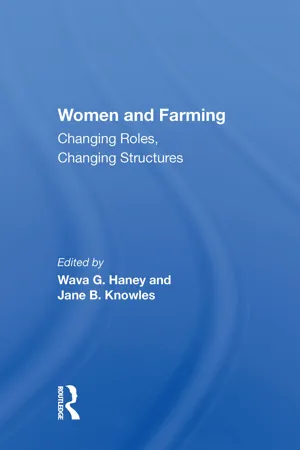
Originally published in 1988, as part of the Rural Studies Series of the Rural Sociological Society, this is a collection of papers from the Second National Conference on American Farm Women in Historical Perspective, held in Madison, Wisconsin, on October 16-18, 1986. Includes the subjects of the impact of social and economic change on farm women; perspectives on the work of ethnic minorities and the Native American experience.
Trusted by 375,005 students
Access to over 1.5 million titles for a fair monthly price.
Study more efficiently using our study tools.
Information
FARM WOMEN'S ECONOMIC ROLES
DOI: 10.4324/9780429267666-10
7 THE PARTICIPATION OF WOMEN AND GIRLS IN MARKET AND NON-MARKET ACTIVITIES ON PENNSYLVANIA FARMS
Carolyn E. Sachs
DOI: 10.4324/9780429267666-11
The extent of women's work on farms has been increasingly documented in recent years. Utilizing the categories of several theoretical perspectives, researchers have attempted to increase the visibility of farm women's work both in the past and in the present. The purpose of research on farm women has been to clearly understand the contributions of women to farm enterprises, to comprehend the lives of women on farms, and to gain information useful for the formulation of public policy. As Harding (1986) and other scholars of women's activities have suggested, feminist theory and research initially "began by trying to extend and reinterpret the categories of various theoretical discourses so that women's activities and social relations could become analytically visible within the traditions of intellectual discourse" (Harding 1986,645). Through our work, we have come to find that the interpretation of theories and the addition of new categories in an attempt to understand women's lives and gender relations have often distorted the original theories. At the same time, the revised theories often fail to fully explain the complexity of women's activities. As Rosenfeld (1985) has observed in her book on American farm women, the difficulty in predicting what a farm woman does may be due to the fact that women's roles are fluid, especially in periods of transition. Given the major changes in agriculture occurring at the present time, periods of transition are almost a constant for many farm families. Thus, the major purpose of this chapter is to critique the applicability of categories borrowed from three theoretical perspectives to a comprehensive understanding of women's work on farms. Drawing on a case study of Pennsylvania farm women and girls, the chapter will describe the complexity of women's work and illustrate the problems with using categories derived from traditional theoretical perspectives for understanding women's work.
THEORETICAL APPROACHES TO WOMEN'S WORK
Perhaps the greatest difficulty in documenting women's work in general and farm women's work in particular involves development of appropriate categories for analysis. Several theoretical frameworks have been used to explain women's work and the sexual division of labor. Reinterpretation of the categories of Marxist, neoclassical economist, and structural-functionalist theories of work have provided the background for understanding women's work. In attempts to describe women's work, Marxists have distinguished between productive and reproductive labor, economists have distinguished between market production and subsistence production and wage and non-wage labor, and sociologists have distinguished between work in the home and work outside the home. On U.S. farms, where households are generally the units of production and production is directed primarily towards the market, these theoretical categories are both helpful and distorting. In their daily lives, women often cross the boundaries of these categories. The invisibility and undervaluing of women's work in all three paradigms have created a need to develop new categories for understanding women's work.
The Marxist tradition
Productive ana reproductive labor are categories developed from the Marxist theoretical tradition to explain women's work. With the development of industrial capitalism, production increasingly moved outside the home and the role of the family became limited to the reproduction of the labor force. Prior to a feminist critique, Marxist analyses had focused primarily on productive labor; thus, women's reproductive labor was undervalued. In the past fifteen years, a number of scholars have attempted to assess the value of women's reproductive labor (Vogel 1973; Fee 1976; Macintosh 1979). Reproductive labor, primarily women's work, includes childbearing, child care, household work, ...
Table of contents
- Cover page
- Half Title page
- Title Page
- Copyright Page
- Dedication page
- Table of Contents page
- List of Tables and Figures
- Preface page
- Acknowledgements page
- Introduction: Making 'The Invisible Farmer' Visible
- The Impact of Social and Economic Change on Farm Women
- Portraits of Farm Women's Lives
- Farm Women's Economic Roles
- Farm Women and Resource Control
- Farm Women in Comparative and Historical Perspective
- Farm Women's Community and Political Roles
- Authors' Biographical Data
- Index
Frequently asked questions
Yes, you can cancel anytime from the Subscription tab in your account settings on the Perlego website. Your subscription will stay active until the end of your current billing period. Learn how to cancel your subscription
No, books cannot be downloaded as external files, such as PDFs, for use outside of Perlego. However, you can download books within the Perlego app for offline reading on mobile or tablet. Learn how to download books offline
Perlego offers two plans: Essential and Complete
- Essential is ideal for learners and professionals who enjoy exploring a wide range of subjects. Access the Essential Library with 800,000+ trusted titles and best-sellers across business, personal growth, and the humanities. Includes unlimited reading time and Standard Read Aloud voice.
- Complete: Perfect for advanced learners and researchers needing full, unrestricted access. Unlock 1.5M+ books across hundreds of subjects, including academic and specialized titles. The Complete Plan also includes advanced features like Premium Read Aloud and Research Assistant.
We are an online textbook subscription service, where you can get access to an entire online library for less than the price of a single book per month. With over 1.5 million books across 990+ topics, we’ve got you covered! Learn about our mission
Look out for the read-aloud symbol on your next book to see if you can listen to it. The read-aloud tool reads text aloud for you, highlighting the text as it is being read. You can pause it, speed it up and slow it down. Learn more about Read Aloud
Yes! You can use the Perlego app on both iOS and Android devices to read anytime, anywhere — even offline. Perfect for commutes or when you’re on the go.
Please note we cannot support devices running on iOS 13 and Android 7 or earlier. Learn more about using the app
Please note we cannot support devices running on iOS 13 and Android 7 or earlier. Learn more about using the app
Yes, you can access Women And Farming by Wava G Haney in PDF and/or ePUB format, as well as other popular books in Social Sciences & Sociology. We have over 1.5 million books available in our catalogue for you to explore.