Written by an experienced teacher of statistics, the new edition of this accessible yet authoritative textbook covers all areas of undergraduate statistics and provides a firm foundation upon which students can build their own knowledge. Featuring new chapters on Bayesian and multiple regression analysis, this book gives students a working understanding of how to conduct reliable and methodical research using statistics. Brysbaert illustrates the key concepts using examples from psychological research, with clear formulas and explanations for calculations. With helpful chapter-by-chapter guidance for carrying out tests using SPSS, as well as coverage of jamovi and JASP software, this book aims to develop students' confidence in statistical analysis, and to take the fear out of the topic. It offers an easily navigable layout filled with features that help learners to avoid common pitfalls and check their understanding along the way. This engaging and informative guide is essential reading for undergraduate psychology students taking courses in research methods and statistics. New to this Edition:
- Chapters on Bayesian analysis, mixed-effects models, and multiple regression analysis
- Coverage of jamovi and JASP, two free statistical packages
- 575 pages
- English
- PDF
- Available on iOS & Android
eBook - PDF
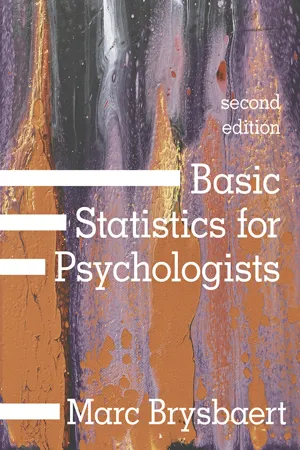
Basic Statistics for Psychologists
About this book
Information
Table of contents
- Cover
- Contents
- Preface
- Acknowledgements
- Tour of book
- Symbols and abbreviations
- Chapter 1 Using statistics in psychology research
- Chapter 2 Summarising data using the frequency distribution
- Chapter 3 Summarising data using measures of central tendency
- Chapter 4 Summarising data using measures of variability
- Chapter 5 Standardised scores, normal distribution and probability
- Chapter 6 Using the t-test to measure the difference between independent groups
- Chapter 7 Interpreting the results of a statistical test: the traditional approach
- Chapter 8 Interpreting the results of a statistical test: the Bayesian approach
- Chapter 9 Non-parametric tests of difference between independent groups
- Chapter 10 Using the t-test to measure change in related samples
- Chapter 11 Non-parametric tests to measure change in related samples
- Chapter 12 Improving predictions through the Pearson correlation coefficient
- Chapter 13 Improving predictions through non-parametric tests
- Chapter 14 Using analysis of variance as an extension of t‑tests
- Chapter 15 Using analysis of variance for designs with more than one independent variable
- Chapter 16 More than one predictor in correlational studies: multiple regression
- Chapter 17 More than one observation per condition per participant: mixed-effects analysis
- References
- Appendices
- Index
Trusted by 375,005 students
Access to over 1.5 million titles for a fair monthly price.
Study more efficiently using our study tools.
Frequently asked questions
Yes, you can cancel anytime from the Subscription tab in your account settings on the Perlego website. Your subscription will stay active until the end of your current billing period. Learn how to cancel your subscription
No, books cannot be downloaded as external files, such as PDFs, for use outside of Perlego. However, you can download books within the Perlego app for offline reading on mobile or tablet. Learn how to download books offline
Perlego offers two plans: Essential and Complete
- Essential is ideal for learners and professionals who enjoy exploring a wide range of subjects. Access the Essential Library with 800,000+ trusted titles and best-sellers across business, personal growth, and the humanities. Includes unlimited reading time and Standard Read Aloud voice.
- Complete: Perfect for advanced learners and researchers needing full, unrestricted access. Unlock 1.5M+ books across hundreds of subjects, including academic and specialized titles. The Complete Plan also includes advanced features like Premium Read Aloud and Research Assistant.
We are an online textbook subscription service, where you can get access to an entire online library for less than the price of a single book per month. With over 1.5 million books across 990+ topics, we’ve got you covered! Learn about our mission
Look out for the read-aloud symbol on your next book to see if you can listen to it. The read-aloud tool reads text aloud for you, highlighting the text as it is being read. You can pause it, speed it up and slow it down. Learn more about Read Aloud
Yes! You can use the Perlego app on both iOS and Android devices to read anytime, anywhere — even offline. Perfect for commutes or when you’re on the go.
Please note we cannot support devices running on iOS 13 and Android 7 or earlier. Learn more about using the app
Please note we cannot support devices running on iOS 13 and Android 7 or earlier. Learn more about using the app
Yes, you can access Basic Statistics for Psychologists by Marc Brysbaert in PDF and/or ePUB format, as well as other popular books in Psychology & Research & Methodology in Psychology. We have over 1.5 million books available in our catalogue for you to explore.