This essential guide offers innovative critical readings of key contemporary novels from Ireland and Northern Ireland. Linden Peach discusses texts that are representative of the richness of Irish writing during the 1980s and 1990s, and reads works by established authors alongside those by the new generation of writers. The novels examined include works by John Banville, Jennifer Johnston, Roddy Doyle, Emma Donoghue, Seamus Deane, William Trevor, Dermot Bolger, Joseph O'Connor, Patrick McCabe, Mary Morrissy, Glenn Patterson and Robert McLiam Wilson.
The Contemporary Irish Novel addresses themes such as ghosts and haunting, mimicry, obedience and subversion, the relocation and reinscription of identity, the mother figure, parent-child relations, madness, masculinity, self-harm, sexuality, domestic violence, fetishism and postmodernity. Drawing on a range of critical approaches including postcolonial, gender and psychoanalytic theory, Peach explores and celebrates the diversity of Irish fiction and suggests that the boundary between literature and theory is as permeable as that between Ireland and Northern Ireland.
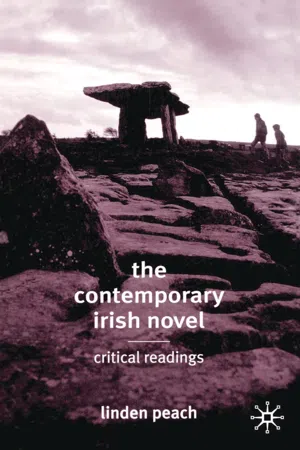
- 266 pages
- English
- PDF
- Available on iOS & Android
eBook - PDF
About this book
Information
Table of contents
- Cover
- Half Title
- Title
- Copyright
- Dedication
- Contents
- Preface
- Acknowledgements
- 1 Interruptive Narratives: Emergent Voices and Haunted Presents
- 2 Posting the Present: Modernity and Modernization in Glenn Patterson’s Fat Lad (1992) and Robert McLiam Wilson’s Eureka Street (1996)
- 3 Secret Hauntings: Seamus Deane’s Reading in the Dark (1996), Joseph O’Connor’s The Salesman (1998), Jennifer Johnston’s Fool’s Sanctuary (1987), Mary Leland’s The Killeen (1985) and Linda Anderson’s To Stay Alive (1984)
- 4 Mimicry, Authority and Subversion: Brian Moore’s The Magician’s Wife (1997), Emma Donoghue’s Slammerkin (2000) and John McGahern’s Amongst Women (1990)
- 5 Unspoken Desires: Jennifer Johnston’s Later Novels, Emma Donoghue’s Stir-fry (1994) and Kathleen Ferguson’s The Maid’s Tale (1994)
- 6 Fetishizing Absence: Dermot Bolger’s Father’s Music (1997) and Emily’s Shoes (1992)
- 7 ‘Mater Dolorosa’: Abject Mothers in Roddy Doyle’s The Snapper (1990) and Mary Morrissy’s Mother of Pearl (1995)
- 8 Limit and Transgression: Roddy Doyle’s The Woman Who Walked Into Doors (1996), Patrick McCabe’s The Butcher Boy (1992) and William Trevor’s Felicia’s Journey (1994)
- 9 Return to Silence and Beyond: Speculative Narrative in Bernard MacLaverty’s Grace Notes (1997) and John Banville’s Birchwood (1973)
- Afterword
- Appendix: Time Chart
- Select Bibliography
- Index
Trusted by 375,005 students
Access to over 1.5 million titles for a fair monthly price.
Study more efficiently using our study tools.
Frequently asked questions
Yes, you can cancel anytime from the Subscription tab in your account settings on the Perlego website. Your subscription will stay active until the end of your current billing period. Learn how to cancel your subscription
No, books cannot be downloaded as external files, such as PDFs, for use outside of Perlego. However, you can download books within the Perlego app for offline reading on mobile or tablet. Learn how to download books offline
Perlego offers two plans: Essential and Complete
- Essential is ideal for learners and professionals who enjoy exploring a wide range of subjects. Access the Essential Library with 800,000+ trusted titles and best-sellers across business, personal growth, and the humanities. Includes unlimited reading time and Standard Read Aloud voice.
- Complete: Perfect for advanced learners and researchers needing full, unrestricted access. Unlock 1.5M+ books across hundreds of subjects, including academic and specialized titles. The Complete Plan also includes advanced features like Premium Read Aloud and Research Assistant.
We are an online textbook subscription service, where you can get access to an entire online library for less than the price of a single book per month. With over 1.5 million books across 990+ topics, we’ve got you covered! Learn about our mission
Look out for the read-aloud symbol on your next book to see if you can listen to it. The read-aloud tool reads text aloud for you, highlighting the text as it is being read. You can pause it, speed it up and slow it down. Learn more about Read Aloud
Yes! You can use the Perlego app on both iOS and Android devices to read anytime, anywhere — even offline. Perfect for commutes or when you’re on the go.
Please note we cannot support devices running on iOS 13 and Android 7 or earlier. Learn more about using the app
Please note we cannot support devices running on iOS 13 and Android 7 or earlier. Learn more about using the app
Yes, you can access The Contemporary Irish Novel by Linden Peach in PDF and/or ePUB format, as well as other popular books in Literature & English Literary Criticism. We have over 1.5 million books available in our catalogue for you to explore.